I hired the cleaner because I thought I was doing something kind.
That is the part I kept replaying later, after the police lights washed red and blue across my son’s driveway and the neighbors started opening curtains.
I had not gone there looking for trouble.
I had gone there with grocery bags, a spare key, and the tired hope that maybe Ryan and Melissa just needed a cleaner house and a few days away from whatever had been tightening around their marriage.
Their house sat outside Columbus, Ohio, on a quiet street where people waved from driveways and trash cans came back from the curb before dinner.
From the sidewalk, it looked ordinary.
Two-car garage.
Trimmed shrubs.
Mailbox by the curb.
A small American flag by the porch that snapped softly whenever a breeze came through the neighborhood.
I had helped Ryan buy that place when he and Melissa were still talking about children, promotions, and all the easy promises young couples make when they think the hard years are behind them.
Back then, Ryan called me for everything.
He called when the furnace made a noise.
He called when he needed help fixing the garage shelf.
He called when he and Melissa found the house and wanted to know if the inspection report sounded bad.
I gave him my time, my advice, and more money than I ever told anyone.
That was the trust signal between us.
I thought my son would come to me if life got too heavy.
Instead, he learned how to close doors.
For months before the Florida trip, something had felt wrong in that house.
Ryan stood in hallways like a guard.
Melissa spoke quietly and watched him before answering simple questions.
At Thanksgiving, I asked whether they were okay, and Ryan answered before she could.
“We’re fine, Dad.”
The turkey was dry.
The kitchen smelled like cinnamon candles and dish soap.
Melissa’s fork stayed untouched beside her plate.
A secret in a family does not always look like a locked door.
Sometimes it looks like a son saying he has everything handled.
When they announced their five-day trip to Florida, Ryan asked me to collect the mail, water the plants, and keep an eye on the place.
He texted me the list Sunday night at 8:12 p.m.
I still had the message.
I still had the little thumbs-up I sent back, because I wanted to believe ordinary errands meant ordinary problems.
By Tuesday afternoon, the house felt worse.
There were dishes stacked in the sink.
Laundry sat half-folded on the couch.
Dust clung to the baseboards, and upstairs the air felt sour and hot, even though the thermostat said seventy-two.
I stood in the kitchen for a moment, listening to the refrigerator click and the street outside go quiet.
Then I called a local cleaning service.
The work order showed a 2:00 p.m. start.
Tasha Reynolds arrived exactly on time.
She was brisk, practical, and not easily impressed by mess.
She wore blue gloves, old sneakers, and carried her supplies in a plastic caddy like a nurse walking into a room she already knew would be difficult.
I showed her the main floor.
I told her where the extra trash bags were.
I told her not to worry about personal clutter upstairs if anything felt too private.
Then I left for the grocery store.
My receipt said 2:47 p.m. when the phone rang.
Tasha’s voice was not embarrassed.
It was afraid.
“Mr. Carter, you need to come back. Right now.”
I asked whether she was hurt.
She said no.
I asked whether something broke.
She said no again, quieter.
“I thought the crying was the TV,” she whispered. “But I turned the TV off. It’s still happening. It’s coming from above me.”
For a moment, my mind tried to turn that sentence into anything else.
Pipes.
A neighbor.
A child outside.
But she said the attic.
The attic was supposed to be storage.
Christmas bins.
Baby furniture.
Camping gear Ryan never used.
Nobody should have been crying up there.
I told Tasha to get outside and wait in her car with the doors locked.
Then I drove back faster than I should have.
When I pulled into the driveway, she was standing beside her sedan, one gloved hand pressed to her chest.
The front door was open behind her.
“She’s still crying,” Tasha said.
“She?” I asked.
Tasha shook her head.
“I don’t know. I didn’t go up.”
Inside, the house looked ordinary in the cruel way houses can look ordinary while something terrible is inside them.
The hallway rug was straight.
The thermostat hummed.
A plastic grocery bag sagged on the counter where I had dropped it too quickly.
Then I stood under the ceiling hatch and heard it.
Thin.
Broken.
Human.
Not a television.
Not pipes.
Not any noise a house should make.
I dragged a chair underneath the pull-down ladder, shoved the panel open, and hot dust rolled over my face.
Tasha stood near the stairs whispering, “Oh my God,” as I climbed.
My phone flashlight shook in my hand.
The beam hit insulation first, then boxes, then a cleared space in the far corner.
Not organized.
Cleared.
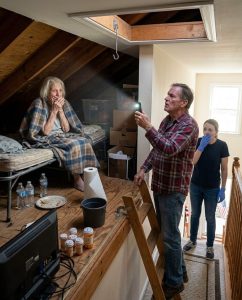
There was a narrow cot under the slanted roof.
A box fan.
A portable heater.
A plastic bucket.
Bottled water stacked against a beam.
A plate with dried soup on the rim.
A small television glowed blue, turned low enough to cover sound without becoming sound.
And on the cot sat Eleanor Mills.
Melissa’s mother.
Eighty-one years old.
Wrapped in a faded blanket, white hair flattened to her forehead, hands trembling like paper in a draft.
Six months earlier, Melissa told me Eleanor had gone into a memory-care facility after a fall and some worsening confusion.
I had sent flowers.
I had asked which facility twice.
Ryan brushed it off both times.
“They’re handling the family logistics,” he said once, as if paperwork could be a wall I was too polite to cross.
Now Eleanor looked at me from an attic like a woman afraid rescue might still be a trick.
“Please don’t tell Ryan I made noise,” she whispered.
I have heard a lot of things in sixty-three years.
I have heard a woman scream after a car accident.
I have heard my late wife’s breathing change in a hospital room.
I have heard my son cry as a boy because he thought he had disappointed me.
But nothing ever struck me the way Eleanor’s apology did.
People do not apologize like that unless someone has made survival feel rude.
I knelt beside her and told her she had done nothing wrong.
She kept saying she tried to be good.
She kept saying she thought Melissa had come home.
Tasha climbed two steps into the attic, saw the cot and the bucket, and covered her mouth.
I asked Eleanor how long she had been there.
Her eyes moved toward the roof, then toward the water bottles, as if time might be counted somewhere in the room.
“Since the leaves were still on the trees,” she said.
That was when I saw the metal hook.
It was fixed near the hatch, simple and ugly, positioned so someone below could latch the attic closed.
Not an accident.
Not a misunderstanding.
Not an overwhelmed couple making one bad choice.
A setup.
I took photos with shaking hands.
The cot.
The hook.
The pill bottles with no schedule.
The plate.
The bucket.
The little television.
Then I saw the metal cash box under the cot.
Inside were pension statements in Eleanor’s name, overdue invoices from a care facility, and benefit-deposit notices.
One notice showed a redirected account.
I knew the last four digits.
I had seen them on a household bill folder in Ryan’s kitchen drawer when he once asked me to help him find his insurance card.
My son had not just hidden an old woman in his attic.
He had been living off her money while telling people she was being cared for.
I called 911 from the attic.
My voice sounded strange to me.
Too calm.
Too old.
I gave the address.
I said an elderly woman had been found confined in the attic and needed medical help.
The dispatcher asked if the person responsible was still in the house.
I looked toward the open hatch.
“No,” I said. “They’re in Florida.”
While we waited, I gave Eleanor water in small sips.
Tasha sat on the hallway floor below the ladder and cried without making noise.
Every few seconds, Eleanor looked toward the hatch.
“He locks it for safety,” she said once.
I did not answer that, because every answer in my mouth was too angry for an old woman who already had too much fear in her.
Ryan called before the officers arrived.
His name lit up my phone from a Florida number.
I answered without saying hello.
“Dad,” he said, low and sharp, “tell me you didn’t let that cleaner go upstairs.”
That was the first confirmation.
Not concern.
Not confusion.
Not surprise.
Fear.
I looked at Eleanor on the cot, at the bruising on her forearm, at the paperwork in the cash box, and something in me went cold enough to hold.
“Ryan,” I said, “I am standing in your attic.”
He went silent.
Then he started talking fast.
He said Melissa was overwhelmed.
He said Eleanor wandered.
He said they were going to move her soon.
He said I did not understand what caregiving costs.
Every excuse came out wearing the clothes of responsibility.
That is how people dress greed when they need family to forgive it.
Then Melissa got on the line.
She was crying.
For a second, my heart almost softened, because I had seen her flinch too many times not to know she was afraid of something.
But fear does not erase what a person leaves another person to endure.
“Daniel,” she said, “please don’t call anyone.”
“I already did,” I told her.
The sirens came three minutes later.
The first officer climbed halfway up the ladder and stopped when he saw Eleanor.
His expression changed in a way I will never forget.
Professional faces do not break easily.
His did.
Paramedics helped bring Eleanor down slowly.
She kept apologizing for being heavy, though she weighed almost nothing in their hands.
One paramedic wrapped a blanket around her shoulders in the hallway while another checked her blood pressure.
Tasha stood by the kitchen counter with both hands around a paper cup of water.
I stood near the front door, watching neighbors gather behind curtains.
The small American flag on the porch moved in the wind.
It should have been an ordinary Tuesday.
It was not.
At the hospital, Eleanor was admitted through intake with dehydration, medication concerns, and bruising that needed documentation.
A nurse asked her questions gently.
Eleanor answered what she could.
When she did not understand, she looked at me first, and that nearly broke me.
The police opened a report.
County Adult Protective Services was notified.
The cash box went into evidence.
My photos were copied.
Tasha gave a statement and cried through half of it.
By evening, Ryan and Melissa were no longer on vacation.
They were driving north from Florida, calling me over and over.
I did not answer.
There are moments when being a father means comforting your child.
There are other moments when being a father means letting your child face what he has done.
This was the second kind.
The next morning, I sat in a hospital chair beside Eleanor while she slept.
Her hand rested outside the blanket.
The veins stood up under thin skin.
She looked smaller in the hospital bed than she had in the attic, which I had not thought possible.
Melissa arrived first.
Her hair was unwashed, her face swollen, her hands shaking.
Ryan came behind her, jaw tight, eyes red, wearing the same vacation hoodie from the photos he had posted two days earlier.
He looked at me like I had betrayed him.
That was almost funny.
Not funny enough to laugh.
A county worker met them before they reached Eleanor’s room.
So did an officer.
Melissa started crying again when they asked for separate statements.
Ryan looked at me once, and for the first time in months, there was no performance on his face.
Only panic.
“Dad,” he said.
I waited.
He opened his mouth like he might explain everything.
Then Eleanor woke up.
Her eyes moved past Ryan and landed on Melissa.
For one fragile second, the whole hallway seemed to hold still.
A nurse stopped with a chart in her hand.
Tasha was not there, but I thought of her anyway, sitting on that hallway floor with both hands over her mouth.
Melissa whispered, “Mom.”
Eleanor did not reach for her.
She reached for me.
That was when Ryan’s face changed.
Not anger.
Not even shame.
Recognition.
He finally understood that the attic had not hidden Eleanor from the world.
It had hidden the truth from him, too, until the truth became too loud to ignore.
The investigation did not end that day.
Financial records had to be reviewed.
Statements had to be taken.
Invoices, account notices, photos, and the 911 call all became part of a file with Eleanor’s name on it.
But Eleanor did not go back to that house.
That was the first real victory.
She went from the hospital into a safe care placement while the county sorted through everything Ryan and Melissa had claimed to be handling.
I visited her the next week.
She was sitting by a window with a cup of tea, watching cars move through the parking lot below.
Her hair had been washed.
Her hands still shook, but less.
When she saw me, she started to apologize again.
I stopped her gently.
“You don’t have to be good for anybody to deserve care,” I said.
She looked down at her blanket.
Then she nodded once.
A secret in a family does not always look like a locked door.
Sometimes it looks like a son saying he has everything handled.
And sometimes, thank God, it sounds like a stranger brave enough to call and say there is someone crying above her head.