My son hosed me down in front of the neighbors while his wife recorded: “You smell like garbage,” he shouted… but he forgot the paper I had signed for that house.
I used to think shame made noise.
I thought it came with yelling, doors slamming, glass breaking, a whole room turning its head at once.
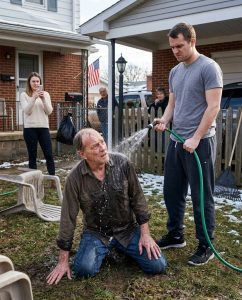
That morning, I learned shame can also sound like a garden hose dragging across frozen concrete.
It can sound like a phone camera clicking on.
It can sound like your own son saying, “Outside,” without looking you in the eye.
My name is Michael.
I am sixty-eight years old, and I worked forty-two years at the county meat-processing plant.
I was never proud of the smell that came home with me, but I was proud of the reason for it.
Blood, bleach, cold metal, cheap soap, black coffee from a dented thermos, and winter mornings before sunrise were all part of the same bargain.
I would do the hard work so my family would not have to.
My wife understood that.
She used to meet me at the back door with a towel and a quiet smile, not because she thought I was dirty, but because she knew the world had taken enough from me already.
She died three years before Daniel bought the house.
After she passed, the house I lived in felt too loud.
The refrigerator hummed at night.
The clock ticked over the stove.
The empty chair across from me made dinner feel like a punishment I had not earned.
Daniel was my only child, so when he started coming around more, I let myself believe grief had given me back a piece of my family.
He was polished in a way I had never been.
He had an office job at a finance company, a clean haircut, a watch that looked expensive, and shoes that clicked when he crossed tile.
Sarah, his wife, looked like a woman who had learned how to smile with only half her face.
She spoke softly, which fooled people at first.
It fooled me too.
One Sunday afternoon, Daniel came to my kitchen with two coffees and a folder.
“Dad, I need your help,” he said.
That was how most expensive things started in our family.
He explained there was a house.
Two stories.
Big backyard.
Good neighborhood.
A place where he and Sarah could build their future.
He said the down payment had to be made that week.
The number was $380,000.
I remember looking at him for a long time because numbers like that do not just sit on a table.
They sit on your chest.
That money was my retirement payout, my savings, and the proceeds from selling the little strip of land my own father had left me.
It was not extra.
It was the rest of my life.
Daniel knew that.
He reached across the table and put his hand over mine.
“You’ll live with us,” he said.
He said I would have my own room downstairs.
He said I would not be alone anymore.
Then he said the one sentence that did it.
“This house will be yours too, Dad. I swear on Mom.”
There are promises that sound holy because they use the dead as witnesses.
I should have known better.
I did not.
On Tuesday morning at 10:15, I withdrew the money.
By 2:40 that afternoon, I was sitting in a small conference room under fluorescent lights while a mortgage officer slid a closing packet toward us.
Daniel’s credit and income did not qualify on their own.
The officer said I would sign as co-borrower.
There was a mortgage note.
There was a deed page.
There was a county recording receipt.
There were initials beside lines I barely understood and signatures where the officer pointed.
Daniel kept tapping the paper with his pen.
“Just paperwork, Dad,” he said.
I believed him.
Fathers are sometimes the last people to realize their children have learned how to use love as leverage.
The house was beautiful when I first saw it.
Bright windows.
Clean floors.
A backyard big enough for a small garden.
A garage that smelled of fresh paint and cardboard boxes.
Sarah opened the door in a cream sweater.
“Welcome, Michael,” she said.
Not Dad.
Not Mr. Michael.
Just Michael, like I was a delivery she had been expecting but did not particularly want.
I told myself not to be sensitive.
They gave me the downstairs room at first.
I kept it neat.
I made my bed every morning.
I wiped the sink after shaving.
I put my work boots on a mat by the garage door even though I had not worked in months, because some habits are less about need than identity.
I made coffee before they woke up.
I brought in grocery bags when Sarah came home.
I swept the patio when leaves collected in the corners.
For a few weeks, I almost felt useful.
Then the rules began.
I was not supposed to sit in the living room when Sarah’s friends came over.
I was not supposed to cook sausage because the smell “got into the curtains.”
I was not supposed to use the main dining table because the chairs were expensive.
I was not supposed to wash my clothes with theirs because Sarah said the odor “transferred.”
At first Daniel acted embarrassed by her.
Then he acted tired.
Then he acted like the rules had always been reasonable and I was the one making them heavy.
One evening I stood in the laundry room with a basket against my hip and heard Sarah speaking in the kitchen.
“Your dad smells like that plant even after he showers,” she said.
Daniel said nothing.
“My friends can’t see him wandering around here. It makes us look horrible.”
I waited.
The washing machine thumped once, hard, like a heart missing a beat.
Daniel finally said, “Give me time, Sarah. I’ll talk to him.”
That was the first night I understood I was not living with my son.
I was living under his permission.
The next morning he gave me a bottle of body wash Sarah had ordered online.
Industrial strength.
That was what the label said.
He asked me to shower twice a day.
He looked at the floor while he said it.
I looked at the bottle.
It smelled like mint and chemicals, sharp enough to sting my nose before I even opened it.
“All right,” I said.
No soap can wash honest work off a man’s hands.
That is not dirt.
That is a life.
I scrubbed until the skin between my knuckles split.
I washed my hair again even when my scalp burned.
I changed shirts twice a day.
Sarah still opened windows after I passed through rooms.
Then came Daniel’s dinner with his work friends.
Sarah spent all day preparing like the house was about to be judged by people who had never been poor enough to understand a folding chair.
She set out cloth napkins.
She chilled wine.
She polished glasses that nobody in that house had ever used before.
At 5:30 p.m., she came to the backyard while I was watering the corner of dirt where I wanted tomatoes in the spring.
“Michael,” she said, “we need to discuss tonight.”
I already knew.
She had that kind of voice.
Polite on top.
Sharp underneath.
“It’s not personal,” she said.
Those words usually mean it is very personal.
“These people are from a different level,” she continued.
I looked past her through the glass doors.
Daniel was inside adjusting his tie.
He did not come out.
That evening, I ate soup in the backyard storage room while laughter came through the walls of the house I had helped buy.
The storage room had a folding cot, a lamp, a space heater, shelves of yard tools, grass seed, and fertilizer.
Daniel called it “more independent.”
Sarah called it “a better arrangement.”
I called it what it was only inside my own head.
Exile.
Within a week, most of my clothes had been moved there.
My file box was pushed under the cot.
The file box had my wife’s death certificate, old tax forms, bank statements, and the closing packet Daniel had told me not to worry about.
I did not look at it much.
Paper can hurt even when it is folded quietly.
The morning everything broke was cold enough to make my breath fog.
It was January, just after 7:00 a.m.
My wool jacket was still hanging in the downstairs bedroom that used to be mine.
The storage room heater had clicked all night and produced almost no heat.
My fingers were numb.
At 7:18, I stepped inside the house.
I remember the exact time because the hallway clock chimed once as I closed the back door behind me.
The house smelled like lemon cleaner and coffee.
For one second, I stood there and let the warmth touch my face.
That was my mistake.
Sarah saw me from the kitchen.
“I told you not to come in here,” she snapped.
I froze.
She covered her nose.
“You stink up the whole house.”
I kept my voice low.
“I’m only getting my jacket.”
Daniel came down the stairs rubbing his face like I had interrupted something important.
“Dad,” he said, “we have rules.”
The way he said it made me feel smaller than the sentence deserved.
“It’s freezing out there,” I said.
Sarah picked up her phone.
“He smells like a wet dog,” she said.
Then she aimed the camera at me.
“Get him out, Daniel. Get him out before everything reeks again.”
That was when I should have turned around and left.
Old men survive many things by leaving before pride starts talking.
But I was cold.
I was tired.
I was in a house my money had helped buy.
So I said the sentence that pushed my son over the edge.
“If I embarrass you that much, then wash me yourself in front of everybody.”
I did not think he would.
Daniel grabbed my arm.
Not a punch.
Not a shove that would look criminal on a security camera.
Just fingers closing around my sleeve with enough pressure to make the meaning clear.
Outside.
He pushed open the back door.
Cold air struck my chest.
Across the fence, a dog started barking.
A curtain moved in the neighbor’s window.
Sarah followed us with her phone raised.
“Daniel,” I said, “what are you doing?”
He went to the spigot.
The hose was coiled beside the patio.
He yanked it so hard the nozzle hit the concrete and bounced.
That sound, more than anything, told me my son was gone from me in that moment.
The Daniel who once fell asleep in a diner booth after my double shift was gone.
The Daniel whose sneakers I bought instead of fixing the truck heater was gone.
The Daniel who cried into my shirt at his mother’s funeral was gone.
In his place was a man who wanted witnesses.
He twisted the spigot.
The hose jumped.
“If you want to smell like an animal,” he said, “I’ll wash you like one.”
Then he squeezed the nozzle.
The water hit me in the chest so hard I stumbled backward.
Cold went through my shirt like knives.
My foot slipped in the mud near the edge of the patio, and one knee went down.
Sarah kept filming.
“Say it again,” she said, almost laughing.
Daniel raised his voice.
“You smell like garbage.”
The neighbor by the mailbox stopped with a trash bag in his hand.
Another neighbor stepped onto the edge of her porch.
Nobody moved toward us.
I do not judge them as much as I used to.
People always think courage arrives as a lion.
Most of the time, it arrives late, embarrassed, looking for permission.
Daniel sprayed my shoulders, my chest, my face.
Water ran down my neck and into my collar.
Mud soaked through my pants.
My hands pressed against the ground, and I saw the cracks in my knuckles fill with dirty water.
For one second, I wanted to stand up and swing.
I saw it clearly.
The hose ripped from his hands.
Sarah’s phone flying into the grass.
Daniel on his back with shock where contempt had been.
I did none of it.
My wife had loved me because I did not let pain choose my character for me.
So I lifted my head through the spray and looked toward the storage room.
The file box was under the cot.
The papers were inside it.
Daniel had forgotten because men like him only read documents until they get what they want.
“Co-borrower and co-owner,” I said.
He did not hear me at first.
The hose was too loud.
“What?” he snapped.
I pushed myself up slowly.
Water dripped from my eyebrows into my eyes.
“The deed page,” I said. “The county recording receipt. The closing packet you said was just paperwork.”
Daniel’s hand tightened on the nozzle.
Sarah’s phone dipped.
The neighbor by the mailbox lowered his trash bag.
“Dad,” Daniel said, and suddenly the word sounded useful to him again.
That hurt almost worse than the water.
He shut off the hose.
Silence fell so fast it felt staged.
The only sounds were dripping water, the dog still barking down the block, and Sarah breathing through her nose like she was trying to calculate how much of this she had recorded.
“Go get the box,” I said.
Daniel’s face hardened.
“This is my house.”
I looked at him.
“No,” I said. “It is our house.”
Sarah whispered, “Daniel, tell me he’s not on the deed.”
He did not answer.
That was answer enough.
I walked past them into the storage room.
My wet shoes left marks on the floor.
My hands shook so badly I had trouble pulling the file box out from under the cot.
Daniel stood in the doorway, blocking half the light.
Sarah hovered behind him, phone at her side now.
The confidence was gone from her face.
I opened the lid.
Inside were old tax forms, my wife’s papers, bank envelopes, and the folder from closing.
I had not read it carefully in months.
Maybe a part of me had not wanted to know.
But grief had made me trusting.
Humiliation made me precise.
I pulled out the deed page.
My name was printed beside Daniel’s.
Not as a guest.
Not as a charity case.
As an owner.
I handed it to him.
He stared at it.
His mouth opened, then closed.
Sarah snatched it from his hand and read faster.
Her face drained in layers.
First annoyance.
Then disbelief.
Then fear.
“You told me he just helped with the loan,” she said.
Daniel reached for the paper, but I pulled it back.
“Don’t,” I said.
It was not loud.
It did not need to be.
The neighbor by the mailbox spoke from the fence.
“Michael,” he said carefully, “do you need help?”
That was the first decent sentence anyone had said to me all morning.
I looked at Daniel.
His eyes flicked toward the neighbor, then toward Sarah’s phone.
Now he understood the shape of the problem.
Not guilt.
Evidence.
At 8:03 a.m., I called the mortgage servicer number printed on the packet.
I put the call on speaker.
My voice shook, but I verified my name, my date of birth, and the last four digits they asked for.
The representative confirmed I was on the loan.
Then she confirmed what Daniel had hoped I would never say out loud.
My name was also connected to the recorded ownership documents.
Sarah sat down on the cot like her knees had stopped working.
Daniel kept saying, “This is being blown out of proportion.”
People who humiliate you in public always want the consequences handled in private.
I asked the representative how to request copies of all signed documents.
She told me the process.
I wrote it down with wet fingers on the back of an envelope.
Then I photographed every page in the folder.
Mortgage note.
Deed page.
County recording receipt.
Wire confirmation.
The $380,000 transfer.
Sarah watched me take each picture.
Daniel finally lunged for the folder.
The neighbor stepped into the doorway before he reached me.
He was not a large man.
He did not need to be.
“Don’t touch him,” he said.
Daniel stopped.
That was the moment I understood power can change hands without anyone raising a fist.
I packed that morning.
Not everything.
Only what belonged to me.
My clothes.
My wife’s photo.
My medications.
My file box.
The old coffee mug Daniel gave me when he was twelve that said Best Dad, cracked at the handle.
I almost left it.
Then I wrapped it in a towel and put it in the bag.
Not because he deserved the memory.
Because I did.
The neighbor and his wife let me warm up in their kitchen.
They gave me dry sweatpants, a towel, and coffee in a paper cup.
Sarah came over once, standing on their porch with her arms crossed.
“Michael,” she said, “this has gotten out of hand.”
I looked at her through the screen door.
“No,” I said. “It got out of hand when you pressed record.”
She left without answering.
By noon, Daniel had called six times.
I did not pick up.
By 1:30, he texted that I was making him look bad.
By 2:12, he texted that Sarah was crying.
By 2:40, he texted the sentence that told me everything I needed to know.
We can work something out if you don’t make this legal.
I saved it.
I printed it later.
I put it behind the county recording receipt.
Over the next week, I did what I should have done at the beginning.
I requested certified copies.
I documented the storage room with photographs.
I wrote down dates, times, and what was said.
I contacted the lender to make sure no changes could be made without my knowledge.
I spoke with a local attorney for one plain reason.
I was not trying to punish my son.
I was trying to stop being erased.
Daniel tried apology first.
Then anger.
Then guilt.
He said Mom would be ashamed of me.
That was the only message that made me sit down.
For a few minutes, I heard my wife’s voice in my head, not as a warning, but as a correction.
She would have opened the door for our son if he came home hungry.
She would not have opened it so he could drag her husband into the yard.
I answered once.
“Your mother watched me come home from that plant for forty-two years,” I told him. “She never once called me garbage.”
He said nothing.
That silence was the closest thing to truth he had given me in months.
The legal part was not dramatic.
No courthouse shouting.
No thunderous speech.
Mostly appointments, copies, signatures, certified mail, and waiting rooms with old magazines.
The attorney explained that my signature had not been decoration.
My money had not been a gift just because Daniel preferred that story.
My name on the documents gave me rights he could not wash off with a hose.
Eventually Daniel and Sarah had to make a choice.
Buy out my share properly or sell the house.
At first Daniel refused both.
Then the recording Sarah made became the thing neither of them could explain away.
She had captured his voice.
She had captured the water.
She had captured me on my knees while he shouted what he shouted.
She had captured herself laughing.
I never posted it.
I never needed to.
A private truth can still be heavy enough to move a wall.
In the end, the house was listed.
The day I came back to collect the last of my things, Sarah would not come downstairs.
Daniel met me by the garage.
He looked thinner.
Angrier too.
Shame does that when it has nowhere honest to go.
“Are you happy now?” he asked.
I looked at the driveway.
At the back porch.
At the backyard fence where the hose was coiled neatly, as if neatness could make it innocent.
“No,” I said. “But I am done being cold behind a house I helped pay for.”
He rubbed his face.
For one moment, I saw the boy again.
Not enough to forget.
Enough to mourn.
“I didn’t think you’d actually leave,” he said.
That was the first true thing he had said.
“I know,” I told him.
The sale took months.
My share did not make me rich.
It made me safe.
I rented a small apartment with morning light in the kitchen and a laundry room down the hall that smelled like detergent instead of humiliation.
I bought a new wool jacket.
I kept my file box on a shelf, not under a cot.
Sometimes I still wake before dawn.
Forty-two years teaches the body when to rise, even after the job is gone.
I make coffee.
I sit by the window.
I think about my wife.
I think about Daniel.
Some days I miss the boy so badly I have to put the cup down.
But missing someone is not the same as letting them destroy what is left of you.
That was the lesson I learned too late, but not too late to use.
No soap can wash honest work off a man’s hands.
That is not dirt.
That is a life.
And the house Daniel thought proved he had risen above me became the thing that finally reminded him where he had been standing all along.