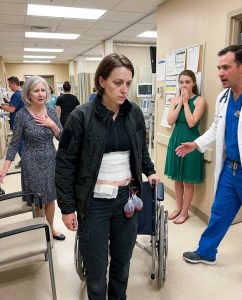
When my sister rolled her eyes at the ER and told the nurse to help “people who are actually sick,” I was bent forward in a plastic chair with one hand pressed under my tactical jacket, trying not to bleed through the dressing.
At that point, I still hadn’t decided which hurt worse: the tearing pain in my abdomen, or the fact that my family found my suffering embarrassing.
My name is Morgan Hale.
I am thirty-one years old, and for most of my life I had one role in my family: the reliable daughter.
The quiet one.
The one who fixed things without needing praise.
If something broke, I handled it.
If a bill had to be paid, I found a way.
If Jessica cried, the whole house spun around her like she was the center of gravity.
Jessica, my younger sister, had never learned how to carry consequences.
She was pretty, theatrical, always in some fresh emergency that somehow became everyone else’s duty.
My mother adored her.
My father avoided conflict by agreeing with whoever was loudest, and that usually meant Jessica.
Over the years I stopped fighting it.
I joined the military young, learned how to pack pain away neatly, and let distance do what honesty never had.
By the time I was assigned to the kind of unit people didn’t talk about, my family barely knew anything real about my life.
They knew I was “away a lot.” They knew I wasn’t married.
They knew I sent money home when my father’s construction business started sliding and Jessica’s wedding expenses began multiplying like mold in summer.
They did not know where the money came from.
They also did not know that six weeks before I came home, I had been cut open in a surgical tent after a mission went sideways.
Officially, I was on medical leave.
Unofficially, I had been erased for a while.
My name disappeared from logs, my movements were scrubbed, and the men who wheeled me from one secured room to another addressed me by a number, not a rank.
I signed forms I couldn’t keep.
I healed under fluorescent lights.
When they finally released me to finish recovery stateside, I had strict instructions: no lifting, no strain, no surprises, no drama.
I broke the last rule first.
I wanted to come home without telling anyone.
Part of me imagined something stupid and human.
My mother crying in the doorway.
My father pulling me into one of his awkward hugs.
Jessica, for once, forgetting herself long enough to say she was glad I was alive.
Instead, when I turned into my parents’ driveway a little before noon, two catering vans were parked out front and a white wedding tent was being raised in the backyard.
Of course.
Jessica’s wedding was three weeks away.
Flowers covered the porch.
Ribbon samples were taped to the dining room wall.
Someone had stacked gift boxes all over the staircase.
I got out of my car carefully because every step pulled against the compression binder under my jacket.
Two drainage bulbs rested against my side beneath the fabric, and a fresh line of staples sat under taped dressings across my abdomen.
I picked up my duffel and walked inside.
Nobody looked up.
My mother, Eleanor, was directing the kitchen like a general preparing for war.
My father, Paul, was on the phone arguing about chair covers.
Jessica stood in the center of the living room in a white silk robe while two bridesmaids and a cousin fussed over her hair.
She saw me first.
“Oh,” she said.
“You’re here.”
That was all.
“I got leave,” I said.
She frowned.
“You could have called.”
My mother glanced over and said, “We don’t have extra rooms, Morgan.”
“I can see that.”
Jessica pointed at a stack of boxes by the stairs.
“Take those up.
My shoes are in one, gifts in another, and the crystal flutes are marked.”
For a second I honestly thought she was joking.
She wasn’t.
I should have said no.
Instead, because old habits are stronger than fresh staples, I picked up the first box.
The first trip hurt.
The second made sweat break across my back.
On the third, something deep inside my abdomen shifted with a hot, wrong sensation that made my vision blur.
I set the box down on the landing and gripped the rail.
Jessica looked up from the living room.
“Are you seriously stopping already?”
“I think something’s wrong,” I said.
She rolled her eyes so hard it would have been funny in another life.
“Naturally.
Any time something important is happening for me.”
I took a breath.
“I need a hospital.”
That got silence.
Not concern.
Silence.
Then Jessica snatched her keys off the table and said, “Unbelievable.”
She drove me to the ER like she was taking out trash.
She kept muttering about fittings and menus and how I had “perfect timing.” I sat with one hand locked across my middle, focusing on not blacking out.
At triage, the nurse asked what brought me in.
Before I could answer, Jessica sighed.
“She’s dramatic.
She always does this when attention isn’t on her.”
I looked at the nurse.
“Recent abdominal surgery.
Sudden tearing pain.
I need imaging.”
Jessica laughed softly like I’d told a joke.
Then my mother arrived, still wearing florist ribbon looped around one wrist.
She swept up to the desk and lowered her voice in that sharp, icy way she used when she wanted to sound reasonable while being cruel.
“Please do not order unnecessary tests,” she said.
“My other daughter’s wedding is in a few weeks.
We are not throwing money away on theatrics.”
The doctor who came in was young, calm, and already half-convinced by them.
I could see it in his face.
Family members can be persuasive when they speak with the confidence of people who have always been believed.
He asked me where the surgery had been done.
“I can’t fully explain that,” I said.
Jessica made a little scoffing sound.
The doctor folded his arms.
“Ms.
Hale, if you want me to help you, I need facts.”
“You need to look inside my jacket,” I said.
My mother cut in.
“She is not getting a CT because of one of her episodes.”
That was when I felt fresh warmth spread under the binder.
I looked at the doctor, then at the nurse, then down at my own shaking hands.
I realized no one in that room was going to save me until I forced them to see me.
So I grabbed the zipper and pulled it down.
The first drainage bulb swung into view, half full of dark red fluid.
Then the second.
Then the edge of the soaked pressure dressing.
Then the staples.
Everything changed in less than a second.
Jessica stumbled backward and hit the wall.
My mother’s face lost all color.
The doctor moved fast, lifting the bandage just enough to see the swelling and seepage beneath.
“Get trauma,” he snapped.
“Now.”
Hands were suddenly everywhere.
A monitor clipped to my finger.
Blood pressure cuff.
Gloved fingers.
A nurse cutting the rest of my jacket away while another shoved paperwork at my mother and ignored the way she had finally gone silent.
Then the ER doors opened and a man in uniform walked in carrying a sealed folder.
Major Simon Reeves.
I knew him on sight, though I had never met him face-to-face before.
Every invisible unit has someone whose job is to appear when things go wrong in public.
He crossed the room, handed the charge nurse an authorization packet, and said, “All treatment is covered under federal medical authorization.
Proceed without delay.”
My mother found her voice then.
“Covered?” she repeated.
Reeves turned toward her with a kind of polite coldness I recognized instantly.
“Was there a reason anyone here asked staff to delay imaging?”
No one answered.
Jessica began to cry.
Not for me.
For herself.
The CT confirmed what the surgeon had already suspected.
I had torn part of the abdominal repair, begun bleeding internally, and was on the edge of a serious infection.
Another hour and the whole thing could have tilted toward sepsis.
They took me straight into surgery.
When I woke up, everything hurt less and more at the same time.
Less because the worst danger had passed.
More because awareness had returned.
Reeves was in the chair by the window.
So was Dr.
Patel, the surgeon.
“You’re lucky,” Dr.
Patel said.
“And I don’t use that word casually.
You should never have been lifting anything.
Another delay would have changed this conversation.”
I nodded once.
I already knew that.
After the doctor left, Reeves opened the folder on his lap.
“There will be an internal report,” he said.
“Delay in treatment after presentation with visible post-op complications is not something we ignore.”
I shut my eyes for a moment.
“They’re still my family.”
He didn’t argue.
“Understood.
There’s another issue.”
He slid a page toward me.
It was a list of scheduled transfers from my recovery account.
Venue balance.
Caterer installment.
Florist.
Rental company.
Mortgage assistance to Paul and Eleanor Hale.
I stared at it, suddenly too tired to even be angry.
Jessica had called me three months earlier in tears because her fiancé’s business had stumbled and half the wedding budget had evaporated.
She begged me to help “just this once” and swore no one needed to know.
She didn’t want our mother discovering that the wedding of the year was being quietly rescued by the daughter she treated like background furniture.
So I paid the deposits.
Then I paid a few more.
Then I saw my father’s account overdrafting and my mother quietly late on the mortgage, and I covered that too because I told myself it was temporary.
Because I told myself family was still family.
Because