By 9:14 that rainy morning, the county courtroom already smelled like floor polish, damp wool coats, and burnt coffee.
I remember that more clearly than anything Daniel said at first.
Smells have a way of pinning humiliation to a place.
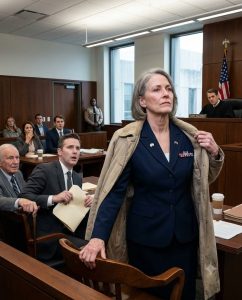
The fluorescent lights buzzed overhead, and every time rain struck the tall windows, it sounded like fingernails tapping glass.
I stood alone at the defense table in a beige coat with worn cuffs and one mismatched button.
My younger brother sat across from me with our father beside him, and both of them looked as if the morning had already gone their way.
Daniel had always loved an audience.
When we were kids, he only lied loudly when somebody important was listening.
Dad.
A teacher.
A neighbor who came by to return a casserole dish.
That morning, he had a judge, a lawyer, a bailiff, and half a gallery of strangers.
He was in his element.
“No attorney, Mrs. Whitaker?” Judge Holloway asked.
He did not ask it cruelly.
That almost made it worse.
Pity has its own kind of weight when people have already decided you are small.
Before I could answer, Daniel leaned back in his chair and laughed.
“She can’t afford one.”
The sound moved through the courtroom fast.
A few people in the gallery smirked.
My father did not laugh out loud, but he nodded once, proud and satisfied, the way he used to nod when Daniel brought home a trophy for a game he had barely practiced for.
Harold Whitaker was eighty-six years old then.
His white hair was combed straight back, his Sunday suit hung loose over narrow shoulders, and his hands rested on a cane he had refused to use in public until Daniel told him it made him look distinguished.
I looked at that cane and thought of our mother.
She had polished the handle herself the winter before she died because Dad kept leaving fingerprints on the silver cap.
Mom had a way of caring for things that never cared for her back.
Maybe that was what Daniel had counted on when he accused me of stealing from her.
He knew I had done the quiet work.
I had sat beside her during hospital intake, signed visitor logs, tracked medication schedules, and kept her bills in a blue folder by the phone.
I had driven Dad to appointments when Daniel was too busy.
I had called the probate office when papers needed correcting.
Quiet work is dangerous because people mistake it for proof you will never defend yourself.
Daniel’s lawsuit called it undue influence.
His petition said I had manipulated our mother into changing financial arrangements while she was weak.
It said I had hidden bank records.
It said I had taken advantage of our father’s age.
He had filed a bank transfer ledger, a probate inventory, and one notarized statement signed by Dad’s shaking hand.
The county clerk stamp on his filing showed 8:37 a.m.
It was not even forty minutes old when they tried to bury me under it.
Their attorney, Richard Talbot, sat at the plaintiff’s table arranging folders like he was setting silverware for a dinner he expected to enjoy.
He had a tall man’s confidence and an expensive suit that made Daniel sit straighter beside him.
He wore a silver watch and the kind of smile that never reached his eyes.
He did not look at me when Judge Holloway explained the seriousness of the case.
“This matter involves allegations of inheritance fraud, undue influence, and financial manipulation,” the judge said.
The words sounded ugly in open air.
Daniel smiled anyway.
“She always was stubborn,” he said.
Dad nodded again.
That was the part that landed hardest.
Not Daniel’s laugh.
Not the people in the gallery.
Dad’s nod.
There are parents who do not need to raise their voices to choose one child over another.
They just keep nodding while the other one bleeds quietly.
I had spent most of my life learning not to react to that nod.
At seventeen, when Daniel blamed me for breaking Dad’s fishing radio, I swallowed the truth because Mom looked tired.
At nineteen, when money disappeared from her purse, I left for boot camp with everybody whispering that I had taken it.
At thirty, when I came home in uniform for Thanksgiving and Daniel joked that I only joined up because nobody else would hire me, I helped Mom wash the dishes and said nothing.
Silence became my family language.
They mistook fluency for surrender.
After my husband died in Norfolk, I bought the beige coat because it was practical and warm.
I wore it to grocery stores, hospital corridors, Dad’s appointments, and finally to court.
The coat had become a costume in their minds.
Poor widow.
Lonely sister.
Obedient daughter.
Easy target.
Judge Holloway looked over his glasses at me.
“Mrs. Whitaker, the court can allow time for you to seek counsel.”
For one second, I considered accepting.
Not because I was afraid.
Because I was tired.
I had slept three hours the night before, sitting at my kitchen table with a yellow legal pad, a stack of photocopies, and the old discipline that had carried me through decades of work most people never saw.
I had tabbed the probate inventory.
I had marked the transfer ledger.
I had copied the county clerk receipt.
I had placed one folded page inside my coat pocket and left it there until the room became exactly what Daniel wanted.
Public.
Polished.
Cruel.
Then Daniel leaned toward Talbot and whispered loudly enough for the first row to hear.
“Here we go.”
That helped.
Sometimes arrogance is useful.
It tells you where to place the blade.
“No, Your Honor,” I said. “That won’t be necessary.”
Then I removed my coat.
I did not throw it over the chair.
I did not snap it off my shoulders like some courtroom performance.
I took it off slowly because my fingers were stiff from the rain, folded it once, and set it over the back of the defense chair.
The courtroom changed before anybody spoke.
Not dramatically.
By inches.
The woman in the second row lowered her coffee cup.
The bailiff stopped rocking on his heels.
Judge Holloway’s eyes shifted from my face to my lapel.
Under the coat, I wore a dark navy suit.
Plain.
Pressed.
Exact.
On my lapel was a small silver pin.
Above my heart was a row of miniature service ribbons I had not worn in years.
They were not decoration to me.
They were memory.
Long hallways.
Locked cabinets.
Bad coffee at midnight.
Names checked twice.
Signatures that could follow a person for the rest of his career.
Daniel saw the ribbons and frowned because he had never paid enough attention to know what they meant.
Dad saw them and looked irritated, as if I had embarrassed him by being more complicated than he preferred.
Richard Talbot saw them and stopped breathing normally.
That was the moment the power shifted.
His hand tightened around the folder.
The paper bent under his thumb.
His eyes moved from the ribbons to the pin and then to my face.
Recognition crossed his expression first.
Then fear.
Judge Holloway noticed it.
“Mr. Talbot?” he said.
Daniel turned toward his lawyer.
“What the hell does that mean?”
Talbot did not answer him.
He was looking at me like I was no longer the woman his client had mocked.
He was looking at me like I was a file number pulled from a locked cabinet.
A personnel note.
A clearance renewal.
A signature line he had hoped would never sit across from him in open court.
I rested one hand on the chair back.
“Mr. Talbot,” I said, “who signed your security clearance?”
No one laughed after that.
Talbot’s mouth opened slightly.
Nothing came out.
The silence in that room was different from the silence I had lived with in my family.
This silence was not avoidance.
This was impact.
Judge Holloway leaned forward.
“Mr. Talbot, answer the question.”
Talbot looked down at the folder in front of him, then at Daniel, then back at me.
“Your Honor,” he said, “I need a moment to confer with my client.”
“No,” I said.
My voice did not shake.
“You need to explain why a lawyer with your clearance history filed a sworn petition accusing me of fraud without disclosing a prior professional conflict.”
Daniel blinked.
“A what?”
Talbot whispered, “Daniel, stop talking.”
That was the first honest thing he had done all morning.
I reached into the inside pocket of my coat and removed the folded page.
The bailiff crossed the room when Judge Holloway asked for it.
My father watched the paper leave my hand with the wary expression of a man seeing a bill he forgot he owed.
It was not a secret government file.
I would never have brought such a thing into a county courtroom.
It was a publicly attachable notation from a clearance renewal packet Talbot himself had referenced years earlier in a civil filing, paired with the county clerk receipt he had submitted that morning.
What mattered was not classified information.
What mattered was the name on the line he had failed to disclose.
Mine.
Judge Holloway read the first two lines.
Then he looked at Talbot.
“Counsel,” he said quietly.
Talbot’s shoulders lowered.
It was almost invisible, but I saw it.
Men like him spend years learning how not to collapse in public.
He still collapsed.
Just neatly.
“Your Honor,” he said, “Mrs. Whitaker was involved in an administrative review connected to my clearance many years ago.”
Daniel turned red.
“Involved how?”
Talbot did not answer quickly enough.
So I did.
“I was the reviewing officer who signed the recommendation allowing his clearance to proceed after a financial disclosure issue was corrected.”
The gallery moved as one body.
A woman inhaled sharply.
Someone’s bench creaked.
Daniel stared at me.
“You never told us that.”
I almost laughed.
Not because it was funny.
Because he had finally said the family rule out loud.
I was supposed to tell them everything useful about me so they could decide whether to believe it.
They were never required to ask.
Judge Holloway removed his glasses and set them on the bench.
“Mr. Talbot, you filed a petition this morning portraying Mrs. Whitaker as financially manipulative, unreliable, and potentially fraudulent.”
Talbot said nothing.
“You also failed to disclose a prior professional relationship in which her judgment directly affected your own clearance history.”
Talbot’s mouth tightened.
“Your Honor, I did not believe it was material.”
The judge’s face did not change.
“That is rarely a sentence that improves a lawyer’s position.”
Daniel leaned toward Dad.
“Did you know about this?”
Dad gripped his cane.
He looked smaller than he had five minutes earlier.
“I knew she worked in offices,” he muttered.
Offices.
That was what he had called my career for thirty years.
Not service.
Not responsibility.
Not the work that paid my mortgage and kept me insured after my husband died.
Offices.
I looked at him and felt something inside me loosen, not forgive, just loosen.
Sometimes people reveal themselves so completely that you stop trying to correct the picture.
Judge Holloway turned the page over, then looked at the plaintiff’s table.
“I am ordering a recess.”
Talbot stood too fast.
“Your Honor—”
“I am not finished.”
The lawyer sat down.
The judge’s voice stayed even.
“When we return, I expect counsel to be prepared to address disclosure, conflict, and the foundation for the allegations in this petition.”
Daniel’s face shifted.
The smirk was gone.
In its place was panic wearing a bad disguise.
“Richard,” he whispered, “fix this.”
Talbot did not look at him.
That was how Daniel finally understood the truth.
The man he had hired to make me look helpless was suddenly worried about himself.
Court recessed for twenty minutes.
In the hallway, Daniel came toward me with the same angry walk he used when we were teenagers and he wanted me to apologize for something he had done.
“What did you do?” he snapped.
I looked at the wet footprints on the courthouse tile.
“I prepared.”
Dad stood a few feet behind him, one hand on his cane, his eyes avoiding mine.
“You should have told us,” Daniel said.
“I did tell you,” I said. “For years. You just preferred the version where I was nothing.”
He looked like he wanted to shout.
He did not.
There were too many people nearby.
That had always been Daniel’s limit.
He only performed cruelty when he believed the room belonged to him.
When the room turned, he became careful.
Talbot came out last.
His face had settled into professional blankness, but his hands gave him away.
The right one trembled slightly when he opened his leather folder.
“Mrs. Whitaker,” he said.
It was the first time all morning he used my name like it had weight.
“Counsel,” I said.
He glanced toward Daniel.
Then toward the courtroom doors.
“I will be making a disclosure to the court.”
Daniel’s head snapped around.
“What kind of disclosure?”
Talbot’s answer was barely above a whisper.
“The kind I should have made before filing.”
My father shut his eyes.
I do not know what finally reached him.
The conflict.
The judge’s tone.
The fact that Daniel’s lawyer had become afraid.
Maybe only the embarrassment of being wrong where strangers could see it.
But when he opened his eyes again, he did not look proud anymore.
He looked old.
We went back in at 10:06 a.m.
The rain had slowed outside, leaving the windows streaked and gray.
Judge Holloway returned to the bench and asked Talbot if he wished to make a record.
Talbot stood.
He admitted the prior administrative connection.
He admitted he had not disclosed it.
He admitted he had relied heavily on Daniel’s summary of family events before filing the emergency petition.
That last part made Daniel flinch.
It should have.
A lawyer can dress a lie in paper, but paper still remembers who handed it over.
Then the judge turned to me.
“Mrs. Whitaker, do you have documents responsive to the allegations?”
“Yes, Your Honor.”
I opened my folder.
Not dramatically.
I had learned long ago that competence is quieter than revenge.
I submitted the bank receipts showing payments I had made from my own account for Mom’s care.
I submitted the hospital intake notes showing who had been present when Mom confirmed her wishes.
I submitted the probate office correction notice showing Daniel had been asked twice for records he never produced.
I submitted my own accounting, dated, labeled, and copied in triplicate.
Talbot did not object to most of it.
He knew better now.
Daniel objected with his face, which was not legally useful.
Judge Holloway reviewed the first stack in silence.
The courtroom waited.
This time, nobody smirked at my coat.
Nobody whispered about what I could afford.
Nobody looked at my worn cuffs and thought they had found the limits of me.
Finally, the judge looked at Daniel.
“Mr. Whitaker, your petition states that your sister concealed expenses related to your mother’s care.”
Daniel swallowed.
“Yes.”
The judge lifted one receipt.
“This appears to show she paid the pharmacy balance herself.”
Daniel’s mouth opened.
Then closed.
Judge Holloway lifted another page.
“And this one appears to show she paid the overdue utility bill at your parents’ residence.”
Dad’s eyes moved to the paper.
I wondered if he remembered that February.
The heat had nearly been shut off.
Daniel had said he was between paychecks.
I had paid it online from my kitchen table at 11:48 p.m. and never mentioned it because Mom asked me not to embarrass him.
Families are full of receipts nobody wants read aloud.
The judge set the page down.
“I am not making final findings today,” he said. “But I am deeply concerned about the manner in which this petition was prepared and presented.”
Talbot remained standing.
“I understand, Your Honor.”
“I hope you do.”
The hearing did not end with a gavel slam.
Real life rarely gives you clean sound effects.
It ended with instructions.
Deadlines.
A continued date.
An order for amended disclosures.
A warning that sanctions could be considered if the petition was shown to have been filed without proper basis.
To Daniel, it probably felt anticlimactic.
To me, it felt like oxygen.
Outside the courtroom, Dad waited near the hallway bench.
Daniel had already stormed ahead toward the elevators, pulling out his phone like he could call the morning back into shape.
Dad looked at my coat.
Then at the ribbons partly visible above it.
“I didn’t know,” he said.
It was not an apology.
Not yet.
Maybe not ever.
But it was the first sentence he had given me all morning that was not built on Daniel’s version of the world.
I could have said many things.
I could have reminded him of every time I had tried to tell him who Daniel was.
I could have asked why he believed the son who took and doubted the daughter who stayed.
For one sharp second, I wanted to.
Then I looked at the cane Mom had polished.
I looked at the man holding it.
“I know,” I said.
His chin trembled once.
That was all.
I put my beige coat back on because it was still raining.
The mismatched button held.
The cuffs were still worn.
Nothing about the coat had changed.
Only the room had.
As I walked toward the courthouse doors, I heard Daniel call my name from near the elevators.
I did not turn around right away.
I let him say it twice.
For most of my life, my family had believed silence meant weakness.
That morning, in a courtroom full of strangers, they finally learned silence can also be preparation.
And preparation, when it is ready, does not need to raise its voice.