I never told Evelyn Carter what I used to do before I married her son.
That was not an accident.
Some parts of a life are not secrets because you are ashamed of them.
They are private because they cost too much to explain to people who would only turn them into decoration.
My husband, Thomas, knew.
He knew about the military courts, the witnesses who shook so hard they could barely sign statements, the commanders who thought rank made them bulletproof, and the long nights when I came home with my jaw locked because justice had required me to stay calm in rooms full of men who mistook cruelty for authority.
Thomas never bragged about it for me.
He never used it at dinner to impress his mother.
When Evelyn called me quiet, he only squeezed my knee under the table and changed the subject.
That was one of the reasons I loved him.
He understood that competence does not always announce itself.
Sometimes it walks in alone, carrying one thin folder.
The morning of the hearing, I stood in my kitchen for longer than I needed to, watching rain thread down the window over the sink.
The house smelled like black coffee and old wood.
Thomas’s mug was still in the cabinet, pushed toward the back because I had not been brave enough to donate it and not foolish enough to keep using it.
The lake cabin key sat beside my purse.
It was an ugly little key with a blue plastic ring, scratched from years of being shoved into tackle boxes, junk drawers, coat pockets, and the console of Thomas’s truck.
Evelyn wanted the cabin because she wanted proof that she could still reach into my life and take something.
She had never liked that Thomas left it to me.
She called it sentimental nonsense.
She said widows make emotional decisions.
She said I would not be able to maintain it, pay taxes on it, or understand the legal paperwork that came with it.
She said all of this in the soft, polished voice she used whenever other people were listening.
After Thomas died, Evelyn did not come to my house with food.
She came with opinions.
She stood in my living room three days after the funeral and told me that grief was not an excuse to be selfish.
Then she mentioned the cabin.
I remember looking at her while the sympathy lilies on the coffee table were already turning brown at the edges.
I remember thinking that some people treat mourning like a door left unlocked.
They do not knock.
They just come in and start measuring the furniture.
At first, I ignored her.
Then the letters started.
A settlement proposal arrived on a Tuesday.
A revised claim followed nine days later.
A packet from her attorney came with highlighted paragraphs, as if neon ink could rewrite a deed.
By the time the court date was set, I had a folder divided into clean sections: deed copy, probate notice, tax receipts, insurance records, and Thomas’s letter.
The letter mattered most.
He had written it six months before he died, after one of Evelyn’s long Sunday dinners where she had smiled across a pot roast and asked whether I really enjoyed being “kept out there in the woods.”
That night, Thomas sat at our kitchen table and wrote four pages in his square, careful handwriting.
He said the cabin was mine.
He said it had been placed in my name for a reason.
He said his mother had a habit of confusing family with ownership.
I did not cry when I found the letter.
I cataloged it.
There are times when grief cannot be survived as a feeling.
It has to be handled as evidence.
At 8:41 a.m., I pulled into the courthouse parking lot and sat with both hands on the steering wheel.
The rain had stopped, but the air was still damp and cold.
People crossed the lot with folders tucked under their coats and paper coffee cups held close to their chests.
A small American flag near the courthouse entrance snapped once in the wind and then hung still.
I took one breath, picked up my folder, and went inside.
The lobby was all marble, glass, and echo.
Security trays clattered at the metal detector.
Shoes squeaked on polished floors.
Somewhere nearby, a printer jammed and complained in short mechanical bursts.
I saw Evelyn before she saw me.
Of course she had dressed for victory.
Cream suit.
Pearl earrings.
Hair arranged into a shape the weather would not dare disturb.
Three attorneys surrounded her with binders, rolling briefcases, and the satisfied stiffness of people who believed they had overprepared against someone who had not prepared at all.
Then Evelyn turned.
Her smile arrived first.
“Well,” she said, letting her voice carry, “Margaret actually decided to show up.”
I walked closer without speeding up.
The lead attorney looked over my shoulder.
He expected someone behind me.
A lawyer, maybe.
A younger associate.
A friend to hold my hand.
There was nobody.
His expression changed so quickly most people would have missed it.
I did not.
Predators and trial lawyers have one thing in common.
They both reveal themselves in the half-second after they think they have found weakness.
Evelyn gave a small laugh.
“Oh, sweetheart,” she said, as if I had wandered into the wrong building. “This is circuit court. You really should have accepted the settlement.”
Her attorney did not stop her.
That told me enough.
“You are walking into a slaughterhouse,” Evelyn continued.
Then she tilted her head and lowered her voice just enough to make it intimate and cruel.
“What makes a dependent little housewife think she can fight me?”
I could have answered her then.
I could have told her about cross-examining officers who outranked everyone in the room except the truth.
I could have told her about sitting across from victims while they decided whether they could survive telling the story out loud.
I could have told her that three attorneys and a Chanel suit did not frighten me.
Instead, I said nothing.
Silence is useful when someone has mistaken your restraint for surrender.
At 9:12 a.m., the clerk called the case.
By 9:27, we were inside the courtroom.
Evelyn’s side spread across their table with theatrical precision.
Binders opened.
Tabs flashed.
Papers moved into stacks.
One attorney placed sticky notes beside highlighted sections.
Another whispered while Evelyn nodded, her eyes never leaving the empty chair beside me.
I sat alone.
I placed my folder on the table.
It looked almost embarrassing next to their mountain of paper.
That was the point.
Evelyn wanted the judge to see a widow overwhelmed by procedure.
She wanted the room to see me as small.
For years, she had treated me as if my quietness were a kind of permission.
Permission to correct me.
Permission to dismiss me.
Permission to explain my own husband’s intentions to me after he was no longer alive to object.
She had been wrong every time.
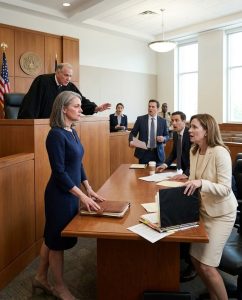
The courtroom settled when the judge entered.
Everyone stood.
The black robe moved behind the bench.
The clerk adjusted the docket sheet.
A bailiff near the wall folded his hands in front of him.
The flag behind the bench stood bright in the window light.
I heard one of Evelyn’s lawyers turn a page.
Then the judge looked down at the file.
He read the case name.
He turned one page.
His eyes lifted.
At first, he looked at Evelyn’s table.
Then he looked at mine.
Then he looked at me.
Recognition does not always arrive loudly.
Sometimes it tightens the air before anyone speaks.
The judge’s face changed just enough for me to know he remembered.
Years earlier, he had been counsel on a military case that crossed my docket.
We had not been friends.
We had not needed to be.
He had watched me handle a witness who had been mocked, cornered, and nearly broken by men who believed rank would protect them.
He had watched me take apart a lie without raising my voice.
Now he sat in a county courtroom while my mother-in-law’s attorney prepared to call me unrepresented.
The attorney stood.
“Your Honor, before we begin, opposing party appears without counsel, and given the complexity of the matter—”
The judge lifted one hand.
The attorney stopped.
It was not dramatic.
It was worse for Evelyn than drama.
It was authority refusing to follow her script.
The judge looked at me and said, “Good morning… Colonel.”
Nobody moved.
One of the attorneys stopped with his hand still on a binder ring.
The clerk’s pen paused over the docket sheet.
The bailiff’s eyes shifted toward Evelyn’s table.
In the second row, someone’s mint wrapper stopped crinkling.
Evelyn’s face lost color in stages.
First the smile disappeared.
Then the tight confidence around her eyes loosened.
Then her mouth opened slightly, as if she had to breathe through the fact that the room had changed without asking her permission.
“Wait,” she whispered.
The sound was small.
“What?”
I did not look away from the judge.
“Yes, Your Honor,” I said.
Evelyn’s lead attorney slowly sat down.
He had enough sense to understand that the case had not vanished.
The deed still mattered.
The probate file still mattered.
The motion still had to be heard.
But the story Evelyn had brought into court had cracked straight down the middle.
She had not brought a helpless widow to slaughter.
She had brought three attorneys to underestimate a woman trained to survive rooms exactly like that one.
The judge adjusted the papers in front of him.
“For the record,” he said, “the court will proceed carefully and with full attention to the filings before it.”
Then he looked at Evelyn’s side.
“Counsel, I suggest precision.”
It was a polite sentence.
Every lawyer at that table heard the warning inside it.
I opened my folder.
The first document was the deed.
The second was the probate notice.
The third was the insurance record.
The fourth was Thomas’s letter.
When I touched that page, my hand did not shake.
I thought it might.
I thought grief would find a way into my fingers.
But grief had already done its work before that morning.
It had emptied me, then sharpened what was left.
Evelyn watched the pages come out one at a time.
The lead attorney cleared his throat.
“Your Honor, we maintain that the decedent intended this property to remain accessible to the family as a whole.”
The judge looked at him.
“Do you have a document supporting that claim?”
The attorney glanced at Evelyn.
There it was.
The first crack between them.
“We have correspondence indicating ongoing family use,” he said.
“Use is not ownership,” I said.
My voice was calm enough that Evelyn looked startled all over again.
The judge turned toward me.
“Colonel Carter, you’ll have your opportunity.”
“Yes, Your Honor.”
Evelyn’s mouth tightened at the name.
Carter had been her family name before it was mine.
She had always treated it like something she had loaned me.
Now it sounded different in the judge’s mouth.
It sounded like mine.
Her attorney tried again.
He spoke about tradition, access, emotional expectations, and alleged promises.
He made the cabin sound like a shared heirloom instead of a legally transferred property.
He avoided the deed for as long as he could.
Then the judge asked for it.
I slid my copy forward.
The clerk took it.
The courtroom stayed quiet while the judge reviewed the page.
Evelyn crossed and uncrossed one ankle beneath the table.
The tiny movement was the only nervous thing she allowed herself.
Her youngest lawyer reached for a tab and missed it.
The judge looked up.
“This deed appears clear.”
Evelyn’s lead attorney stood again.
“We believe undue influence may be relevant.”
I almost smiled.
There it was.
When paperwork fails, some people reach for character assassination like a spare tire.
The judge’s expression did not change.
“Against whom?” he asked.
The attorney hesitated.
Evelyn stared straight ahead.
“Against Mrs. Carter,” he said.
The judge looked at me.
Then he looked at the attorney.
“You are alleging that the widow improperly influenced her own husband to transfer property to her?”
“We are suggesting the circumstances warrant inquiry.”
“Then be prepared to state your factual basis.”
That sentence landed hard.
Evelyn’s hand went to her pearls.
It was the same gesture she used at family dinners whenever she wanted everyone to notice that she was wounded by someone else’s boundaries.
This time, nobody comforted her.
I placed Thomas’s letter on top of the folder.
“Your Honor,” I said, “when appropriate, I can provide a signed letter from my husband explaining his intent in his own words.”
Evelyn turned toward me so fast one of her earrings swung against her neck.
“You have no right to use that,” she hissed.
The judge’s eyes moved to her.
The courtroom went cold.
Her attorney whispered, “Mrs. Carter.”
But it was too late.
The outburst had done what my argument had not needed to do yet.
It proved she knew the letter existed.
It proved she knew it mattered.
The judge leaned back.
“Mrs. Carter,” he said, “you will allow counsel to speak for you unless I ask you a direct question.”
Evelyn swallowed.
For the first time that morning, she looked less like a woman defending family property and more like a woman realizing she had brought the wrong story into a room built for records.
I did not feel victorious.
That surprised me.
For weeks, I had imagined the moment Evelyn finally understood.
I thought it would feel like relief.
Instead, it felt like standing at the edge of the lake cabin porch after a storm, looking at branches all over the yard and knowing cleanup still had to happen.
The judge reviewed the letter.
The handwriting was Thomas’s.
The date was there.
The language was plain.
He had written that the cabin belonged to me, that he trusted me with it, and that he did not want his mother or any other family member pressuring me to sell, transfer, or share ownership after his death.
He had written, “Margaret has spent enough of her life fighting other people’s battles. This place is where I want her to rest.”
That was the line that finally reached me.
Not because it won anything.
Because it sounded like him.
My eyes burned, but I kept them steady.
Evelyn looked down at the table.
Her lawyer spoke more carefully after that.
The judge asked questions.
I answered only what was asked.
No speeches.
No revenge.
No dramatic declaration about who I used to be.
The facts did not need me to decorate them.
By the end of the hearing, Evelyn’s emergency motion was denied.
The court did not award her the cabin.
It did not validate the settlement pressure.
It did not accept the idea that grief made me legally incompetent.
The judge set further procedural deadlines and warned both sides that unsupported allegations would not be entertained.
That was enough.
Outside the courtroom, Evelyn did not laugh.
Her attorneys gathered their binders without looking at her much.
One of them dropped a tabbed section and bent too quickly to retrieve it.
Evelyn stood by the hallway window, pale under the courthouse light.
When I walked past, she said my name.
Not sweetheart.
Not housewife.
My name.
“Margaret.”
I stopped.
For a moment, I saw the older woman beneath the suit, the mother who had lost her son and tried to turn that loss into control because control was the only language she trusted.
I could have softened.
I could have made it easier for her.
That had been my habit for years.
But being kind does not require handing someone the weapon they just tried to use on you.
“You embarrassed me in there,” she said.
I looked at her for a long second.
“No,” I said. “You did that before I arrived.”
Her mouth tightened.
“You should have told me.”
“That I was a colonel?”
“That you knew how to do this.”
I thought of Thomas’s letter in my folder.
I thought of every dinner where she had made me smaller because smaller suited her version of the family.
Then I said the truth as gently as I could.
“You never asked who I was. You only decided who you needed me to be.”
She had no answer for that.
I walked out through the courthouse lobby with the folder under my arm.
The marble still smelled like polish and rain.
The flag outside moved in the wind.
In the parking lot, I sat in my car and finally let myself breathe.
I did not drive straight home.
I drove to the lake cabin.
The road was wet, the trees dark from the rain, and the gravel under my tires sounded exactly the way it had when Thomas used to pull in after long weekends away.
The screen door stuck when I opened it.
It always had.
Inside, dust floated through the afternoon light.
His old fishing cap still hung on the peg by the door.
I placed the folder on the kitchen table and stood there for a while, listening to the refrigerator hum and the lake move softly against the dock.
The cabin was not valuable because of the square footage.
It was not valuable because of the land.
It was valuable because it was the one place Thomas had tried to protect for me after he was gone.
Evelyn had looked at it and seen property.
Thomas had looked at it and seen rest.
For years, that family had taught me to stay quiet so they could mistake me for weak.
That morning in court, they learned silence had never meant surrender.
It had only meant I was waiting until the record was ready.