The mountain road looked narrower than it had six weeks earlier.
Caleb Mercer noticed that before he noticed the cruisers.
The gravel curled between pine trunks and old drainage ditches, climbing toward the gray cedar house that had sat empty long enough for people to start treating it like scenery instead of property.
His trailer bounced behind the truck with a dull metallic rattle.
A toolbox shifted.
The thermos in the cupholder knocked once against the dash.
Caleb kept both hands on the wheel and watched the front porch come into view.
Two police cruisers were parked across the clearing.
Three black SUVs waited behind them, angled like a small parade that had not wanted to call itself one.
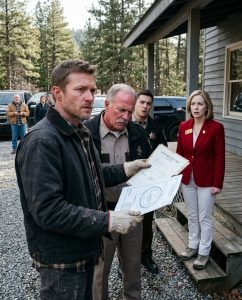
On the porch stood Diane Merriweather.
She wore white slacks, spotless hiking boots, and a red blazer with the gold pine-tree pin that Timber Ridge Estates used on every newsletter, gate sign, and complaint letter.
The house rose behind her in three rough stories of weathered cedar.
Plywood covered most of the windows.
The stone chimney had a lightning split running down it like an old scar.
For a second, Caleb sat there with the engine idling and looked past Diane to the dark front door.
The padlock on that door was his.
He had put it there the day after the auction.
The day after his name appeared on paperwork nobody in Timber Ridge seemed to respect.
He had bought the place for $91,000 cash at a county tax auction.
That number still felt unreal when he said it to himself.
Not because the house looked worth more.
It did not.
From the outside, it looked like a bad decision with a roof.
But Caleb had not bid because of the roof.
He had bid because of a beam inside the kitchen.
Years earlier, his grandfather had brought him up that same mountain and lifted him onto a dusty counter so he could see a name carved above the fireplace.
Mercer.
The letters had been cut deep, uneven, and stubborn.
His grandfather had said almost nothing about it.
That was how men in Caleb’s family tended to handle grief, land, and regret.
They pointed once, then went quiet.
At the auction, Caleb had almost walked away.
The roof needed work.
The siding was tired.
The place had been tangled in unpaid taxes long enough that most bidders saw only liability.
Then the clerk read the parcel description, and Caleb saw the line printed under the property boundary.
“Parcel includes private access road, spring rights, and all structures beneath grade.”
The room moved on.
Caleb did not.
Beneath grade.
Those two words changed the house from a ruin into a question.
So he paid.
He recorded the deed.
He bought title insurance.
He requested a written acknowledgment from the sheriff’s office because he had spent enough years around contractors, liens, and angry property owners to know that paper mattered most when somebody hated what it said.
Now he had all of it in a folder on the passenger seat.
Diane saw him look toward it.
Her face changed for half a breath.
Then she smiled again.
Caleb turned off the engine.
The mountain seemed to go quiet around him.
When he stepped out, Diane came down one porch step and said, “You’re trespassing on community property.”
The young deputy nearest her shifted his weight.
He looked about twenty-eight, with a clean jaw and nervous eyes.
His hand hovered near his belt, not touching anything, but close enough for Caleb to notice.
The older deputy stood beside the porch rail.
He had a gray mustache, a sunburned neck, and the look of a man who had spent years sorting real trouble from rich people’s panic.
Caleb closed his truck door gently.
Not hard.
Not dramatic.
Just firmly enough that the latch clicked across the clearing.
“My name is Caleb Mercer,” he said. “This is my property.”
Diane’s smile tightened.
“No, Mr. Mercer. This is a restricted historical structure inside Timber Ridge Estates. You bought a paperwork mistake. The board has already filed to correct it.”
Behind the cruisers, one of the neighbors lowered his sunglasses.
Another held a phone near her coat pocket.
Nobody spoke.
That was how groups like this worked, Caleb thought.
One person did the talking.
Everyone else supplied the silence.
The older deputy glanced at the trailer.
Then at the padlocked front door.
Then back at Caleb.
“Mr. Mercer,” he said, “we got a call about attempted unlawful entry.”
Caleb looked at the padlock again.
Rust had already started staining the new metal around the old hasp.
“That call came from her?” he asked.
Diane lifted her chin.
“It came from a concerned community president.”
Caleb nodded once.
He had met people like Diane before.
They never said my interest.
They said community.
They never said I want control.
They said safety.
They never said this belongs to us because we are used to looking at it.
They said history.
He moved toward the passenger door of the truck.
Diane took a quick step forward.
The young deputy stiffened.
Caleb stopped with one hand on the handle.
“I’m getting paperwork,” he said.
Diane’s voice cut through the clearing before either deputy could answer.
“Cuff him before he gets inside. He doesn’t know what’s buried under that house.”
The words did not echo.
They landed.
Hard.
The younger deputy turned to her first.
Then the older one did.
Caleb felt something cold settle behind his ribs.
He had expected a property fight.
He had expected HOA letters, threats about lawyers, maybe a gate code argument.
He had not expected Diane Merriweather to say the quiet part out loud in front of law enforcement.
The house stood behind her, still and gray.
A loose board tapped once in the wind.
Caleb opened the truck door and took out the folder.
Diane’s mouth pressed into a thin line.
He laid the papers across the hood because that kept his hands visible and gave the deputies no reason to invent fear.
County deed.
Tax-sale receipt.
Survey map.
Title insurance binder.
Sheriff’s acknowledgment.
The older deputy took the first page.
His name tag read Harlan.
Caleb did not know whether to be relieved by that or worried.
A name made a man real.
It also made him accountable.
Harlan read without speaking.
The younger deputy leaned in over his shoulder.
Diane came closer.
“Deputy Harlan, I’m sure you understand that our attorneys—”
Harlan raised one hand without looking up.
Diane stopped.
It was not a grand victory.
No one cheered.
No music swelled.
But the little crowd felt it.
For the first time that morning, someone had interrupted Diane Merriweather and the world had not ended.
Harlan turned the page.
The younger deputy’s expression changed first.
His face did not become friendly.
It became careful.
“You bought this on April 29?” he asked.
“Yes,” Caleb said.
“You paid all back taxes?”
“Yes.”
“You own the access road from County Route 17 up to this structure?”
“Yes.”
Diane gave a short laugh.
It sounded polished and false, like something practiced at board meetings.
“That road services our emergency gate.”
Caleb looked at her then.
“No,” he said. “Your emergency gate blocks my road.”
The black SUVs behind the cruisers suddenly seemed less neutral.
The neighbors were not just watching a dispute.
They were standing beside the thing he was disputing.
That gate sat lower on the mountain, painted green to blend with the pines, marked with Timber Ridge’s neat little sign.
Private Emergency Access.
Residents Only.
Caleb had driven past it twice with a county map open on the passenger seat and a bad feeling growing in his stomach.
Now the bad feeling had a name.
Harlan found the survey page.
Caleb had circled one section in blue pencil before leaving home.
Not because he wanted drama.
Because he wanted clarity.
Private access road.
Spring rights.
All structures beneath grade.
The younger deputy read the first phrase under his breath.
Then the second.
When he reached the third, his finger stopped.
Diane saw exactly where he was looking.
Her face lost color so quickly that one of the neighbors behind her whispered her name.
Harlan lifted his eyes.
“Ma’am,” he said, “how did you know something was buried under his house?”
Diane did not answer.
Not right away.
She looked over her shoulder toward the porch.
Caleb followed her gaze.
The boards near the front door were warped, but not randomly.
Dust and pine needles had gathered along a seam that formed a rough rectangle near the threshold.
He had noticed it on auction day but had not pushed farther because the house was not safe to explore alone.
Now he saw the old iron ring half-hidden beneath dirt.
Diane had known it was there.
Harlan saw it too.
“Step down from the porch,” he said.
The instruction was calm.
That made it stronger.
Diane looked offended enough to refuse, then thought better of it.
She stepped onto the gravel.
Her clean hiking boots finally met mud.
Caleb did not smile.
He wanted to.
He did not.
There are moments when restraint says more than triumph.
Harlan handed the papers back to Caleb and spoke to the younger deputy.
The younger deputy moved to the porch, crouched, and brushed away the pine needles with the edge of his glove.
The iron ring showed itself fully.
It was old, black, and set into wood that had been cut to lift.
Nobody opened it yet.
That mattered.
Harlan first turned to Diane.
“You called this in as unlawful entry,” he said.
She recovered enough to speak.
“This property has been maintained by Timber Ridge for years. It is historically sensitive. We cannot allow random buyers to damage protected features.”
Caleb almost laughed at random buyers.
He had a recorded deed in his name.
She had a blazer.
Harlan looked back at the survey.
“Is Timber Ridge the owner of record?”
Diane’s jaw moved once.
“No, but—”
“Does Timber Ridge have a court order preventing Mr. Mercer from accessing this property?”
“No, but our attorneys are—”
“Do you have documentation showing this road belongs to the association?”
Diane went still.
The neighbors stopped shifting.
Even the pine trees seemed to quiet.
Harlan did not raise his voice.
He did not have to.
“Until you have a legal order that says otherwise,” he said, “Mr. Mercer has documentation showing ownership and access.”
The young deputy stood by the trapdoor seam.
His foot was beside the iron ring.
He looked at Caleb, not Diane.
“You want this opened today?” he asked.
Caleb looked at the house.
At the chimney.
At the boarded windows.
At the place where his grandfather’s name waited above the fireplace.
Then he looked at Diane.
She was not frightened of damage.
She was frightened of discovery.
“Yes,” Caleb said. “But not until this is documented.”
That answer changed Harlan’s face.
He looked like a man who had been hoping the property owner would not make the mistake of acting on anger.
“Good,” Harlan said.
He had the younger deputy take photographs of the papers, the lock, the porch, the gate issue, and the seam in the boards.
Diane objected twice.
Both times Harlan told her to wait.
That was when one of the neighbors finally spoke up.
A man in a fleece vest said Timber Ridge had always handled that structure for safety.
His voice thinned halfway through the sentence when Harlan asked if he was on the board.
He was.
That explained the SUVs.
Not spectators.
A board delegation.
Caleb’s stomach tightened in a new way.
They had not come to watch Diane handle a trespasser.
They had come to witness a removal.
His removal.
The kind done politely.
With police present.
With words like mistake and restriction and community.
Harlan instructed Diane and the board members to move away from the porch while Caleb unlocked the front door.
The old padlock scraped in Caleb’s hand.
Inside, the house smelled of dust, old smoke, and cold wood.
Sunlight cut through cracks in the plywood and landed in thin bright lines across the floor.
The kitchen was to the left.
Caleb went there first.
He did not mean to.
His feet took him.
Above the fireplace, under a crust of dust, the carved letters were still there.
Mercer.
His throat tightened before he could stop it.
Harlan waited at the doorway and said nothing.
The young deputy stayed near the porch opening.
Diane remained outside, watched by people who had suddenly become less loyal to her certainty.
Caleb turned back toward the front.
The trapdoor lifted with a groan that seemed too loud for such a small space.
Cold air came up from below.
Not rotten air.
Wet stone air.
Spring air.
The beam from Caleb’s flashlight slid down a short set of steps and struck stonework built beneath the house.
There was a chamber under the front section, not huge, but deliberate.
Hand-laid stone.
Old timber bracing.
A narrow channel where water moved softly through the dark.
The mountain had been feeding something under that house for a long time.
Caleb did not climb down right away.
He aimed the light across the stone wall.
There, scratched into a support near the bottom step, was the same family name.
Mercer.
Harlan saw it.
The young deputy saw it.
Diane, standing outside, could not see the carving, but she saw their faces.
That was enough.
The story she had planned to tell was collapsing without anyone raising a voice.
Caleb backed away from the opening and set the flashlight on the floor so the light still pointed down.
He did not need to touch anything else.
The proof was not treasure.
It was not bones.
It was not some wild secret from a movie.
It was worse for Diane than all of that.
It was recorded land, visible water, old construction, and a family mark that matched the deed she had tried to erase with confidence.
Harlan asked Diane for the HOA’s paperwork.
She did not have it with her.
She said it was with counsel.
Harlan told her she could provide it later, but she could not use a pending board claim to keep the recorded owner from the property that day.
He also told the board members that the emergency gate blocking the access road needed to be addressed through proper legal channels, not by calling police on the owner.
The man in the fleece vest looked at the ground.
The woman with the phone stopped recording.
Diane did not apologize.
People like Diane rarely apologize in the first hour.
They revise.
They reposition.
They call it a misunderstanding.
She tried that next.
She said Caleb had arrived aggressively.
Harlan looked at the truck, the trailer, the folder, and the unlocked but undamaged front door.
Then he wrote down what had happened.
The younger deputy took Diane aside for her statement.
That was when her composure finally cracked.
Not into tears.
Into calculation.
She spoke quieter.
She chose words more carefully.
She no longer ordered anyone to cuff Caleb.
By early afternoon, the cruisers were still there, but they were no longer pointed at him.
They were there because the call Diane had made now needed its own paperwork.
Caleb stood on the porch with the deed folder tucked under one arm and the old house open behind him.
The mountain wind moved through the boards.
From below, the spring made a steady sound in the dark.
It was not loud.
It did not need to be.
Some truths do not shout when they surface.
They just keep running.
Harlan returned Caleb’s documents and gave one final instruction to everyone present.
No one from Timber Ridge was to enter the house, block the porch, cut the lock, remove boards, or interfere with Caleb’s access unless they had a court order saying they could.
The board members heard it.
Diane heard it.
So did Caleb.
For six weeks, he had felt like a man holding paper against a machine.
Now the machine had been forced to read the paper out loud.
The emergency gate did not disappear that afternoon.
Nothing that expensive disappears in one afternoon.
But before the deputies left, Harlan documented where it sat in relation to the county road and Caleb’s recorded access.
That mattered.
A week later, after the appropriate notices and calls, Timber Ridge unlocked it.
Not because Diane had changed her heart.
Because she had lost the one thing she had been counting on.
She had lost the assumption that Caleb would fold before the paperwork did its job.
Caleb returned to the mountain house the next Saturday with safer lights, a respirator, and a friend who knew old foundations.
He did not tear through the place like a man hunting treasure.
He moved slowly.
He photographed everything.
He braced what needed bracing.
He cleaned the fireplace last.
When the dust came off the beam, his grandfather’s carved name looked darker, clearer, almost new.
Caleb stood there for a long time.
Outside, Timber Ridge’s perfect roofs shone across the valley.
Inside, the house still needed more work than one man could do quickly.
But it was his work now.
His road.
His spring rights.
His below-grade structure.
His name on the deed.
Diane had thought the mountain house belonged to whoever could sound most official on the porch.
She had thought two cruisers and an HOA blazer could turn a recorded owner into a trespasser.
She had thought the secret under the house was power.
It was not.
The power was the paper she had hoped nobody would read.
And the moment it was read, the whole porch understood what Caleb had known from the beginning.
Some homes are abandoned only until the right person comes back with proof.