The backyard smelled like lighter fluid, grilled burgers, and beer sweating in plastic cups.
A small American flag tapped against my mother’s porch rail every time the humid evening wind moved through the yard.
Thirty off-duty cops stood around folding tables, paper plates, and lawn chairs, laughing like they owned every inch of that little suburban backyard.
It was my brother Mark’s thirty-fourth birthday.
My mother, Sylvia, had spent three days preparing for it.
She had scrubbed the patio, bought two sheet cakes, set out coolers, and reminded me twice not to embarrass him.
That was funny, in a cruel sort of way, because nobody in my family had ever worried about Mark embarrassing me.
They called it teasing.
They called it sibling stuff.
They called it Mark being Mark.
By the time I arrived, the grill smoke was hanging low near the fence, the potato salad was already too warm, and Mark was holding court near the beer cooler in his department polo and tactical boots.
His badge was clipped to his belt even though he was off duty.
That was Mark all over.
He never took the badge off unless someone made him.
He liked the way people looked at it.
He liked the small pause it created in a room.
He liked being treated like a man who could start trouble and call it order.
My mother adored that about him.
To Sylvia, Mark was proof that she had raised someone important.
I was proof of something less useful.
I was the daughter who did not come to every holiday.
The daughter who asked too many questions.
The daughter who had left home, built a quiet career, and stopped pretending Mark’s cruelty was charming.
Nobody in that backyard knew much about my work.
That was partly because I kept it that way.
My family knew I worked in “audit.”
That was the word my mother used when she wanted to make it sound boring.
“She does paperwork,” she told people, usually with a little shrug.
I let her.
Paperwork has ruined more powerful men than shouting ever has.
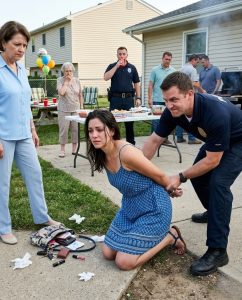
I stood near the kitchen door in a blue sundress, holding a paper plate with a burger I had barely touched.
The concrete patio was still warm through my sandals.
Behind me, the screen door squeaked open and shut as people moved between the kitchen and the yard.
Someone popped open a beer, and the hiss cut across the music from Mark’s speaker.
That was when Mark turned his head toward me.
“You know, Elena,” he said, dragging my name out with a slur, “my new Seiko watch just went missing.”
A few men chuckled.
Not because it was funny.
Because Mark had decided it was supposed to be.
I looked at him and felt the familiar tightening behind my ribs.
There are tones you recognize before the words arrive.
Mark used that tone whenever he wanted a crowd.
He lifted his bottle and pointed it at me.
“And someone matching your exact description was seen lingering near the kitchen.”
My mother looked over from the cooler.
She did not look confused.
She looked entertained.
“Mark,” I said softly, “don’t.”
That was all.
I did not raise my voice.
I did not step toward him.
I did not give him the drama he was fishing for.
He lunged anyway.
His hand clamped around my wrist hard enough to crush the bones together.
Before I could twist away, he caught my other arm and wrenched both behind my back.
Pain flashed white up my shoulder.
My paper plate hit the concrete.
The burger slid off and landed beside my foot.
Someone said, “Hey, man.”
Someone else laughed.
The laugh was thin, uncertain, the kind people give when they are waiting to see whether cruelty is going to be permitted.
Mark gave them permission.
Click-click.
Click-click.
Cold steel closed around my wrists.
The cuffs were too tight immediately.
I felt the metal bite into the soft skin near the bone.
Then he shoved me down.
My knees hit dirt at the edge of the patio, and the impact went straight up my legs.
“You’re under arrest for theft!” Mark shouted.
The yard froze.
The music kept playing, low and stupid and cheerful.
A fly circled the ketchup on somebody’s plate.
Plastic forks hovered in midair.
One of Mark’s friends looked into his red cup like he could hide inside it.
My Aunt Linda whispered, “Mark, stop it.”
My mother moved before anyone else did.
For half a second, I thought she was coming to help me.
That was the old child in me, still stupid enough to hope.
Sylvia walked straight to my purse and kicked it across the patio.
The sound was small.
A scrape.
A thud.
Then everything inside came loose.
My wallet slid under a lawn chair.
My keys skidded toward the cooler.
My lipstick rolled in a slow pink line across the concrete.
Tampons scattered near Mark’s boots.
Thirty grown men saw them.
Half of them looked away.
The other half looked first, then pretended they had not.
“If you didn’t steal it, prove it,” my mother snapped.
Her face was tight with the old pleasure of choosing Mark over me.
“You always were a jealous, sneaky little girl.”
That sentence did more damage than the cuffs.
Not because it was new.
Because it was not.
Sylvia had been saying versions of it since we were kids.
When Mark broke a neighbor’s window, I must have distracted him.
When Mark crashed her car at seventeen, I should have stopped him.
When Mark failed out of community college the first time, I had probably made him feel judged.
He was always reacting.
I was always responsible.
The metal dug deeper into my wrists as I shifted on my knees.
My fingers tingled.
My shoulder throbbed.
I could smell dirt, grill smoke, and the sour edge of beer on Mark’s breath when he leaned over me.
“Where’d you hide it, Elena?” he asked loudly.
He was performing now.
He nudged through my belongings with the toe of his boot.
My wallet flipped open.
A receipt blew against the leg of a folding table.
“Come on,” he said. “Don’t make this hard.”
I said nothing.
He needed me to cry.
He needed me to shout.
He needed me to give the men in that yard a reason to call me unstable.
That is how men like Mark survive.
They create the injury, then prosecute the reaction.
So I stared at the patio instead.
I counted breaths.
I watched a bead of condensation slide down a beer can.
I kept my face still while the cuffs pinched a nerve and pain shot into my fingers.
Mark’s laughter began to lose shape.
He kicked gently through my purse again.
No watch.
He bent lower and checked beneath the lawn chair.
No watch.
He glanced toward my mother.
For one quick second, the performance broke.
Then he replaced it with a louder laugh.
“Relax, everybody,” he called.
He reached down and unlocked the cuffs.
“It’s a joke. I was testing the tension on the rookie cuffs.”
The steel released, but the pain did not.
He hauled me to my feet too roughly, his fingers digging into my arm.
“Can’t take a joke, Elena?” he said near my face.
His breath smelled like cheap beer and onions.
“You’re too damn sensitive.”
Some of the men laughed again because now they knew what version of the story Mark wanted.
Just a joke.
Just family.
Just Elena being dramatic.
My mother stood beside my spilled purse with her chin lifted.
She did not apologize.
She did not look at my wrists.
She looked proud of herself.
I looked down.
Two red bands circled my skin.
One spot had split open and started to bleed.
For one ugly heartbeat, I imagined slapping Mark so hard the whole yard went quiet for a different reason.
I imagined grabbing the beer bottle from his hand.
I imagined making him afraid of me.
Then I let the thought pass.
Rage is easy to dismiss when the wrong person is holding a badge.
Evidence is harder.
I crouched and gathered my things.
I picked up my wallet.
I picked up my keys.
I picked up the lipstick with the cracked cap.
I picked up each tampon from the concrete while the men shifted and cleared their throats and pretended to check their phones.
I did not hurry.
At 6:42 p.m., I took a photo of both wrists beside the handcuffs still lying on the patio table.
At 6:44 p.m., I photographed my purse, the scattered items, and the boot print Mark had left through my makeup powder.
At 6:45 p.m., I took one more picture from a wide angle that showed the porch, the flag, the guests, Mark’s badge, and my mother standing in the background.
That third photograph mattered.
Context always matters.
A bruise is a bruise.
A bruise with witnesses, timestamps, and a department-issued restraint becomes something else.
I walked to my car at the edge of the driveway.
Nobody stopped me.
Mark had already turned away for another beer.
The show was over, as far as he was concerned.
He had made me small.
He had made everyone watch.
He had called it a joke before anyone could call it what it was.
I got into my car, locked the doors, and set the phone against the steering wheel.
My hands did not tremble until I was alone.
The cuff marks looked worse under the clean light of the dashboard.
The skin was swelling.
The blood had started to bead.
For a moment, I was not the Senior Auditor for the Office of Professional Accountability.
I was just a woman sitting in a hot car outside her mother’s house, trying not to cry because her family had once again chosen a cruel man’s comfort over her dignity.
Then I opened the secure contact list.
My family thought I did paperwork.
They were right.
I reviewed complaint files.
I matched timecards against body-camera activation logs.
I compared use-of-force reports to hospital intake notes.
I read witness statements, disciplinary histories, evidence summaries, internal memos, and misconduct review packets.
My signature had ended careers before.
Not because I enjoyed it.
Because some badges rot from the inside if nobody cuts the rot out.
At 6:51 p.m., I dialed the unlisted number.
The deputy director answered on the second ring.
“Elena?” he said.
His tone sharpened immediately.
“What happened?”
I looked through the windshield.
Mark was laughing under the porch flag.
His badge caught the light when he moved.
His friends stood around him with their beers, already trying to relax back into the lie.
I said, “Open an emergency conduct hold on Officer Mark Alvarez.”
Silence hit the line.
Then the deputy director asked, “Are you safe?”
“Locked in my vehicle,” I said.
My voice sounded calmer than I felt.
“Thirty off-duty witnesses. Unauthorized restraint. Public accusation of theft. Visible injury. Photos taken at 6:42 and 6:44 p.m. Additional context photo at 6:45.”
A chair scraped on his end.
That sound told me everything.
He was no longer hearing a family incident.
He was hearing an officer use department-issued restraints at a private party to stage a fake arrest against a civilian.
He was hearing witness intimidation by laughter.
He was hearing abuse of authority.
“Do you need medical attention?” he asked.
“Not emergency medical,” I said.
“I will document the injuries at urgent care after I leave the scene.”
“Do not leave yet unless you believe you are in danger,” he said.
His voice had gone fully official.