I can still hear the laugh that ruined the room.
Not because it was the loudest sound I had ever heard.
Because it was the sound of people deciding I deserved it.
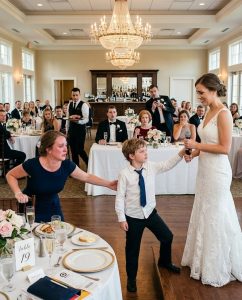
The reception was held at Magnolia Creek Country Club, the kind of place with polished floors, cream walls, and chandeliers that made ordinary people feel like they had to lower their voices.
The ballroom smelled of roses, candle wax, perfume, prime rib, and the sweet frosting from a four-tier wedding cake waiting against the far wall.
I had spent the morning trying to make sure Eli felt proud to be there.
At 7:18 that morning, he stood beneath the fluorescent lights at Target, holding up a blue tie with tiny silver stripes and asking if it made him look like a lawyer.
I told him it made him look like the most handsome nine-year-old in the state.
He believed me.
That was the thing about Eli.
He still believed words could mean exactly what they were supposed to mean.
I wore a navy dress I had bought on clearance two months earlier and kept in the back of my closet for occasions where I needed to look like I had not been counting grocery money.
It fit well enough.
It was not expensive.
I had steamed it in my bathroom while Eli brushed his teeth and practiced saying, “Congratulations, Uncle Miles,” with the solemnity of a child performing in court.
Miles was my little brother.
That fact mattered more than it should have.
When we were children, I walked him to school because he was afraid of dogs.
I made him scrambled eggs when Mom worked double shifts and our father disappeared into the kind of silence that never sends birthday cards.
I learned which bills could wait and which envelopes made Mom cry at the kitchen table.
Miles learned to sleep through arguments.
I learned to stand between him and them.
That was our childhood.
By the time he became the groom standing under Magnolia Creek’s chandelier, wearing a black tuxedo and a smile I barely recognized, I had already spent most of my life being older than my years.
Diane Prescott, our mother, liked to call that responsibility.
She never called it sacrifice.
She never called it parenting her own son by proxy.
She certainly never called it love.
Diane had always been graceful in public.
She could slice someone open with a sentence and still look like she was discussing floral arrangements.
When I became pregnant with Eli at twenty-two and his father disappeared before the ultrasound photo had even curled at the edges, Diane did not scream.
That would have required honesty.
She only looked at me and said, “Well, Nora, some women make themselves harder to choose.”
I carried that sentence for nine years.
I carried Eli too.
To daycare.
To feverish midnight clinics.
To kindergarten registration.
To Brookside Elementary conferences where teachers told me he was bright, careful, and too quick to apologize for things he had not done.
That last part hurt.
Children learn apology from the rooms they live in.
I tried to give him better rooms.
When Miles called three weeks before the wedding, he did not ask whether I wanted to come.
He asked whether I could keep Mom calm.
The text was still in my phone.
4:06 p.m.
“Please just keep Mom calm today. Brielle is stressed.”
I stared at it for a long time before replying, “Of course.”
That was my role in the family.
Of course.
Of course I would smooth things over.
Of course I would absorb whatever Diane decided to throw.
Of course I would show up, smile, and make sure nobody else’s day became uncomfortable.
Service only feels noble to people who benefit from it. The moment you stop bowing, they call it attitude.
I did not stop bowing that day.
Not at first.
At the reception, our table sat near the kitchen doors.
Table 19.
I noticed because the seating chart card had been printed in gold script, and my name was lower than nearly every relative I had ever met.
Nora Prescott.
Eli Prescott.
Beside us were a former coworker of Brielle’s father, two distant cousins, and a woman who spent most of dinner trying to remember whether she had met me before.
The chicken arrived lukewarm.
The butter on my bread plate shone under the chandelier.
Eli behaved beautifully.
He kept his napkin in his lap.
He asked whether he could have more water.
He told the woman beside him that Uncle Miles used to draw dinosaurs on napkins when he was little.
I watched Miles across the room and tried to feel happy.
There were moments when I almost did.
He looked nervous, but proud.
Brielle looked radiant in the way brides can look when nobody has ever told them no and meant it.
Her gown was lace from collarbone to wrist.
Her hair was pinned with pearls.
She held the room’s attention as easily as she held her bouquet.
I had met Brielle five times before the wedding.
She was polite in the polished way some people are polite to service workers.
Her smile was fixed.
Her questions were light.
Her eyes always seemed to be measuring the room for hierarchy.
The first time she met Eli, she touched his shoulder and said, “Aren’t you brave?”
He looked confused afterward.
“Why did she say brave?” he asked me in the car.
I told him adults sometimes used the wrong word.
That was a lie, but it was a gentle one.
At Magnolia Creek, the speeches began after dinner.
The best man told a story about Miles getting lost on a camping trip.
Brielle’s father made everyone laugh by pretending to warn Miles about the cost of happy wife, happy life.
Diane dabbed her eyes with a napkin even though no tears had fallen.
Then Brielle took the microphone.
She thanked the planners.
She thanked her parents.
She thanked the guests who had traveled.
She thanked people for believing in love.
I remember taking a sip of water right before her voice shifted.
It went lighter.
Sweeter.
Meaner.
“And of course,” she said, smiling at the guests, “we want to thank everyone who came tonight. Even people who remind us that love is still possible after… well, after life makes other plans.”
Her eyes slid to me.
My hand tightened around the water glass.
Miles looked down at his champagne.
He knew.
That was the first small betrayal.
Not that Brielle said it.
That Miles knew where she was aiming before the arrow landed and still looked away.
Brielle laughed softly.
“Like Nora, Miles’s sister,” she continued. “She’s such a brave little example. A sad single mother, but still showing up for romance. Isn’t that sweet?”
The first laugh came from a bridesmaid with glossy hair and pearl earrings.
The second came from a cousin near the dance floor.
Then the sound multiplied.
It moved through the ballroom like a spill.
Eli lowered his fork.
His blue tie had gone crooked during dinner.
He looked at me with a question he should never have had to ask.
“Mom?”
I kept my gaze forward.
“It’s okay.”
It was not okay.
I could feel my face heating.
I could hear the tiny clink of ice in someone’s glass.
I could smell roses and wax and roasted meat and the powdery perfume Diane had worn since I was a child.
That perfume always meant she was about to perform.
She leaned slightly toward her wine glass.
The microphone was still live.
Diane did not raise her voice.
She never needed to.
“She’s like a clearance item with a torn tag,” my mother said. “Marked down so many times nobody knows where she belongs.”
The ballroom laughed again.
Bigger this time.
Because a mother had given them permission.
That was the second betrayal.
My hands started shaking under the table.
I wanted to lift my water glass, but I knew they would see the tremor.
So I curled my fingers into fists beneath the white linen.
The room froze in pieces.
Forks paused in midair.
A champagne flute hovered near a woman’s lips.
One waiter stood with a tray balanced on his palm, staring at the tablecloth instead of at me.
A groomsman looked at his phone without unlocking it.
A bridesmaid covered her smile too late.
Nobody moved.
That was the part I remembered most afterward.
Not the joke.
Not even my mother’s line.
The witnesses.
The way people can recognize cruelty and still choose etiquette over mercy.
Eli leaned close.
“Why are they laughing at you?”
I opened my mouth.
Nothing came out.
There are questions a mother should never have to answer in a ballroom.
Because they think being unmarried makes me smaller.
Because your grandmother knows the old wounds and likes to press them in public.
Because Uncle Miles forgot who held his hand when he was little.
Because sometimes family is not the people who protect you from the world.
Sometimes family is the first place you learn how much the world can hurt.
I could not say any of that to Eli.
Not there.
Not while his tie was crooked and his eyes were still innocent enough to expect adults to be ashamed of themselves.
I pushed my chair back.
My plan was simple.
Stand.
Take his hand.
Walk out.
Leave the cold chicken, the butter smear, the laughter, the chandelier, and every person who had mistaken my silence for permission.
But Eli moved first.
His chair scraped the floor.
The sound was clean and sharp.
The laughter thinned.
“Eli,” I whispered.
I reached for him, but my fingers caught only the edge of his sleeve.
He stepped away from our table.
Small shoulders squared.
White shirt tucked carefully into dress pants.
Blue tie crooked.
Face pale, but not frightened.
Brielle saw him walking toward the stage and smiled.
That was her mistake.
She thought children were props.
She thought mine was about to give her another charming interruption.
Diane lowered her wineglass.
Miles finally looked up.
Eli climbed the first stage step.
Then the second.
The microphone was still in Brielle’s hand.
He stopped in front of her and asked, “Can I say something about my mom?”
The microphone caught every word.
It caught the tiny shake in his breath.
It caught my chair scraping again as I stood fully now, my body moving before I decided anything.
Brielle hesitated.
Her smile stayed in place, but her eyes flicked toward Miles.
Miles did not rescue her.
He did not rescue me either.
He simply sat there, trapped between the woman he had married and the sister he had allowed her to humiliate.
Eli reached into his pocket.
At first, I thought he was looking for a tissue.
Then I saw the paper.
Folded twice.
Soft at the corners.