Nineteen years as a county sheriff had taught Robert Ramirez to keep his voice steady when everyone else lost theirs.
He had walked into trailer parks after midnight when neighbors were still screaming through screen doors.
He had stepped between drunk brothers in gravel driveways with broken bottles in their hands.
He had pulled scared teenagers out of wrecked cars while paramedics shouted over radios and glass crunched under boots.
He had learned how to breathe through scenes that wanted to take the breath from him.
But nothing in nineteen years prepared him for the sound coming from his own front porch.
It was a thin, frantic chirp.
Not loud enough to fill the street.
Not dramatic enough to make strangers run.
Just a sharp electronic warning slicing through the 95-degree Texas heat while the smell of sun-baked grass and hot porch wood rose around his house.
Robert stepped out of his cruiser at 3:18 p.m. and froze.
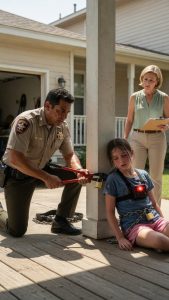
His eight-year-old daughter was chained to the porch pillar.
“Emma!”
The name tore out of him before he could think.
Emma Ramirez was slumped sideways against the wooden railing in a faded blue shirt and pink shorts, her face flushed a frightening red.
A heavy steel chain circled her small waist and ran to the front porch support, where a thick brass padlock held it tight.
The battery-powered heart monitor strapped under her shirt was chirping in panicked bursts.
Robert knew that sound.
He had heard it at hospital bedsides after long nights and bad calls.
He had heard it when doctors moved too quickly and nurses stopped smiling.
He had never heard it in front of his own door.
“Daddy’s here,” he shouted, already running. “Baby, I’m here.”
His duty belt hit the dry grass before he remembered dropping it.
The radio thudded beside the walkway.
The cuffs bounced once and settled near a sprinkler head.
His badge stayed clipped to his uniform shirt, but everything else that made him Sheriff Ramirez suddenly felt useless.
He was only a father crossing a lawn while his child fought for breath.
Emma’s eyes rolled toward him but did not focus.
Her lips parted.
No words came out.
Robert grabbed the chain with both hands and pulled.
The metal bit into his palms.
It did not give.
He looked at the lock.
It was not a toy chain.
It was not some backyard mistake.
It was heavy, polished, and deliberately fastened.
Someone had brought the right object for the wrong purpose.
Someone had stood close enough to wrap it around his child.
“Robert!”
The voice came from the hedge next door.
Mrs. Gable was standing there with one hand over her mouth and her phone clutched in the other.
She was a retired school secretary who watered her roses at the same time every evening and left banana bread on their porch after Emma’s last hospital stay.
Now she looked like she might collapse into the bushes.
“It was Diana!” she cried. “Diana Harrington did this!”
Robert turned his head just enough to hear her.
Diana Harrington.
The neighborhood HOA president.
The woman with the clipboard.
The woman who left warning notices under windshield wipers like she was serving warrants from a kingdom of lawn edging and mailbox colors.
For six months, Diana had been circling Robert’s house.
First it was a notice about his grass being half an inch too high after a double shift.
Then it was a complaint about his trash cans staying near the curb until morning because Emma had needed him inside at bedtime.
Then it was a warning about the little American flag Emma had taped beside the front window after her school Veterans Day assembly.
Diana had said it was not an approved exterior display.
Robert had peeled the notice off the door, looked at Emma watching him from the living room, and put the flag right back where she had taped it.
He had thought Diana was petty.
He had thought petty people stayed within petty limits.
That was his mistake.
He kicked open the side door of the garage and started tearing through shelves.
A socket set hit the concrete and burst open.
A plastic bin of screws spilled under the workbench.
A rake clanged against the wall.
His breath came in hard, ugly bursts as he searched for the red-handled bolt cutters he used after storms.
At 3:19 p.m., his hand closed around the grips.
He ran back.
Emma’s monitor shrieked again.
The street had begun to wake around them.
A neighbor across the road stood in his driveway with a garden hose still running over his shoes.
Another woman had opened her front door and frozen with one hand on the frame.
Mrs. Gable was crying quietly behind the hedge, still holding the phone like proof and prayer in the same hand.
No one moved toward Emma.
The world sometimes freezes around cruelty before it decides what kind of people live in it.
Robert dropped to his knees and set the bolt cutter blades around the brass shackle.
His hands were steady now.
That scared him a little.
He had learned that the most dangerous rage was not the kind that made a person shake.
It was the kind that made every motion clear.
Then he heard heels clicking on the driveway.
Slow.
Certain.
Unashamed.
Diana Harrington walked up beside his cruiser holding a clipboard against her cream blouse.
Her sunglasses were pushed into her hair.
Her mouth had a thin satisfied curve, like she had arrived to correct a landscaping violation.
“Sheriff Ramirez,” she said. “Before you damage community property, you need to understand why I had to secure the child.”
Robert looked at her.
Behind him, Emma made a small sound that was barely a breath.
“You chained my daughter,” he said.
Diana lifted her chin.
“She was outside unsupervised,” she replied. “She knocked over a potted plant near the common walkway and refused to identify the responsible adult. Under the community guidelines, that constitutes a safety issue.”
Robert stared at her clipboard.
There was a form clipped to the front.
The top line said INCIDENT LOG.
Diana tapped it with one manicured finger.
“I recorded the violation at 2:46 p.m. I logged the enforcement action with the board secretary at 2:58. There is a process, Sheriff. I followed it.”
A timestamp.
A document.
A child in medical distress.
Robert felt something inside him go cold.
Diana had not panicked.
She had not made a split-second mistake.
She had written it down.
“Move back,” he said.
“I will not,” Diana said. “You may intimidate people at work, but this is a private community.”
The bolt cutters were still in Robert’s hands.
For one ugly heartbeat, he saw them in a way he would later be ashamed to admit.
Not as a rescue tool.
Not as metal for metal.
As something heavy enough to make Diana Harrington understand what fear felt like.
He looked at Emma instead.
He forced his whole world down to the lock.
“Daddy,” Emma whispered.
It was the smallest sound he had ever heard.
“I’m here,” he said. “Look at me, baby.”
Diana stepped closer.
“If you break that lock, I will include destruction of HOA property in my report.”
The neighbor with the garden hose finally said, “Diana, stop.”
She did not even look at him.
“This is not your matter, Mr. Bell.”
Mrs. Gable came through the hedge gate then, shaky but moving.
“It became everybody’s matter when you chained a child to a porch.”
Diana’s face tightened.
“That child was not harmed until her father arrived and escalated the situation.”
Emma’s monitor screamed higher.
Robert squeezed the handles.
The brass lock cracked.
The sound was small, almost disappointing, for a thing that changed the whole shape of the afternoon.
The chain dropped hard against the porch boards.
Emma sagged forward.
Robert caught her against his chest and felt the terrible heat of her skin through her shirt.
Her hair stuck damp to her forehead.
Her heart beat too fast against him.
“EMS,” he said, reaching blindly for his radio on the grass. “I need EMS at my residence. Pediatric patient, heat exposure, cardiac monitor alarm. Send a second unit for unlawful restraint of a minor with a medical condition. Suspect still on scene.”
Diana laughed once.
It was short and brittle.
“You cannot arrest me for enforcing neighborhood rules.”
Robert did not answer.
He lowered Emma carefully onto the porch boards and kept one hand behind her neck.
Mrs. Gable knelt beside him and pushed her phone toward him.
“Robert,” she said. “I recorded it.”
For the first time, Diana’s expression shifted.
Not guilt.
Calculation.
Mrs. Gable tapped the screen with a trembling thumb.
The video was shaky, but it was clear enough.
It showed Diana standing on Robert’s porch at 2:51 p.m.
Emma was crying.
The chain was already around her waist.
Diana was bending over the padlock.
Emma’s voice came through the speaker, thin and scared.
“My chest hurts.”
Diana’s reply was crisp.
“Then maybe next time your father will teach you compliance.”
No one spoke.
The neighbor with the hose sat down hard on the curb.
Mrs. Gable made a sound like air leaving a punctured tire.
Robert looked at Diana.
Her clipboard was still in her hand, but it had lowered slightly.
The woman who had arrived armed with rules now looked like she was counting exits.
A small golf cart rolled up from the next street.
Carl Benson, the HOA board secretary, climbed out in a polo shirt and khaki shorts.
He was sweating before he reached the driveway.
“Diana,” he called. “What is going on? You said there was a teenager trespassing.”
Diana snapped, “Carl, go home.”
But Carl had already seen Emma on the porch.
He had already seen the chain.
He had already seen Robert’s uniform and the broken lock.
His face drained of color.
“Diana,” he whispered. “You told me she was fifteen.”
That sentence moved through the yard like a second alarm.
Robert turned slowly.
“What did you just say?”
Carl swallowed.
He looked at Diana.
Then at Emma.
Then at the phone in Mrs. Gable’s hand.
“She called me at 2:58,” he said. “She said an unsupervised teenage girl was vandalizing common property and refusing to leave. She asked me to enter the incident into the HOA file before she left the premises. She did not say it was Emma. She did not say anything about a medical device.”
Diana’s mouth tightened.
“Carl is confused.”
“No,” Carl said quietly. “I’m not.”
It was the first brave thing Robert had ever heard him say.
Sirens appeared in the distance before the vehicles turned the corner.
First EMS.
Then a patrol unit.
Then another.
Robert kept his hand on Emma’s shoulder and spoke to her in a low voice while the paramedics came up the walk.
“You’re okay. Stay with me. You’re okay.”
She was not okay yet.
He knew better than to lie too easily.
But children need a voice to hold on to when the world feels too hot and too bright.
So he kept talking.
The paramedic at the front porch checked Emma’s pulse and called out numbers to his partner.
Another fitted oxygen over Emma’s face.
A third asked Robert about her condition, her medications, and the monitor.
Robert answered like a sheriff giving a report because if he answered like a father, he was afraid he would break in half.
“Underlying cardiac condition,” he said. “Heat exposure. Restrained outdoors. Unknown duration, at least twenty-five minutes based on witness video.”
At least twenty-five minutes.
The words almost took his knees.
Diana stood near the driveway with Officer Jenkins beside her.
Jenkins had been one of Robert’s deputies before transferring to patrol.
He looked like he would rather be anywhere else on earth.
“Ma’am,” Jenkins said, “I need you to set the clipboard down.”
Diana stared at him.
“Excuse me?”
“Set it down.”
“This is my documentation.”
“It may be evidence. Set it down.”
There are moments when power changes hands without anyone raising their voice.
That was one of them.
Diana placed the clipboard on the hood of Robert’s cruiser.
Her hand shook just enough for him to see it.
Jenkins photographed the chain, the lock, the porch pillar, and the position of the broken shackle.
Mrs. Gable sent him the video.
Carl handed over his phone with the HOA call log and the incident entry showing 2:58 p.m.
The paramedics loaded Emma onto the stretcher.
That was when Robert finally stood.
Diana looked at him as though the badge had become a betrayal.
“You know this will look bad for you,” she said. “A sheriff using his position over a neighborhood dispute.”
Robert looked at his daughter being lifted into the ambulance.
He looked at the chain on his porch.
Then he looked back at Diana.
“This stopped being a neighborhood dispute when you put a lock on a child.”
Jenkins stepped forward.
“Diana Harrington, place your hands behind your back.”
Diana actually smiled.
It was not confidence anymore.
It was disbelief pretending to be confidence.
“You people are making a terrible mistake.”
“Hands behind your back,” Jenkins repeated.
Carl covered his mouth.
Mrs. Gable started crying again.
Diana’s smile disappeared as the cuffs clicked.
Robert did not watch the whole thing.
He climbed into the ambulance with Emma.
The ride to the hospital felt longer than any pursuit, any transport, any late-night call he had ever made.
Emma’s fingers found his sleeve.
He held them with both hands.
At the hospital intake desk, the nurse asked what happened.
Robert opened his mouth.
Nothing came out.
The paramedic answered for him.
“Eight-year-old female, heat exposure after unlawful restraint outdoors. Heart monitor alarm on arrival. Father is law enforcement. Suspect detained on scene.”
The nurse’s face changed at unlawful restraint.
She typed quickly.
Hospital intake form.
Incident report.
Witness video.
HOA incident log.
The afternoon became paperwork because paperwork was how the world admitted what it had seen.
Emma was treated for heat stress and monitored for cardiac complications.
By 6:40 p.m., her color had improved.
By 7:15, she asked for ice chips.
By 7:32, she asked whether the little flag was still in the window.
Robert put his forehead against her hand and almost lost himself right there.
“Yes,” he said. “It is still there.”
“Did I do something bad?” she asked.
The question cut deeper than the chain.
Robert lifted his head.
“No, baby. You knocked over a plant. That’s it. Adults are supposed to help children fix mistakes. They are not supposed to hurt them for making one.”
Emma thought about that.
“She said rules matter.”
“Rules do matter,” Robert said. “But rules are not chains.”
The county investigation moved quickly because the evidence was not subtle.
Mrs. Gable’s video showed Diana securing the padlock after Emma said her chest hurt.
Carl’s phone showed Diana had knowingly misrepresented Emma’s age and the situation to create an official HOA record.
The clipboard showed Diana had written down the time, location, alleged violation, and enforcement action in her own handwriting.
The chain had Diana’s fingerprints on the lock and links.
The patrol report cataloged everything.
The hospital record confirmed heat exposure and cardiac distress.
For once, the truth did not need a speech.
It had timestamps.
Two days later, the HOA held an emergency board meeting in the same community room where Diana used to lecture people about trash cans.
Robert did not attend in uniform.
He wore jeans, a plain gray T-shirt, and the tired face of a father who had not slept much.
Mrs. Gable sat beside him.
Carl sat across the room with his hands folded and his eyes down.
The board removed Diana from her position before the meeting had been open ten minutes.
No one clapped.
No one needed to.
There are some victories that do not feel like winning.
They feel like getting air back after someone has held your head underwater.
Diana’s attorney later tried to frame it as a misunderstanding, a regrettable overreach, a rule-enforcement situation that had become emotional because Robert was a sheriff and a father.
But the video did what video does.
It removed the soft places where lies like to hide.
When Emma’s little voice said, “My chest hurts,” in that courtroom, Diana looked down at the table.
When Diana’s own voice answered, “Then maybe next time your father will teach you compliance,” the room went still.
Robert sat behind the prosecutor and kept his hands clasped so tightly his knuckles turned pale.
He did not need revenge.
He needed the world to say out loud that what happened on his porch had been wrong.
And it did.
Diana pleaded guilty to charges connected to unlawful restraint and child endangerment.
The civil side followed later, quieter and slower, with documents, insurance letters, board minutes, and policy revisions that banned any HOA officer from direct enforcement involving a child.
Carl resigned from the board.
Mrs. Gable became the unofficial watch captain of the street, though she refused any title more formal than “nosy neighbor with standards.”
Emma came home with instructions, follow-up appointments, and a new fear of being alone on the porch.
That was the part no report captured well.
The way she stopped running outside when the ice cream truck passed.
The way she asked twice whether the front door was locked.
The way she watched strangers with clipboards like they carried weather she could not predict.
Robert changed his schedule for a while.
He traded shifts.
He ate dinner at the kitchen counter while Emma did homework within sight.
He installed another porch camera, then hated himself for needing it.
One evening, three weeks after the incident, Emma stood by the front window holding a new piece of tape.
The little American flag she had put up months before had faded at the corners from sun.
“Can I fix it?” she asked.
Robert looked at the window.
He remembered the first warning notice.
He remembered peeling it off the glass.
He remembered thinking Diana was only petty.
“You can fix it,” he said.
Emma smoothed the flag into place with careful fingers.
Then she looked toward the porch.
“Can we sit outside?”
Robert’s throat tightened.
“Yes,” he said. “We can.”
They sat together on the front steps as the evening cooled.
Mrs. Gable watered her roses next door.
A neighbor waved from the mailbox.
Somewhere down the street, a garage door rattled open and a dog barked once at nothing important.
Ordinary sounds returned slowly.
That was how healing came.
Not as one grand moment.
As a child choosing the porch again.
As a father learning to breathe in the place where he had almost lost her.
As a neighborhood finally understanding that silence can be a witness too.
Nineteen years as a sheriff had taught Robert Ramirez what panic sounded like.
But that summer taught him something else.
The badge could enforce the law.
The law could punish the crime.
But the thing that saved Emma first was not a badge, a form, or a rule.
It was a father refusing to let a chain decide what his child was worth.