The bill folder did not look heavy when the waiter set it down.
It was just black leather, polished at the corners, the kind of thing expensive restaurants use to make payment feel private and elegant.
But when my father pushed it toward me with two fingers, it felt like the whole table shifted with it.
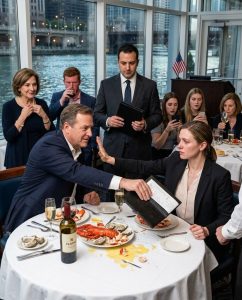
“You’re paying, right, Claire?”
Sixteen people turned their heads.
My mother did not blink.
My brother Ryan leaned back with a grin already forming, red in the face from wine and proud of himself for reasons I had not yet understood.
Aunt Carol looked down into her glass like she had discovered a very urgent study of melting ice.
My cousins lowered their phones.
Nobody looked confused.
That was the first real answer I got all night.
Bellmont House sat on the Chicago River behind a long wall of glass, with white tablecloths, gold pendant lights, polished wood floors, and servers who moved so quietly you almost forgot they were there.
The room smelled like lemon butter, garlic, expensive wine, and the faint cold dampness that clung to people’s coats when they came in from the river.
It was not the kind of restaurant my family chose by accident.
It was not the kind of place where sixteen people casually ordered lobster, oysters, steak, crab, champagne, imported caviar, and a bottle of Cabernet my father bragged about because it cost four hundred dollars.
It was the kind of place where someone planned the humiliation before the first glass was poured.
I had not seen my family in three years.
Not for Christmas.
Not for birthdays.
Not for weddings, cookouts, group texts, or the carefully worded voicemails my mother left when she wanted to sound wounded enough to make me call back.
Three years earlier, my grandmother Eleanor died and left me the two things she had always said were safe.
Her small lake cottage in Wisconsin.
And the modest investment account she had built over forty years as a teacher.
It was not a fortune.
It was not the kind of money that changes the world.
But it was enough to give me a place that was quiet, a little breathing room, and the knowledge that one person in my family had wanted me to have something no one else could take.
That was exactly why they tried to take it.
My father said Eleanor had been “confused near the end,” though he had never been the one sitting beside her in the clinic waiting room or picking up her prescriptions.
My mother said I should “share the blessing.”
Ryan said I must have manipulated Grandma because nobody would leave me more than him unless something was wrong.
Aunt Carol said I was tearing the family apart.
Then they came to my apartment with papers.
My father held the folder.
My mother held tissues.
Ryan held nothing, because he preferred to pace and point.
They told me it would be cleaner if I signed the cottage and account over to the family and let everyone decide together what was fair.
I asked if Grandma’s will counted as fair.
My father called me selfish.
My mother began crying harder.
Ryan shouted that I thought a corporate job downtown made me better than everyone else.
I said no.
That one word changed everything.
After that came the silence, and then the punishment inside the silence.
Invitations stopped.
Pictures were posted without me.
My mother left messages that began with “I don’t understand why you’re doing this to us” and ended with “your grandmother would be ashamed.”
My father did not call often, but when he did, his voice carried the same hard edge it had carried when I was twelve and had broken a plate by accident.
Ryan sent one text after another until I blocked him.
For three years, I built a life around absence.
I worked.
I paid bills.
I took care of the cottage.
I learned how peaceful a Sunday morning could be when no one was waiting to accuse me of ruining it.
Then, on a Tuesday night at 7:18 p.m., my mother texted.
Your father and I think it’s time to put the past behind us. Dinner? Just us. No pressure.
I stared at those words for a long time.
Just us.
That was the hook.
That was the little shining thing she knew I might reach for.
When I was eight, my mother used to braid my hair at the kitchen table before school.
She would tug gently through the tangles and say, “Family is forever, Claire.”
I believed her because children believe the person holding the hairbrush.
Part of me still wanted that sentence to have been true.
Another part of me knew family had been forever only while I was useful.
By Friday afternoon, I agreed to dinner.
By Saturday at 8:03 p.m., I was standing inside Bellmont House while the hostess looked down at her reservation book and said, “Your party is already seated.”
Party.
Not parents.
Not two people.
Party.
I looked past her shoulder and saw them.
My father rose first with his arms open, smiling as if a camera crew had just asked him to play a loving man.
“There she is!”
My mother turned with a brightness that was too quick to be real.
“Claire, sweetheart.”
Ryan lifted his glass.
“Look who finally decided to come back from exile.”
The table laughed softly.
It was not a warm laugh.
It was a group testing how much they were allowed to do in public.
I should have left.
I knew that the second my body went still.
But other diners were glancing over, the hostess was holding my coat, and my father had always known that I hated public scenes.
He had built whole punishments around that knowledge.
So I walked to the empty chair.
I sat down.
The waiter appeared with water and a menu I barely opened.
My father had already ordered appetizers “for the table.”
My mother put her hand on my wrist and told me tonight was about healing.
Ryan said, “You know, this is actually big of us.”
I looked at him.
He smiled like he had done me a favor by letting me sit down.
Course by course, the old pattern came back.
My father made decisions and waited for everyone to admire them.
My mother softened his cruelty by pretending it was concern.
Ryan poked at me until he found a bruise and then acted surprised that I felt it.
Aunt Carol contributed little side comments with a smile.
“You were always sensitive,” she said when I declined a second glass of wine.
“She was always stubborn,” my father said.
My mother squeezed my wrist.
“But we forgive you.”
That sentence sat between us longer than any plate.
They forgave me.
They had tried to pressure me into signing away my grandmother’s inheritance, punished me for saying no, smeared me for three years, and now they were offering forgiveness like I should be grateful.
I looked down at my napkin because I did not trust my face.
Not regret.
Not accountability.
Not even the thin decency of “we hurt you.”
Forgiveness.
People who never apologize love forgiveness because it lets them stay in charge of the story.
The food kept coming.
Lobster tails.
Oysters on ice.
Crab legs split open and glistening under butter.
Steaks ordered medium rare.
Desserts with flakes of gold leaf so delicate they looked like someone had shredded money over cream.
My father asked for another bottle of Cabernet without glancing at the list.
The waiter nodded and disappeared.
Ryan ordered cocktails with names that sounded like beach vacations.
My cousins filmed everything.
I noticed that no one asked what I wanted.
I noticed that every expensive thing was spoken into existence before I could object.
I noticed that my mother watched me every time a plate landed.
Some part of me understood before the bill arrived.
The body often knows when a trap has been set.
The mind just takes longer because it keeps hoping the people setting it are not really that cruel.
For one heartbeat, I imagined getting up and leaving without a word.
Then Aunt Carol leaned across the table and said, “It’s so nice you came, Claire. Your grandmother always worried you’d end up alone.”
My hand tightened around my water glass.
The condensation made my palm slippery.
I did not answer.
That was not weakness.
It was strategy, though I did not have the word for it yet.
When the waiter finally came with the bill folder, my father’s expression sharpened.
He watched it land.
He watched my eyes move to it.
Then he pushed it across the table.
“You’re paying, right, Claire?”
Everything froze.
Forks held still above plates.
A champagne glass stopped halfway to Ryan’s mouth.
One cousin’s phone remained pointed at the table, but her thumb hovered over the screen as if she had forgotten what she meant to record.
Butter slid down a silver sauce cup and pooled on the white linen.
My mother’s smile did not change, and that was what made it ugly.
The table had been waiting for this.
I opened the folder.
The receipt was itemized.
Sixteen guests.
Premium seafood service.
Wine.
Dessert.
Bellmont House.
Saturday, 10:17 p.m.
Total due: $4,386.72.
For a second, the number blurred.
Then everything inside me went quiet.
My father chuckled.
“After all, you’re the executive now. Biggest salary at the table.”
Ryan grinned.
“Consider it three years of family dues.”
My mother tilted her head in that delicate way she used when she wanted a demand to sound like love.
“It would mean so much to us, Claire. A gesture.”
I thought of my grandmother’s cottage.
I thought of my father standing in my apartment with papers under his arm.
I thought of my mother’s tears, brought out right on cue.
I thought of Ryan calling me selfish because I would not surrender something that had been given to me.
Then I smiled.
My father’s grin thinned.
“What’s funny?”
I closed the bill folder and raised my hand for the waiter.
When he came over, I leaned slightly toward him and kept my voice low.
“Please bring your manager.”
His professional smile held.
I continued.
“And please ask for the reservation notes, the itemized order log, and whoever approved the billing request.”
The waiter’s eyes flicked, just once, toward my father.
That tiny movement told me more than any speech could have.
He nodded.
“Yes, ma’am.”
Ryan stopped smiling.
My father sat back.
My mother whispered, “Claire, don’t make this unpleasant.”
I turned to her.
“It already is.”
That was the first sentence I had said all night that was not designed to keep peace.
Aunt Carol made a small sound.
My father leaned forward.
“You’re embarrassing yourself.”
“No,” I said. “I’m asking a question.”
He laughed, but it came out wrong.
For fifteen minutes, the table sat in a silence that was not really silence.
It was breathing.
Shifting.
Ice cracking.
Silverware touching china.
My mother’s fingers tapping once against her glass and then stopping.
Ryan kept checking the path to the host stand.
My father kept staring at me as if he could still make me small by looking hard enough.
I stared back.
I was not loud.
I was not shaking.
That seemed to worry him more.
The manager arrived with the waiter behind him.
He carried a second black folder.
My mother’s eyes went to it immediately.
My father’s hand moved toward the original bill, but the manager placed his own hand gently over the folder first.
“Sir,” the manager said, “before I take any payment, I need to clarify who arranged this dinner.”
My father gave him the smile he used on parking attendants, bank tellers, and anyone he thought should be grateful for his tone.
“This is a family matter.”
The manager did not move.
“It became a restaurant matter when a guest was asked to pay charges she did not authorize.”
My mother’s lips parted.
Ryan looked at my father.
That was new.
He did not look at me first.
He looked at Dad.
The manager opened the second folder.
Inside was a printed reservation intake page.
There was the date.
There was the time.
There was the guest count.
There was the premium seafood and wine service confirmed before I ever arrived.
There was my father’s phone number.
And there was a special request field.
The manager did not read it right away.
He gave my father one chance to stop pretending.
My father’s face hardened.
“Careful,” he said.
The manager’s expression cooled.
“I am being careful.”
Then he read the line.
Please present final check to daughter Claire. Family reconciliation dinner. She owes us.
A sound moved through the table.
Not a gasp exactly.
More like sixteen people realizing at different speeds that the private cruelty had just become public.
My mother’s hand flew to her necklace.
Ryan pushed back from the table.
Aunt Carol whispered, “Oh my God.”
My father said, “That is not what it sounds like.”
I almost laughed.
It sounded exactly like what it was.
The manager looked at me.
“Ms. Claire, did you make this reservation?”
“No.”
“Did you authorize the premium menu or wine service?”
“No.”
“Did you agree to cover this table?”
“No.”
Each answer landed cleanly.
My father tried to interrupt.
“She is my daughter.”
The manager turned back to him.
“That does not make her your payment method.”
For the first time all night, my mother looked genuinely frightened.
Not for me.
For the collapse of the performance.
Because there are families that care more about being exposed than about being cruel.
My father lowered his voice.
“We are not doing this here.”
I looked at him.
“You already did.”
The manager closed the folder halfway.
“The charges remain with the reservation holder and the guests who placed the orders. We cannot transfer responsibility to a person who neither arranged nor authorized the service.”
Ryan stared at the check.
“You said she agreed,” he said.
My father shot him a look.
Ryan’s mouth opened, then closed.
That was the moment I understood Ryan had known there would be pressure, but maybe not that it had been written down.
It did not make him innocent.
It only made him less prepared.
My mother turned to me.
“Claire, please. This has gone far enough.”
I thought about all the times she had used that voice to end the part where I got to speak.
When I was thirteen and Ryan broke my camera, she said it had gone far enough.
When I was nineteen and Dad used my graduation dinner to joke that I was “expensive to educate,” she said it had gone far enough.
When they came for Grandma’s cottage, she said I was making everything uglier than it needed to be.
Far enough always meant the same thing.
Stop before the truth reaches the person who deserves it.
I reached into my purse and took out my card.
My mother’s shoulders lowered in relief.
My father’s smile began to come back.
Then I handed the card to the waiter.
“For my sparkling water and whatever portion of the entrée I actually ordered,” I said. “Nothing else.”
The waiter nodded immediately.
“Yes, ma’am.”
My father’s face changed.
“You ungrateful little—”
“Sir,” the manager said.
It was not loud.
It did not need to be.
My father stopped.
That small interruption, from a stranger in a suit at a restaurant, did what years of my pleading had never done.
It made him contain himself.
My card came back a few minutes later with a small receipt.
I signed it.
The total was almost funny compared to what they had tried to put on me.
I folded my copy and placed it in my purse.
Nobody spoke while I stood.
My mother reached for my wrist.
I moved before she touched me.
“Claire,” she whispered.
I looked at her hand in the air between us.
Then I looked at her face.
“You told me just us.”
Her eyes filled instantly.
There they were again.
The tears.
The ones that arrived when language failed her.
“It was supposed to help,” she said.
“No,” I said. “It was supposed to make me pay.”
Ryan muttered, “You could have just said no.”
I looked at him.
“I did. Three years ago. That’s why we’re here.”
That shut him up.
The manager stepped slightly aside so I could leave.
The waiter brought my coat.
I put it on slowly, not because I wanted drama, but because my hands were finally beginning to tremble and I refused to let them see me rush.
Behind me, my father started arguing with the manager in the controlled, furious voice he used when he wanted witnesses to think he was reasonable.
My mother cried softly.
Aunt Carol said my name once, but I did not turn.
Outside, the air off the river hit my face so cold it felt clean.
I walked half a block before I stopped.
My body did not know what to do with safety.
It kept waiting for footsteps.
For my father’s voice.
For my mother’s hand on my arm.
For Ryan to turn the whole thing into a joke sharp enough to cut.
Nothing came.
Only traffic, wind, and the low rush of water beyond the railing.
My phone buzzed before I reached the corner.
Mother.
You humiliated your father.
I looked at the message until the screen dimmed.
Then I blocked her.
Not because it stopped hurting.
Because hurt is not proof that you made the wrong choice.
Sometimes hurt is only proof that the chain was attached for a long time.
The next morning, Ryan texted from a new number.
Dad had to put the whole thing on his card. Are you happy?
I did not answer.
Then Aunt Carol messaged.
Your grandmother would be heartbroken.
That one almost got me.
I sat at the small kitchen table in the lake cottage Eleanor had left me, the same table she used to cover with coupons and lesson plans, and I read that sentence twice.
Then I looked out at the pale Wisconsin morning and imagined my grandmother sitting across from me in her old cardigan, tapping a pencil against a crossword puzzle.
Eleanor would not have been heartbroken that I refused to be used.
She would have been heartbroken that I ever wondered whether I had to buy love by the plate.
So I blocked Aunt Carol too.
Over the next week, the story changed in the family, because stories always change when people cannot survive the plain version.
I became dramatic.
Then cruel.
Then greedy.
Then “brainwashed by money.”
Nobody mentioned the reservation note.
Nobody mentioned the $4,386.72.
Nobody mentioned the line that said she owes us.
That was fine.
I kept my copy of the receipt.
I kept the screenshot of my mother’s “just us” text.
I kept the manager’s business card, which he had quietly given me on my way out in case anyone tried to dispute what happened.
I did not need to use any of it.
I just needed to know I had it.
That is what three years away had taught me.
Peace is not always soft.
Sometimes peace is a folder full of proof, a locked door, a blocked number, and a dinner bill you refused to make your punishment.
Months later, I went back to the cottage alone.
I opened the windows.
I swept the porch.
I made coffee in my grandmother’s chipped blue mug and sat where the lake caught the morning light.
For the first time in a long time, my phone stayed quiet.
No guilt.
No emergency.
No family crisis with my name written across the bottom like a payment line.
Just quiet.
I thought again about Bellmont House, the lobster shells, the frozen faces, the manager’s voice cutting through my father’s performance.
This was not dinner. It was collection.
But I had finally stopped being collectible.
And that, more than any inheritance, was what my grandmother had left me.