Every morning started before the coffee finished brewing.
Not with an alarm.
Not with my daughters asking for cereal.
Not with birds on the fence or the school bus rumbling somewhere beyond our block.
It started with my husband’s boots on the back steps.
The old wooden boards behind the kitchen would groan under his weight, and the screen door would slap shut in that sharp, ugly way that made my stomach tighten before he ever said my name.
I used to think fear came all at once.
It doesn’t.
It learns the layout of your house.
It learns the sound of a drawer opening, the silence before a question, the exact weight of a man’s walk when he has already decided he wants someone to blame.
My name is Sarah, and for seven years, I lived inside that kind of fear.
My husband, Michael, did not begin our marriage with his fists.
He began with opinions.
Small corrections.
A joke about how I folded towels.
A complaint about dinner being too plain.
A warning that I embarrassed him when I spoke too much around his friends.
By the time our first daughter, Emily, was born, he had turned disappointment into a language.
By the time our second daughter, Olivia, arrived, he had turned that language into punishment.
He wanted a son.
He said it like a right.
He said it like I had stolen something from him.
Emily had my eyes and Michael’s serious little frown.
Olivia had soft brown curls and a laugh that filled the kitchen even on mornings when the walls felt too close.
They were not disappointments.
They were my whole world.
But in that house, Michael talked about them like proof that I had failed him.
His mother lived with us, too.
She had come after Michael’s father died, bringing three suitcases, a box of framed religious pictures, and a quiet habit of watching everything without ever stepping in.
In the front room, above the small table where she kept candles and prayer cards, hung a framed picture of the Statue of Liberty that had belonged to the previous owners.
She never took it down.
Sometimes, while Michael dragged me toward the backyard, I could see it through the hallway.
Freedom, hanging crooked on the wall.
That morning was Tuesday.
I remember because Emily had spelling practice, and Olivia had show-and-tell.
I had packed one lunchbox already.
The other sat open on the counter, waiting for apple slices I never got to cut.
The kitchen smelled like burnt toast and cheap coffee.
Outside, the grass was wet from the sprinklers, and the air had that cool morning bite that disappears by noon.
Michael came in wearing his work boots and dark jacket.
He did not say good morning.
He looked at the girls’ cereal bowls, then at me.
“You know what people say at work?” he asked.
I kept my eyes on the lunchbox.
I had learned that looking directly at him could be called disrespect, and looking away could be called attitude.
With Michael, every answer had already been marked wrong.
“They ask when I’m finally going to have a boy,” he said.
Emily’s spoon stopped halfway to her mouth.
Olivia slid lower in her chair.
“Michael,” I whispered, “not in front of them.”
That was all it took.
His face changed.
Not a lot.
Just enough.
A tightening around the mouth.
A flatness in the eyes.
Then his hand closed around my upper arm.
The girls knew not to scream.
That is a terrible thing for children to know.
He pulled me through the kitchen, past his mother in the hallway, past the crooked Statue of Liberty picture, out through the screen door and into the backyard.
His mother held a prayer card between both hands.
She did not look up.
The first slap made my ear ring.
The second knocked me sideways against the chain-link fence.
A dog barked two houses down.
Somewhere across the yard, a window slid shut.
That sound hurt more than I can explain.
The fence rattled behind me, and Michael stood over me, breathing hard.
“I married you,” he said, “and you aren’t even good enough to give me a son.”
He had said that sentence before.
Many times.
In the kitchen.
In the bedroom.
Once in the garage while I was holding Olivia on my hip.
But outside, with the morning light on us and the neighbors pretending the world was ordinary, it sounded less like an insult and more like a verdict.
Then came the kick.
I curled around myself because my body knew what to protect even when my mind floated away from the moment.
Ribs.
Face.
Stomach.
I heard Emily crying behind the laundry room window.
I saw her little hands pressed flat to the glass.
Olivia was beside her, frozen with her mouth open.
For one second, something hot and wild moved through me.
I saw the cracked flowerpot by my knee.
I pictured my hand closing around it.
I pictured Michael staggering back for once.
I pictured every window on the block opening because I had finally made a sound big enough to shame them.
Then I saw my daughters watching.
I let the thought go.
I could not teach them that rage was the only way to survive rage.
So I swallowed it.
That was the last thing I remember clearly before the pain changed.
It stopped being sharp in one place and became heat everywhere.
Pressure.
A tearing ache low inside me.
My ears rang until the yard blurred white around the edges.
The mailbox at the end of the driveway seemed to tilt.
Michael’s mouth kept moving, but the words sounded like they were underwater.
Then his boot came forward again.
I folded.
The ground rose up.
Olivia screamed.
Then there was nothing.
When I opened my eyes, I thought I was still outside because the light was so bright.
But the smell was different.
Disinfectant.
Plastic.
The cold metallic smell of hospital air.
A bed rail pressed against my arm.
There was a pulse monitor clipped to my finger and a plastic wristband around my wrist.
My throat felt raw.
My ribs burned when I tried to breathe.
Michael stood beside the gurney.
His hands were in his pockets.
He wore the face he saved for strangers.
Concerned.
Tired.
Almost gentle.
The kind of face that made people ask him if he was holding up okay.
A nurse checked the monitor.
A doctor in blue scrubs came in holding a clipboard.
“Mrs. Harris?” he said.
I blinked at him.
“Can you tell me what happened?”
My mouth opened.
Nothing came out.
Before I could try again, Michael stepped forward.
“She fell down the stairs,” he said.
He said it quickly.
Too quickly.
The doctor looked at him.
Then he looked at me.
Then he looked at the bruises on my cheek, my neck, my arms, and the place where my gown had shifted enough to show marks along my ribs.
The room went quiet in a way I recognized.
But this silence was different from the neighbors’ silence.
This one was paying attention.
“What stairs?” the doctor asked.
Michael blinked.
“At home,” he said.
“How many?”
“I don’t know. Five or six. She tripped.”
The doctor wrote something down.
That pen moved across the paper, and for the first time in years, Michael looked afraid of a sound.
A nurse at the hospital intake desk had recorded our arrival at 8:03 a.m.
Another nurse took my blood pressure twice.
The doctor ordered a full trauma workup.
Hospital intake form.
Injury chart.
Radiology order.
Internal scan.
Photos of visible bruising.
Every ordinary piece of paperwork felt like a small door opening in a house where every door had been locked from the outside.
The nurse asked Michael to wait in the hall while she adjusted my gown.
He did not like that.
I saw it in the way his jaw tightened.
Men like Michael do not fear consequences first.
They fear losing control of the room.
“I’m her husband,” he said.
“And right now,” the nurse replied, “I need to examine my patient.”
My patient.
Two words.
I almost cried from them.
Not because they were kind.
Because they were clear.
For once, I belonged to myself before I belonged to him.
At 8:41 a.m., they wheeled me into radiology.
The hallway lights passed above me one by one.
The wheels under the bed squeaked at uneven intervals.
Somewhere nearby, a phone rang at a nurses’ station.
A man coughed behind a curtain.
Life kept going in all its ordinary noises while my body lay there carrying evidence.
The radiology room was cold.
The table felt narrow and hard beneath my back.
The technician had kind eyes and a calm voice.
“Try not to move,” she said.
I wanted to laugh.
I had spent years trying not to move.
Trying not to flinch.
Trying not to make him angrier.
Trying not to let my daughters see blood on the sleeve of my robe.
The machine hummed above me.
I stared at the ceiling tile and counted the little black dots until the numbers stopped making sense.
After the X-rays, they took more images.
Then blood.
Then notes.
A nurse cleaned a scrape near my temple and asked, quietly, whether I felt safe at home.
Michael stood outside the curtain.
I could see his shoes.
Dark work boots.
Mud still caught along the edges from the backyard.
I looked at those boots and thought of Emily’s lunchbox.
I thought of Olivia’s show-and-tell.
I thought of my daughters at the laundry room window, learning that mothers could disappear in front of them while everyone called it marriage.
My lips moved.
I do not know if sound came out.
The nurse touched my hand once.
Not dramatically.
Not like a movie.
Just two fingers against my wrist, steady and human.
“You don’t have to answer with him here,” she said.
Those words stayed with me.
Nearly an hour later, the doctor came back.
His face had changed.
Doctors are trained to carry bad news carefully, but careful does not mean blank.
His eyes moved from me to Michael, then back again.
“Mr. Harris,” he said, “I need to speak with you in the hallway.”
Michael straightened.
“About what?”
“The films.”
Michael followed him out.
The door did not close all the way.
A strip of hallway remained visible.
I could see the edge of Michael’s dark sleeve and the doctor’s shoulder.
My body hurt too much to sit up, but every part of me strained toward their voices.
“Sir,” the doctor said, “I need you to look at these films.”
There was silence.
Paper shifted.
Something clicked onto a light board.
Michael said nothing.
That was when I knew something was wrong in a way even he could not explain away.
Michael always had words.
He had words for bruises.
Words for neighbors.
Words for his mother.
Words for the girls when they asked why Mommy was sleeping with the bedroom door locked.
But in that hallway, he had nothing.
The doctor spoke again, lower this time.
I caught only pieces.
“Pattern…”
“Not consistent…”
“Internal trauma…”
Then one phrase landed clearly.
“This did not happen from a fall down five or six stairs.”
Michael’s breath changed.
I had heard that sound before, too.
It was the sound he made when rage had nowhere safe to go.
But this time, he was not in our backyard.
He was in a hospital hallway with cameras, nurses, forms, time stamps, and a doctor looking directly at him.
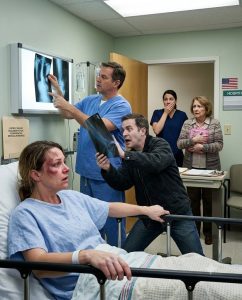
At 9:37 a.m., the door swung open.
Michael walked in first.
He was pale.
Not angry pale.
Afraid pale.
His fingers clutched the lower corner of an X-ray film so tightly it bent slightly under his grip.
He looked at me as if I had done something to him.
As if my body had betrayed him by keeping a record.
His lips moved.
No sound came out.
The doctor stepped in behind him and took the film gently but firmly from his hand.
He clipped it against the light board inside the room.
The white glow filled the wall.
I could see shapes I did not understand.
Darkness.
Bone.
Shadow.
The doctor pointed once, then looked at me.
“Mrs. Harris,” he said, “I am going to explain this clearly.”
Michael swallowed.
His mother appeared in the doorway before the doctor could continue.
She wore her church sweater and held Emily’s pink lunchbox against her chest.
I later learned a neighbor had called her after the ambulance left.
Not the police.
Not the hospital.
Her.
Even then, the neighborhood still wanted the family to handle it quietly.
She looked smaller than she had that morning.
Her prayer card was gone.
Her hands shook around the lunchbox.
Behind her, a nurse stood with a folder.
On the front were printed words I could read from the bed.
SUSPECTED ASSAULT PROTOCOL.
The folder made Michael flinch.
Not my bruises.
Not my pain.
The folder.
The doctor said, “The injuries we are seeing are severe, and they are not consistent with the explanation your husband gave.”
Michael shook his head.
“She fell.”
His voice was thin now.
Almost childish.
“No,” the doctor said.
One word.
Steady.
Clean.
The room held still around it.
The nurse stepped closer to my bed.
My mother-in-law looked from the X-ray to Michael.
For years, she had hidden behind prayers, behind age, behind the excuse that marriage was private and men had tempers and women endured.
But the film on that light board did not care about her excuses.
Paperwork does not look away.
X-rays do not close the window.
The doctor pointed to the image again and explained what they had found.
He did not use dramatic words.
He did not need to.
Internal injury.
Older healed fractures.
Fresh trauma.
Patterns that showed repeated impact over time.
My body had become a record of every morning I had tried to make breakfast afterward.
Michael backed toward the wall.
“No,” he whispered again.
The nurse opened the folder.
“We also documented visible bruising,” she said. “Face, arms, ribs, abdomen, back. Photographs were taken at 8:26 a.m. and 8:31 a.m.”
Times.
Specific times.
I held onto them like handles.
For so long, everything in that house had been fog.
He said I was dramatic.
He said I remembered wrong.
He said I bruised easily.
He said the girls misunderstood.
But now there were times.
Forms.
Images.
A wristband with my name on it.
A doctor who would not let him speak over me.
My mother-in-law made a sound that was almost a sob.
“Michael,” she whispered, “what did you do?”
He turned on her so fast the nurse moved between them.
“Don’t,” he snapped.
That one word told the room more than he meant it to.
The doctor reached for the phone mounted beside the cabinet.
“Before anyone leaves this room,” he said, “I need everyone to understand what happens next.”
Michael’s eyes widened.
He understood then that the hospital was not our kitchen.
He could not shut this door.
He could not send the girls to their room.
He could not tell the neighbors it was none of their business.
He could not make an X-ray apologize for embarrassing him.
A hospital social worker arrived first.
Then security.
Then two officers who spoke quietly with the doctor in the hall before coming inside.
No one tackled Michael.
No one shouted.
That almost made it more frightening for him.
The consequence came calmly.
It came with clipboards and badges and questions asked in the correct order.
One officer asked if I was willing to make a statement.
I looked at Michael.
His face had gone hard again, but fear was still behind it.
For years, I had thought courage would feel like fire.
It didn’t.
It felt like exhaustion finally telling the truth.
“Yes,” I said.
My voice cracked.
But it was mine.
The social worker asked about my daughters.
That was when I started crying.
Not from pain.
Not from relief.
From the thought of Emily and Olivia standing behind that laundry room window, believing the world would always work that way.
My mother-in-law sat down in the hallway chair as if her legs had given out.
Emily’s lunchbox stayed in her lap.
The apple slices inside were still missing.
It is strange what breaks you.
Not always the worst thing.
Sometimes the small unfinished thing.
A lunchbox.
A spelling test.
A child who went to school with cereal still on her shirt because an ambulance came before anyone found her jacket.
The officers took Michael out of the room.
He looked back once.
I had expected rage.
Instead, I saw confusion.
He truly did not understand how a morning that began like every other morning had ended with strangers believing me.
That was the part that stayed with me.
He had not thought he was doing something new.
He had only thought he was doing it somewhere no one would write it down.
Later, the hospital helped me call a victim advocate.
They helped me arrange a safe place for the girls and me to stay.
They helped me understand that the injury documentation packet could be used in court, along with the medical imaging and the statement from the doctor.
I signed forms with a hand that shook so badly the pen scratched across the paper.
At 2:14 p.m., Emily and Olivia were brought to me.
Emily came in first.
She tried to be brave because oldest daughters often become brave before anyone asks whether they should have to.
Olivia climbed onto the edge of the bed carefully, afraid to hurt me.
“Mommy,” she whispered, “are you coming home?”
I looked at her face.
Then at Emily’s.
Then at the hospital wristband around my wrist.
“No,” I said softly. “Not to that house.”
Emily’s chin trembled.
“Is Dad mad?”
I touched her hair.
“Your dad is not in charge of us anymore.”
It was the first promise I had made in years that did not feel like a lie.
The road after that was not simple.
People like neat endings because they make pain easier to share.
Real endings come with paperwork.
Court dates.
Temporary orders.
School pickup changes.
Phone calls from relatives who think peace means the loudest person gets forgiven first.
There were nights I woke up certain I had heard his boots on the back steps.
There were mornings I burned toast and cried because the smell pulled me straight back into that kitchen.
There were days Emily got quiet whenever a man raised his voice in a grocery store.
There were days Olivia asked if girls were really enough.
Every time she asked, I answered the same way.
“You are more than enough.”
I said it until I believed it for myself, too.
The medical records mattered.
The photographs mattered.
The X-ray mattered.
But so did the moment the nurse called me her patient.
So did the moment the doctor said no.
So did the moment my daughters saw me leave that house and not return.
Months later, when the case moved through court, Michael’s attorney tried to make the morning sound confused.
A fall.
A misunderstanding.
A troubled marriage.
Then the hospital records were entered.
Arrival time: 8:03 a.m.
Photographs: 8:26 and 8:31 a.m.
Radiology completed: 8:41 a.m.
Doctor’s assessment.
Injury pattern.
Suspected assault documentation.
The truth did not need to shout.
It had dates.
It had signatures.
It had my name spelled correctly on every page.
My mother-in-law testified, too.
She cried on the stand.
She admitted she had heard things.
She admitted she had prayed instead of helping.
I thought I would hate her forever for that.
Maybe part of me still does.
But when she looked at Emily and Olivia outside the courtroom and said, “I should have opened the door,” I saw my daughters hear an adult admit the truth.
That mattered more than my anger that day.
Michael did not freeze forever.
Men like him recover their voices when they think the room might still be theirs.
But he never again sounded the way he had in our backyard.
Not in front of the judge.
Not in front of the doctor.
Not in front of the paperwork.
And not in front of me.
The house was sold later.
I did not go back for much.
Clothes.
Birth certificates.
The girls’ school papers.
A chipped mug Olivia had painted with fingerprints.
The framed Statue of Liberty picture was still hanging crooked in the front room when I walked through for the last time.
I stood under it for a moment with a cardboard box in my arms.
For years, I had passed that picture while being dragged toward the backyard.
Freedom had been there the whole time, hanging on someone else’s wall like decoration.
That day, I left with my daughters and understood something simple.
Freedom is not a picture.
It is a door you do not have to beg anyone to open.
Every morning started with the same sound once.
His boots on the back steps.
Now our mornings start differently.
Emily argues about socks.
Olivia pours too much cereal.
The coffee still burns sometimes because I forget it when the girls are laughing.
Our apartment is smaller than the old house.
The mailbox sticks when it rains.
The upstairs neighbor walks like he is moving furniture at midnight.
But no one closes the windows on us anymore.
No one calls my daughters a curse.
No one drags me into a backyard before breakfast.
And sometimes, when the morning light comes through the kitchen blinds and lands warm across the floor, I think about that X-ray on the hospital light board.
I think about Michael’s face going pale.
I think about how the man who had filled our backyard with insults every morning could not find one word.
What he saw on that X-ray was not what he had come to hide.
It was what he never knew he had destroyed.
But it was also what finally proved I had survived.