I was sanding the edge of a walnut crib rail when my phone buzzed across the workbench and rattled into a tin of brass screws.
The sound was small, almost ordinary, but it split the afternoon in half.
I had sawdust in my eyebrows, country radio muttering from a shelf above the vise, and the kind of steady focus that comes when your hands know exactly what they’re doing.
The rail was warm under my palm from friction.
I was thinking that if I rounded the corner just a little more, no baby would ever catch a cheek on it.
Then I saw the name on the screen.
Jessica.
My daughter was not careless with me.
She knew I worried.
If she was driving, she usually called when she stopped.
If she texted, it was something normal and full of life.
A photo of a dog she’d seen in a truck bed.
A complaint about grocery prices.
A reminder that I still owed her banana bread from Sunday.
The message on my screen was none of those things.
Dad, help.
Grand View Trail.
Can’t walk.
That was it.
No second text.
No explanation.
No typo fix.
No “please.”
I called immediately.
Voicemail.
I called again.
Same thing.
By the third call, the workshop felt wrong.
The neat rows of clamps, the stacked cedar boards, the smell of walnut and varnish that usually settled me—all of it seemed to drift away, as if I were standing outside my own life looking in through thick glass.
I grabbed my keys so fast I knocked the crib rail to the floor.
It struck concrete and split at the corner.
Any other day, I would have cursed, checked the damage, and maybe stared at it longer than necessary.
That day, I didn’t even turn around.
The drive from my place outside Kelowna to the Grand View access road usually took thirty-five minutes.
I made it in twenty-eight.
The October sky was the color of iron.
Wind shoved my truck whenever the road opened along the ridge.
Pines blurred past in dark green streaks.
I called Jessica every few minutes until I could no longer bear hearing her bright voicemail greeting tell me to leave a message.
Fear is cruel that way.
It keeps trying to soften the truth before it lands.
Maybe she’d twisted an ankle.
Maybe her battery was dying.
Maybe she’d slipped near the overlook and just needed help getting back to the car.
Maybe maybe maybe.
At a stop sign before the turnoff, my mind betrayed me with a memory.
Sunday dinner.
Jessica at my kitchen table, both hands around a mug of peppermint tea.
She’d been smiling at something private, almost shy.
She looked tired, but not sick-tired.
Careful-tired.
Tender with herself.
I asked if work was wearing her down, and she said, “I’ve just got a lot on my mind.”
Then she looked at me longer than usual and asked, “Dad, did Mom ever tell you when she first knew someone was wrong for her?”
That surprised me enough that I set down my fork.
“Before me, you mean?”
She smiled without showing her teeth.
“Yeah.”
I told her what her mother had once said after a bad date in college: good people make you feel more like yourself,
not less.
Jessica stared into her tea after that.
“What if it changes slowly?” she asked.
I had not understood the weight of that question.
When I reached the trailhead, her Subaru was parked crooked with one rear tire half off the gravel.
No one else was there.
The woods were too quiet.
I left my truck running and started shouting her name before I had fully closed the door.
The air smelled of wet pine and cold dirt.
My boots slid on the damp trail as I moved too fast, calling, listening, calling again.
About fifty yards in, I found one of her earrings lying near the edge of the path.
A few yards farther, there was a muddy smear on a cedar trunk at shoulder height, as if someone had struck it hard trying to catch themselves.
Then I saw a strip of blue fabric caught on a low branch.
Jessica had worn a blue sweater on Sunday.
I went off the trail.
I shoved through saplings and deadfall, branches whipping my face, wet earth giving under my boots.
My heart was pounding so hard it blurred the edges of my vision.
Then I heard something thin and broken below me.
Not a scream.
A breath trying not to become one.
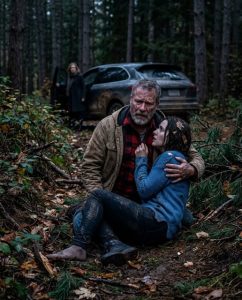
She was wedged against a fallen log in a shallow gully, half-covered in leaves.
Her face was gray under the dirt.
One cheek was swelling.
There was blood dried into her hairline, and one of her shoes was gone.
For one terrible second, my body forgot how to move.
Then I was on my knees beside her, lifting her shoulders carefully, saying her name over and over until her eyelids fluttered.
“Dad,” she whispered.
“I’ve got you, baby.
I’ve got you.”
Her fingers clutched weakly at my jacket.
Her lips trembled.
She forced the words out in pieces.
“It was Carolyn…
she said my blood was mixed and dirty.”
I felt something violent rise in me, but before it could take shape Jessica swallowed hard and whispered one more sentence.
“She knew…
about the baby.”
Carolyn.
Luke’s mother.
Perfect hair, polished smile, expensive boots she probably never dirtied herself.
The kind of woman who spoke sweetly in public and cut with precision in private.
I had never liked her, but I had not known the depth of what my daughter was carrying.
I slid one arm under Jessica’s knees and another behind her back.
She cried out when I lifted her, and I nearly lost my mind right there on that hillside.
But my father taught my brother Thomas and me something years ago: fury first, and you miss the truth.
When someone hurts family, you preserve the ground before you trample it.
So I forced my hands steady.
I carried Jessica up to the trail.
I took photos of the slope, the torn branch, the earring, the fresh tire tracks near the pullout.
I wrapped my coat around her in the truck and texted Thomas.
It’s our turn.
Time for what Dad taught us.
He replied almost instantly.
On my way.
Save everything.
Don’t call Carolyn.
Don’t call Luke.
At the hospital, they took Jessica straight through double doors while I stood there with mud on my jeans and her blood drying on my cuff.
Thomas
arrived fifteen minutes later still wearing his forestry jacket, face hard and pale.
People who didn’t know us thought Thomas was calmer than me.
That was never true.
He just hid it better.
“What did she say?” he asked.
“Carolyn did it,” I said.
“And Jessica’s pregnant.”
Thomas looked like someone had slammed a fist through his chest.
He closed his eyes once, then opened them sharp again.
“All right,” he said.
“Then we do it properly.”
That was what our father had taught us.
Not vengeance.
Exposure.
If a liar thought emotion would protect them, you brought facts.
If they hid in the dark, you switched on every light.
A doctor came out an hour later.
Jessica had a concussion, severe bruising, and enough blood loss to frighten him.
Then he lowered his voice.
“There is still a fetal heartbeat,” he said.
“Faint, but present.
We’re monitoring closely.”
I sat down because my knees would not hold me.
When Jessica finally woke enough to speak clearly, she looked from me to Thomas and started crying before she even formed words.
Between shivers and pauses, she told us what had happened.
Luke had known about the pregnancy for three days.
Jessica had told him first because she was frightened and hopeful in equal measure.
He had held her face in both hands and said they would figure it out together.
Then, without asking her, he told Carolyn.
Carolyn texted Jessica that morning and asked to meet at Grand View Trail to “talk woman to woman.” Jessica thought maybe Carolyn was trying to make peace.
Carolyn had always been cool toward her, always measuring, always faintly disapproving in ways Luke tried to explain away as stress, tradition, or old-fashioned manners.
Jessica went because she loved Luke, and because love makes decent people hope too long.
They stood near the overlook.
Carolyn did not waste time pretending kindness.
First she offered money.
A lot of it.
Enough to move away, enough to “start over,” enough to disappear quietly.
When Jessica refused, Carolyn’s voice changed.
She said her family had a name, a history, a line to protect.
She said ugly things about blood and breeding and what kind of children “belonged” in their family.
Jessica told her she was disgusting and turned to leave.
Carolyn grabbed her arm.
Jessica pulled away.
There was a struggle, a slip, loose gravel, then the drop.
Jessica struck the slope once, then again lower down.
She said she screamed that she was pregnant and begged Carolyn not to leave her.
Carolyn looked down and said, “This is what happens when girls don’t understand their place.”
Then she walked away.
Jessica had managed to send me the text before her phone died.
I wanted to go straight from that hospital room to Carolyn’s house and tear her front door off its hinges.
Thomas knew it.
He stood in the doorway and said, very quietly, “Don’t make this smaller than it is.”
He was right.
While detectives interviewed Jessica, Thomas went to work.
He knew the area better than anyone.
One of the service roads below Grand View had a maintenance camera that caught vehicles coming and going.
A nearby orchard gate had another.
Thomas contacted the right people, not loudly, not emotionally, just with the kind of precise urgency that makes decent people move.
By midnight he had two images on his phone.
Carolyn’s black SUV going into the access road at 1:12 p.m.
Carolyn’s black SUV leaving at 1:55 p.m.
In the first photo, Luke was in the passenger seat.
In the second, he was gone.
That mattered.
The police were careful at first, too careful for my taste.
Carolyn chaired charity boards, donated to half the visible causes in town, and knew how to perform innocence.
But influence has limits when enough facts pile up in one place.
Jessica’s phone had not actually been lost.
A search of the slope turned it up the next morning, cracked and packed with dirt.
The screen was ruined, but the audio recorder had been running in her pocket because she had planned to document the meeting in case Carolyn tried to deny it later.
The recording was broken, muffled by fabric and wind, but certain parts came through with monstrous clarity.
Carolyn’s voice saying, “Our family line will not be polluted.”
Jessica saying, “I’m keeping my baby.”
Carolyn again, colder this time: “Girls like you always think love erases what you are.”
Then a scuffle.
Gravel sliding.
Jessica crying out.
Then silence and Carolyn’s footsteps moving away.
When detectives played that clip in a private room, the officer nearest the door looked sick.
Thomas stared straight ahead.
I put both hands on the table because I wanted to break something with them.
Luke came to the hospital that afternoon.
He looked like he had not slept.
His hair was a mess, and there was dried mud near the edge of one boot.
The moment Jessica saw him through the glass, her whole body tensed.
I stood up before he crossed the room.
“You don’t get near her,” I said.
He stopped a few feet away, eyes red.
“I didn’t push her.”
It was the wrong thing to say first, and all of us knew it.
Thomas stepped between us and held up his phone.
“You were there.”
Luke’s face drained.
He sat down hard in the nearest chair and looked about twelve years old.
The story came out in pieces.
Carolyn had told him she wanted to apologize.
Halfway up the road, she admitted she was going to “fix” the situation.
He thought she meant pressure, not violence.
When she started talking the way she did on the trail, he told Jessica they should leave.
Then Jessica called Carolyn vile and cruel, turned to walk away, and Carolyn lunged for her arm.
Luke froze.
That was his crime before the law named any others.
He froze.
After Jessica fell, he panicked.
Carolyn ordered him back to the SUV.
He refused at first.
Then Carolyn told him that if he called for help, he would destroy their family, his father’s health, the business, everything.
She said Jessica was conscious, that someone else would find her, that this could still be managed.
He let himself be managed.
He got out of the SUV on the way back down, sick and shaking, and walked along the lower service road for nearly an hour before going home.
He had the texts to prove it because Carolyn started sending instructions before he even reached town.
Delete everything.
You were never there.
If you love your family, you keep your mouth shut.
Those messages were the crack that broke her open.
With the recording, the camera images, Luke’s texts, and Jessica’s statement, detectives got a warrant.
They searched Carolyn’s house that evening.
They found the cash envelope she had brought to the trail.
They found dirt and cedar needles on the passenger floor mat.
They found Jessica’s broken phone case in Carolyn’s garage garbage bin wrapped inside a grocery flyer.
And they found the blue sweater button that had torn off in the struggle lodged in the tread of one of Carolyn’s boots.
She was arrested just after sunset.
I did not go to watch.
I stayed at the hospital because Jessica needed surgery to stop the bleeding, and there are moments when even justice has to wait outside a door.
Thomas sat beside me while we stared at the red light above the operating room.
He said almost nothing.
Once, after an hour had passed, he looked at me and said, “Dad was right about one thing.”
“What’s that?”
“The truth hurts longer than a punch.”
When the surgeon finally came out, his shoulders dropped before he spoke, and I knew we were not burying two people that week.
Jessica was going to recover.
And the baby had made it through.
I cried then.
Not neatly.
Not with dignity.
I put my face in my hands and cried like a man who had been holding up a roof with his bare spine all day and finally got permission to let it fall.
The months after that moved in two directions at once.
Jessica healed slowly and angrily.
There were headaches, nightmares, sudden tears in grocery store parking lots, and long stretches where she could not stand to hear Luke’s name.
But there was also life pushing forward inside her, stubborn and undeniable.
Luke tried to apologize more than once.
He said he had loved her.
Maybe he had.
But love that freezes while danger steps closer is not protection.
Jessica told him the only reason she and the baby were alive was because she had enough strength left to text me.
Then she asked him to leave and never come back unless the Crown called him.
He did testify.
To his credit, once he stopped hiding, he stopped halfway measures too.
He handed over every text, every call log, every message his mother sent after the fall.
He admitted his cowardice under oath.
It did not redeem him, but it prevented Carolyn from rewriting the day.
Carolyn tried anyway.
At first her lawyer painted it as a misunderstanding.
Then as an accident.
Then as a family conflict inflated by emotion.
But the recording was merciless.
The photos were merciless.
Jessica’s injuries were merciless.
And Luke’s testimony about the bribe, the slurs, and Carolyn’s orders to stay silent finished the job.
She was convicted on charges that amounted to exactly what she had done: she assaulted a pregnant woman, left her injured in the woods, and tried to bury the truth under money and reputation.
Some people in town said they were shocked.
I wasn’t.
Cruel people rarely become cruel all at once.
They spend years being polished enough that everyone mistakes their control for character.
By spring, Jessica could walk the orchard rows near my place without flinching at every sound.
By summer, she laughed more often than she cried.
By early fall, her daughter arrived red-faced and furious at the world, with Jessica’s mouth and my late wife’s stubborn chin.
Jessica named her Mara.
I asked her why.
She said, “Because I wanted a name that sounds soft until you realize it isn’t.”
A month later, I went back into my workshop and started sanding a walnut crib rail again.
Not for a customer this time.
For my granddaughter.
When I rounded the corners smooth, I thought about the day my phone rattled across the bench and split my life open.
I thought about Jessica in the leaves, about Thomas in the waiting room, about the old lesson our father had handed us before he was gone: don’t let evil choose the shape of your response.
We did not answer Carolyn with fists.
We answered her with evidence, witnesses, and daylight.
Sometimes people ask whether I can forgive Luke.
I tell them that is not the question that keeps me awake.
The question is what the biggest warning sign really was.
Was it Carolyn’s hatred when it finally showed its face? Or was it all the smaller moments before that—every dismissive comment, every excuse, every time Jessica was made to feel she should shrink to keep the peace?
I know my answer.
The mountain did not nearly take my daughter because one woman was monstrous for one afternoon.
It happened because too many people had spent too long pretending her kind of cruelty was just personality.
Mara sleeps in the crib now, safe and loud and gloriously alive.
And every time I hear her cry, I remember that terrible recording from the woods could have been the last sound our family ever got from the life Jessica chose to protect.
That is why I still keep the photos from Grand View locked in a drawer.
Not because I need help remembering Carolyn.
Because I never again want to forget what silence costs.