I unfolded the paper. It was a letter, longer than the note, written on both sides in her careful slanted hand. It was dated six months ago — six months before I had sat her down in the armchair by the window and explained, reasonably, that she needed to go.
My darling,
If you are reading this, I am gone, and you have found what I left. I am sorry for the theatre of it — the note, the soil, the searching. Your father would have laughed at me. But I wanted to be sure you would find it at the right time, and not before.
The money is for you. Not for the nursing home — I hope that wasn’t too much of a burden. Not for the children’s school, or the EMI, or any practical thing, though you may use it for whatever you need. I want you to understand where it came from first.
Your father left the flat to you, which was right. You were the one who stayed, who visited, who called. Your sister in Canada has her own life. The flat was yours, and I always knew that. I was never confused about this, even if I sometimes pretended otherwise.
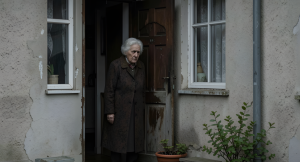
But the flat was also my home for thirty years. I cooked in that kitchen. I sat in that garden. I grew old in those rooms. When you told me I had to go, I was not surprised. I had felt it coming for some time — the way the house reorganised itself around your family, the way my presence required accommodation rather than being simply part of things. I am not saying this to cause you pain. I am only saying I understood.
What I want you to know is this: I was never angry.
I was sad, yes. I missed your father. I missed the garden. I missed the smell of the house in the morning, before anyone else was awake, when it was just me and the light. But I was never angry with you, because I know you. I know you are a man who does his best with what he has, and sometimes the best is not enough, and that is not a crime. That is just life.
The money. I saved it over forty years, a little at a time, from the household money your father gave me. Every month I put a small amount aside — he knew, and he didn’t ask questions, because he understood that a woman needs something of her own, even in a good marriage, maybe especially in a good marriage. After he died, I continued. The interest from the fixed deposit I closed last year is in there too.
I thought about giving it to you before. I thought about handing it over and saying: here, take it, use it. But I was afraid you would spend it on my nursing home, or feel obligated to put me somewhere better because of it, and I didn’t want that. I didn’t want money to make things complicated between us. Money makes everything complicated. Soil keeps secrets better.
So I put it in the soil of the plant your father gave me the year we were married. He bought it from a man selling plants on a cart near Connaught Place. Five rupees, he said. He was very proud of himself. I have had it for forty-six years.
Please keep the plant alive. That is the only thing I ask.
And please don’t spend too much time feeling guilty. You gave me a roof and a window and a pot to put my plant in. That is more than many people get. And you visited. You came and sat with me. The third time, you held my face and said you loved me, and I saw in your eyes that you meant it, and that is not nothing. That is, in fact, everything.
I am not a woman who needed much.
I needed the plant.
I needed to know you were all right.
I am leaving now knowing both of those things.
All my love, always, and after —
Your Ma
I sat on the kitchen floor for a long time.
The plant was above me on the sill, its vines trailing down toward me in the dim evening light, and I sat beneath it with the letter in one hand and the roll of notes in the other and I thought about forty-six years of marriage and five rupees spent near Connaught Place. I thought about a woman who had put her savings into soil because she trusted soil. I thought about the smile she had given me when I told her she had to go — not a broken smile, not a bitter one — and I understood it now, finally. It was the smile of someone who had already settled their accounts with the world. Who had already made their arrangements. Who was leaving nothing unfinished except the one thing that can never be finished, which is love.
Meena found me there. She didn’t ask questions. She sat down beside me on the floor and put her arm around me, and I showed her the letter. She read it twice. When she looked up, her eyes were wet.
“She never said a word,” Meena said.
“No,” I said. “She never said a word.”
We sat together under the plant for a long time. Priya came in looking for dinner and found us there and didn’t say anything, just sat down on my other side. Dev appeared and leaned in the doorway, reading the room. Even the baby came and climbed into Meena’s lap and was, for once, quiet.
All five of us, sitting on the kitchen floor in the fading light, under a trailing money plant that was forty-six years old, that had come from a cart near Connaught Place, that had traveled in the lap of a woman who smiled when her heart was breaking, that had grown three new leaves in a nursing home window while its keeper grew quieter and quieter and made ready.
I moved the plant to the living room after that. I put it where it would get morning light. I bought a bag of good soil and repotted it the way she had shown me — gently, disturbing the roots as little as possible, pressing the fresh earth around the base with both hands.
I talk to it sometimes.
I know how that sounds. I know that a plant cannot hear, that it does not understand grief or guilt or gratitude, that it processes sunlight and water and nothing more complex. I know all of this. I talk to it anyway, because she told me to, and because there are not many instructions she gave me that I followed well enough, and I would like, now, to follow this one.
I tell it about the children. I tell it that Priya got into the college she wanted, that Dev has started playing guitar badly and enthusiastically, that the baby — who is not a baby anymore — has developed an inexplicable passion for dinosaurs. I tell it about the ordinary days: the traffic, the rain, the good meal, the argument forgotten by morning.
Sometimes I just sit beside it and don’t say anything.
I put some of the money toward a small bench in the garden of the nursing home, with a little plaque on it. Not my mother’s name — she would have found that embarrassing, too grand, too much fuss. Just a line from a poem she used to murmur sometimes when she thought no one was listening: The root is not visible, but it holds.
I put the rest of the money in a fixed deposit, in an account I opened in Priya’s name.
There is, I have come to understand, no way to pay a debt like this. There is no transaction that settles it, no gesture adequate to what was given. A woman saved money for forty years in the dark of a pot and buried it in soil and smiled when she was asked to leave and did not complain and left instructions for a plant and died in a clean, quiet room and asked for nothing except that the plant be kept alive and that her son not spend too much time being guilty.
I am trying to honor the second request. I am not succeeding perfectly. But I am trying.
The plant is alive. It has grown. It has sent out new vines that trail almost to the floor now, heart-shaped leaves overlapping like a held hand.
I water it with the leftover water from washing rice.
I don’t know why that matters. It just seems right to do it the same way. To carry the gesture forward, even if I can’t carry everything forward. To say, with water and attention and a little quiet conversation, what I failed to say with enough of the things that counted when it mattered most:
I see you. I know what you did. I know what it cost.
Thank you.