The cemetery was almost empty the afternoon I learned that death had been lying to me.
Cold wind moved through the rows of headstones and made the rope on the flagpole tap softly against metal.
Tap.
It was the only sound that seemed brave enough to exist near my sons’ grave.
My name is Emily Carter, and for three months, I had been trying to become the kind of woman who could survive losing two children.
I was not doing well.
Nobody does well with that.
People just start saying softer things around you.
They bring casseroles.
They text hearts.
They say the names carefully, as if Mateo and Lucas were glass.
Mateo was seven.
Lucas was five.
Mateo had two missing front teeth and a habit of asking questions that made grown men give up.
Lucas still called oatmeal ‘breakfast soup’ and could not sleep unless his dinosaur blanket was tucked under his chin.
They had disappeared on a Saturday afternoon after a family cookout near the river trail.
The search lasted eight days.
Police, volunteers, dogs, flashlights, helicopters, printed flyers on gas station windows, neighbors moving through brush with thermoses and shaking hands.
On day five, they found Mateo’s jacket near the riverbank.
On day six, they found Lucas’s sneaker wedged in a tangle of branches downstream.
On day eight, a county search coordinator stood in our driveway with his hat in both hands and used a sentence no parent should ever hear.
He said the conditions were not survivable.
After that, there were reports.
A police case file.
A coroner’s provisional statement that made room for uncertainty without making room for hope.
A funeral without bodies.
Two small coffins filled with folded clothes, favorite toys, and photographs because grief is cruel enough to invent substitutes when it cannot give you the thing you need.
My husband, Daniel, signed every document because my hand would not hold a pen.
He signed the funeral home paperwork at 9:36 a.m. on a Monday.
He signed the cemetery plot contract with his jaw clenched so tightly I thought his teeth would crack.
He signed the police follow-up forms while I sat in our laundry room holding Lucas’s dinosaur blanket to my face because it still smelled faintly like baby shampoo and crackers.
For months, our house became a museum of interrupted life.
Two cereal bowls in the cabinet.
Two backpacks hanging by the garage door.
A school pickup tag still clipped to the visor of our SUV.
Mateo’s half-finished science worksheet under a magnet shaped like a rose.
Lucas’s tiny rain boots by the porch, both turned the wrong direction.
People told me time would help.
Time did not help.
Time just taught me how long a house could stay quiet.
Daniel and I went to the cemetery every Thursday because Thursday was the day the boys used to have early release from school.
It made no sense, but grief rarely does.
At 2:00 p.m., when I should have been waiting in the pickup line behind minivans and school buses, we stood in front of a granite stone with our sons’ names carved into it.
That Thursday, I had brought fresh flowers and two framed photographs.
The photos were already wet from my tears by the time we reached the grave.
The cold had worked through my coat.
My fingers ached around the frames.
Daniel stood beside me, one arm around my shoulders, one hand resting on the top edge of the stone.
He had aged ten years in three months.
There was gray in his beard that had not been there before.
He still went to work at the warehouse every morning because bills do not respect tragedy.
He still packed my lunch some days when I forgot food existed.
He still put gas in my car.
He still left the porch light on, even though there was no one left to come running through the yard after dark.
I think that was how he loved me then.
Quietly.
Practically.
With his heart broken and his hands still moving.
I was staring at Mateo’s face in the picture when something tugged the hem of my coat.
At first, I thought it was wind catching the fabric.
Then it happened again.
Small fingers.
I looked down.
A little girl stood beside me.
She was maybe six years old.
Barefoot.
Her hair was tangled into dark knots, and her sweatshirt hung off one shoulder like it belonged to a much older child.
Dirt streaked her knees.
Her lips were cracked.
There was a smell around her that made my stomach turn, damp concrete and old garbage and air that had not moved in too long.
She stared at the photographs in my hands.
Not curious.
Not shy.
Certain.
Then she pointed at Mateo’s picture.
‘Why are you crying for Mateo and Lucas?’ she asked.
Daniel’s hand tightened on my shoulder.
The girl blinked up at me.
‘They played hide-and-seek with me yesterday.’
The whole cemetery seemed to tilt.
For one terrible second, I thought my mind had finally broken under the weight of wanting them back.
I had dreamed their voices before.
I had heard Lucas calling from the hallway at 3:00 a.m. and woken Daniel by tearing through the house in my socks.
I had seen a boy in a red hoodie at the supermarket and followed him two aisles before realizing he was someone else’s child.
Grief turns the world into a hallway full of false doors.
But this was not a dream.
This child was standing in front of me with mud on her feet and fear in her eyes.
Daniel crouched so quickly his knee hit the wet grass.
‘What did you say?’
The girl flinched from his voice.
I put a hand on Daniel’s shoulder.
‘It’s okay,’ I whispered, though nothing was okay.
The child looked past us toward the road.
‘They live with me under the highway bridge,’ she said. ‘They cry a lot because the man locks the door.’
I stopped breathing.
Daniel went pale in a way I had only seen once before, in the funeral home when the director asked whether we wanted the boys’ names on the same headstone or separate ones.
‘What man?’ he asked.
She shook her head.
‘The man with keys.’
At 2:17 p.m., I called 911.
My fingers were so numb I almost dropped the phone.
The dispatcher asked for the location.
I gave the cemetery name, then the road, then shouted for Daniel to slow down because he was already moving.
He had grabbed the little girl’s hand and was heading toward the gravel parking lot.
‘Where?’ he asked her.
She pointed beyond the cemetery office, past a chain-link fence, toward the highway overpass that cut across the low land beyond the trees.
I told the dispatcher we were following a child who claimed our missing sons were alive.
There was a pause.
Then her voice changed.
Calmer.
Sharper.
She told me to stay on the line.
I did not stay still.
No mother on earth would have stayed still.
We ran past the cemetery office, where a small American flag sticker had been taped in the window above a stack of condolence envelopes.
We ran past the mailbox where sympathy cards had kept arriving long after I stopped opening them.
We crossed the narrow service road, pushed through weeds, and started down the muddy slope toward the bridge.
Cars rushed overhead.
The sound swallowed everything.
The closer we got, the worse the smell became.
Trash.
Rainwater.
Rotting food.
Something sour and metallic underneath.
The little girl did not hesitate.
She moved like someone who had walked that slope in the dark.
Daniel kept one hand around hers and one arm out behind him, as if he could physically hold me back from falling apart.
Under the bridge, broken bottles glittered in the mud.
A paper grocery bag had dissolved into pulp near a concrete pillar.
There were old blankets pushed into a corner, a cracked plastic bucket, a child’s sock stuck to the wet ground.
Then the girl stopped.
She pointed at the brush.
At first, I saw only weeds.
Then Daniel shoved the branches aside.
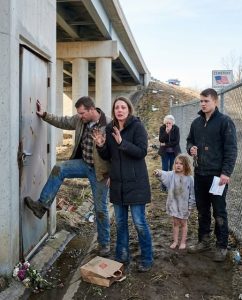
A rusted sheet-metal door was bolted into a concrete maintenance opening beneath the highway.
It had been hidden by mud, brush, and a slab of broken plywood.
A heavy padlock hung from the hasp.
Daniel touched it once, then looked at me.
I saw the answer in his face before either of us spoke.
Someone had built a hiding place.
Not an accident.
Not a tragedy.
A place.
A lock.
A routine.
The dispatcher was still talking in my ear.
I could barely hear her.
Daniel pressed his ear to the metal door.
I pressed both hands flat against it.
The cold shot through my palms.
For a few seconds, all I heard was traffic.
Then came a tiny sob.
Daniel slammed his fist into the door.
‘Mateo! Lucas!’
The sob stopped.
A thin voice answered from the other side.
‘Mom?’
I fell to my knees in the mud.
There are sounds a body recognizes before the mind can survive them.
Your child’s voice is one of them.
Even muffled by metal.
Even weaker than it should be.
Even coming from a place so wrong that the world should have split open around it.
‘Lucas,’ I choked. ‘Baby, I’m here.’
Then another voice, hoarse and terrified.
‘Mommy?’
Mateo.
Daniel made a sound that was half sob, half roar.
He kicked the door.
The metal buckled but did not open.
He kicked it again.
Rust flaked down.
The little girl backed away and covered her ears.
I was still on the phone, screaming at the dispatcher that my sons were alive, that there was a locked door under the bridge, that we needed police, firefighters, anyone with a cutter, anyone with a crowbar, anyone with hands.
Daniel stepped back for a third kick.
That was when we heard keys.
A small metallic jingle from behind the nearest concrete pillar.
Daniel froze.
I turned.
A man stepped out from behind the pillar.
For a second, my brain refused to name him.
It showed me pieces instead.
Work boots muddy to the ankle.
Dark jacket zipped to his throat.
Hands shaking around a key ring.
A county maintenance badge clipped crookedly near his pocket.
Then his face came into focus.
My brother.
Michael.
The same Michael who had stood beside me at the funeral and held me when my legs gave out.
The same Michael who had paid for half the headstone because he said family takes care of family.
The same Michael who had organized search volunteers, passed out flyers, and hugged Daniel in our driveway under the porch light.
The same uncle who had brought Mateo a baseball glove for his last birthday and taught Lucas how to whistle through his teeth.
Trust is not always a feeling.
Sometimes it is a key you never ask about because you cannot imagine the wrong person holding it.
‘Michael,’ I said.
My voice did not sound like mine.
He looked past me at the door.
Then at Daniel.
Then at the little girl.
‘Emily,’ he said, almost gently.
That was the worst part.
He sounded embarrassed.
As if we had walked in on a private mistake.
Daniel moved toward him.
Michael raised one hand.
The keys flashed.
‘Don’t,’ he said.
From inside the door, Lucas began crying harder.
‘Daddy?’
Daniel stopped like the word had struck him.
Police sirens sounded faintly in the distance.
Michael heard them too.
His face changed.
The calm cracked.
He looked toward the slope, then back at the door, calculating distance, time, consequence.
At the top of the hill, my mother appeared near the fence.
She had followed after hearing my call from the cemetery office.
She was sixty-four, wearing the same gray cardigan she had worn to the funeral.
She held one hand to her chest as she picked her way down the muddy slope.
‘Emily?’ she called. ‘What happened?’
Then she saw Michael.
She saw the keys.
She saw me kneeling in the mud with my hand pressed to a locked door that had my children behind it.
My mother’s face emptied.
‘No,’ she whispered.
Michael turned toward her.
‘Mom, go back up.’
She stopped walking.
‘What did you do?’
For the first time, Michael looked angry.
Not ashamed.
Not sorry.
Angry that she had asked the question out loud.
‘You don’t understand what I had to fix,’ he said.
Daniel lunged.
Michael stumbled back, but the mud betrayed him.
He slipped, hit one knee, and the keys flew from his hand.
I saw them land near a piece of broken concrete.
The little girl saw them too.
She darted forward before anyone else moved.
Tiny barefoot child, filthy sweatshirt, shaking hands.
She snatched the key ring and ran straight to me.
Daniel grabbed Michael by the jacket and shoved him against the pillar.
Not a punch.
Not yet.
Daniel was shaking too hard for that.
He held him there with both fists and said, very quietly, ‘If they are not alive when I open that door, you will have to beg the police to get here first.’
I took the keys.
There were six of them.
My hands would not work.
The first key did not fit.
The second stuck halfway.
The third turned.
The lock opened with a heavy click.
I pulled the chain free.
Daniel released Michael long enough to grab the edge of the door.
Together we pulled.
The smell hit us first.
Stale air.
Urine.
Mold.
Old food.
Cold concrete.
The flashlight from my phone shook so badly the beam jumped across the walls.
The space inside was low and dark, a storage cavity under the bridge barely tall enough for Daniel to stand bent over.
Blankets were piled in one corner.
Empty water bottles lay scattered across the floor.
A fast-food bag crawled with ants near the wall.
And there, huddled together under a gray blanket, were my sons.
Mateo had one arm around Lucas.
His cheeks were hollow.
His hair was matted.
One of his eyes was swollen from crying or infection, I could not tell which.
Lucas was smaller than I remembered.
That is what broke me first.
Not the dirt.
Not the smell.
Not the darkness.
The size of him.
Three months had made my five-year-old look like a shadow trying to stay warm.
‘Mommy,’ Lucas whispered.
I crawled to them.
I do not remember crossing the floor.
I only remember their bodies hitting mine, all bones and trembling and desperate little hands grabbing my coat, my hair, my neck.
Mateo kept saying, ‘I knew you would come.’
Over and over.
‘I knew you would come.’
Daniel collapsed beside us and wrapped all three of us in his arms.
He was crying so hard he could not speak.
Outside, sirens grew louder.
Police officers came down the slope.
A firefighter followed with bolt cutters he did not need anymore.
An EMT dropped to her knees near the doorway and started speaking gently to the boys.
She wrapped them in thermal blankets and checked their pulses.
She asked when they had last eaten.
Mateo looked at Michael.
Then he looked at me.
‘He said you stopped looking,’ Mateo whispered.
My mother made a sound from outside the door.
A broken sound.
Michael was on the ground by then, hands behind his back, an officer kneeling beside him.
He kept talking.
That was the strangest thing.
He would not stop explaining.
He said he had debts.
He said he owed people money.
He said he only meant to keep the boys long enough to pressure Daniel into selling the house and giving the family a share.
He said things got complicated after the search began.
He said the funeral made it impossible to bring them back.
He said my sons were safer with him than with strangers.
Every sentence made less sense than the last.
Evil rarely announces itself as evil.
It calls itself pressure.
It calls itself panic.
It calls itself a plan that got out of hand.
The little girl stood near the EMT, wrapped in a foil blanket too big for her shoulders.
Her name was Ava.
She had been reported missing from another county seven weeks earlier.
She told police Michael found her sleeping near a bus station and said he knew a warm place.
She said he brought food sometimes.
She said he locked the door every time.
She said Mateo had shared his crackers with her even when he was hungry.
That sentence nearly ended me.
At the hospital, the intake desk printed three bracelets.
Mateo Carter.
Lucas Carter.
Ava Miller.
The nurse fastened Lucas’s bracelet around his wrist at 4:52 p.m.
I remember the time because I stared at the wall clock while they checked him for dehydration and tried not to scream every time he whimpered.
Daniel stood beside Mateo’s bed with one hand on his son’s ankle because Mateo panicked whenever Daniel moved too far away.
A police detective came in with a recorder and asked if the boys could answer a few questions later.
I said no at first.
Not because I wanted to protect Michael.
Because my sons had been used enough.
The detective nodded and wrote it down.
She said there would be time.
There were photos taken.
Medical notes.
A police report.
Evidence bags with the padlock, key ring, blankets, food wrappers, and Michael’s maintenance badge.
A county supervisor confirmed Michael had access to service areas near multiple bridges because of a temporary contract job.
The funeral home director called me that evening and cried when Daniel told him the boys were alive.
The cemetery office removed the flowers from the grave the next morning.
For a while, nobody knew what to do with the headstone.
How do you erase a grave without feeling like you are tempting the world?
We left it there for two weeks.
I could not look at it.
Then Daniel went alone one morning and placed a note under the vase.
It said, ‘You did not keep them.’
Michael’s arrest made the local news, but I did not watch it.
I could not stand hearing strangers say my sons’ names like a headline.
My mother did not leave our house for six days.
She slept on the couch, cried in the kitchen, and kept whispering that she should have known.
I told her the truth.
We all should have known only because now we knew.
Before that, Michael had built his hiding place out of ordinary trust.
He had keys because of work.
He had our schedule because he was family.
He had our grief because we handed it to him.
He knew when we were at the cemetery.
He knew when Daniel worked late.
He knew which neighbors were helping with meals.
He knew how to stand close enough to be comfort and far enough to be invisible.
That is the part people do not understand.
The monster does not always arrive wearing a stranger’s face.
Sometimes he pays for the headstone.
Sometimes he carries your flowers.
Sometimes he says, ‘I’m here for you,’ and means it in the worst possible way.
Mateo and Lucas came home after four days in the hospital.
Ava went to her aunt, and later, after her family reached out through the detective, she sent the boys a drawing of the three of them under a bright yellow sun.
Lucas taped it to the refrigerator.
For months, both boys slept with the hallway light on.
Mateo checked the locks every night.
Lucas would not go near bridges.
Daniel stopped driving the highway route to work because the boys went silent whenever we passed an overpass.
Healing was not beautiful.
It was appointments.
Nightmares.
Protein shakes.
Police interviews.
School re-entry meetings.
A therapist with a soft voice and a box of crayons.
It was Daniel sitting on the bathroom floor at 2:00 a.m. while Lucas threw up from fear.
It was me standing in the grocery aisle crying because Mateo asked whether we could buy crackers for Ava in case she ever came over.
It was our SUV back in the school pickup line, with two small backpacks in the backseat and my hands shaking on the steering wheel.
The first day I brought them home from school again, the same flag rope was tapping outside the building.
Tap.
Tap.
Tap.
For three months, that sound had belonged to the cemetery.
Now it belonged to the living.
Michael eventually confessed enough that prosecutors did not need my sons to carry the whole case on their small shoulders.
He tried to make it sound like desperation.
The evidence made it sound like planning.
Search maps in his garage.
A second padlock receipt.
Photos of the bridge on his phone.
A note with our Thursday cemetery routine written on the back of a utility envelope.
The detective showed me that note only once.
I did not ask to see it again.
There are some truths you only need one time.
At sentencing, Daniel spoke.
I thought I would, but when I stood up, my body would not let me.
So Daniel held the paper with both hands and told the judge about Mateo teaching Lucas to count cars by color in the dark.
He told the court about Lucas sharing half a granola bar with Ava because he thought little kids should eat first, even though he was five.
He told them about our sons asking whether Uncle Michael was still mad at them.
That was when Michael finally looked down.
Not when the charges were read.
Not when the evidence was listed.
When Daniel said our boys thought they had done something wrong.
The judge called it a calculated betrayal of family access and public trust.
I remember that phrase because it sounded official enough to survive what plain language could not.
Calculated betrayal.
Family access.
Public trust.
Those words went into the file.
They did not go into my sons’ nightmares.
But they mattered.
They named what happened.
And naming a thing is sometimes the first lock you break.
Months later, we went back to the cemetery.
All four of us.
Daniel, me, Mateo, and Lucas.
The headstone was gone by then.
The cemetery had helped us remove it quietly.
In its place, the grass was still uneven, a rectangle of earth trying to become ordinary again.
Lucas held my hand.
Mateo held Daniel’s.
For a long time, nobody said anything.
Then Mateo looked up at me and asked, ‘Were you really crying here?’
I nodded.
He studied the empty patch of ground.
Then he squeezed my hand.
‘But we came back.’
I could not answer right away.
Because he was right.
We had cried in front of my two sons’ grave when a little voice froze my blood.
And somehow, impossibly, that little voice had led us away from death and back to a locked door beneath a bridge.
Back to the truth.
Back to the boys we had buried without bodies and found still breathing in the dark.
People ask me sometimes how we survived it.
I do not have a clean answer.
We survived it the way ordinary families survive impossible things.
One school morning.
One therapy appointment.
One unlocked bedroom door.
One porch light left on because this time, the children really were coming home.