far side.
They got to Ellie first, wrapping her in thermal gear before she could even fully process what was happening.
Then they lifted me.
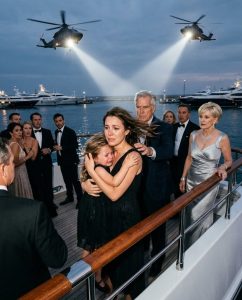
By the time I was dragged onto the deck, coughing seawater and shaking violently, the music had stopped, the champagne flutes were overturned, and the entire performance of elegance was gone.
All that remained was truth.
Ellie was bundled in silver rescue material, crying into a medic’s shoulder.
I pushed myself up on numb hands just as Adrian stepped onto the deck.
He wore a dark coat over black clothes, water-resistant boots, no tie.
Nothing flashy.
Nothing performative.
But the men who came with him moved with the automatic deference of people who knew exactly who he was and what his authority meant.
Daniel went pale.
“Mr.
Vale,” he breathed.
Lillian turned to him.
“Why are you saying it like that?”
Adrian didn’t answer her.
His eyes found me.
Then Ellie.
Then the water dripping from my dress onto the polished deck.
I had never seen his face so calm.
Or so dangerous.
He crossed straight to us, crouched beside Ellie, and touched her cheek with a hand that was visibly shaking from contained rage.
“I’ve got you,” he told her softly.
She looked at him, confused through tears.
“Daddy?”
The word landed like a bomb.
My mother’s mouth actually fell open.
My father stared as if the deck had tilted beneath him.
Lillian turned slowly toward me, then toward Adrian, then back again.
Adrian stood.
He faced my parents first.
“Which one of you pushed them?” he asked.
His tone was controlled.
Almost gentle.
That frightened me more than shouting would have.
My mother recovered first, because arrogance was always her survival skill.
“You have no right to storm in here and disrupt a private event,” she snapped.
“And whatever Claire has told you—”
“Claire didn’t tell me enough,” Adrian said.
My father straightened his jacket.
“Your daughter damaged private property.
We were handling a family matter.”
“You threw a woman and a child into freezing water,” Adrian replied.
“It was an accident,” Lillian cut in quickly.
Adrian turned to the nearest member of his team.
“Record that statement.”
A tablet lifted immediately.
Daniel took a step back.
That was when another man in Adrian’s group approached him with a sealed folder.
He said something low and direct.
Whatever it was, Daniel’s face collapsed.
Lillian grabbed his arm.
“What is happening?”
He didn’t answer.
Adrian finally looked at the crowd—the investors, the social climbers, the people who had laughed when a child went into the harbor.
“My name is Adrian Vale,” he said.
“Since several of you appear confused, let me clarify.
The woman you just watched being assaulted is Claire Hale.
The child you mocked is my daughter.
And the acquisition Daniel Mercer has been trying to close for the last eleven months?”
He paused just long enough for Daniel to stop breathing.
“It depends entirely on my signature.”
A ripple of horror moved through the deck.
Daniel stepped forward, voice unsteady.
“Mr.
Vale, please, this is a misunderstanding.”
Adrian looked at him once.
“I watched a video feed from the harbor approach on the way in,” he said.
“It was not.”
I blinked through cold and shock.
“Video feed?”
He turned to
me and softened, just for a second.
“The yacht’s marina berth had contracted security integration through one of our affiliates,” he said quietly.
“I already have multiple angles.”
My mother’s face drained of color.
My father looked at the water as if it could still erase what had happened.
Then the police arrived.
Marine patrol first, then local officers from the harbor authority who had been alerted by Adrian’s team and the emergency response dispatch.
Statements began immediately.
Guests who had been delighted spectators moments earlier now suddenly remembered appointments, children, medical conditions, anything that might excuse leaving.
No one was permitted to go.
The footage was reviewed right there in a control monitor brought aboard by security.
I watched it with a medic’s blanket around my shoulders and Ellie asleep against me.
There was no ambiguity.
Daniel shouted.
Lillian lunged.
My father shoved.
My mother stood by and laughed.
Then, on a second angle, came the moment I had not heard clearly in the water—my mother’s voice, crisp as glass:
“Maybe this will teach them not to show up where they don’t belong.”
Even the officer reviewing the footage went still.
Arrests did not happen that night, but formal detentions did.
Statements were signed.
Daniel’s corporate counsel was contacted.
His investors, several of whom were on that deck, witnessed enough to begin distancing themselves before sunrise.
Lillian spent an hour sobbing into ruined mascara.
My father alternated between outrage and begging.
My mother demanded a lawyer, then tried to claim she was in shock, then insisted I had provoked everything.
None of it mattered.
Adrian took Ellie and me home.
Not to a hotel.
Not to some hidden apartment.
Home.
The home he had kept out of public view for years because privacy had protected us better than disclosure ever could.
When we arrived, Ellie was checked by a pediatric specialist Adrian had already called in.
I was treated for mild hypothermia and bruising.
Only after Ellie was asleep in a warm bed did Adrian sit across from me in the quiet living room and let the anger leave his face.
“You should have called sooner,” he said.
“I know.”
“Why didn’t you?”
I looked down at my tea.
“Because part of me still wanted them to choose me on their own.”
He was silent for a long moment.
Then he moved beside me, took my face in both hands, and said, “They already made their choice.
Now you make yours.”
The next week changed everything.
Daniel’s pending deal collapsed publicly.
Not because Adrian sought revenge in secret, but because the board overseeing the partnership received the marina footage, multiple guest statements, and a conduct report serious enough to trigger ethics review.
Daniel was placed on leave, then forced out.
Investors don’t like men who scream at children and attend events where assault becomes entertainment.
Lillian’s wedding plans dissolved almost overnight.
My father was charged with assault and child endangerment after the district attorney reviewed the footage and witness testimony.
My mother was charged as well—not for pushing us herself, but for conspiracy-related conduct and for obstructive false statements she made afterward.
The exact legal path took months, as those things do, but the case moved because the evidence was overwhelming.
They all assumed I would eventually soften.
My
mother sent messages through relatives saying blood should matter more than pride.
My father insisted he had only meant to “move me away from the scene.”
Lillian wrote once to say I had ruined her life over “a family misunderstanding.”
I never answered.
For the first time in my life, silence felt clean.
When the hearings began, I testified clearly.
So did several guests, including one older investor who admitted—with visible shame—that he had laughed because everyone else did.
“I told myself it was some family drama,” he said.
“I didn’t realize how monstrous that sounded until later.”
That line stayed with me.
How monstrous that sounded until later.
So much cruelty survives on that delay.
Not seeing clearly until after the damage is done.
Months later, after the legal consequences settled and the gossip cycle moved on to newer scandals, Adrian and I finally did what fear and timing had postponed for too long.
We told the truth publicly.
Not everything.
Not the parts tied to his previous security work or the private risks that had shaped our secrecy.
But enough.
Enough for Ellie to stop hearing whispers.
Enough for the story about me being abandoned to die.
Enough for us to stand together in daylight without calculation.
There was no glamorous press conference.
No dramatic reveal.
Just a photograph, a short statement, and a family portrait taken on a quiet afternoon where Ellie was laughing because Adrian kept making ridiculous faces behind the camera.
The responses were mixed.
Some people expressed shock.
Some apologized for assumptions.
Some insisted they had always suspected there was more to the story.
I didn’t care.
The audience had never been the point.
The point was that Ellie finally got to live in the open.
A year after the harbor incident, we returned to the marina.
Not for a party.
For closure.
Ellie wore a yellow coat and held both our hands as we walked the dock.
She stopped near the berth where the *Silver Horizon* had once been tied and peered into the water.
“Are you scared here?” I asked her.
She thought about it.
“A little,” she admitted.
“But not the bad kind.”
“What kind?” Adrian asked.
“The kind where you remember something sad,” she said, “but then you remember we left.”
Children can say enormous things in tiny sentences.
We left.
That was the whole story in four words.
Not just the yacht.
Not just the harbor.
Not just the family that confused control with love.
We left the script they wrote for us.
I used to think the deepest wound my family gave me was humiliation.
It wasn’t.
It was training me to believe I had to endure humiliation to keep belonging.
The night they threw me into freezing water with my daughter in my arms, that lie finally drowned.
And when the helicopters came roaring over the harbor, it wasn’t rescue alone that changed my life.
It was exposure.
Truth descending loud enough that nobody could pretend not to hear it anymore.
Even now, sometimes people ask whether I regret waiting so long to stand up to them.
I tell them regret is too simple a word.
What I feel is sharper than regret and gentler than guilt.
I feel clarity.
I know exactly when I should have
walked away.
I also know why I didn’t.
And if there is any aftershock left from that night, it is this question:
What was the real red flag?
The shove?
The laughter?
The years of smaller cruelties before it?
For me, it was the empty chair.
The seat no one saved for my daughter.
Because by the time people are willing to throw you overboard, they have usually been pushing you out in quieter ways for years.
END!