I answered as the owner, not the daughter.
“Now,” I said.
The police arrived twenty minutes later.
Mrs.
Delaney provided her statement before anyone asked twice.
Mr.
Hensley from two houses down confirmed the movers had been there in the afternoon.
The officer at the door listened, took copies of the title history and forged filings, and asked my father and Emily to step outside separately.
Emily tried to keep speaking for both of them.
The officer cut her off.
Then came the detail that finally shattered whatever remained of my father’s composure.
During the attempted filing, Emily had listed my house as a transfer pending “sale for care-related expenses.” She had already contacted a real-estate agent.
She had not been trying to protect me.
She had been trying to liquidate me.
My father looked at her as if he had just discovered the depth of the hole beneath his feet.
“You told me it was temporary,” he said.
Emily’s face sharpened.
“Don’t do this now.”
“Temporary?” I repeated softly.
Rachel touched my sleeve, warning me not to step back into old emotional ground.
She was right.
By midnight, a locksmith hired by Rachel had restored access under police supervision.
I walked back into my house with an officer beside me and felt the strange ache of entering a familiar room after a funeral.
A few drawers in my office had been opened.
My filing cabinet showed signs of tampering.
Two framed photographs of my mother were missing from the living room mantel and had been placed face-down in a hallway box labeled donate.
That hurt more than I expected.
Not because of the objects.
Because of the intention.
They had been erasing me in my own house.
I found my mother’s blue mixing bowl still on top of the fridge.
I stood in the kitchen, touched its cool edge, and finally let myself cry.
Not long.
Just enough.
By morning, Emily had retained a criminal-defense lawyer.
My father left three voicemails I did not return.
The first sounded stunned.
The second sounded ashamed.
The third sounded like a man trying to explain his way back into a role he had forfeited.
I let Rachel handle everything.
Over the next six weeks the truth unfolded piece by piece.
Emily had drafted the narrative of my supposed instability for months, collecting sympathetic ears the way other people collected recipes.
She had persuaded my father that I was too emotionally tied to the house to manage it “rationally.” She had located a notary whose seal impression she copied from an old church document.
She had altered a medical intake note from a routine stress-related appointment and built an entire false packet around it.
My father had not invented the scheme.
But he had signed where she pointed.
In the end, that distinction mattered morally, not legally.
The county referred the forged filing for prosecution.
Emily was charged.
The real-estate agent she contacted cooperated immediately once shown the paperwork.
The locksmith swore under statement that he changed the lock because my father claimed to be acting under emergency authority.
Rachel filed a civil claim for damages, unlawful exclusion, attempted fraud, and attorney’s fees.
My father moved into a short-term rental across town.
Three months later he asked to meet me at a diner
near the old hardware store where we used to buy paint and screws when I was a kid.
I almost declined.
Then I said yes because sometimes closure is not forgiveness.
Sometimes it is just a full stop.
He looked smaller there, without the house behind him and without Emily arranging the mood of the room.
“I should have stopped it,” he said.
“Yes,” I answered.
He swallowed.
“At first she said she was helping.
Then I kept telling myself it had gone too far to undo quietly.”
“That’s what betrayal usually sounds like in the middle,” I said.
He flinched but did not argue.
He told me he had signed because he was afraid—afraid I would one day sell the house and move away, afraid of aging, afraid of losing the place that still smelled faintly of my mother in certain corners after rain.
Emily had turned those fears into a weapon.
But he had still picked it up.
“I miss you,” he said at last.
I believed him.
That did not change anything.
“I miss who you were,” I replied.
The case resolved in early autumn.
Emily accepted a plea arrangement tied to the forged filing and paid restitution as part of the civil settlement.
My father signed a formal affidavit acknowledging my sole ownership and his role in the attempted exclusion.
Rachel insisted on a recorded no-contact agreement from Emily and a written surrender of any claim, present or future, connected to my property.
When the final documents were signed, Rachel leaned back in her chair and smiled for the first time in months.
“You can breathe now,” she said.
I looked at the stack of papers and thought about how close I had come to being turned into a story someone else told about me.
Too emotional.
Too attached.
Too overwhelmed.
It would have been so easy for them if I had doubted myself a little more.
Instead, I changed my own locks the next day.
Not because I was afraid they would come back.
Because I wanted the sound of the new key turning to belong to me.
That evening I sat alone on the porch swing with a blanket over my knees and watched the light fade over Hawthorne Lane.
The rosemary pot needed trimming.
The steps needed resealing before winter.
Across the street, Mrs.
Delaney lifted a hand in greeting and pretended not to stare.
I smiled and waved back.
The house was quiet again.
Not empty.
Not wounded.
Just honest.
My mother’s blue mixing bowl still sat on top of the fridge.
The floors still held the shine I had worked for.
The walls still carried every repair I had made by hand.
For the first time since March, I could feel the place settle around me instead of bracing against intrusion.
People like Emily always believe control is the same thing as ownership.
People like my father learn too late that surrendering your judgment to someone else does not make you innocent.
And people like me—people who were told they were too emotional, too attached, too much—sometimes survive by keeping records when everyone expects tears.
I still think about the moment my key first scraped that changed lock.
At the time it felt like loss.
Now I know it was the
sound of truth finally catching.
And when I tell the story, the part that stays with people is never the forged papers or the police or even the settlement.
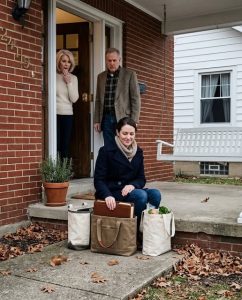
It is the image of me sitting on my own porch, groceries at my feet, smiling at a locked door.
Because sometimes the most dangerous thing you can do to people who think they have trapped you is let them believe, for one more minute, that their plan worked.