It was a Tuesday in late October, and the whole morning had the color of old dishwater.
Wet leaves clung to the curb outside my house.
The driveway smelled like rain, cold pavement, and the first hint of winter.
I remember that because ordinary details become sharp when your life is about to split in two.
I had my granddaughter Lily’s birthday present buckled into the passenger seat of my old sedan.
She was turning eight that weekend.
The gift was wrapped badly because I had never been good at wrapping anything.
My late wife, Ellen, used to wrap presents like she was building small works of art.
She tucked corners tight.
She curled ribbon with scissors.
She wrote names on tags in that soft blue ink she loved.
Four years earlier, pancreatic cancer took her in forty-one days.
After that, I kept some rituals because letting them go felt like losing her twice.
So I bought Lily’s present at the same tiny toy store Ellen used to love.
I sat at my kitchen table the night before with tape stuck to my sleeve and wrapping paper sliding around under my hands.
The corners came out crooked.
The ribbon refused to lie flat.
Still, I was proud of it.
A child can feel effort, Ellen used to say.
That morning, I drove to Mark’s house with the heat turned low and the present beside me like a passenger.
My son lived in a quiet neighborhood with leaf piles by the curbs, Halloween pumpkins sagging on porches, and small flags tucked beside mailboxes.
It was the kind of street where everything looked normal from the outside.
That is the trouble with normal.
It can hide almost anything.
Natalie opened the door before I finished knocking.
She was my daughter-in-law, though that word had never felt warm between us.
She was polite in the way people are polite when they have already decided you are an inconvenience.
“Mark’s at work,” she said.
No hello.
No smile.
No how have you been.
She opened the door just wide enough for me to step inside and glanced toward the kitchen like she wished I would hurry up and finish existing in her house.
I lifted the gift.
“I brought Lily’s birthday present early. Thought I’d surprise her.”
Natalie’s mouth moved into something that almost passed for a smile.
“She’s out back.”
The house smelled too clean.
Lemon cleaner.
Dish soap.
Something sharp under it, like a room scrubbed after company left.
I noticed two plastic cups upside down in the drying rack.
I noticed the sink was spotless.
I noticed Natalie was watching me notice.
At the time, those details were just details.
Later, they became evidence in my mind.
Through the kitchen window, I saw Lily sitting on the tire swing in the backyard.
Her sneakers dragged through the mulch.
Her hair hung forward.
Her little hands gripped the rope too tightly.
Children are supposed to sit on swings like the world is pushing them forward.
Lily sat like the world had already made her tired.
I stepped out onto the back porch and called her name.
She looked up.
For half a second, her whole face lit.
Then something flickered behind it.
She ran to me anyway.
I crouched down, and she wrapped her arms around my neck the way she had since she was three.
Her hair smelled like apple shampoo, sweet and cheap and familiar.
For one foolish second, I let myself believe familiar meant safe.
We sat on the back steps with the wrapped present between us.
A damp wind moved through the fence boards.
Somewhere down the street, a dog barked twice and stopped.
Lily did not rip into the paper.
She touched the tape with one finger.
She traced the crooked ribbon.
Most kids open gifts like they are breaking into treasure.
Lily handled hers like evidence.
“You okay, kiddo?” I asked.
She nodded too fast.
“Yeah.”
I had spent most of my adult life as a civil engineer.
Bridges.
Overpasses.
Retaining walls.
Things built to hold under pressure.
You learn that collapse is rarely the beginning of a disaster.
It is the ending.
The beginning is always quieter.
A hairline crack.
Rust under paint.
A small sound where silence should be.
Lily’s quiet felt exactly like that.
I nudged the present closer.
“Go on. Early birthday surprise.”
She peeled the paper slowly.
Inside was a small bracelet-making kit, the kind with beads and little charms and colored string.
Her face tried to become happy.
It almost made it.
“Thank you, Grandpa.”
“You’re welcome, sweetheart.”
She slipped one little birthday bracelet from the kit onto her wrist.
Then she leaned close enough that her breath warmed my cheek.
“Grandpa,” she whispered, “can you ask Mom to stop putting things in my juice?”
The yard went quiet in a way that did not feel natural.
I kept my face still.
That was the hardest thing I did all day.
Children watch adult faces for permission to be afraid.
If I had shown her what happened inside me, I would have handed her panic she did not deserve.
“What do you mean, sweetheart?” I asked.
She looked toward the sliding-glass door.
“The juice before bed.”
“What about it?”
“It tastes weird,” she said.
Her voice dropped even lower.
“Then I sleep really, really long. Sometimes I don’t remember the morning.”
My hand went between her shoulder blades.
I told myself it was to comfort her.
The truth was I needed something to hold on to.
“How long has this been happening?”
Lily frowned hard, like time was a puzzle she had not been taught to solve.
“Since summer, maybe. Or when school started.”
She blinked slowly.
“Mom says it’s vitamins. But vitamins aren’t supposed to make your legs feel floaty.”
I heard that sentence as a grandfather.
Then I heard it as a man who had spent thirty-six years looking at warning signs other people missed.
Floaty legs.
Long sleep.
Missing mornings.
Weird taste.
A cup before bed.
Every word landed in its own place.
Behind us, in the sliding-glass door, Natalie’s reflection appeared.
She stood still.
She had not come out to ask if Lily was thirsty.
She had not come out to ask what we were talking about.
She simply watched long enough to measure the distance between Lily’s whisper and my reaction.
Then she was gone.
Some people lie with words.
Some lie with rinsed cups, clean counters, and smiles that never quite touch the eyes.
I wanted to stand up.
I wanted to go inside.
I wanted to open every cabinet and read every label and ask Natalie exactly what she thought she was doing.
I did not.
Anger is fast.
Protection has to be careful.
I told Lily I loved her.
I told her we would talk to her dad.
I told her everything was fine, because children deserve calm even when adults are shaking inside their own skin.
She opened the rest of the gift.
She smiled where she was supposed to smile.
She hugged me where she was supposed to hug me.
I laughed where I was supposed to laugh.
When I left, Natalie stood in the entryway with her arms crossed.
“Nice of you to stop by,” she said.
“Always nice to see Lily,” I answered.
Our eyes met for one second too long.
I think she knew.
Not what I would do.
Just that I had heard enough.
I made it to the end of the street before I pulled over.
My car idled beside a mailbox with a small American flag sticker peeling at one corner.
I gripped the steering wheel until my knuckles went white.
I pictured myself turning around.
I pictured my fist on that door.
I pictured Natalie’s face when I demanded every bottle, every cup, every so-called vitamin in that kitchen.
For one ugly heartbeat, rage offered me the simple version.
But simple would not protect Lily.
Documented would.
At 11:46 a.m., I called Columbus Pediatrics.
I told the receptionist my granddaughter needed an urgent appointment.
I did not say everything over the phone.
I said enough.
At 12:17 p.m., I called Mark.
He answered with warehouse noise behind him, metal rolling and somebody shouting over a forklift.
“Dad? Everything okay?”
“I’m picking Lily up for lunch,” I said.
“Today?”
“Today. Meet me at the pediatric office.”
There was a pause.
“Why?”
“Don’t call Natalie first.”
That was the first time my son went quiet.
“Dad,” he said slowly, “what is going on?”
“Meet me there. Please.”
At 12:29 p.m., Natalie texted me.
She already ate
No period.
No question about why I wanted to take Lily.
No offer to pack a snack.
No normal mother irritation about a changed schedule.
Just three words sitting on my screen like a locked door.
She already ate.
I stared at it until the letters stopped looking like words and started looking like a warning.
At 1:06 p.m., I pulled back into their driveway.
Natalie opened the door before I knocked again.
“She doesn’t need lunch,” she said.
“We’re just going for a little drive,” I answered.
Her eyes narrowed.
“Mark knows?”
“Mark knows I’m picking up his daughter.”
That sentence changed the air between us.
Lily came down the hallway with her backpack, though I had not asked her to bring it.
She looked from Natalie to me.
Children learn to read rooms before they learn to read books.
“Come on, kiddo,” I said gently.
Natalie did not hug her goodbye.
She watched us walk to the car.
I buckled Lily into the back seat because I wanted to see her face in the mirror.
She held the birthday bracelet in one hand.
“Are we really getting lunch?” she asked.
“We’re going to see a doctor first.”
Her eyes widened.
“Am I sick?”
“We’re just going to make sure you’re okay.”
That was not a lie.
It was the only truth I could give her without giving her fear.
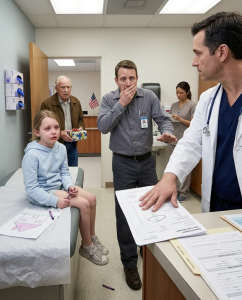
By 1:38 p.m., Lily was sitting on an exam table at Columbus Pediatrics.
The paper sheet under her made a soft crinkling sound every time she shifted.
Her sneakers swung above the floor.
The bracelet from my gift sat loose on her wrist.
She looked small under fluorescent light.
Too pale.
Too patient.
Too used to waiting for adults to decide what happened next.
The nurse came in with an intake form on a clipboard.
She asked about sleep.
Appetite.
Headaches.
Dizziness.
Medication.
Vitamins.
Lily looked at me when the nurse said vitamins.
I kept my voice even.
“That’s one of the things we’re here to discuss.”
Mark arrived halfway through the form.
His work badge was still clipped to his belt.
His hair was windblown.
His face had the look of a man who was irritated because fear had not fully reached him yet.
“Dad,” he said. “What is this?”
Before I could answer, Lily did.
“The bedtime juice makes me floaty.”
The nurse stopped writing.
Not paused.
Stopped.
Mark looked at Lily.
Then at me.
Then back at Lily.
“What juice?”
Lily’s shoulders lifted.
“The one Mom gives me before bed.”
Mark’s face changed a little.
Only a little at first.
That is how fear enters some men.
It does not kick the door open.
It turns the knob.
The doctor came in a few minutes later.
He spoke softly to Lily.
He did not crowd her.
He asked about taste, sleep, dreams, mornings, school, stomachaches, dizziness.
Lily answered in pieces.
The juice tasted bitter under the fruit taste.
She slept hard.
Sometimes she woke up with a dry mouth.
Sometimes she did not remember brushing her teeth.
Sometimes her legs felt like balloons.
Mark sat down when she said that.
The doctor ordered a blood draw, a urine screen, and a toxicology panel.
Clinical words can sound calm even when they are carrying terror.
The nurse explained everything to Lily before touching her.
Mark held her hand for the blood draw.
I stood behind him with one palm on his shoulder.
His shirt was damp at the collar.
At 2:24 p.m., the samples were sent.
At 2:31 p.m., the doctor documented Lily’s statement in the medical record.
At 2:42 p.m., Mark stepped into the hall and stared at his phone without calling anyone.
I knew he wanted to call Natalie.
I also knew he was finally afraid of what she might say.
“Dad,” he whispered, “you really think…”
He could not finish it.
I did not make him.
“I think Lily told us something we have to take seriously.”
That was the safest sentence in the world.
It was also the heaviest.
Back in the room, Lily colored on the paper sheet covering the exam table.
She drew a crooked purple house.
A yellow sun.
Three stick people.
Then she paused and added a fourth person standing far away by the fence.
“Who’s that?” I asked.
She shrugged.
“I don’t know.”
Children draw what they cannot say.
Mark watched the purple crayon move.
His jaw tightened.
I saw the exact second he stopped defending the idea of his home and started looking at his daughter.
At 3:52 p.m., the doctor returned.
He held a printed lab report.
The story continues — don’t miss what happens next