The first sound Mallory Hayes remembered after nearly dying was not a voice.
It was a monitor.
Beep.
Pause.
Beep.
The machine counted time with a patience that felt almost cruel, as if it had no opinion about whether she stayed in the world or slipped out of it.
Fluorescent light pressed down through the ceiling panel above her hospital bed.
The room smelled like disinfectant, cold metal, and the lemon hand lotion nurses used after washing their hands too many times.
Mallory tried to swallow and felt pain scrape down her throat.
A man’s voice whispered from her left.
“Easy.”
She turned her head and saw Ethan folded into a narrow blue hospital chair beside her bed.
Her husband looked like someone had removed days from his life by force.
His shirt was wrinkled, his beard had grown unevenly, and purple shadows sat beneath his eyes.
One hand covered hers.
The other still held a paper cup of coffee with a skin formed over the surface.
When he realized she was awake, his face collapsed with relief.
“Oh, thank God.”
He stood so quickly the chair legs scraped the floor.
Mallory was thirty-three years old, a senior payroll manager in downtown Omaha, and the sort of person other people called when life went sideways.
At work, that meant missing checks, tax forms, angry employees, and quarterly deadlines.
At home, that meant her parents’ utility bills, her sister’s overdraft fees, and every family emergency that somehow always arrived when Mallory was tired, paid, and available.
She had spent years believing responsibility was proof of love.
Her family had encouraged that belief without ever naming it.
Her mother called her practical.
Her father called her reliable.
Her younger sister called her dramatic when Mallory asked to be paid back.
Ethan called it something else.
“They use you,” he had told her more than once.
Mallory always defended them.
They were family.
That sentence had covered a thousand small injuries.
It covered the night she drove forty minutes to fix her mother’s internet because her father said the customer service line was “for people with patience.”
It covered the property tax bill Mallory paid after her father forgot the deadline and acted like the county had personally betrayed him.
It covered the sister who cried in parking lots after spending money she did not have, then stopped crying the moment Mallory transferred cash.
Trust is not always a beautiful thing.
Sometimes it is just the door you leave unlocked for people who already know where you keep the money.
The last thing Mallory remembered before the hospital was standing near the copier at work with reports pressed against her chest.
Her coworker Jenna had called her name from the hallway.
The carpet tilted under Mallory’s shoes.
The ceiling rushed toward her.
Then there had been nothing.
“How long?” she managed to ask Ethan.
His grip tightened around her hand.
“Nine days since you collapsed,” he said. “You were unconscious for most of it.”
Nine days did not sound real.
It sounded like a number from someone else’s disaster.
A nurse named Carla entered after Ethan called for help.
She had silver braids pinned into a neat knot and a gentle steadiness that made the room feel less frightening.
She checked Mallory’s monitor, shined a light into her eyes, and adjusted the blanket over her legs.
“You gave everybody quite a scare,” Carla said.
Everybody.
Mallory looked toward the window.
There were two empty visitor chairs there.
No flowers from her mother.
No balloon from her father.
No sticky note from her sister on the whiteboard.
The only personal objects in the room were Ethan’s jacket, Jenna’s paperback novel, and a small grocery-store bouquet drooping in a plastic pitcher.
“Where are they?” Mallory asked.
Ethan looked at Carla.
It was only a glance.
It told her more than an answer would have.
“My parents,” Mallory said. “Did anyone call them?”
Carla lowered her clipboard.
“We used every emergency contact listed in your file,” she said carefully.
Mallory watched her face, already afraid of what kindness was trying to soften.
“And?”
“Your mother answered twice,” Carla said. “Your father returned one call. They told us they had several things happening and would come when their schedule allowed.”
The words sat in the sterile room like something rotten.
“When their schedule allowed?”
Carla’s expression tightened.
“We made it clear your condition was critical.”
Mallory stared at the empty chairs.
Her parents lived forty minutes away.
Her sister lived twenty-five minutes away.
She had lain unconscious for nine days while machines and nurses and Ethan fought to keep her body attached to this life.
Not one of them had walked through the door.
For the first few days after she woke, Mallory kept asking questions she already knew the answer to.
Maybe they had been turned away.
Maybe the hospital had made a mistake.
Maybe her father had written down the wrong room number.
Ethan did not argue with her.
He just opened the folder he had started building during her admission.
The folder contained the hospital intake form.
It contained the emergency contact call log.
It contained the notation from Nebraska Medical Center that read FAMILY NOTIFIED — CONDITION CRITICAL.
It contained the 3:17 PM workplace incident report Jenna had filed after Mallory collapsed beside the copier.
It contained the ambulance dispatch record and Jenna’s email to Mallory’s emergency contacts.
There were dates.
There were times.
There were names in black ink.
Proof has a texture when love fails.
Paper edges. Time stamps. Signatures. The ugly comfort of records that cannot be guilted into changing their story.
Mallory read everything with the hospital blanket pulled to her waist and Ethan’s hand resting near her knee.
On day eleven, her sister sent a text asking whether Mallory knew the password to the streaming service.
Mallory stared at it for almost a minute.
Then she turned the phone over without answering.
On day fourteen, her mother sent a message that said, Hope you’re better.
No question mark.
No visit.
No apology.
On day sixteen, her father forwarded a joke about hospital food.
Mallory did not laugh.
She did not respond.
Her body recovered slower than her mind wanted it to.
Standing made her dizzy.
Walking to the bathroom felt like crossing a field.
Her muscles trembled after small tasks, and sometimes she woke at night with the memory of the monitor still ticking in her ears.
Ethan stayed beside her through all of it.
Jenna brought clean socks, dry shampoo, and a paperback Mallory never managed to read.
Carla checked on her even when another nurse was assigned to the shift.
Mallory learned that care had weight.
It looked like a man sleeping badly in a plastic chair.
It looked like a coworker bringing a hairbrush.
It looked like a nurse adjusting a blanket so a frightened woman could keep a little dignity.
It did not look like silence from people who called themselves family.
When Mallory finally came home, the house felt both familiar and strange.
The living room smelled faintly of laundry detergent and the chicken soup Ethan had made and then forgotten to eat.
Her discharge folder sat on the side table beside pill bottles, a water glass, and the hospital bracelet she had cut off because the plastic made her wrist itch.
She was weak enough that Ethan walked behind her on the stairs.
She hated needing that.
He never made her feel ashamed of it.
For the first week home, Mallory slept in pieces.
She woke to take medication.
She woke because her body still expected alarms.
She woke because somewhere deep inside, she was still listening for someone who never came.
A month after she left the hospital, she was sitting at the kitchen table while Ethan made toast she only half wanted.
Her phone buzzed beside her mug.
The message was from her father.
We need $12,000 for your mother’s surgery.
Mallory read it twice.
No hello.
No how are you feeling.
No mention of the weeks she had spent half outside her own life.
Just a demand with a dollar sign.
Ethan watched her face change.
“What is it?”
She turned the phone toward him.
His expression hardened.
“Don’t,” he said.
The word was quiet.
Mallory knew exactly what he meant.
Do not explain.
Do not beg them to understand.
Do not build another bridge for people who had watched the last one burn and complained about the smoke.
Her jaw locked tight enough that her molars ached.
She opened her banking app.
She entered $1.
She sent it to her father and typed two words.
Good luck.
The reply came fast.
You selfish little witch.
Mom is sick.
You owe this family.
That sentence found the last soft part of her and cauterized it.
You owe this family.
Mallory thought of the property taxes.
She thought of the phone bills.
She thought of midnight drives, emergency transfers, swallowed insults, and the empty chairs beside her hospital bed.
She thought of Carla saying, We made it clear your condition was critical.
She did not answer.
She took screenshots.
Then she saved the $1 transfer receipt, the text asking for $12,000, and the replies that followed.
She forwarded everything to Ethan and Jenna.
Not because she expected police.
Because payroll managers learn early that anything not documented becomes a story someone else can rewrite.
A few hours later, someone knocked on the front door.
Three hard strikes.
Ethan looked through the peephole.
When he turned back, his face had gone still.
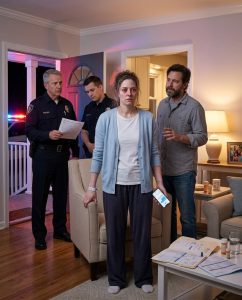
Red and blue light pulsed across the living room wall.
It washed over the discharge folder on the side table and flashed against the pill bottles.
“Mallory,” Ethan said quietly. “It’s the police.”
She stood slowly, one hand on the chair until the room stopped tilting.
Her body was still not ready for anger.
Her mind was.
When Ethan opened the door, two officers stood on the porch.
The older officer held a printed complaint.
The younger one looked past Ethan toward Mallory with the practiced caution of someone entering a domestic accusation without knowing who was dangerous.
“Mallory Hayes?” the older officer asked.
“Yes.”
“We received a report from your father. He claims funds intended for your mother’s surgery were transferred to you and that you’re refusing to return them. He also made allegations of ongoing financial exploitation.”
Ethan took one step forward.
Mallory lifted her hand.
She wanted the room clean.
She wanted the record clean.
“Officer,” she said, “may I show you something?”
The officer nodded.
Mallory opened her phone and pulled up the text thread.
First, the demand for $12,000.
Then her $1 transfer receipt.
Then her father’s words.
You owe this family.
The older officer read silently.
The younger officer shifted his weight.
Ethan went to the side table and picked up the hospital folder.
His hands were steady in a way Mallory recognized.
He had spent weeks being terrified.
Now he had something solid to hold.
He handed the officer the call log.
He handed him the intake form.
He handed him Carla’s patient-advocate note, dated the morning Mallory’s mother told the hospital they would come when their schedule allowed.
The older officer read that one twice.
His face changed.
Not dramatically.
Worse.
Professionally.
“Ma’am,” he said, “your father also requested a welfare check on your mother. He said you were withholding funds while she was in immediate surgical danger.”
Mallory looked down at her phone.
There was a new voicemail.
It was from her father.
She pressed play.
His voice filled the living room, sharp and careless, the way he sounded when he believed no outsider would ever hear him.
“You think you’re clever? You send one dollar and embarrass me? I’ll make sure everyone knows what kind of daughter you are. You either send the money tonight, or I’ll tell them you’ve been stealing from us for years.”
The recording ended.
For a moment, nobody spoke.
The red and blue lights moved across the wall again.
The younger officer looked at the older one.
Ethan’s hand found Mallory’s lower back.
The older officer folded the complaint slowly.
“Mrs. Hayes,” he said, “I strongly recommend you preserve that voicemail. Do not delete anything.”
“I won’t.”
“Do you have any reason to believe your mother is actually awaiting emergency surgery tonight?”
Mallory swallowed.
“No. I have reason to believe my father needed money and used her name because he knew it would hurt me.”
The officer nodded.
He did not apologize for coming.
Mallory did not need him to.
He had followed a report.
Her father had weaponized one.
Before the officers left, the older one gave Mallory a case number and explained how to request a copy of the report.
He also advised her to consider documenting unwanted contact.
The words were careful, official, and strangely merciful.
Documenting unwanted contact.
For most people, that phrase meant harassment.
For Mallory, it meant learning to describe family without protecting them.
The next morning, she called Nebraska Medical Center and requested certified copies of the call log and patient-advocate note.
She emailed Jenna for the original incident report from work.
She downloaded her bank statements showing years of transfers to her parents and sister.
She did not do it to punish them.
She did it because the people who had abandoned her had already tried to write themselves as victims.
By noon, her father called seven times.
Mallory did not answer.
Her mother texted, Your father is upset.
Mallory stared at the sentence and almost laughed.
Her father was upset.
Not Mallory, who had woken up to a machine counting her seconds.
Not Ethan, who had slept in a hospital chair until his back seized.
Not Jenna, who had watched her coworker collapse on office carpet.
Her father.
The center of gravity had always been wherever his discomfort stood.
Mallory typed one reply.
Do not contact me for money again.
Her mother responded fifteen minutes later.
After all we’ve done for you?
Mallory did not answer that either.
There are questions that are not questions.
They are traps wearing punctuation.
Over the next week, Mallory’s sister sent long messages alternating between panic and insult.
Dad didn’t mean it.
Mom really might need tests.
You’re tearing the family apart.
You always think you’re better than us.
Mallory saved every message.
She filed the police case number with the hospital documents.
She created a folder titled FAMILY FINANCIAL CONTACT and backed it up twice.
Ethan watched her at the kitchen table one evening, pale and focused, with a blanket around her shoulders and bank statements spread in front of her.
“You don’t have to prove anything to me,” he said.
“I know,” she answered.
Then she clicked save.
“I’m proving it to myself.”
That was the quietest turning point.
Not the police lights.
Not the voicemail.
Not even the $12,000 demand.
The real break came when Mallory understood that defending herself did not make her cruel.
It made her done.
Her father tried one more time.
He left a voicemail that began with anger and ended with a performance.
He said he had been scared.
He said hospitals made him uncomfortable.
He said her mother cried every night.
He said family should not keep score.
Mallory listened once.
Then she sent a final message in a group thread with her parents and sister.
I was in the hospital for weeks and almost died. Not one of you came to visit me, not even once. A month later, Dad demanded $12,000 and then filed a false police accusation when I refused. I have the hospital records, the bank receipt, the texts, and the voicemail. Do not ask me for money again. Do not come to my home uninvited.
Her sister replied first.
Wow.
Her mother replied next.
You have changed.
Mallory looked at that one for a long time.
Maybe she had.
Maybe nearly dying had burned away the reflex that made her apologize for bleeding on someone else’s floor.
Maybe waking up beside two empty visitor chairs had taught her what absence looked like when it stopped pretending to be busy.
Ethan came into the kitchen and found her crying quietly.
He sat beside her without speaking.
After a while, Mallory said, “I kept waiting for them.”
“I know.”
“Even after I knew. I still kept waiting.”
He put his arm around her.
She cried harder then, not because she missed who they were, but because she was finally grieving who they had never been.
In the months that followed, Mallory got stronger.
Her hands stopped shaking when she carried a mug from the counter to the table.
She returned to work part-time, then full-time.
Jenna decorated her desk with a ridiculous banner that said WELCOME BACK, PAYROLL QUEEN.
Mallory laughed so hard she had to sit down.
Carla sent a card through the hospital’s patient office after Mallory wrote a thank-you note.
Ethan framed neither the card nor the hospital records, but Mallory knew exactly where both were.
Some documents remind you what happened.
Some remind you who showed up.
Her father never sent an apology that did not come with a request attached.
Her mother never admitted she had chosen convenience over her daughter.
Her sister eventually stopped texting after Mallory stopped paying.
That silence hurt.
It also healed.
The first holiday without them was strange.
Mallory kept expecting guilt to knock the breath out of her.
Instead, she woke late, made pancakes with Ethan, and sat in the quiet kitchen while winter light moved across the floor.
There were no emergency calls.
No accusations.
No invoices disguised as love.
Only peace, which at first felt suspicious because Mallory had mistaken chaos for belonging for so long.
By spring, she could talk about the hospital without hearing the monitor in her sleep.
By summer, she could pass Nebraska Medical Center without gripping the steering wheel.
By fall, she had learned to say no without explaining it three different ways.
The police report stayed in the folder.
So did the call log.
So did the patient-advocate note.
Mallory did not look at them often.
She did not need to.
She had memorized the truth.
Her family had left the chairs empty.
Ethan had filled the room.
Jenna had shown up with socks.
Carla had written down what others wanted forgotten.
And Mallory had finally stopped confusing need with love.
Years of being useful had taught her to answer every crisis like a command.
Nearly dying taught her something harder.
A person can owe gratitude.
A person can owe kindness.
A person can owe honesty.
But no one owes their life to people who only notice them when money is missing.
When Mallory thinks back to that night now, she does not remember the accusation first.
She remembers standing in her living room, weak and shaking, with police lights moving across the wall and her hospital folder open on the table.
She remembers Ethan beside her.
She remembers pressing play.
She remembers her father’s own voice doing what years of arguments never could.
It told the truth for her.
And for the first time in her life, Mallory let the truth stand without dressing it up as forgiveness.