That was when her confidence cracked all the way through.
“What is that?” she demanded.
My father did not answer.
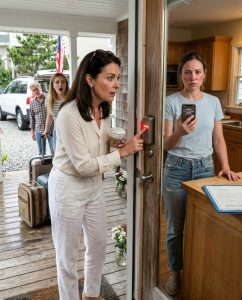
He opened the envelope with the stiff, careful movements of a man who already knows the news is bad and wants witnesses to see him take it well.
The first page slid halfway out.
I could see the top line from where I stood.
NOTICE REGARDING PROPERTY ACCESS AND NON-RESIDENCY CLAIM.
Victoria saw it too.
Her mouth tightened.
“Give me that,” she said.
My father did not.
It was the first time I could remember him refusing her something without looking at me like it was my fault.
He read silently.
The ocean kept moving behind them.
The porch flag snapped again.
Somewhere down the street, a dog barked twice and stopped.
Real life has a strange way of continuing during moments that feel like they should stop the whole world.
Paige stepped away from the suitcases.
“Mom,” she said again, quieter this time, “did you tell Dad this was already arranged?”
Victoria’s face changed.
That was answer enough.
My father lowered the page.
“Victoria,” he said, “what exactly did you tell Paige?”
She turned on him so fast the coffee in her cup sloshed against the lid.
“I told her what we discussed.”
“We didn’t discuss moving in.”
The sentence landed harder than I expected.
For twelve years, my father had lived in half-sentences around me.
Soft omissions.
Useful fog.
But this one was clear.
Victoria laughed, but it broke in the middle.
“You said family should be welcome.”
“I said she might let us visit.”
The porch went still.
Paige looked at me through the glass, then at the suitcases, then at the upstairs balcony she had already claimed out loud.
Her cheeks flushed.
For the first time, she did not look like the spoiled girl from my childhood.
She looked like a woman who had been handed someone else’s room and told it was hers.
I did not enjoy that as much as I thought I would.
That surprised me.
Revenge sounds clean in your head.
In real life, it has witnesses.
My father read the second page.
This one had bullet points.
No tenant agreement.
No ownership interest.
No permission to access the property.
No authority to assign rooms, storage, closets, or occupancy.
I watched his eyes move over each line.
He looked up at me.
“I didn’t know she had packed,” he said.
It was not an apology.
But it was closer to truth than anything he had offered me in years.
Victoria inhaled sharply.
“Oh, don’t start performing for her now.”
My father flinched.
There he was.
The man everyone else respected.
The man who could argue in courtrooms and fold inside his own family.
I thought it would feel satisfying to see him small.
It did not.
It felt like finding a leak in a wall you had lived beside for years.
You are angry, but you also understand how long the damage has been spreading.
I opened the door wider.
Only a little.
Enough for them to see the chain lock still held.
Enough for them to see me.
“Dad,” I said, “did you tell Victoria she could move into my house?”
He looked down at the paper.
Then he looked at the suitcases.
Then he looked at the balcony.
“No,” he said.
Victoria made a sound under her breath.
I had heard that sound before.
It was the sound she made when a clerk questioned a coupon, when a server brought her tea without lemon, when a teenage me said I wanted to keep one of my mother’s sweaters.
It was the sound of the world failing to arrange itself around her fast enough.
“This is ridiculous,” she said. “We are family.”
“You are not moving in,” I said.
The sentence came out calm.
That was the strangest part.
No shouting.
No trembling.
No courtroom speech.
Just six words standing where I had never been allowed to stand.
Victoria leaned closer to the door.
“You think a folder makes you powerful?”
“No,” I said. “I think ownership does.”
Her eyes flicked behind me toward the kitchen.
I knew she was looking for the folder.
Even now, she wanted the object.
The proof.
The thing she could grab, dismiss, question, smear, misplace.
So I did not touch it.
I left it in the drawer.
There is a kind of power in not performing your evidence for people who would never believe you anyway.
My phone rang then.
The attorney’s number.
I answered on speaker.
“Good morning,” he said. “I received confirmation of the failed access attempt and the notice delivery. Are the parties still on the porch?”
Victoria went pale.
My father closed his eyes.
“Yes,” I said.
“Then please keep the door locked,” he said. “Do not permit entry unless you choose to do so. Your documentation is complete. Your position is clear.”
Documentation.
Complete.
Position.
Clear.
Words I had once thought belonged only to other people.
Victoria straightened.
“This is absurd,” she said loudly, as if volume could turn a driveway into her living room. “She is humiliating us.”
My father opened his eyes.
“No,” he said.
Victoria turned toward him.
He looked at the suitcases again.
“She bought a house,” he said. “We brought luggage.”
Nobody spoke.
Paige looked down at her suitcase handle and let go.
The handle snapped back into place with a cheap plastic click.
It sounded final.
I did not invite them in.
That part matters.
There were years when I would have opened the door out of panic, made coffee, apologized for the tension, cleared a closet, and then spent months trying to reclaim a life I had paid for.
But the chain stayed fastened.
The keypad stayed red.
The blue folder stayed in the drawer.
My father folded the notice along its original crease.
“I’m sorry,” he said.
He said it to me.
Victoria laughed again, but this time it did not land anywhere.
I wanted to say twelve years’ worth of things.
I wanted to tell him about my mother’s scarves.
About the bedroom.
About Paige’s tutoring bill.
About every time he had called surrender peace.
Instead, I said, “You can start by taking your luggage out of my driveway.”
His face tightened.
Then he nodded.
Victoria stared at him as if he had betrayed her by recognizing gravity.
Paige moved first.
She picked up her suitcase without looking at me.
Halfway down the steps, she stopped.
“I didn’t know,” she said.
I believed her on one point only.
She had known how to enjoy what was handed to her.
She had not known what it cost.
My father loaded the suitcases back into the SUV.
The garment bag swung once, then disappeared behind the hatch.
Victoria stood on the porch until she realized nobody was waiting for her final word.
That was when she walked down the steps.
Slowly.
Carefully.
As if pride had weight.
Before she got into the SUV, she turned back.
“You’ll regret shutting out your family.”
I looked at my father.
For once, he did not correct me.
For once, he did not tell me to be kind, flexible, understanding, patient, smaller.
I looked back at Victoria.
“I’m not shutting out my family,” I said. “I’m locking my door.”
The SUV backed out of the driveway at 10:26 a.m.
I remember the time because my phone still had the alarm alert open.
I stood behind the glass until the street was empty.
Then I closed the door.
The house did not feel triumphant.
It felt quiet.
Quiet in the way a hospital room feels after machines stop beeping.
Quiet in the way a child’s bedroom feels after someone finally stops packing boxes.
I walked into the kitchen and opened the drawer.
The blue folder was still there.
Untouched.
I pressed my palm flat over it and let myself shake.
Not from fear this time.
From release.
Later that afternoon, I hung my mother’s beach photo in the hallway.
I used the nail I had been saving.
The frame sat a little crooked at first, and I almost fixed it immediately.
Then I didn’t.
My mother had laughed crooked in the picture anyway.
The Atlantic moved beyond the balcony.
The porch flag flicked in the wind.
The house smelled like salt, lemon oil, cooling coffee, and flowers that would probably not last through the week.
For twelve years, I had been trained to expect the door to open and someone else to decide where I belonged.
That morning, the door stayed shut.
And for the first time in my life, that was not loneliness.
It was peace.
END!