“Eleanor,” he whispered, “they put our daughter on a collection sheet.”
Mia made a small sound behind me.
Not crying.
Not yet.
Just the sound of a kid realizing the adults had not misunderstood her.
They had meant it.
I opened the FAMILY TRANSFERS folder.
I selected the screenshots.
Every month.
Every amount.
Every quiet little rescue I had been told not to mention.
I attached them to the chat.
Then I typed.
Since everyone wants to discuss family responsibility, let’s discuss the money I’ve been sending every month since 2019.
I sent the screenshots.
This time, the silence lasted longer.
A full minute passed.
Then two.
Heather typed and stopped.
Leo typed and stopped.
My mother called again.
I declined it.
Then I wrote another message.
Effective today, all recurring transfers are canceled. Mom and Dad’s mortgage gap, Heather’s mortgage top-up, Heather’s kids fund, Leo’s support, and the family utility payment. Do not contact Mia about money again.
I pressed send.
The phone did not ring for ten seconds.
Then it began ringing like the house was on fire.
By 6:08 p.m., I had 17 missed calls.
By 7:12, there were 34.
By the next morning, there were 53.
My mother left voicemails.
Her first one was angry.
Her second one was wounded.
Her third one used the word selfish four times.
The fourth was my father, saying they had bills coming due and I was being cruel at the worst possible time.
Heather sent a paragraph about how Sophie had already been promised horse camp.
Horse camp.
That was the $900 birthday present.
Not medicine.
Not rent.
Not food.
Horse camp.
A 12-year-old girl had scrubbed a neighbor’s house until her hands hurt so her cousin could go to horse camp.
That was the moment the last soft place in me hardened.
I called Mrs. Novak that morning.
I did not accuse her of anything.
She was horrified when I explained what had happened.
She told me Mia had insisted on cleaning baseboards, the inside of the trash cabinet, and the bathroom grout.
“I thought she was saving for something special,” Mrs. Novak said, her voice shaking. “I never would have let her work that hard if I had known.”
I believed her.
She brought over a plate of muffins an hour later and cried on our porch.
Mia accepted one because she is kinder than the people who tried to use her.
At 9:30 a.m., my mother came to the house.
She did not call first.
She knocked like she had authority over the door.
Thomas answered.
I stood behind him in the hallway.
Mia was upstairs.
My mother looked past Thomas and aimed her voice at me.
“This has gone far enough.”
She was wearing the beige cardigan she wore when she wanted to look soft in public.
Behind her, my father sat in the car with the engine running.
A small American flag on our porch moved in the morning wind between us.
It was such an ordinary detail.
Such a normal front-porch morning.
That made the whole thing uglier.
“You told my daughter she was no longer family if she didn’t pay $100,” I said.
My mother pressed her lips together.
“I was teaching her responsibility.”
“No. You were teaching her that love can be revoked over cash.”
“Don’t twist my words.”
“I’m quoting them.”
For once, she did not have a clean answer ready.
Thomas held the door but did not move aside.
“You need to turn the payments back on,” Mom said.
There it was.
Not Mia.
Not her hands.
Not the threat.
The payments.
“No,” I said.
My mother’s face changed.
It was small, but I saw it.
The shock of a person who had always assumed a button would keep working because it always had before.
“Your father and I count on that money.”
“Then you should have treated the person sending it with more respect.”
“We are your parents.”
“And I am Mia’s mother.”
That stopped her.
Not because it moved her.
Because it reminded her there was another hierarchy in the room.
My phone buzzed in my pocket.
Heather.
I ignored it.
My mother lowered her voice.
“You are going to tear this family apart over one sentence?”
I looked at her for a long moment.
I thought about my 12-year-old self handing over babysitting money.
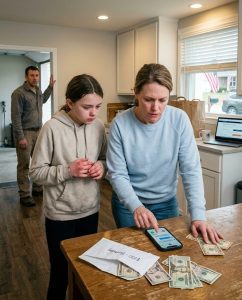
I thought about Mia rubbing her sore fingers under the kitchen table.
I thought about the phrase personal responsibility written beside my daughter’s name.
“No,” I said. “You tore it. I just stopped paying to hold it together.”
My mother stepped back as if I had slapped her.
I had not raised my voice.
That seemed to bother her most.
People who train you to explode know how to call you unstable.
People who train you to stay calm do not know what to do when calm turns into refusal.
My father got out of the car then.
He looked smaller than I remembered.
Not fragile.
Just exposed.
“Ellie,” he said, using the childhood nickname he only used when he wanted something. “We can talk about all this.”
“We already did. For years. Every time I sent money. Every time I said yes. Every time you watched Mom treat my child like she owed dues.”
He looked at the porch floor.
My mother glared at him for looking away.
That was when I understood something else.
She had controlled the script, but he had signed it by silence.
Heather pulled into the driveway ten minutes later in her SUV.
Sophie was not with her.
Thank God.
Heather got out holding her phone like evidence.
“Do you know what you’ve done?” she demanded.
“Yes.”
“Sophie is crying.”
“Mia cried too. You didn’t ask about that.”
Heather’s eyes flicked away.
Only for a second.
But I saw it.
“Mom was trying to make it fair,” Heather said.
I almost laughed.
There was no humor in it.
“Fair would be adults paying for the child they are celebrating. Fair would be not assigning another child a $100 debt. Fair would be asking me, not threatening Mia.”
Heather hugged her arms around herself.
She looked less polished in the daylight.
More tired.
More human.
But tired people can still be cruel when cruelty benefits them.
“You always act like you’re better than us because you help,” she said.
“No,” I said. “I acted like helping was love. You all acted like it was rent.”
The words landed.
Heather’s mouth opened, then closed.
My mother whispered, “Enough.”
But it was not enough.
Not anymore.
I turned to Heather.
“You asked my daughter for $100 toward Sophie’s horse camp. Do you understand how insane that sounds?”
Heather flushed.
“It wasn’t just horse camp. It was her birthday experience.”
“Mia’s experience was cleaning bathroom grout.”
Nobody answered.
A car passed slowly on the street.
Somewhere down the block, a dog barked.
The world kept being ordinary around us, which felt unfair.
Then the front door behind me opened.
Mia stood there.
She had put Band-Aids around two fingers, clumsy and crooked.
Her hoodie sleeves were pulled over her wrists.
Everyone turned.
My mother’s face softened instantly, but not with remorse.
With performance.
“Mia, honey—”
Mia stepped behind me.
She did not speak to my mother.
She looked at Heather.
“Is Sophie mad at me?”
Heather’s face crumpled a little.
For the first time all morning, she looked ashamed.
“No,” she said quietly. “No, sweetheart.”
Mia nodded, but she did not believe her.
That was the damage.
Not the money.
Not the party.
The question.
A child had been taught to wonder if another child’s disappointment could make her disposable.
I put an arm around Mia’s shoulders.
“Go back inside,” I said gently.
She went.
The door closed.
My mother wiped her eyes like she was the injured one.
“See what you’re doing to her?” she said.
Thomas spoke before I could.
“No, Linda. We saw what you did to her.”
My mother looked at him like he had no right to exist in the conversation.
He did not blink.
That was when my father finally said something that mattered.
“Linda,” he said, “we shouldn’t have asked the girl.”
My mother whipped toward him.
“Don’t start.”
He looked at me, not her.
“We shouldn’t have.”
It was not enough.
Not even close.
But it was the first honest sentence one of them had spoken.
Heather sat down on the porch step and covered her mouth.
Her shoulders shook once.
She was not fully changed.
People do not transform in one driveway.
But she had seen Mia’s hands.
Sometimes the truth has to borrow a child’s fingers to become visible.
I told them the terms before anyone could turn the moment into a group apology I would be expected to accept.
No one would contact Mia directly about money.
No one would tell her she owed love, attendance, affection, forgiveness, or silence.
The transfers would remain canceled.
If my parents needed help, they could speak to a financial counselor, a lender, their church office, or their adult children as a group.
Not to my child.
Not through shame.
Not through me by default.
My mother said I was being cold.
I said cold was making a 12-year-old believe she had to buy her place in a family.
My father said they would leave.
Heather stood up slowly.
Before she got into her SUV, she turned back.
“I’ll talk to Sophie,” she said.
“Good,” I replied. “Start by telling her the truth.”
They left in three separate kinds of silence.
My mother furious.
My father hollow.
Heather shaken.
Thomas closed the door and leaned his forehead against it for a second.
Then he turned around and found Mia sitting on the stairs.
Of course she had heard some of it.
Kids always hear more than adults think.
She looked at me and asked, “Am I still going to have cousins?”
I sat beside her.
The stairs creaked under my weight.
“I hope so,” I said honestly. “But if someone only stays your cousin when you pay, that is not a cousin problem. That is an adult problem.”
She leaned against me.
Carefully.
Her hands rested in her lap.
I wanted to rewind the world back to before she knew any of this.
I could not.
So I did the only thing I could do.
I stayed.
That afternoon, I took her to the drugstore for hand cream and proper bandages.
We got milkshakes from the drive-thru on the way home because she asked, and because sometimes repair looks like whipped cream and a cherry in a plastic cup.
Sophie called that evening.
Not Heather.
Sophie.
Mia took the call in the living room on speaker because she wanted me nearby but did not want me to talk.
Sophie sounded embarrassed.
“I didn’t know Grandma said that,” she whispered.
Mia looked at me.
I nodded once.
“Okay,” Mia said.
There was a long pause.
Then Sophie said, “I don’t want you to pay for my birthday.”
Mia’s face changed.
Only a little.
But I saw the first thread of relief.
“Okay,” she said again.
They did not fix everything in that call.
They talked about school.
About a math test.
About a girl in their grade who had cut her own bangs and pretended it was intentional.
Normal things.
Blessedly normal things.
After Mia went to bed, I checked my phone.
There were 53 missed calls total.
I did not return them.
I opened the banking app instead.
All the recurring payments showed canceled.
For the first time in years, nothing was scheduled to leave my account in the name of family guilt.
Thomas stood behind me and placed a mug of tea on the table.
“You okay?” he asked.
I thought about it.
The answer was not yes.
Not exactly.
But it was not no either.
“I will be,” I said.
The next morning, Mia came downstairs wearing one of Thomas’s old hoodies.
Her hands still looked sore, but she held her cereal bowl without hiding them.
That mattered.
Small things matter after big hurts.
A child stops whispering.
A mother stops paying.
A family learns that access to your life is not the same as ownership of it.
Mia sat at the kitchen table in the same chair as the day before.
This time, her palms were not pressed flat against the wood.
They were wrapped around a warm bowl, held carefully in the morning light.
And when my phone started ringing again, she looked at it, then looked at me.
“Are you going to answer?” she asked.
I smiled a little.
“Not right now.”
She nodded.
Then she took a bite of cereal.
For the first time in two days, my daughter ate like she was not trying to earn the right to sit at the table.
You don’t pay for love.
And if someone says your place in the family costs money, that is not love.
That is a transaction.
I had spent most of my life paying it.
Mia would not spend one more minute believing she had to.
END!