“Mrs. Brooks was never the recipient.”
For a moment, the room did not seem to understand the words.
They hung there, plain and impossible, beneath the steady beeping of the heart monitor and the quiet hiss of air through the vents. I stared at Dr. Hale, trying to make my mind connect one thought to the next.
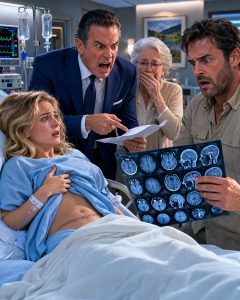
Never the recipient.
My kidney was gone.
Vivian was sitting there in her shawl, pale but very much unchanged, the same faint arrogance frozen on her face.
Adrian’s hand slipped from the folder.
The divorce papers slid against the hospital blanket, their corners brushing the edge of my bandage.
“What are you talking about?” he asked.
His voice had lost its smooth confidence. It came out thin, almost boyish.
Dr. Hale did not look away from him.
“I’m saying the transplant scheduled for your mother was canceled before it began.”
Vivian’s fingers tightened around the armrests of her wheelchair.
“That’s impossible. I was prepped. They took me down.”
“You were taken to pre-op,” Dr. Hale said carefully. “Then your vitals became unstable. The surgical team determined the procedure could not continue safely.”
“But Elena had surgery,” Adrian said.
“Yes.”
The room went still again.
I swallowed, but my throat felt scraped raw.
“Doctor,” I whispered, “please tell me what happened.”
His expression softened when he turned to me.
“Elena, I need you to listen carefully. You are stable. The surgery went well. But there are serious matters involving consent, medical records, and donor assignment that we are now investigating.”
“Donor assignment?” Cassidy repeated.
She had moved closer to Adrian without seeming to realize it, one hand resting protectively on her stomach.
Dr. Hale glanced at her only briefly.
“Mrs. Brooks’ kidney was transplanted into another patient.”
The world narrowed to a bright white point.
Another patient.
Not Vivian.
Not the woman who had wept at our kitchen table, gripping my hands, calling me her miracle.
My kidney was inside someone else.
I tried to sit up. Pain sliced through my side so sharply that my vision blurred. A nurse placed a firm but gentle hand on my shoulder.
“Easy,” she murmured. “Don’t move like that.”
“Who?” I asked. “Who has my kidney?”
Dr. Hale hesitated.
It was the smallest pause, but I saw it.
So did Adrian.
“This is absurd,” he snapped. “You don’t get to stand here making accusations and withholding information.”
“I am protecting a patient’s privacy,” Dr. Hale said. “Something everyone in this room should have done.”
Adrian’s face flushed.
“You’re implying I did something wrong?”
“I am stating that a donor recovering from major surgery was found with legal documents placed on her body and a pen in her hand while she was under medication and distress. That alone is enough for hospital security to become involved.”
The second physician standing behind him shifted slightly, as if the word security was not an empty one.
Vivian finally spoke.
Her voice was quieter now.
“If I didn’t receive the kidney, then why was Elena taken into surgery at all?”
Dr. Hale opened the medical file.
“That is one of the questions we are working to answer.”
His gaze moved toward Adrian again.
“And it appears the answer may begin with the documents submitted to the transplant committee.”
Adrian blinked.
“What documents?”
“Compatibility summaries. Donor intent forms. Family-history disclosures.”
“I signed what your office gave me.”
“No,” Dr. Hale said. “Mrs. Brooks signed what was presented to her by hospital staff after verification. But several supporting records did not originate from our office.”
Vivian turned her head sharply toward Adrian.
“Adrian?”
He looked at her, then away.
It was quick, but not quick enough.
Something moved through my chest that was colder than fear.
I knew that look.
I had seen it when a credit card bill arrived once and he told me it had to be a clerical error. I had seen it when Vivian accused me of ruining one of her charity luncheons because the florist delivered the wrong color lilies, and Adrian shrugged helplessly as though truth were less useful than silence.
But this time, silence had cut into my body.
“Adrian,” I said, my voice barely above a breath. “What did you do?”
He stepped toward me, lowering his voice as if we were alone.
“Elena, don’t let him confuse you. Hospitals make mistakes. You know how complicated these things are.”
I stared at him.
He had always been good at that tone. Warm enough to sound like comfort. Calm enough to sound like authority. He used to speak to me that way when I questioned why his mother never invited me to family dinners unless she needed help setting the table. When Cassidy’s name popped up on his phone after midnight. When I caught him moving money from our joint savings account and he said it was for “family obligations.”
Family.
That word had been a room I kept knocking on, never realizing no one intended to let me in.
“Don’t talk to me like I’m confused,” I said.
His mouth tightened.
Dr. Hale nodded to one of the nurses. “Please remove those documents from the patient’s bed.”
The nurse lifted the divorce papers carefully, as though they were contaminated.
Adrian reached for them.
“Those are private legal papers.”
“They are not appropriate in this room,” Dr. Hale replied.
Vivian’s face had changed. The disdain was still there, but uncertainty had cracked it. She turned to me, and for the first time since she entered, she actually looked at me.
Not through me.
At me.
“Elena,” she said slowly, “did you know the kidney wasn’t for me?”
I laughed once, softly, but there was no humor in it.
“I woke up thinking I saved your life.”
Vivian lowered her gaze.
Cassidy shifted uncomfortably. Her earlier smile had vanished completely.
“I think I should sit down,” she whispered.
No one moved to help her.
At last, Dr. Hale turned to the second physician.
“Dr. Park, would you please stay with Mrs. Brooks while I call hospital administration?”
Dr. Park stepped forward. She was younger than Dr. Hale, with composed eyes and a silver badge clipped to her coat.
“Of course.”
Then Dr. Hale looked at me.
“Elena, I’m going to ask security to escort nonessential visitors out for now. You need rest, and you need an advocate who is not connected to the Brooks family. Is there anyone you trust that we can call?”
The question struck me harder than it should have.
Anyone I trust.
For years, I had answered that question with Adrian’s name. Automatically. Gratefully. Like a person clutching a single candle in a dark house.
Now that candle had gone out.
I searched my mind. My parents were gone. My aunt who raised me had passed three winters ago. I had friends, but I had let so many of them drift away because Adrian said they didn’t understand our life.
Then a name surfaced.
“Mara,” I said.
My voice cracked.
“Mara Singh. She’s my friend. She works at a school. Her number is in my phone.”
The nurse smiled gently.
“We’ll find it.”
Adrian drew himself up.
“This is unnecessary. I’m her husband.”
Dr. Hale’s voice became very calm.
“At this moment, Mr. Brooks, that does not give you unlimited access to her.”
“Are you removing me from my wife’s hospital room?”
“I am asking you to leave so my patient can recover safely.”
Adrian’s eyes flicked to the second doctor, then the nurses, then me. I watched him calculate. He had always calculated quickly. Which face to wear. Which truth to bend. Which apology to perform.
At last, he took a step back.
“Elena,” he said, “we’ll talk when you’re less emotional.”
The old me would have flinched. The old me would have worried that I was making things worse.
But something had been taken from me under anesthesia, and with it went the last soft piece of my belief in him.
“No,” I said. “We’ll talk when I have a lawyer.”
His expression hardened.
Vivian made a small sound.
Cassidy stared at me as though I had suddenly become someone else.
Maybe I had.
Security arrived quietly. Two officers in dark uniforms appeared in the doorway, polite but unmistakable. Adrian looked as if he wanted to protest, but Dr. Hale stood between him and my bed, and for once, my husband did not control the room.
Vivian was wheeled out by a nurse. She did not look at me again.
Cassidy paused near the door.
For a second, I thought she might say something cruel, or triumphant, or defensive.
Instead, she looked frightened.
“Elena,” she whispered, “I didn’t know.”
Adrian turned on her.
“Cassidy.”
She lowered her eyes and followed him out.
When the door closed, the room felt enormous.
The steady beeping of the monitor became the only proof that I was still here.
I began to shake.
Not dramatically. Not the kind of shaking people notice in movies. It started in my fingers and moved up my arms until the blanket trembled.
The nurse, whose name tag read Louise, touched my shoulder.
“You’re safe for now,” she said.
For now.
Those two words stayed with me.
Dr. Park adjusted the IV line and checked the monitor.
“Elena, your body has been through a lot. Emotional distress can intensify pain. I’m going to give you something mild to help, but you’ll still be able to speak with Dr. Hale when he returns.”
“I don’t want to be foggy,” I said quickly.
Too quickly.
The fear rose sharp in my throat.
“I signed things when I trusted people. I don’t want to sign anything else. I don’t want anyone making decisions while I’m sleeping.”
Dr. Park’s eyes softened.
“You don’t have to sign anything. And I will place a note in your chart now that no visitors are allowed without your direct verbal consent while you are awake and oriented.”
Awake and oriented.
Such clinical words.
Such precious words.
I nodded, and tears slipped sideways into my hair.
“I feel stupid,” I whispered.
Louise shook her head.
“No. You feel betrayed. That’s different.”
The sentence broke something open in me.
I cried then. Quietly at first, then with a force that made my side ache until Dr. Park reminded me to breathe shallowly, carefully. I cried for the kidney, yes, but also for the years before it. The dinners where I laughed too quickly. The birthdays Adrian forgot but expected me to forgive. The way Vivian introduced me as “Adrian’s wife” but never as family. The way I had mistaken being needed for being loved.
After a while, the door opened again.
Dr. Hale returned, and behind him was a woman in a charcoal suit with kind, serious eyes.
“Elena,” he said, “this is Naomi Wells from patient advocacy. She’s here for you.”
For me.
Not for Adrian. Not for Vivian. Not for the Brooks name.
For me.
Naomi pulled a chair beside my bed.
“I know this is overwhelming,” she said. “My role is to help protect your rights as a patient and make sure you understand each step before anything happens.”
I wiped my face.
“Can you tell me where my kidney went?”
Naomi glanced at Dr. Hale.
Dr. Hale exhaled slowly.
“We can’t disclose another patient’s identity without authorization. But I can tell you this: the recipient was in critical need, and the transplant was medically successful.”
My emotions tangled together until I could not separate them.
Relief that the kidney had saved someone.
Anger that I had not been told.
Fear that my body had been used in a story I didn’t know.
“Was it an accident?” I asked.
Dr. Hale did not answer immediately.
“That is under review.”
Naomi leaned forward.
“Elena, there are different possibilities. A clerical error. A breakdown in communication. Or intentional misrepresentation by someone involved before the hospital received the final documents. We don’t know yet.”
“But you suspect something.”
Dr. Hale’s jaw tightened.
“I suspect enough that I halted routine discharge processing and contacted the transplant ethics board.”
The words felt too large for the room.
Transplant ethics board.
I had entered the hospital as a wife trying to prove her love.
Now I was evidence.
“Did Adrian know?” I asked.
Naomi’s expression remained careful.
“We cannot state that yet.”
But I remembered his face.
I remembered the split second after Dr. Hale said Vivian was never the recipient.
Adrian had not looked confused first.
He had looked afraid.
A soft knock sounded.
Louise opened the door and leaned in.
“Elena? Your friend Mara is here. She says she’ll leave immediately if you don’t want visitors.”
Fresh tears filled my eyes.
“She came?”
“She came fast.”
“Please let her in.”
Mara entered like a storm trying to behave politely.
She wore a mustard cardigan over a blue dress, her dark curls tied up messily, and her eyes were red before she even reached the bed. She stopped when she saw me, one hand flying to her mouth.
“Oh, Elena.”
That was all she said.
Then she crossed the room and took my hand, carefully avoiding the IV.
“I’m here,” she whispered. “I’m here. I’m sorry. I should’ve pushed harder. I knew something was wrong with how fast everything was moving.”
I clung to her fingers.
“You told me to slow down.”
“I didn’t tell you enough.”
“You did. I didn’t listen.”
She shook her head.
“No. Don’t do that. Not today.”
Naomi gave us a few minutes before speaking.
“Mara, Elena has named you as a trusted support person. With her permission, you can stay while we discuss next steps.”
I nodded.
Mara sat down, her face sharpening into the expression she used when one of her students’ parents tried to bully a teacher.
“Tell us everything you can.”
Dr. Hale explained again, this time with more detail.
Vivian had been evaluated as a recipient but had developed complications the morning of surgery. My kidney had still been removed. The final matching record in the system showed a different recipient code. The switch should have triggered multiple confirmations. Somehow, those confirmations appeared complete.
“Appeared?” Mara asked.
Dr. Hale’s eyes narrowed.
“At least one electronic approval may have been entered using credentials that are now under review.”
“Are you saying someone hacked the system?” she asked.
“I’m saying someone used access they should not have used.”
My heart beat faster.
“Could Adrian do that?”
Dr. Hale looked at Naomi, then back at me.
“I don’t know.”
Mara’s grip tightened.
“Adrian’s cousin works in medical software,” she said suddenly.
I turned toward her.
“What?”
“Remember? Last Thanksgiving. You told me everyone ignored you except some cousin who kept talking about hospital databases. What was his name?”
“Graham,” I whispered.
Graham Brooks.
I had almost forgotten him because, in the Brooks family, people appeared and disappeared depending on usefulness. Graham was Adrian’s cousin, quiet, restless, always checking his phone. Vivian once called him “brilliant but unreliable.” Adrian had helped him get consulting work, or so he said.
Dr. Hale’s expression changed just slightly.
“Graham Brooks?”
“Yes,” Mara said. “Does that mean something?”
He closed the file.
“It may.”
Naomi stood.
“I’m going to document that. Elena, I need to ask: did anyone explain to you, clearly, that your kidney might be given to someone other than Vivian Brooks?”
“No.”
“Did you agree to donate to an anonymous or alternate recipient?”
“No.”
“Did you sign any form indicating you would participate in a paired donation chain?”
I searched my memory.
The days before surgery were a blur of appointments, blood tests, phone calls, Vivian’s trembling voice, Adrian’s hand on my back. Papers had been placed in front of me. Medical terms. Legal terms. Adrian saying, “It’s standard.” Vivian saying, “Please, Elena, I’m so tired.”
“I don’t know,” I said. “Maybe. I signed what they told me to sign.”
Naomi did not make me feel foolish. She simply wrote it down.
“We’ll obtain copies.”
Mara’s eyes flashed.
“And Elena gets her own copies too.”
“Yes,” Naomi said. “Absolutely.”
For the next hour, people came and went. Quiet people with badges. A hospital administrator who spoke in measured sentences. A legal liaison who looked worried beneath her professionalism. Dr. Park returned to check my pain level. Louise brought ice chips and adjusted my pillows.
Through it all, Mara stayed.
Whenever someone said “Mrs. Brooks,” she interrupted gently.
“Elena. Please call her Elena.”
At first, it embarrassed me.
Then I realized why she did it.
Mrs. Brooks belonged to them.
Elena belonged to me.
By evening, the sky beyond the hospital window had darkened to a deep violet. The city lights came on one by one, blurred by the glass. My pain had settled into a heavy pulse. I was exhausted, but sleep felt dangerous, like stepping away from a door that needed guarding.
Mara noticed.
“I’m not leaving,” she said.
“You have work tomorrow.”
“I have personal days. My students will survive one substitute. You, however, are not dealing with this alone.”
I turned my head toward the window.
“I thought he loved me.”
The words sounded small.
Mara did not rush to answer.
That was one of the reasons I trusted her. She never tried to patch a wound with the first comforting lie she could find.
“I think,” she said slowly, “Adrian loved being loved by you.”
I closed my eyes.
It hurt because it was true.
“When my parents died,” I said, “everyone told me I was brave. I hated that. I didn’t want to be brave. I wanted someone to keep me. Then Adrian came along and he was so certain. He chose the restaurant. He chose the apartment. He chose the life. I thought certainty meant safety.”
Mara brushed a tear from her cheek.
“Sometimes certainty is just control wearing a nice shirt.”
A weak laugh escaped me, and it hurt, but I was grateful for it.
A phone buzzed.
Mara picked up my cell from the bedside table and frowned.
“It’s Adrian.”
My stomach tightened.
“Don’t answer.”
“I won’t.”
It stopped.
Then immediately buzzed again.
This time, a text appeared on the screen.
Mara read it silently, and her mouth went flat.
“What does it say?” I asked.
She hesitated.
“Mara.”
She turned the phone toward me.
Adrian: Don’t let strangers turn you against me. You don’t understand what’s at stake. My mother could still die.
A second message appeared.
Adrian: Cassidy is very upset. This stress isn’t good for the baby. Please be reasonable.
Reasonable.
I stared at that word until it blurred.
“He’s still asking me to take care of everyone else,” I said.
Mara set the phone facedown.
“Not tonight.”
But the messages kept coming.
Some were soft.
I know you’re scared.
Some were sharp.
You signed consent forms.
Some were desperate.
I can explain about Graham.
That one made us both freeze.
Mara picked up the phone again.
“He mentioned Graham.”
I felt suddenly cold.
“Show Naomi.”
Mara stepped into the hall and returned a few minutes later with Naomi, who photographed the message with my permission and advised me not to respond.
“Do you feel safe with him knowing you’re here?” she asked.
I almost said yes automatically. Adrian had never hit me. He had never needed to shout often. His power was quieter than that.
But safety, I was beginning to understand, was not only about whether someone raised a hand.
“No,” I said.
Naomi nodded as if I had given the correct answer to a question I had spent years failing.
“We’ll keep visitation restricted.”
Later that night, after Mara dozed in the recliner beside my bed, I lay awake listening to the hospital.
There is a strange honesty to hospitals after midnight. The daytime performance fades. No visitors carrying flowers. No doctors surrounded by teams. Just footsteps, low voices, distant machines, the small private battles of people trying to survive until morning.
I wondered about the person who had received my kidney.
Were they awake?
Did they have family beside them?
Did they know my name?
Had they asked?
The story continues — don’t miss what happens next