Dr. Salgado said it softly, and that was how Daniel Herrera knew the news was worse than anything he had prepared himself to hear.
The pediatric suite smelled like hand sanitizer, warm plastic, and the bitter coffee Daniel had abandoned on the window ledge three hours earlier.
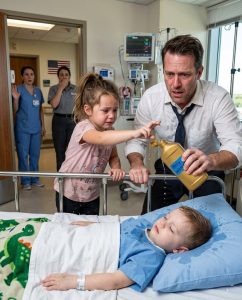
Machines breathed beside his son in small electronic beeps.
Beyond the glass, Dallas shimmered in the afternoon heat, bright and careless, like the rest of the world had been allowed to keep going.
“Mr. Herrera,” the doctor said, lowering his voice, “we’ve done everything medically possible.”
Daniel’s hand tightened around the chrome bed rail.
“What does that mean?”
He heard the crack in his own voice and hated it because he had spent his whole adult life learning how not to sound helpless.
Dr. Salgado looked at the floor for half a second too long.
“With the way the illness is progressing, your son has, at best, five days,” he said. “Maybe a week.”
Daniel stared at him.
For a moment, the whole room seemed to continue without him.
The monitor blinked.
The vent hummed.
Somewhere down the hall, a cart wheel squeaked against polished tile.
But inside Daniel’s chest, everything stopped.
Nicolás Herrera was three years old.
He was almost lost beneath white sheets, IV tubing, and a hospital wristband printed at 7:18 a.m. that morning.
Nicolás Herrera.
Nico.
The boy who used to run barefoot through the kitchen with a green dinosaur in one hand and a cracker in the other.
The boy who laughed so hard he snorted.
The boy who stretched his arms up and yelled, “Again, Daddy,” every time Daniel tossed him into the air.
Now he looked weightless.
“No,” Daniel whispered. “No. There has to be another option.”
Dr. Salgado did not interrupt him.
“Money is not the issue,” Daniel said, faster now. “I can fly in specialists. New York. Europe. Anywhere.”
“We already consulted them,” the doctor said. “This condition is rare, aggressive, and moving faster than anyone expected.”
Daniel shook his head.
He had built a career out of finding leverage where other men saw walls.
He owned properties, companies, vehicles, accounts, and favors.
He knew which calls opened doors after midnight.
But his son lay in front of him, too weak to grip a toy dinosaur, and there was no invoice Daniel could pay to make the doctor take the sentence back.
“Right now,” Dr. Salgado said gently, “all we can do is keep him comfortable and out of pain.”
Five days.
Rich men are used to hearing numbers as problems to solve.
This one was not a price, not a deadline, not a deal waiting for pressure.
It was a sentence.
After the doctor left, Daniel lowered himself into the chair beside Nico’s bed.
His knees did not feel steady.
He took Nico’s cold little hand between both of his and held it as carefully as if it might break.
Nico did not wake up.
His fingers only twitched faintly, as if he was reaching for someone in a dream.
That was when Daniel broke.
The tears came without permission.
They fell onto the blanket while the skyline blurred behind him.
He thought of Marisol in Denver for a work conference, still believing the doctors were only worried.
At 1:43 p.m., Daniel had texted her that Nico was stable.
He had not texted the truth.
He had not told his wife that doctors were now counting the last days of their child’s life.
That omission sat in his throat like a stone.
He had married Marisol eight years earlier after meeting her at a charity event where she had been the only person in the room who laughed at his dry jokes instead of his bank account.
She used to leave notes in his suit pockets before early flights.
She had painted the nursery pale yellow herself when she was pregnant because she said hired painters would not care enough about the corners.
For years, Daniel had believed their marriage was built on small proofs like that.
A hand on his shoulder at midnight.
A packed bag before a business trip.
A text reminding him to eat.
When Nico was born, Marisol cried so hard Daniel thought something had gone wrong.
Then she whispered, “He has your mouth,” and laughed through the tears.
That memory came back to him in the hospital room and hurt worse than he expected.
Because the woman in that memory was still his wife.
And his wife was somewhere else, believing he had told her enough.
Daniel pressed his forehead against Nico’s hand.
“I’m here,” he whispered.
Then the door opened.
Daniel wiped his face quickly and turned, expecting a nurse.
It was a little girl.
She could not have been more than six or seven.
Her pink shirt had faded from too many washes.
Her pants were a little too short, exposing thin ankles above mismatched sneakers.
Her dark hair was tied in a crooked ponytail, and in one small hand she carried a cheap gold plastic bottle.
It looked like the kind of bottle sold outside roadside churches, bright and flimsy, with a cap that never quite screwed on straight.
Daniel stood.
“What are you doing in here?” he said. “This is a private room.”
The girl did not even look at him.
She walked straight to Nico’s bed, climbed onto the visitor stool, and stared down at his sleeping face with a seriousness no child should have had to carry.
“He looks worse than yesterday,” she murmured.
Daniel went cold.
“Excuse me?”
The girl twisted open the bottle.
“Hey,” Daniel snapped, stepping closer. “Where are your parents?”
“I’m going to help him,” she said.
Before Daniel could stop her, she sprinkled water across Nico’s forehead.
Then she sprinkled it over his chest.
With two damp fingers, she drew a crooked little cross on his hospital gown.
“What on earth are you doing?” Daniel barked.
He lunged forward and yanked the bottle from her hand.
Water darkened the pillowcase.
A few drops slid down Nico’s gown.
The boy coughed once but did not wake.
At that exact second, a nurse hurried in.
“Mr. Herrera?” she asked. “Is everything okay?”
“This girl broke into my son’s room and poured who-knows-what on him,” Daniel said, holding up the bottle. “Get her out of here.”
The nurse’s face changed.
“Lupita,” she whispered. “Not again.”
A woman in a gray maintenance uniform appeared in the doorway, breathless, one hand still near the cleaning radio clipped to her belt.
Her hair was pinned up badly.
The dark circles under her eyes looked older than she was.
“Guadalupe,” the woman said, mortified. “I told you not to come upstairs.”
“But Mom,” the little girl said, still looking at Nico, “there’s no time. He needs the water.”
The woman turned to Daniel.
Her face had gone red with shame.
“I am so sorry, Mr. Herrera,” she said. “I work maintenance here. Sometimes I have nobody to leave her with, and she slipped away. It won’t happen again.”
Daniel still held the plastic bottle.
The label had no brand.
No seal.
Just a strip of tape with HOLY WATER written in blue marker.
“How does your daughter know my son’s name?” Daniel asked.
The woman swallowed.
“Maybe she saw it on a chart,” she said. “Maybe in the hallway.”
“That’s not true,” Lupita said, pulling away from her mother’s hand. “Nico is my friend.”
Daniel looked at her.
“What did you say?”
“We played together at daycare,” Lupita said.
The room became very still.
Nurse Angela, whose name Daniel had barely noticed on her badge before that moment, lowered her hand from the call button.
Daniel’s eyes narrowed.
“My son has never been to daycare,” he said.
Lupita frowned as if adults were being slow on purpose.
“He did,” she said. “At Aunt Marta’s house by the freeway. In the yellow room.”
The maintenance worker closed her eyes.
“Guadalupe,” she whispered.
“Two days a week,” Lupita continued. “His mommy kissed him fast and cried in the car after.”
Daniel stared at the child.
For over a year, Marisol had told him Nico stayed home with a private nanny while Daniel worked twelve-hour days.
The nanny was supposed to be experienced, discreet, and expensive.
Daniel had signed every childcare reimbursement without reading past the total because the household folder was one of the few parts of his life he had allowed himself not to question.
He trusted the papers because he trusted his wife.
Sometimes betrayal does not arrive shouting.
Sometimes it waits inside a file name you never bothered to open.
“At Aunt Marta’s,” Lupita repeated, softer now. “He had the green dinosaur lunchbox.”
Daniel’s throat tightened.
Nico did have a green dinosaur lunchbox.
Marisol had ordered it online because Nico cried when a cartoon dinosaur on the box looked “lonely” in the picture.
“He liked the crackers with the cheese in the middle,” Lupita said. “But he gave me the cheese part because he said I smiled funny when I ate it.”
The words struck Daniel harder than accusations would have.
Children could repeat names they saw on doors.
Children could overhear things in hallways.
But children that small did not invent lunchboxes, yellow rooms, cheese crackers, and mothers crying in cars.
At 2:06 p.m., Daniel pulled his phone from his jacket.
His hand was not steady.
He opened the shared expense folder.
The nanny receipts were there, neat and monthly, attached as PDFs with Marisol’s forwarded notes.
Paid.
Please reimburse.
Thanks.
The numbers were rounded.
The formatting was clean.
The signatures were scans.
Daniel stared at one receipt dated three months earlier and realized he could not remember ever hearing the nanny’s voice.
Not once.
He could not remember seeing a photo, a license, a resume, or even a phone number he had personally called.
He had been too busy being a provider to notice he had outsourced his own certainty.
“Lupita,” her mother whispered, “that is enough.”
But the little girl’s eyes stayed on Nico.
They were wet and stubborn.
“He got sick after the blue juice,” she said.
Daniel stopped scrolling.
“What blue juice?” Nurse Angela asked.
“The one Miss Tessa said was only for special naps,” Lupita said. “I told him not to drink it.”
Daniel felt the room tilt.
Nurse Angela turned very slowly toward the child.
The maintenance worker pressed her hand over her mouth.
Daniel looked from Lupita to Nico, then back to the phone in his hand.
“What did you just say?” he asked.
Lupita pointed at Nico’s bed with one trembling finger.
“If you ask the daycare lady what she did when the other kids were sleeping,” she said, “she’ll lie first.”
The words did not make sense and made too much sense at the same time.
Daniel called Marisol.
The phone rang once.
Twice.
Three times.
Then voicemail.
He tried again.
Voicemail.
He sent one text.
CALL ME NOW.
The message delivered.
No typing bubbles appeared.
Nurse Angela stepped into the hallway and spoke quietly into the nurses’ station phone.
She did not say anything dramatic.
She said words like supervising physician, social worker, and document the statement.
Those words frightened Daniel more than shouting would have.
Process had begun.
A hospital intake note was opened.
Nurse Angela asked Lupita’s mother for her full name.
The maintenance worker gave it in a voice so thin Daniel could barely hear it.
The story continues — don’t miss what happens next