The pounding started at exactly 3:00 a.m.
Not a polite knock.
Not the kind of sound a neighbor makes when a branch falls across the driveway or a dog gets loose in the rain.
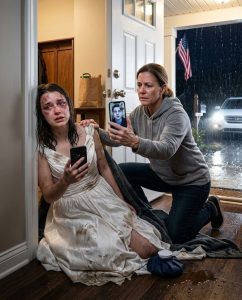
This was somebody hitting my front door with both hands, fast and uneven, like the wood itself was the only thing keeping her upright.
I woke before I understood why.
The house was dark except for the microwave clock glowing over the kitchen counter and the porch light flickering through the rain.
The gutters were overflowing, and water slapped the front steps in steady sheets.
For one foolish second, I thought it might be storm damage.
Then I heard my daughter’s voice through the door.
“Mom.”
There are sounds a mother never forgets.
The first cry.
The first time they call you from school because something hurts.
The voice they use when they are trying not to be terrified because they do not want to make you terrified too.
I opened the door, and Emily fell into my arms wearing her wedding dress.
The wedding had ended less than six hours earlier.
In the photos, she had looked like every mother hopes her daughter will look on that day.
Nervous.
Bright.
Trying to act older than she was.
Standing beside a man who had held her hand at the altar and promised to protect her in front of a room full of people who clapped like promises were easy.
Now the white satin was ripped and soaked.
The hem dragged behind her in muddy strips.
Rain had glued her hair to her face, and her makeup had run down her cheeks in gray lines.
One side of her face was swollen so badly that it changed the shape of her.
Her left wrist had red finger marks around it.
Her knees were scraped raw enough that she could barely put weight on them.
I caught her before she hit the entryway floor.
She smelled like rain, cold hotel soap, and fear.
“Mom,” she said again, and the word broke apart in her throat.
I locked the door with one hand and held her with the other.
For a second, I was not looking at a married woman.
I was looking at the little girl who used to come through that same doorway after school, kicking off sneakers, dropping permission slips on the floor, asking if we had cereal because she did not want whatever I had cooked.
She had grown up in this house.
She had measured herself against the kitchen doorframe until she was sixteen and embarrassed by the pencil marks.
She had learned to drive in the same driveway where rain was now hitting the windshield of my old SUV.
The little American flag beside my mailbox snapped hard in the storm.
It was such an ordinary sound that it made the whole thing feel worse.
I wrapped a blanket around her shoulders and guided her to the bench by the coat closet.
Her hands would not stop shaking.
“What happened?” I asked.
Emily stared at the floor as if the answer were written somewhere in the water dripping from her dress.
“He locked the honeymoon suite.”
I felt my body go still.
“Your husband?”
She nodded.
The word husband sat between us like something rotten.
“He locked the door,” she whispered. “Then his mother came out of the bedroom.”
I had met the woman four times before the wedding.
She was polished in the way some people mistake for respectable.
Cream suits.
Pearl earrings.
A voice that softened whenever strangers were close enough to hear.
She had hugged Emily at the rehearsal dinner with one hand and adjusted her necklace with the other, smiling at me like we had both been lucky to be invited into her family.
I had not trusted her.
I had told myself that was just a mother’s suspicion.
I was wrong.
Emily pressed the blanket under her chin and tried to breathe.
“They had papers,” she said. “A deed transfer.”
“The condo?”
She nodded again.
The condo was Emily’s before the wedding.
It was the one thing that was not mixed with anyone else’s name, anyone else’s money, or anyone else’s promises.
Her grandmother had left enough for the down payment, and Emily had worked until her eyes burned to keep it.
By the time the neighborhood changed and the market climbed, that condo was worth $3M on paper.
To Emily, it was not a prize.
It was safety.
It was the place she could go if life ever turned cruel.
Some people can smell safety on another person and immediately begin planning how to take it.
“They said I owed him now,” she said. “Because we were married.”
Her voice was so flat that I knew shock had taken over.
“They said if I did not sign it over before morning, they would kill me and make it look like I jumped from the balcony.”
The refrigerator hummed.
Rain struck the windows.
Somewhere near the sink, water dripped from the edge of her dress onto the tile.
I wanted to scream.
I wanted to grab my keys and drive to that hotel with nothing but rage steering the car.
For one ugly second, I imagined dragging my daughter’s new husband through the lobby by his collar while his mother watched from behind her pearls.
I did not move.
Rage feels powerful until you realize evidence is quieter and lasts longer.
“What did they do to your face?” I asked.
Emily shut her eyes.
“His mother slapped me.”
I waited.
“She counted.”
My mouth went dry.
“She said forty times,” Emily whispered. “She said, ‘Forty times, so you remember what family means.’”
I had to put my hand on the counter to keep myself upright.
Forty times.
Not one loss of control.
Not one slap thrown in a fight.
A count.
A lesson.
A performance.
Cruelty is different when somebody keeps score.
That was the moment my fear became something colder.
I took an ice pack from the freezer and wrapped it in a clean dish towel.
I placed it gently against her cheek.
She flinched anyway, and the tiny movement went through me like a blade.
“Did you sign anything?” I asked.
“No.”
“Did they get your ID?”
“No.”
“Did anyone see you leave?”
“I don’t know.”
She swallowed so hard I could hear it.
“They were arguing by the bed. He said his lawyer could fix the timing if I signed before the county clerk opened. His mother said I was more trouble than I looked. The bathroom window was small, but it opened into a maintenance ledge.”
She lifted one trembling hand and pointed toward her ribs.
“I climbed out. I left my shoes.”
Only then did I see her bare feet.
They were gray with rainwater and streaked with dirt from the hotel service path.
I knelt and wrapped another towel around them.
The mother in me wanted to pull her into my lap and rock her until the world went away.
The part of me that had survived divorce, lawyers, custody calendars, and men with expensive smiles knew the world does not go away.
It gets ahead of you if you let it.
I looked at the microwave clock.
3:04 a.m.
I took photos of her cheek, her wrist, her knees, the torn dress, and the cracked phone lying on my counter.
I used my own phone so the timestamp would stay clean.
I told her not to shower yet.
I put the loose strip of satin that had torn off near the hem into a paper grocery bag, not plastic, because I remembered enough from a hospital intake nurse years earlier to know moisture ruins things.
I set her cracked phone screen-up beside mine.
There were missed calls from the honeymoon suite.
There were messages she had not opened.
There was one audio file she had not yet told me about.
I did not dial 911 first.
That is the part people always judge before they understand the room you are standing in.
The family my daughter married into was not just rich.
They were comfortable with power.
They donated to things.
They knew people in suits.
They had friends who answered calls before breakfast.
They treated staff like furniture and legal paperwork like a weapon.
I knew a police report mattered.
I knew a hospital intake form mattered.
I knew the county recorder’s office mattered if anyone tried to move that deed.
But I also knew one more thing.
Before anyone could soften the story, rename it as a marital misunderstanding, or bury it under expensive language, Emily’s father needed to see her face.
Damian had not been my husband in any meaningful way for years.
We had been two names on school forms.
Two chairs at graduation.
Two separate checks for things Emily needed.
We were polite when we had to be and silent when we could be.
But once, before resentment hardened everything between us, Damian had slept in a hospital chair for three nights because Emily had pneumonia and would cry if he put her down.
Once, he had learned to braid her hair by watching videos because she wanted to be a flower girl and I was stuck at work.
Once, he had carried her off a soccer field with a twisted ankle and looked at the teenage boy who had tripped her so calmly that the boy apologized to the grass.
People called Damian dangerous.
They were not entirely wrong.
But the most dangerous thing about him was not shouting.
It was memory.
He remembered dates.
He remembered signatures.
He remembered who had lied and who had helped them lie.
He remembered the names of people who thought money made them untouchable.
I scrolled to his number with my thumb shaking.
I had not called him after midnight since Emily was a child.
He answered on the second ring.
“Why are you calling me?”
No hello.
No warmth.
Just a man waking up already braced for war.
I looked at our daughter under my hallway light with the blanket slipping off one shoulder and the ice pack pressed to her face.
“Damian,” I said. “They hurt your daughter.”
The line went quiet.
Not empty.
Quiet in the way a room gets quiet when every person inside it realizes a table has just caught fire.
“Put the camera on her,” he said.
I tapped video.
His face appeared on my screen, lit blue in the dark.
He was wearing a T-shirt, hair flattened on one side from sleep, eyes narrowing before the image even steadied.
I turned the camera toward Emily.
For one second, he did not breathe.
Emily saw him and tried to straighten herself.
That hurt more than anything.
Even half-collapsed in a torn wedding dress, my daughter still tried to look less injured for her father.
“Daddy,” she whispered.
Something changed in his face.
It did not become rage.
Rage is hot.
This was colder.
“Don’t wipe anything off her,” he said.
His voice had gone flat.
“Photograph everything. Keep the dress. Do not let her shower. Put anything torn into paper, not plastic. Lock every door. I am on my way.”
“Damian,” I said, because I heard another voice behind him and the sound of keys.
He ignored me.
“Emily,” he said, and for the first time his voice softened. “Look at me.”
She did.
“Did you sign anything?”
“No.”
“Good girl.”
She broke then.
Not loudly.
Not the way people think breaking looks.
Her shoulders folded inward, and the hand holding the ice pack dropped into her lap.
She cried like she had been waiting for permission.
I held the phone in one hand and put the other on the back of her head.
Outside, somewhere beyond the rain, an engine started.
Then another.
Then another.
Damian had always moved fast when he stopped pretending not to care.
Emily reached suddenly for the counter.
The story continues — don’t miss what happens next