The first thing I remember about that hospital is the cold.
Not the kind of cold that makes you shiver and pull your sleeves over your hands.
The kind that gets under your skin because everything around you is too clean, too bright, and too permanent.
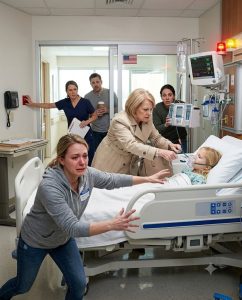
The pediatric ICU lights buzzed overhead like they had no idea a family was falling apart beneath them.
The plastic chair stuck to the backs of my legs.
The air smelled like disinfectant, coffee gone stale, and that faint rubber smell that clings to hospital tubing.
Emma had fallen at 4:18 p.m. on a Thursday.
She had been in the backyard treehouse, the one Marcus built with two weekends, a borrowed ladder, and more pride than carpentry skill.
I had told him it was fine.
He had reinforced the railing twice.
He had sanded the steps until there were no splinters left because Emma hated Band-Aids and called them “sticky blankets.”
That afternoon, she had climbed up while he was inside making grilled cheese.
I was folding laundry near the back door when I heard her shout, “Mommy, look!”
Then came the crack.
Then came the scream.
Then came the sound I still cannot make myself describe without swallowing first.
By 5:06 p.m., the hospital intake desk had Emma’s name printed on a wristband.
By 5:41, a surgeon was standing in front of me using words I never thought I would have to learn in one breath.
Skull fracture.
Brain swelling.
Internal bleeding.
Emergency surgery.
Marcus stood beside me with a paper coffee cup in both hands, but he never drank from it.
The cup trembled so much the lid clicked against the cardboard rim.
He kept saying, “I should have been outside.”
I kept saying, “This is not your fault.”
Neither sentence could reach the place inside him where guilt had already moved in.
When my phone lit up with my father’s name, I almost collapsed from relief.
I had left him three voicemails.
The first was shaky.
The second was worse.
The third was just me whispering, “Please call me. Emma is in surgery. Please.”
So when I answered, I thought I was about to hear my father become my father.
Instead, he sighed.
“Rebecca,” he said, “your niece’s birthday party is Saturday. Your mother sent you the invoice. Why hasn’t it been paid?”
I looked down at the hospital floor.
There was a scuff mark near my shoe, black against all that polished white.
I remember staring at it because if I looked anywhere else, I might have screamed.
“Dad,” I said, “Emma might not live through the night.”
There was a pause.
Not long enough to be grief.
Just long enough to be irritation.
“Children bounce back,” he said.
Then he told me Charlotte had already booked the venue, the entertainment, the custom cake, and the party favors.
He told me Madison was expecting a big day.
He told me not to embarrass the family with my dramatics.
My sister Charlotte had always been the bright center of our family.
When we were kids, she cried and got held.
I cried and got told to stop being sensitive.
She forgot a birthday card and everyone laughed because that was just Charlotte.
I missed one family brunch because Emma had a fever and my mother called me selfish for a week.
When Charlotte had Madison, my parents treated that child like the family crown had finally found a head.
Emma was loved in scraps.
Late Christmas gifts.
Birthday calls made two days after the fact.
School pictures left in envelopes on the kitchen counter because nobody asked for a frame.
Still, I believed there were limits.
A child in an ICU bed should have been the limit.
Fifteen minutes after my father’s call, the invoice appeared in my email.
The total was $2,300.
Not for medical help.
Not for groceries.
Not because anyone was in trouble.
A unicorn birthday party.
Balloon arch.
Dessert table.
Party favors.
Costumed performer.
The note at the bottom was from my mother.
Payment required by Friday at 6 p.m. Madison is counting on you.
People like my parents do not ask for help.
They invoice obedience.
They put family in the subject line and control in the attachment.
I left the email open until the words blurred.
Then Charlotte started texting.
You always make everything about you.
Madison is crying.
Do you know how selfish this is?
I typed, Emma is in critical condition.
Charlotte replied, Kids fall all the time.
Then she sent, Madison asked why Aunt Becca hates her.
I did not answer.
There are moments when silence is not weakness.
Sometimes it is the last piece of yourself you are trying not to throw at someone.
Marcus’s brother Josh drove in before sunrise.
He came with phone chargers, hoodies, granola bars, and the kind of anger decent people get when they see cruelty dressed up as family obligation.
He stood beside Emma’s bed for a long time.
She looked so small under that blanket.
Part of her blonde hair had been shaved.
The oxygen mask fogged softly with every assisted breath.
There were tubes in places I could not look at for long.
Josh finally turned to me and said, “This isn’t normal.”
He looked at Marcus.
“None of this is normal.”
It was the first clean sentence anyone had spoken around me in hours.
The next day at 2:12 p.m., my father called again.
“That bill still isn’t paid,” he snapped.
“What exactly is the hold up?”
I stepped into the hallway because I did not want Emma to hear his voice, even unconscious.
“My daughter is in intensive care,” I said.
My own voice sounded strange to me.
Flat.
Careful.
“If you ask me for one more cent while she is lying here, do not ever contact me again.”
He laughed under his breath.
“You don’t get to talk to us that way.”
I hung up.
The thing about people who build their power on access is that boundaries feel like theft to them.
They do not hear no as an answer.
They hear it as a challenge.
The following afternoon, I heard my mother’s voice before I saw her.
She was at the nurses’ station, sharp and offended.
She had the tone she used at restaurants when she wanted a manager.
My father was with her.
They swept into Emma’s room dressed like they were on their way to lunch.
My mother’s coat was beige and spotless.
Her purse hung from her arm like she had brought it as proof that she belonged anywhere she chose to stand.
My father did not look at Emma first.
He looked at me.
My mother said, “That bill wasn’t paid. What’s the hold up?”
The room froze.
The nurse at the doorway stopped with one hand on the chart.
Marcus’s paper coffee cup crumpled in his grip.
Josh looked up from the wall phone.
The monitor kept beeping beside Emma’s bed, steady and small.
It was the only thing in the room doing its job.
“Get out,” I said.
My father folded his arms.
“We drove all this way. The least you can do is stop acting hysterical and explain yourself.”
I pointed to the bed.
I pointed to the bandage.
I pointed to the mask.
“Look at her,” I said. “She almost died. She still might. Leave.”
My mother barely glanced over.
“She is asleep,” she said. “Enough with the theatrics. Charlotte needs that money today.”
I reached for the call button.
That was when her face changed.
I had seen anger from my mother.
I had seen disappointment.
I had seen that polished public smile she wore when she wanted strangers to think we were close.
But this was different.
This was calculation.
“You would not dare humiliate us,” she hissed.
Then she lunged toward Emma’s bed.
Her fingers caught the elastic strap of the oxygen mask.
For one awful second, nobody moved because the human mind has a delay when it sees something it knows should not be happening.
Then the seal broke against Emma’s cheek.
The monitor screamed.
The sound filled the room so fast it felt like the walls had split open.
My mother ripped the mask away and flung it toward the foot of the bed.
“Well, she’s gone now,” she said. “You can come with us.”
I do not remember deciding to move.
I remember my hip hitting the bed rail.
I remember the nurse shouting.
I remember Marcus making a sound that did not sound human.
The nurse got to Emma first.
She grabbed the mask, pressed it back over my daughter’s face, and hit the wall alarm with the heel of her hand.
“Respiratory,” she shouted. “Now.”
Josh caught Marcus under one arm as Marcus slid down the wall.
My father stepped backward.
Not toward Emma.
Away from what my mother had done.
That told me everything.
Two more staff members came in.
Then security appeared in the doorway.
The nurse kept one hand on Emma’s mask and one hand near the tubing, her eyes never leaving my mother.
“Do not touch this child again,” she said.
My mother straightened her coat.
For one insane second, I thought she was going to argue with the nurse about manners.
My father said, “This is a family matter.”
The security guard said, “Not anymore.”
Those two words were the first justice I got.
They were not dramatic.
They did not fix my daughter.
They did not erase the alarm still ringing in my bones.
But they cut through years of my parents acting like family meant they could do anything and call it concern.
The charge nurse asked me if I wanted them removed.
I said yes before she finished the sentence.
My mother whipped toward me.
“Rebecca,” she said, and for once her voice had panic in it.
Not sorrow.
Not regret.
Panic.
“You are making a mistake.”
I looked at Emma.
Her lashes rested against her pale cheeks.
The mask fogged again.
Softly.
Proof of breath.
“No,” I said. “I made the mistake a long time ago when I kept letting you back in.”
Security escorted them out.
My father tried to speak to the nurse at the station.
My mother tried to say I was unstable.
The staff did not debate with them.
They documented.
That word matters.
The nurse wrote an incident report.
The security guard took statements.
The hospital chart noted an unauthorized interference with medical equipment by a visitor.
Josh gave his statement while Marcus sat on the floor outside the room with his head in his hands.
I gave mine sitting beside Emma’s bed with one hand on the blanket and one eye on the monitor.
At 6:03 p.m., my phone started lighting up again.
Charlotte.
Then my father.
Then my mother.
Then Charlotte.
I turned the phone off.
For the first time in my life, I did not feel guilty for being unreachable.
A respiratory therapist checked Emma’s oxygen levels twice.
A doctor came in and asked careful questions in a voice that made me trust him because he did not pretend what happened was small.
He said Emma had stabilized.
He said the mask had been restored quickly.
He said they would keep watching her.
Then he looked at me, not over me, and said, “You did the right thing asking them to leave.”
The story continues — don’t miss what happens next