My mother died on a Thursday in late February, and by Friday the house smelled like lilies, wet wool, and the burnt coffee neighbors always bring when they don’t know what else to do with grief.
I slept that night in my childhood bedroom with my suitcase open beside the bed.
One sock hung over the zipper.
A black dress was draped across the chair.
My mother’s cough drops still sat in a little dish on the nightstand from the weeks when I’d moved back home to care for her.
Everything in that room looked paused, as if the house had decided not to acknowledge what had happened downstairs.
But the silence was different.
Heavier.
Final.
My mother, Helena Varga, had been sick for eleven months and dying for six.
In the end, dying was less dramatic than people imagine.
It was pills lined up on a kitchen counter.
It was keeping track of temperatures, appetite, and nausea.
It was washing sheets at 3:00 a.m.
and learning how to smile while crushing ice chips into a cup because someone you love no longer has the strength to lift her own hand.
I had done all of it.
My brother Stefan loved our mother.
I believe that.
But love from a distance can look an awful lot like absence.
He lived forty minutes away with his wife, Yvonne Keller, and their son Leo.
At first he came every weekend.
Then every other weekend.
Then only when things became serious enough to make him feel guilty.
Yvonne came even less.
Whenever she did appear, she looked around the house the way some people look around hotel suites, measuring the windows, the staircase, the size of the lot.
Once, when my mother was in the hospital and I returned home to grab fresh clothes, I found Yvonne standing in the den with one of the desk drawers open.
She smiled when she saw me.
‘I was just looking for a pen,’ she said.
The drawer she had opened contained my mother’s insurance papers, tax records, and a folder labeled ESTATE.
I knew then what kind of woman she was, but grief makes you pick your battles badly.
My mother was still alive.
I didn’t want my last months with her poisoned by a fight over a future she hadn’t even left yet.
A week later, while I helped Mom sip broth in bed, Yvonne came to visit.
She stood at the foot of the bed in a cream sweater that never should have been worn into a sickroom and said, in a voice she probably thought sounded caring, ‘Helena, have you finalized the house situation yet? We just don’t want things to get messy.’
My mother’s face changed.
She was weak then, but not confused.
People always assume the dying lose their ability to recognize greed.
They don’t.
Sometimes they see it more clearly than anyone else in the room.
After Yvonne left, my mother held onto my wrist with surprising force.
‘Don’t let them twist it,’ she whispered.
‘I made it fair.’
That word stayed with me.
Fair.
Not equal.
Not pleasant.
Not convenient.
Fair.
The morning after the funeral, I was still trying to understand how a house can contain everything and nothing at the same time when Yvonne stepped into
the hallway and told me to leave.
She waited until Stefan had gone to handle what she called ‘errands.’ The second his car disappeared, she folded her arms and said, ‘You need to leave.’
At first I thought she meant the kitchen.
Then the room.
Then maybe she was talking about some paperwork appointment.
But no.
She meant the house.
I still remember the cold air that rushed in when she opened the front door.
Sympathy cards lifted from the entry table and slid across the floor like pale birds.
‘Pack your things,’ she said.
‘This is our house.’
I asked if Stefan knew about this.
She said yes.
I asked how she could say something so vile less than twenty-four hours after my mother was buried.
She shrugged and told me dead women didn’t get to correct paperwork.
I called my brother.
He didn’t answer.
I texted him: Did you tell Yvonne Mom left you the house?
Nothing.
So I packed with a stone in my throat and my mother’s cardigan pressed against my face when Yvonne wasn’t looking.
Then I wheeled my suitcase down the front walk, past the hydrangea bushes my mother used to trim herself, and slept that night on my friend Maren’s couch.
Maren didn’t ask many questions.
She took one look at my face, put a blanket over me, and slid a mug of tea onto the coffee table.
At around two in the morning she said softly, ‘Do you want me to come with you tomorrow?’
I stared at the ceiling.
‘No.
If Yvonne’s right, I should hear it alone.
And if she’s lying, I want to see her face when the lie breaks.’
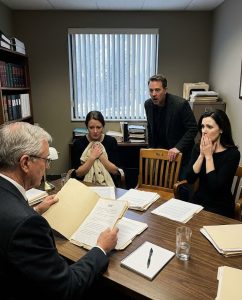
The attorney’s office was in an old brick building downtown that smelled like lemon cleaner and dust.
Mr.
Alden had handled my mother’s legal work for years.
He was precise, formal, and impossible to rattle, which turned out to be exactly what that day required.
Stefan was already there when I arrived.
He stood when I walked in, then sat back down without speaking.
He looked exhausted, like someone who had slept badly and shaved too fast.
Yvonne, by contrast, looked immaculate.
Black dress.
Pearls.
Hair pinned perfectly.
She gave me the kind of tiny smile people use when they believe the unpleasant part is already over.
It made something inside me go cold.
Mr.
Alden opened the will and began reading.
My mother had left her jewelry in specific ways: a sapphire ring to me, her gold bracelet to Leo when he turned eighteen, her wedding band to be melted and reset into two small pendants if Stefan and I ever agreed.
She left me her car because, as Mr.
Alden read from one note, ‘Eva always kept gas in it anyway.’ She left Stefan a substantial education fund for Leo, my grandfather’s watch, and a savings certificate she had bought years ago and never touched.
With each item, Yvonne sat a little straighter.
Then Mr.
Alden turned the page.
‘And to my daughter, Eva Varga,’ he read, ‘I leave my residence at 14 Linden Street, free and clear, together with all furnishings and contents not otherwise designated.’
Stefan was on his feet before the sentence ended.
‘What?’ he said.
Then louder, ‘What on earth?’
His chair screeched
backward across the floor.
Yvonne’s hand slipped off his knee.
All the color left her face so quickly it was like watching milk poured into ink.
For one heartbeat nobody moved.
Then Mr.
Alden continued in the same even tone, as if he had expected exactly this.
‘Mrs.
Varga attached a letter to be read aloud if any beneficiary claimed she intended the residence for Stefan Varga or Yvonne Keller.’
He unfolded a second page.
‘If Yvonne Keller tells anyone that I promised her my home, she is lying,’ he read.
‘She asked me about the house more than once while I was medicated and too weak to throw her out myself.
I refused her every time.
My daughter has given me care, dignity, sleep, work, and peace for months.
She has already paid for this house in ways no bank would ever understand.’
Yvonne made a strangled sound.
‘She was confused,’ she snapped.
‘This is ridiculous.’
Mr.
Alden reached for another envelope.
‘This is a notarized affidavit from Carla Mendez, the hospice nurse present on February eleventh when Mrs.
Varga wrote that statement.
Ms.
Mendez confirms Mrs.
Varga was lucid and specifically asked that this letter be added after Ms.
Keller attempted to present paperwork regarding the residence.’
The room went so quiet I could hear the clock on the wall.
Stefan turned to his wife.
‘What paperwork?’ he asked.
Yvonne’s eyes flicked toward her handbag.
That was all it took.
Mr.
Alden saw it.
I saw it.
Stefan saw it.
He grabbed the bag before she could pull it closer.
Yvonne lunged for it, hissing his name, but he stepped back and opened the clasp.
Inside was a large manila envelope.
He pulled out a photocopy of an old will draft.
I knew instantly it was old because the date in the corner was from the previous autumn, before my mother’s final hospitalization.
In that draft, the house had been left jointly to Stefan and me, with provisions for a possible sale later.
Stefan stared at it.
‘You told me this was the final copy.’
Yvonne’s mouth opened and closed.
‘She changed it because you have a child.
She told me that.
I was protecting what should have gone to our family.’
‘My sister is my family,’ Stefan said, and there was such stunned disgust in his voice that even Yvonne seemed startled by it.
Mr.
Alden removed his glasses, polished them, and said quietly, ‘Mrs.
Varga revised the will three weeks later.
She informed me she had discovered someone had been looking through her papers.
She said she wanted no ambiguity left for ambitious people to exploit.’
Ambitious people.
Yvonne flinched as if she’d been slapped.
Then Mr.
Alden handed Stefan one more sealed letter.
‘This is for you,’ he said.
‘Your mother instructed that you read it privately, but given the circumstances, I suspect you may wish to do so now.’
Stefan opened it with shaking hands.
He read silently at first.
Then his face changed.
His shoulders dropped.
His eyes filled.
Later he let me read it.
My mother had written: Eva sat beside my bed when I was afraid.
You stood farther away than I needed.
I still love you.
That is why I leave you enough to help your son.
But a house.
The story continues — don’t miss what happens next