I was mopping the Livingston County courthouse lobby when the life I had buried came looking for me again.
The marble under my boots was cold enough to bite through the worn soles, and the mop water smelled like bleach, old coffee, and the wet grit people dragged in from the parking lot.
Above me, the fluorescent lights buzzed with the tired hum every county building seems to have, making the floor shine in thin streaks wherever my mop passed.
Quiet work suited me.
Most people in that building knew me as Dennis Irwin, night janitor.
Blue shirt.
Name patch.
Keys on my belt.
A man who nodded to deputies, emptied trash cans, changed paper towels, cleaned coffee spills outside the clerk’s window, and disappeared before sunrise.
At home, I was Sarah’s husband and Tyler’s dad.
We had a small house with a red mailbox Sarah had painted herself one Saturday afternoon while Tyler bounced a basketball in the driveway and missed the hoop more often than he made it.
We had grocery bills, a mortgage, a family SUV with a bad passenger-side window, and a porch light I kept promising to replace.
That was the life people saw.
It was the only life I wanted them to see.
Seventeen years earlier, men who never appeared in press releases had called me Reaper.
I had led teams through rooms so tight that one wrong breath could get somebody killed.
I had learned what fear sounded like behind a closed door.
I had learned what a lie looked like under bad lighting.
I had learned that powerful men were often only powerful because everyone around them agreed to stay afraid.
Then I came home.
I married Sarah.
I raised Tyler.
I buried that other version of myself under school pickups, driveway oil stains, paper lunch bags, late bills, and a janitor’s uniform that smelled like bleach no matter how many times Sarah washed it.
I did not miss the old name.
A man should be grateful when his son knows him by the sound of his truck in the driveway, not by the stories people whisper when doors are locked.
At 9:38 p.m., my phone buzzed hard against my thigh.
Sarah never called during my night shift unless something had split the world open.
I answered with one hand still around the mop handle.
“Hey.”
For one second, there was only breathing.
Ragged.
Wet.
Broken.
Then my wife said my name like she was falling.
“Dennis. It’s Tyler.”
The mop handle slipped from my hand and cracked against the marble.
The security guard at the front desk looked up.
“What happened?” I asked.
“There’s been a shooting.”
My chest went quiet.
“Where?”
“Mercy General. Trauma Bay Three. Dennis, please hurry.”
I do not remember the drive the way a person should remember a drive.
I remember red lights sliding across my windshield.
I remember the steering wheel creaking under my hands.
I remember the smell of bleach trapped in my sleeves as I ran through the ER doors in my cheap janitor uniform.
Sarah was standing under the white hospital lights with both hands pressed to her mouth.
Her mascara had run down her cheeks in jagged black lines.
A paper coffee cup lay tipped over beside her shoe, spreading dark coffee across the tile while nurses moved around it because hospitals do not stop for grief.
“Where is he?” I asked.
Sarah pointed through the glass.
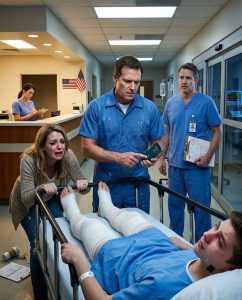
My son was on a gurney.
Tyler was seventeen and six feet tall, all elbows, shoulders, and stubborn hope.
That morning, he had left his basketball shoes in the hallway and kissed his mother’s cheek because she had slipped five dollars into his lunch bag for gas.
That night, his face was pale under the ER lights, and both legs were wrapped from thigh to shin.
The bandages around his knees were thick, white, and already telling the truth in dark patches.
A doctor stepped out, peeling off latex gloves.
For half a second, the hospital disappeared.
“Harold?”
Dr. Harold Donnelly froze.
His hair had gone white at the temples, and the lines around his eyes were deeper, but I knew him.
I had dragged that man out of a blown-out doorway years earlier with dust in both our mouths and shrapnel in both our arms.
Now he was standing between me and my boy.
“Dennis,” he said quietly.
“How bad?”
Harold looked at Sarah, then back at me.
“Both kneecaps are completely destroyed,” he said. “Not cracked. Destroyed. He needs surgery tonight, and he’ll need more after that.”
Sarah made a sound that did not belong in a human throat.
I looked at my hands.
Some men rage because rage gives them something to do.
Some men break because breaking gives everybody else permission to stop looking.
I did neither.
“Who shot him?”
Sarah grabbed the front of my blue work shirt.
Her fingers shook so badly the fabric snapped against the buttons.
“Sheriff Barnes.”
The ER noise narrowed until only her voice remained.
“But Dennis, it wasn’t a mistake. He didn’t just shoot him. He stood over our boy while he was bleeding and laughed.”
Harold went still.
Sarah swallowed.
“He said, ‘Shouldn’t have looked at me wrong, boy. Let’s see your pathetic janitor daddy try to mop this up.’”
Behind the glass, the monitor kept beeping.
At the hospital intake desk, someone called for a family member to sign a treatment consent form.
A printer coughed out a police report request.
The world kept doing paperwork while my son lay there learning what pain could steal from a body.
I stepped inside.
Tyler turned his head when he saw me.
His eyes were red, wild, and ashamed in that awful way kids get when adults hurt them and somehow make them feel responsible for bleeding.
“Dad,” he whispered. “I’ll never walk again.”
I put one hand on the rail of his gurney and made myself breathe through my nose.
For one ugly second, I pictured Barnes laughing.
For one ugly second, I pictured Barnes laughing.
Not the sheriff.
The man.
The one standing over my son.
The one who thought a badge made him untouchable.
Then I looked at Tyler.
And the picture disappeared.
Because this wasn’t about revenge.
It was about my boy.
“Look at me.”
Tyler swallowed.
Tears slid sideways into his hair.
“Dad…”
“Look at me.”
He did.
“You are alive.”
His jaw trembled.
“I can’t feel my legs right.”
The fear in those words nearly broke me.
I squeezed the rail until my knuckles turned white.
“Doctors are working.”
“What if they can’t fix it?”
I thought carefully.
Children deserve truth.
Especially when they’re old enough to recognize lies.
“I don’t know.”
His eyes filled again.
“But I know this.”
I leaned closer.
“You won’t face it alone.”
For the first time since I arrived, he nodded.
Just a little.
But enough.
Surgery started at 11:17 p.m.
Sarah sat beside me in the waiting room.
The vending machine hummed.
The television mounted in the corner showed a weather forecast nobody watched.
Rain was coming.
I remember that detail because my mind kept grabbing useless facts.
The human brain does strange things when it’s trying not to drown.
At 12:03 a.m., Harold returned.
Not as a doctor.
As an old friend.
He sat across from me.
Quiet.
Watching.
Eventually he spoke.
“You know who Barnes is?”
“Everybody knows who Barnes is.”
“No.”
Harold folded his hands.
“I mean who he really is.”
That got my attention.
The old version of me stirred slightly.
Not Reaper.
Just instinct.
The part that notices when questions are actually warnings.
“What are you saying?”
Harold glanced toward Sarah.
Then lowered his voice.
“Three years.”
“What?”
“Three years of complaints.”
I stared at him.
“Against Barnes?”
Harold nodded.
“Excessive force.”
The waiting room suddenly felt colder.
“How many?”
Harold laughed once.
Without humor.
“Enough.”
The story continues — don’t miss what happens next