By the time I buckled Lily into her red velvet Christmas dress, I had already talked myself into pretending.
I told myself Christmas at my parents’ house would be fine.
I told myself my mother would be careful because Lily was there.
I told myself I had grown enough not to let one cruel sentence undo me.
The bedroom smelled like clean laundry and baby lotion, and outside the window the winter light looked thin and cold across the driveway.
Lily sat on our bed between two folded blankets, kicking her socked feet like she had discovered her legs for the first time.
She was eight months old, small for her age, and absolutely healthy.
Every doctor had said the same thing.
Small, but healthy.
Petite.
Growing on her own curve.
Strong.
Still, my hands slowed when I smoothed the red velvet over her belly.
There are things your body remembers even after the emergency is over.
Mine remembered three weeks in the NICU.
It remembered fluorescent lights at 3:18 a.m., warm milk in plastic bottles, paper coffee cups going cold, and the soft alarm sounds that could turn a mother’s spine into glass.
Lily had been born six weeks early.
For three weeks, I learned to celebrate numbers other people never think about.
Ounces.
Oxygen.
Minutes between feedings.
Grams gained.
By December, her pediatrician had cleared every fear that mattered, but my mother, Carol, had never needed facts when a criticism would do.
Evan came into the bedroom carrying the diaper bag and the first stack of gifts.
He looked at my face before he looked at Lily.
“You okay?” he asked.
“Yeah,” I said.
He smiled gently, not because he believed me, but because he loved me enough not to trap me in the lie.
“We’ll eat, open presents, make an excuse, and leave before anyone starts talking politics,” he said.
“My mom doesn’t need politics,” I told him. “She can start a war with a casserole.”
He kissed the top of Lily’s head.
“Then we stay near the exits.”
My parents’ house looked warm from the outside.
White lights lined the porch.
A wreath hung on the door.
A small American flag stood near the front steps, stiff in the cold.
From the street, it looked like every Christmas card my mother had ever wanted people to think we were.
Inside, it smelled like roasted turkey, pine cleaner, and her sharp floral perfume.
The driveway was already full.
Mark’s SUV was there.
My aunt’s sedan was crooked along the curb.
My grandmother’s beige Buick sat beneath the bare oak tree, and two cousins had parked like they were fleeing a fire.
The second we walked in, everyone came toward Lily.
“Oh my goodness, look at that dress.”
“She’s getting so big.”
“Those eyes.”
My sister-in-law Jenna took Lily carefully, and for a few minutes my shoulders dropped.
Jenna had three kids and the kind of calm that made you feel there was still oxygen in the room.
“She looks beautiful,” Jenna said softly.
My mother heard that and smiled like it belonged to her.
“Pictures matter,” she said, reaching to straighten Lily’s bow.
I had received that exact phrase by text at 11:58 a.m.
Mom: Don’t forget the green bean casserole. And please make sure the baby has a bow or something. Pictures matter.
That was Carol in one sentence.
The casserole mattered.
The bow mattered.
The picture mattered.
What it cost people to sit inside that picture had never mattered much to her.
For the first hour, she stayed just close enough to make my skin tight.
She corrected the way I folded Lily’s blanket.
She asked whether the red dress was “a little much for her coloring.”
She told Evan that babies needed real food soon, not “all that gentle-parenting nonsense.”
Then she asked, in front of two cousins and my grandmother, whether Lily’s pediatrician was concerned yet.
I felt Evan stiffen beside me.
“No,” I said. “Her growth chart is fine.”
My voice sounded calm.
That was practice, not peace.
I had the hospital discharge summary saved at home.
I had the pediatrician’s December 12 note in the folder with Lily’s name on it.
I had the first feeding logs, the ones I could barely look at anymore because they were written by a version of me who thought love meant documenting every ounce before fear could take it away.
My mother did not ask because she wanted to know.
She asked because concern was a respectable costume for cruelty.
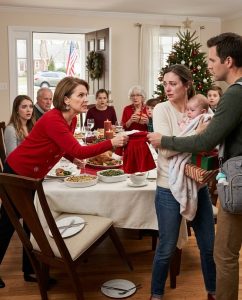
Dinner was called at 2:07 p.m.
We crowded into the dining room, elbows close, plates warm, napkins folded into little holiday triangles.
Lily sat in the high chair beside me, hitting one tiny hand against the tray.
The chandelier shone over the turkey, cranberry sauce, rolls, and the green bean casserole my mother always treated like evidence of character.
For a while, people talked around the tension.
My cousin asked about work.
Mark’s kids argued softly over who got the last roll.
Grandma smiled at Lily every few minutes as if she could pour love into the baby through eye contact alone.
Then my mother looked at Lily.
She tilted her head.
She smiled.
Not a grandmother smile.
A measuring one.
“She really is still so small,” she said.
The table quieted by half a breath.
I put my hand on Lily’s foot under the tray.
“She’s healthy.”
My mother made a small sound.
It was the sound she used when she wanted everyone to believe she was being reasonable.
“I’m just saying, some babies look a little more… finished by now.”
My fork stopped over my plate.
Jenna’s hand froze around her water glass.
Mark looked down at his mashed potatoes as if they could provide instructions.
The candle beside the gravy boat kept flickering, bright and stupid, while every adult at that table waited for my mother to decide how far she wanted to go.
She went farther.
“Maybe next Christmas she’ll look less like a sick little doll.”
My mother’s smile stayed exactly where it was.
Like she had commented on the weather.
Like she had not just aimed a knife at a baby.
Silence spread across the table.
Heavy.
Embarrassed.
Familiar.
I looked around.
Nobody laughed.
Nobody agreed.
But nobody stopped her either.
The same old family tradition.
Carol says something cruel.
Everyone waits for someone else to react.
Nobody does.
My grandmother set down her fork.
“Carol,” she said quietly.
Just that.
A warning.
My mother sighed dramatically.
“What?”
“I’m worried about her.”
She pointed toward Lily.
“As her grandmother, I’m allowed to worry.”
Lily banged her hand against the tray.
Completely happy.
Completely unaware.
My daughter smiled at the cranberry sauce.
The sight nearly broke me.
Because she was perfect.
Not perfect in the way grandparents brag.
Perfect in the way surviving babies are.
Perfect because she existed.
Perfect because she fought.
Perfect because she came home.
And suddenly I was tired.
Not angry.
Not shaking.
Just tired.
Tired of defending a child who had done nothing except be born early.
Tired of explaining medical facts to someone who preferred insults.
Tired of pretending concern and cruelty were the same thing.
I looked at my mother.
Then I looked at Lily.
And something finally clicked into place.
I realized I didn’t want my daughter growing up learning what I had learned.
That love meant endurance.
That family meant swallowing pain.
That peace meant staying quiet.
I stood up.
My chair scraped the floor.
Everyone looked at me.
My mother blinked.
“Where are you going?”
I lifted Lily from the high chair.
She immediately grabbed my necklace.
“We’re leaving.”
My mother’s face changed.
Not hurt.
Offended.
“Don’t be ridiculous.”
“I’m not.”
“You always overreact.”
I laughed once.
A small sound.
Not happy.
Just surprised.
Because suddenly I could hear exactly how ridiculous she sounded.
My daughter had been insulted at Christmas dinner.
And somehow I was the dramatic one.
Evan stood immediately.
No hesitation.
No discussion.
He grabbed the diaper bag.
My mother noticed.
Her eyes narrowed.
“Evan.”
He looked at her.
Polite.
Calm.
Dangerously calm.
“Yes?”
“Tell your wife she’s being unreasonable.”
The room became very still.
Evan smiled.
Not warmly.
“Carol, you just called my daughter a sick little doll.”
“I didn’t mean—”
“You absolutely did.”
My mother opened her mouth.
Closed it.
Opened it again.
People like her hate witnesses.
Especially accurate ones.
My brother Mark finally spoke.
“Mom.”
She turned toward him.
Relieved.
Certain he would rescue her.
Instead he shook his head.
“That wasn’t okay.”
For the first time all afternoon, she looked surprised.
Then Jenna spoke.
“It wasn’t okay last Thanksgiving either.”
My mother frowned.
“What does that mean?”
Jenna set down her napkin.
“It means you’ve been making comments about Lily for months.”
Nobody moved.
Nobody interrupted.
Because everybody knew she was right.
Jenna continued.
“Every visit.”
“Every phone call.”
“Every picture.”
“She’s too small.”
“Too pale.”
“Too thin.”
“Not developing fast enough.”
“You don’t sound worried.”
“You sound mean.”
The words landed like stones.
One after another.
My mother stared at her.
Speechless.
That almost never happened.
Then my grandmother surprised everyone.
She pushed back her chair.
Slowly.
Carefully.
At eighty-two, every movement looked deliberate.
She looked directly at her daughter.
“You sound exactly like your father.”
The room froze.
Nobody breathed.
Nobody spoke.
Because everybody knew what that meant.
My grandfather had been dead for fifteen years.
And he had been cruel.
Not dramatic.
Not violent.
Just relentlessly cruel.
The kind of person who could find weakness in sunshine.
The kind of person who treated criticism like affection.
My mother’s face went white.
“Mother—”
“No.”
The story continues — don’t miss what happens next