I woke before sunrise in my parents’ house in Columbus, Ohio, with my alarm vibrating against the nightstand and my body aching before my feet touched the floor.
I was twenty-nine, working as a respiratory therapist at a hospital that always seemed short on people and full of crisis.
That week had been especially brutal.
Two double shifts.
Too many patients.
Too many families waiting outside rooms with their hands clasped, begging with their eyes for good news I could not always give.
I pulled on my blue scrub top in the dark and checked the small zipper pocket of my work bag out of habit.
My badge was there.
My keys were there.
My wallet felt like it was there, though I did not pull it out.
I was already late, and my mother hated hearing me rush through the kitchen before dawn.
The house was quiet when I left.
My father’s truck was in the driveway.
My brother Jason’s car sat at the curb, even though he had told everyone he had an early job interview that morning.
I noticed it, but I was too tired to think about it.
I had lived there for almost two years, after my aunt Denise died and left behind a complicated estate, a grieving family, and one savings account with my name attached to it.
My parents had insisted I stay with them instead of renting an apartment.
Save your money, my mother had said.
Graduate school is expensive.
Family helps family.
At first, I believed her.
Then family started needing little things.
Groceries when Dad’s hours were cut.
Car insurance when Mom forgot the due date.
Jason’s phone bill when he was between jobs again.
A repair on the furnace.
A medical copay.
None of it was called rent.
None of it was called repayment.
It was just expected, wrapped in guilt, delivered with a smile.
I paid because I wanted peace.
I paid because I had spent my whole life trying to earn a softer version of my mother’s love.
I paid because every time I said no, Jason acted wounded, Dad acted disappointed, and Mom acted like I had become a stranger.
Still, I protected one account more carefully than anything else.
It held nearly $38,000, money I had saved for graduate school and money connected to Aunt Denise’s estate.
Not all of it was freely mine.
After Aunt Denise died, the probate court had placed restrictions on part of the funds because she had written instructions for my education and future licensing.
The estate attorney had explained it twice, slowly, across a polished desk.
You can use this money for approved education and related expenses, Emily.
Keep records.
Do not treat it like cash.
Every major movement is documented.
I understood.
I respected it.
To me, that money was not a prize.
It was a promise.
By nine that Thursday night, I had forgotten all of that for a few minutes.
I was too exhausted to think beyond a shower and leftovers.
My feet throbbed inside my hospital shoes.
My head pounded from fluorescent lights and alarms.
I pulled
He Emptied Her Account, But The Money Had A Hidden Owner
into the driveway, noticed the kitchen lights glowing, and hoped no one would want to talk.
Then I opened the front door and saw my suitcase sitting beside it.
For a second, my brain refused to understand the scene.
My black suitcase belonged in the hallway closet behind winter coats and old Christmas decorations.
Instead, it stood upright near the welcome mat, handle raised, one wheel crooked.
My gray hoodie was folded across the top.
My toiletries were zipped inside a clear plastic bag.
My laptop charger stuck out of a side pocket.
Someone had packed me.
The kitchen erupted in laughter.
I walked toward it slowly, feeling the shift before I understood it.
My mother sat at the table with her hands wrapped around a coffee mug, though I could smell beer.
My father leaned back in his chair, relaxed in a way he only looked when someone else was about to suffer.
Jason sat between them with one of Dad’s heavy glass mugs in his hand and a grin that made my stomach go cold.
“Oh, you’re home,” my mother said.
Her tone was casual.
Almost cheerful.
I pointed behind me.
“Why is my suitcase by the door?”
Jason leaned back, stretching his legs like he owned the room.
“Your work is finished,” he said.
“We got what we wanted.
Don’t look back at us now.”
I stared at him.
“What are you talking about?”
Dad chuckled.
“Don’t act confused, Emily.”
That was when Jason reached into his pocket and placed my ATM card on the table.
I recognized the worn corner immediately.
The little scratch across the silver logo.
The card I had used the night before to buy gas after leaving the hospital.
My mouth went dry.
“Why do you have that?”
Jason tapped it once with his finger.
“You should be more careful with your things.”
“You stole it.”
“Borrowed,” he said.
“Then emptied the account.”
For a moment, every sound in the room disappeared except the rush of blood in my ears.
I lunged for the card, but Jason covered it with his palm and laughed.
“Relax.
It’s family money anyway.”
“No,” I said.
“It is not.”
Mom sighed, as if I were making a scene at a restaurant.
“It was a good decision.
You have been hoarding money while living under this roof.”
“Hoarding?” My voice shook.
“I have been saving for school.”
“You have been eating our food,” Dad said.
“I bought groceries last week.”
“You use electricity.”
“I paid the utility bill in January.”
Jason rolled his eyes.
“Here she goes.
Always the victim.
Always with receipts.”
I grabbed my phone from my bag.
My fingers were clumsy from panic, and it took me two tries to open the banking app.
I kept hoping he was lying.
Jason lied the way some people breathed.
He exaggerated to scare people, to control them, to make himself feel powerful.
But the screen loaded.
Savings: $0.43.
Checking: $12.11.
I clicked into the transaction history.
Cash withdrawals, one after another, from two ATMs across town.
Hundreds at a time.
Then more.
Then a wire transfer that made my knees weak.
Nearly $38,000 was gone.
I looked up at my family.
Not one of them looked ashamed.
“That was my graduate school money,” I whispered.
Jason!
He Emptied Her Account, But The Money Had A Hidden Owner
stood.
He was taller than me, broad-shouldered, and he had spent our whole childhood using his size as a warning.
He did not have to raise a hand.
He just had to step close enough for me to remember every door he had slammed, every wall he had punched beside my head, every time my parents said I provoked him.
“Not anymore,” he said.
“Give it back.”
“No.”
Dad rose beside him and crossed his arms.
“Your mother and I discussed it.
You have stayed here almost two years.
Food, bills, wear and tear on the house.
This balances things out.”
I turned to my mother.
“You told me to stay.
You told me not to rent.
You said I should save.”
She looked away for one second, then hardened again.
“We should not have had to ask our own daughter to contribute.”
“I did contribute.”
Jason laughed.
“Not enough.”
The words landed with a clarity that almost steadied me.
They had never wanted me to save.
They had wanted me close enough to use.
They had watched me drag myself home from the hospital night after night, too tired to eat, and decided the money I was saving looked better in their hands.
“What did you do with it?” I asked.
Jason’s smile flickered.
“None of your business.”
“It came from my account.”
“It came from this family.”
“No,” I said, louder this time.
“Some of it came from Aunt Denise.”
My mother’s eyes sharpened.
There it was.
The first crack.
Jason did not notice.
“Aunt Denise is dead.”
“And the court is not,” I said.
The room went quiet for half a breath, but Dad covered it with another chuckle.
“You always were dramatic.”
Jason grabbed my suitcase and dragged it toward the door.
“Enough.
You can go now.”
He opened the front door and shoved the suitcase onto the porch.
Cold March wind swept into the hallway, carrying the smell of rain and wet pavement.
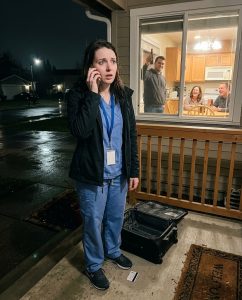
I stood there in my thin scrubs, still wearing my hospital badge, feeling like a stranger in the house where my baby pictures hung on the wall.
My mother followed us only far enough to watch.
“Mom,” I said, hating the way the word broke.
“You are really doing this?”
She lifted her chin.
“It was a good decision.”
Dad nodded from the kitchen.
“Best for everyone.”
Jason picked up my ATM card and flicked it toward my feet.
“Keep it.
There’s nothing left.”
Then he shut the door.
I stood on the porch with my suitcase leaning against my leg, my hands freezing, and my whole body trembling with shock.
Through the front window, I could see Jason raising his glass like he was making a toast.
My parents laughed with him.
My phone buzzed.
The caller ID said unknown.
I almost ignored it.
I had no strength left for another voice, another demand, another person needing something from me.
But the phone buzzed again.
I answered because some part of me still believed responsible people answered calls, even after their families threw them into the cold.
“Am I speaking with Emily Carter?” a woman asked.
“Yes.”
“This is Marlene Brooks with First Ohio Bank’s fraud department.
We have been trying to reach you regarding unusual activity on an account ending!