Celeste must have seen that hunger immediately.
She fed it.
Then she sharpened it.
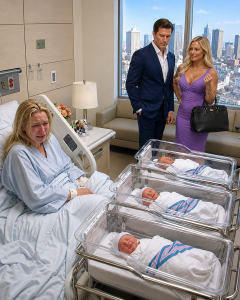
The first time Adrian finally called from a number I did not recognize, I answered.
Mara signaled to record.
“Evelyn,” he said.
His voice was different.
Not smug now.
Frayed.
“What do you want, Adrian?”
“You need to call off your father.”
“No.”
“You don’t understand what you’re doing.”
“You said that already.”
“This isn’t just divorce anymore.”
“No,” I said. “It became fraud when you forged my signature.”
A pause.
Then his voice lowered. “I didn’t forge anything.”
“Then your mistress did.”
“Don’t call her that.”
I almost smiled. “That is the part that bothers you?”
He breathed hard into the phone. “You have no idea what kind of people your parents are.”
I looked through the glass doors of the study.
My father stood in the hall, holding Samuel against his shoulder. Samuel’s tiny fist was curled against his suit jacket.
“I know exactly who they are,” I said.
“No,” Adrian snapped. “You know what they let you know.”
Mara leaned closer, listening.
“What did Celeste tell you?” I asked.
His silence answered too much.
I continued, “Did she tell you she loved you? That you deserved more? That my family looked down on you? That she could help you take what should have been yours?”
“Shut up.”
“She played you.”
“She gave me the truth.”
“No,” I said quietly. “She gave you a mirror, and you fell in love with it.”
His breath hitched.
For one second, I thought I had reached the part of him that used to bring me coffee in bed. The part that cried when our first pregnancy ended at ten weeks. The part that kissed my forehead and said we would try again when I was ready.
Then he said, “Those children are still mine.”
Every trace of softness vanished.
“My sons,” I said, “are not bargaining chips.”
“They’re heirs, Evelyn.”
I froze.
Mara’s eyes sharpened.
“What did you say?”
Adrian seemed to realize his mistake. “I mean they’re my sons.”
“No. You said heirs.”
He hung up.
For a while, no one spoke.
Then my mother said, “He knows about the Ashford succession structure.”
My father handed Samuel to the nurse and entered the study.
“That information is sealed,” he said.
Mara was already typing. “Celeste again.”
I wrapped my arms around myself. “What succession structure?”
My parents looked at me.
I almost screamed.
“No more secrets,” I said. “Not one.”
My father nodded once.
Then he told me.
Ashford Global was not merely my father’s company. It was a privately held empire built through shipping, land, infrastructure, and finance. Generations old. Layered through trusts so complex they had their own legal ecosystem. My parents had always kept me distant from the machinery because I hated it, and because after my brother died, they thought they were protecting me.
But protection, I was learning, could resemble a locked room.
My sons changed everything.
Under the Ashford family trust, direct descendants triggered a restructuring clause. Upon the birth of my first child, certain shares moved into a protected generational trust. Upon the birth of male heirs, an old clause from my grandfather’s era activated additional voting rights unless amended within thirty days.
“Male heirs?” I repeated, disgusted despite everything.
“My father wrote it,” my dad said. “I have spent years trying to dismantle parts of it.”
“But it still exists.”
“Yes.”
“And because I had sons…”
“They inherited future control rights,” Mara said. “Not immediate access. Not money Adrian can touch. But influence. Enormous influence.”
My skin crawled.
“So when Adrian said my lawyers will bury you…” I whispered.
“He didn’t just want custody to punish you,” my mother said. “He wanted proximity to the trust.”
The room spun again.
Adrian had looked at our sleeping newborns and seen keys.
Not sons.
Keys.
I pressed my palm against my mouth.
My mother moved toward me, but I stepped back.
“I need air.”
I walked out before anyone could stop me.
The hallway blurred. The stairs blurred. The winter garden blurred. I made it to the glass conservatory and stood among orange trees heavy with fruit, breathing like someone who had run miles.
A minute later, my father appeared at the doorway.
He did not come in immediately.
“May I?” he asked.
I nodded.
He approached slowly.
“When your brother died,” he said, “I made decisions out of grief. I thought if I kept you away from the inheritance, the machinery, the enemies that gather around money, then you could have a life.”
I looked at him. “I did have a life.”
“I know.”
“And it was invaded anyway.”
His face tightened. “Yes.”
I turned toward the glass. Outside, the lawns rolled silver beneath winter light.
“Did Adrian ever love me?”
My father did not answer quickly.
That was kindness.
“I think,” he said, “Adrian loved how he felt beside you until resentment became larger than love.”
A tear slipped down my cheek.
“I hate him,” I whispered.
My father stood beside me. “Good.”
I looked at him, startled.
He gave the faintest smile. “For now. Hate has energy. Use it carefully.”
By evening, the second article dropped.
Sources close to Vale Capital confirmed an internal investigation into alleged misuse of corporate funds, unauthorized asset pledges, and suspicious payments to consultant Celeste Monroe.
By midnight, investors were demanding answers.
By morning, Adrian’s board suspended him pending review.
Celeste vanished.
Not metaphorically.
Actually vanished.
She checked out of the hotel at 3:18 a.m., left through the service entrance wearing sunglasses and a scarf, and entered a black SUV registered to a shell company.
But she left something behind.
A gift.
It arrived at Ashford House in a white box tied with black ribbon.
Security intercepted it before it reached the main door. The bomb squad was called. Nothing explosive was found. No powder. No wires. No poison.
Only a baby rattle.
Silver.
Antique.
Engraved with the Ashford crest.
My mother saw it and went pale.
I had never seen Vivienne Ashford go pale.
My father took one look and closed his eyes.
“What is it?” I asked.
Neither answered.
Mara did.
“That belonged to your brother.”
The world stopped.
My brother, Nathaniel, had died when he was seven and I was four. A boating accident, they told everyone. A storm. A tragic mistake. His body recovered two days later. My parents never spoke of it beyond the simplest facts. His room was closed. His portraits remained, but grief had turned him into a museum piece in our house.
I looked at the rattle.
“That was buried with him,” I said.
My mother covered her mouth.
My father said nothing.
Mara’s voice was quiet. “Then someone opened his grave.”
My knees buckled.
This time my father caught me.
For the next hour, Ashford House became something else entirely.
Security doubled. Gates locked. Former intelligence men appeared as if summoned from the walls. My mother disappeared into her office and began making calls in a voice I had never heard before. Calm, precise, lethal.
I sat in the nursery with my babies and watched the door.
Leo woke first.
Then Noah.
Then Samuel.
I held them one by one, pressing my lips against their tiny heads, breathing in milk and warmth and life.
Someone had touched my dead brother’s grave.
Someone had sent a message into my home.
Someone wanted us afraid.
And for a moment, they succeeded.
At 2:00 a.m., I found my father alone in the library.
The fire was low. He stood before the mantel, staring at a portrait of Nathaniel.
My brother had golden hair, serious eyes, and one hand resting on the shoulder of a brown spaniel long dead.
“Was it an accident?” I asked.
My father did not turn.
“No.”
The word entered me like ice.
I gripped the back of a chair. “What?”
He turned then.
In the firelight, he looked hollowed out.
“Nathaniel did not die in an accident,” he said. “He was taken.”
I could not breathe.
“For ransom?”
“At first, we thought so.”
My mouth went dry. “Who took him?”
He looked at the portrait again.
“Margot Ellery.”
Celeste’s mother.
The name filled the library like smoke.
My father continued, each word measured as if speaking too quickly might shatter him.
“Black Harbor collapsed because Margot and her partners were stealing from it. When I exposed them, she lost everything. Money, access, protection. She blamed me. She took Nathaniel from the marina during a family event.”
My hand went to my throat.
“My mother said he drowned.”
“She believed that was all you should know.”
“And you?”
“I agreed.”
“Why?”
His face twisted, just once.
“Because you were four years old. Because you woke every night asking why your brother wasn’t coming home. Because your mother stopped eating. Because I had already failed one child and thought hiding the horror from the other was mercy.”
The anger rose fast.
Hot. Wild.
“You lied to me my entire life.”
“Yes.”
“And now her daughter is here?”
“Yes.”
“And my children are involved?”
His silence was answer enough.
I stepped back.
“Evelyn,” he said.
“No.” My voice shook. “No, you do not get to say my name like that. Not tonight.”
“I know.”
“What else?”
He looked at me carefully.
“What else did you bury with my brother?”
My father’s expression changed.
It was slight.
But I saw it.
A door closing.
I laughed once. “There it is.”
“Evelyn—”
“No more secrets, you promised.”
He looked toward the portrait.
Then toward the fire.
“When Nathaniel’s body was found, there was an object with him. A small drive. Hidden in the lining of his jacket.”
“A drive?”
“Yes.”
“What was on it?”
“Records. Names. Accounts. Evidence from Black Harbor. Enough to destroy several people who are still alive and powerful.”
“Why was it with Nathaniel?”
“Margot put it there.”
“Why?”
“To keep herself alive,” he said. “She knew if she was caught, she needed leverage.”
I felt sick. “And what happened to it?”
“I secured it.”
“Where?”
His eyes met mine.
Before he could answer, every light in the library went out.
The house plunged into darkness.
For one suspended second, there was only the fire and the sound of my heartbeat.
Then the security alarm screamed.
My father grabbed my arm.
“Nursery,” he said.
We ran.
Pain tore through my body with every step. I had no strength, no speed, no breath. But I ran anyway.
The hallway emergency lights flashed red. Doors opened. Guards shouted. Somewhere downstairs, glass shattered.
My mother appeared at the top of the stairs in a robe, holding a phone and a small pistol with the calm familiarity of a woman who had never told me she knew how to use one.
“Vivienne!” my father called.
“The nursery,” she said. “Go.”
We reached the nursery door.
It was open.
The nurse was on the floor, conscious but dazed, a red mark blooming at her temple.
The bassinets—
Empty.
For one second, my mind refused to understand what my eyes saw.
Three cribs.
Three blankets.
No babies.
No sound came out of me.
Then a cry.
Small.
Muffled.
From the wardrobe.
My father crossed the room and threw open the doors.
Inside, crouched behind hanging blankets, was Mara Devereux.
Blood ran down the side of her face.
In her arms were Leo and Noah.
Samuel was not there.
I fell to my knees.
“Where is he?” I whispered.
Mara’s eyes were glassy with pain. “I got two.”
The room tilted violently.
My mother caught the doorframe.
My father’s face went white.
From somewhere outside, beyond the broken glass and screaming alarm, a car engine roared to life.
I crawled toward Mara, taking Leo and Noah into my arms. They wailed against me, alive, warm, terrified.
But Samuel’s bassinet stood empty.
On his tiny pillow lay a folded card.
My father picked it up with a hand that did not shake.
I saw the words before he could hide them.
One heir for one truth.
Black Harbor opens at dawn.
PART 3 — THE HEIR TAKEN IN THE DARK
Samuel was gone.
For three seconds, the entire world stopped breathing.
Then I screamed.
It was not a pretty sound. It was not human. It ripped out of me so violently that Leo and Noah began crying harder in my arms, their tiny bodies trembling against my chest.
My father held the card in his hand.
One heir for one truth.
Black Harbor opens at dawn.
My mother took one look at the words and went still in a way that terrified me more than panic ever could.
“Jonathan,” she said.
My father did not answer. His eyes were fixed on the empty bassinet, on the little blanket where Samuel had been sleeping minutes ago.
Mara, bleeding from her temple, tried to stand. “There were two of them,” she said hoarsely. “One came through the service stair. The other cut the nursery cameras. I got Leo and Noah into the wardrobe, but Samuel was closest to the window.”
“The window?” my mother whispered.
The nursery window was open.
Cold air moved the curtains like ghostly hands.
My knees nearly gave out again. “They took my baby through the window?”
Mara’s face twisted. “I’m sorry.”
I looked at my father.
For the first time in my life, Jonathan Ashford looked afraid.
Not worried. Not angry. Afraid.
And that broke something in me.
“No,” I said.
Everyone turned.
“No more standing around. No more secrets. No more protecting me from the truth while my child disappears into the night.” My voice shook, but it did not break. “You are going to tell me everything. Now.”
My father looked at the card again.
Then he said, “Bring the car.”
My mother’s head snapped toward him. “Jonathan.”
“They asked for the truth,” he said. “Then that is what they’ll get.”
“Who?” I demanded. “Celeste?”
My father’s jaw tightened. “Celeste is only the hand. Someone else is moving her.”
Mara pressed a cloth to her bleeding head. “Sir, we cannot take Evelyn into this.”
I stepped toward her, holding my two sons tighter. “You cannot keep me out of it.”
“You gave birth days ago,” Mara said.
“And someone just stole my newborn.”
The room fell silent.
My mother came to me and gently lifted Noah from my arm. “Then we go together.”
Outside, Ashford House burned with alarms and floodlights. Guards ran across the lawn. Dogs barked near the tree line. Somewhere beyond the walls, Samuel was being carried away from me, wrapped in a blanket that still smelled like home.