My parents disowned me years ago.
Not with a dramatic scene in the driveway.
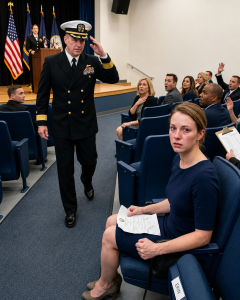
My name is Erin Callahan, and for fifteen years, my family kept a smaller version of me alive in their mouths.
In that version, I had washed out.
In that version, I had drifted.
In that version, I was the unstable daughter who could not settle down, could not come home, could not be trusted with the truth of herself.
It was convenient for them.
A family can forgive almost anything except the person who refuses to stay inside the story they wrote.
When I came back, I thought the first hard part would be the house.
The porch was still painted the same shade of tired white.
The swing still hung crooked from the chain my father had promised to fix when I was sixteen.
The mailbox still had the little flag that stuck when it rained, and a small American flag snapped beside it in the warm afternoon wind.
The place smelled like lemon polish, baked ham, cut grass, and all the sentences nobody had ever been brave enough to finish.
My father opened the door.
He looked older, but not softer.
His hair had gone silver at the temples, and his jaw still worked like he was grinding down anything that came too close to feeling.
He looked me over once.
“You’re still alive,” he said.
That was his welcome.
Four words, delivered like an accusation.
I had imagined anger.
I had prepared for questions.
I had not prepared for the quiet disappointment of being received like an unpaid bill.
My mother appeared behind him with a dish towel folded over one hand.
She smelled faintly of perfume and kitchen heat.
For one second, I saw the woman who used to check my fever with the back of her wrist.
Then her eyes moved past me to the driveway, as if she expected someone more important to be standing there.
“Your sister’s weekend is already very full,” she said.
Not hello.
Not you look thin.
Not where have you been all these years?
Just a warning.
Caitlyn’s weekend.
That was why I had been allowed back into the orbit.
My younger sister was being honored at a Navy ceremony, and the family had folded the whole house around her achievement like linen around good silver.
Inside, the living room was not a room.
It was a museum.
My father’s command portrait hung above the fireplace.
My mother’s old uniform photo sat in a silver frame near the lamp.
My brother Blake’s deployment picture rested on the mantel, clean and centered.
Caitlyn’s Navy portrait had its own small light above it, the kind people usually reserve for artwork or saints.
There were medals, plaques, ship photos, certificates, shadow boxes, polished frames, and a family history arranged with military precision.
I looked for myself because some reflexes survive humiliation.
There was no photo.
Not one.
No graduation picture.
No boot camp photo.
No birthday with candles.
No child in pigtails standing in the driveway with skinned knees and a stubborn little chin.
My mother noticed me looking.
She did not explain.
That was how I knew it had not been an accident.
The house had not forgotten me.
It had been edited.
When I asked where to put my suitcase, my mother gave a tight smile.
“Your old room is full of wedding things.”
Caitlyn’s engagement party was the same weekend.
Of course it was.
My mother pointed toward the garage.
“There is space by the storage bins if you don’t mind.”
The garage smelled like cardboard, dust, lawn fertilizer, and old rain caught in concrete.
My cot had been set up beside boxes labeled CAITLYN – TABLE DECOR and CAITLYN – CENTERPIECES.
A plastic bag of silk flowers leaned against my duffel.
For a moment, I stood there with my hand still on my suitcase handle and felt a laugh rise in my throat.
It was not a happy laugh.
It was the kind of laugh that comes when the insult is so precise you almost have to respect the craftsmanship.
They had not just made me invisible.
They had made me useful as empty space.
That night, dinner was loud.
The dining room chandelier was warm.
The good china was out.
The ham had been glazed, the rolls brushed with butter, the green beans arranged in a dish my mother only used when she wanted guests to understand she had standards.
The main table filled before I even reached the doorway.
Uncles.
Cousins.
Neighbors.
Friends from church.
Men my father had served with.
Women who called my mother an inspiration.
Gold-rimmed place cards sat neatly beside every plate.
There was no card for me.
My mother did not look embarrassed.
She pointed at a folding table near the wall.
“There’s room over there.”
The vent above it did not work.
Someone had left a paper plate there with a cold half-slice of pizza from earlier in the day.
I sat.
I folded my napkin in my lap because old training shows up in ridiculous places.
A teenage cousin glanced at me between bites of roll.
“Are you one of Caitlyn’s friends?”
Before I could answer, Caitlyn laughed softly.
She had always had a gift for making cruelty sound casual.
“Oh, that’s Erin,” she said. “She used to be in the Navy, I think. Didn’t really finish. Now she does yoga or nonprofit stuff overseas or something. She kind of floats.”
People chuckled because they thought they were supposed to.
My father cut his ham.
My mother reached for the butter.
Blake looked down at his plate.
Nobody corrected her.
I wanted to say something.
I wanted to stand there and tell them about the places I had been, the names I had carried, the rooms where my voice had mattered because people lived or died by whether it stayed steady.
Instead, I picked up my fork.
There is a kind of discipline nobody sees.
Not the discipline of running five miles before dawn.
Not the discipline of standing straight in uniform.
The discipline of not giving cruel people the explosion they already planned to blame on you.
I ate three bites.
Every bite tasted like salt.
The next night was Caitlyn’s engagement party at the VFW hall.
Outside, pickups and family SUVs filled the lot.
A little flag moved under the porch light.
Inside, the hall had been transformed with navy-and-gold balloons, silver trays, framed photos, and a cake table arranged like something from a bridal magazine.
The woman at check-in had a printed guest list.
She scanned it.
Then she scanned it again.
“What name?” she asked.
“Erin Callahan.”
She looked uncomfortable before she meant to.
I have learned to recognize that moment in people.
The moment they realize the problem is not theirs, but they are about to hand it to you anyway.
“I don’t see you here,” she said.
“I’m family.”
Her smile tightened.
“Maybe you’re under a plus-one?”
“No.”
She checked the stack of cards again.
There were cards for cousins I barely remembered.
Cards for neighbors.
Cards for old Navy friends.
Cards for people who had flown in late and people who had only known Caitlyn for a year.
There was no card for me.
Finally, the woman handed me a blank sticker and a black marker.
“You can just write your first name.”
It was such a small thing.
Sticky paper.
Cheap ink.
A stranger trying to be helpful.
But my hand shook once before I wrote ERIN in the corner.
I pressed it to my dress and walked inside like I had not just been reduced to a label at my own sister’s celebration.
Caitlyn stood near the cake table in a white sundress, glowing under the lights.
People told her she looked beautiful.
They told my parents they must be proud.
They told Blake he was next in line to make the family proud.
I stood near the kitchen doors, where the portable fan clicked every few seconds.
Click.
Click.
Click.
Like a timer.
Caitlyn’s academy friend eventually drifted over and asked, “So how do you know the bride?”
Caitlyn answered from behind her wineglass.
“That’s Erin. She sort of floats.”
There it was again.
Not a mistake.
A script.
Some lies begin as convenience and become family law.
I walked to the display table after the toast.
My father’s command picture sat beside my mother’s uniform photo.
Blake’s desert camouflage photo was angled toward the room.
Caitlyn’s dress whites stood in a frame with a little gold ribbon around it.
There was a space in the arrangement.
Not a physical empty spot, exactly.
My mother was too careful for that.
It was the kind of absence only the missing person can see.
The place where a life should have been acknowledged.
I nearly left that night.
I had my phone in my hand.
I had the airline app open.
I could have been gone before sunrise.
Then Caitlyn texted two days later.
If you’re still around, doors open at 1300.
No heart.
No please come.
No I’m glad you’re here.
Just a timestamp.
At the auditorium, the young ensign at the entrance checked the manifest with a finger running down the printed page.
Then he checked again.
“I’m sorry, ma’am, I don’t see your name.”
I showed him Caitlyn’s text.
He frowned at the screenshot like I might have forged my way into being related.
“Last row, left aisle,” he finally said.
It would have been funny if it had not felt so familiar.
The auditorium smelled like floor wax, pressed uniforms, coffee, and the faint metallic warmth of stage lights.
Rows of chairs faced the podium.
An American flag stood on the stage.
Caitlyn’s name was printed on the ceremony board near the front.
My parents sat in the first row.
Blake sat beside them.
My mother had one hand folded over her program.
My father sat straight-backed, proud, composed, ready to be seen by people whose approval mattered to him.
I sat in the last row with my phone screenshot still crumpled in my palm.
The blank sticker from the engagement party was still in my purse.
I do not know why I kept it.
Maybe because evidence matters.
Maybe because some part of me knew that one day I would need proof that I had not imagined how small they tried to make me.
When Caitlyn walked to the podium, the room softened.
She looked calm and polished.
She thanked the officers present.
She thanked her mentors.
She thanked my father for teaching her what service meant.
She thanked my mother for showing her strength.
She thanked Blake for carrying the Callahan name forward.
Her voice did not tremble once.
She did not say Erin.
Not once.
I sat still.
My hands were folded tightly enough that my nails pressed half-moons into my palms.
For one ugly second, I imagined standing.
I imagined walking down that aisle, taking the microphone, and telling the room what a family looks like when it turns a living daughter into a ghost.
I imagined my father’s face.
I imagined my mother’s shame.
Then I breathed through it.
The point of surviving people like that is not to become their spectacle.
Caitlyn continued.
She spoke about sacrifice.
She spoke about honor.
She spoke about carrying a legacy.
That was when the rear doors opened.
Not loudly.
Just enough for the hinge to sound across the back of the room.
A senior officer stepped inside.
The shift in the room was immediate.
People who understand rank often react before they understand why.
Heads turned.
Spines straightened.
Caitlyn’s voice caught.
My father’s shoulders went rigid.
The officer scanned the room once.
His eyes moved over the front row.
Over the podium.
Over the stage.
Then they landed on me.
He stopped.
Not because he was confused.
Because he recognized me.
There are moments when the truth does not arrive with thunder.
Sometimes it simply walks down an aisle in polished shoes.
The officer changed direction.
He came straight toward the last row.
I could feel my family turning before I saw them.
My mother’s program wrinkled in her hand.
Blake leaned forward.
Caitlyn gripped the podium with both hands.
My father did not turn at first.
Maybe he already knew.
Maybe some part of him had always known the lie could not hold forever.
The officer stopped beside my seat.
He looked at me with the controlled respect of a man trying not to disrupt a formal room more than he already had.
Then he said, clear enough for the nearest rows to hear, “Ma’am… Commander Callahan?”
The title did not explode.
It spread.
One row at a time.
A whisper here.
A sharp inhale there.
A chair leg scraping the floor.
Commander.
Callahan.
My mother turned fully around.
Her mouth opened, but nothing came out.
Caitlyn’s face changed in a way I had never seen before.
For the first time all weekend, she looked younger than me.
The officer’s eyes dropped to the seat beside me, then to the empty space around me.
“Why are you back here?” he asked softly.
It was not an accusation.
That made it worse.
It was simple professional confusion.
Because in his world, people who had served the way I had did not sit in the last row under someone else’s silence.
The blank sticker slipped from my purse when I reached for my phone.
It landed faceup by my shoe.
ERIN.
No last name.
No title.
No place.
A woman two seats away looked down at it, then back at me.
The officer saw it too.
His expression did not change much, but his jaw tightened.
That tiny movement did more damage than a speech.
Caitlyn tried to recover.
“Sir, I’m sorry, we were just in the middle of—”
He turned toward the podium.
“I understand.”
The room went quiet again.
He looked toward my father.
“Sir, I was not aware Commander Callahan had been seated as a walk-in guest.”
My father stood.
His hand went to the back of the chair in front of him.
He had commanded rooms before.
He knew how to make people listen.
But he did not know what to do with a room that had already started listening to someone else.
“There must have been a mistake with the list,” he said.
It sounded clean.
It sounded reasonable.
It sounded like the kind of sentence men like him use when they need a lie to wear shoes.
Blake looked at him.
“Dad,” he said.
Just that.
One word, but it carried years.
My mother whispered, “Erin…”
I looked at her then.
Really looked.
Her eyes were wet, but grief arriving late is still late.
Caitlyn’s friend from the engagement party sat three rows from the front.
I saw recognition move across her face.
The floating sister.
The blank sticker.
The last row.
The officer asked me, “Ma’am, would you like to come forward?”
Every eye in the auditorium turned toward me.
I could have refused.
I almost did.
There is a comfort in staying seated when people have spent years insisting you do not deserve a place to stand.
But I thought of the garage cot.
The cold pizza.
The empty wall.
The way my own sister had said I floated while standing on a floor built partly from my silence.
So I stood.
The officer stepped back to give me room.
Not much.
Just enough.
But it was more space than my family had given me all weekend.
The walk down the aisle felt longer than any march I had ever made.
My shoes made small sounds against the floor.
Caitlyn stared at me like she was watching a door open inside a wall she thought was solid.
When I reached the front, the officer faced the room.
“Commander Callahan served with distinction,” he said.
He did not raise his voice.
He did not need to.
“Some of us in this room owe more than professional respect to her judgment, her restraint, and her leadership.”
That was all he said.
He did not list details.
He did not turn my life into a spectacle.
He did not expose what did not belong to the room.
That restraint saved me.
It also destroyed the lie more completely than bragging ever could have.
Because the people in that auditorium did not need classified stories.
They needed only to see the way an officer addressed me and the way my family reacted to it.
Caitlyn stepped aside from the microphone without meaning to.
The movement was small.
Everyone saw it.
My father looked at me then, and for the first time since I had come home, he did not look disappointed.
He looked afraid.
Not afraid of me hurting him.
Afraid of the version of himself the room could suddenly see.
The ceremony continued, but it was no longer Caitlyn’s polished stage.
Every word after that had a new weight.
When Caitlyn thanked her family again at the end, she paused.
Her eyes flicked toward me.
“My sister Erin,” she said, barely above a breath.
It was too late to sound generous.
It sounded like damage control.
Afterward, people gathered in the lobby under the bright lights.
The smell of coffee and floor wax was stronger there.
Programs rustled.
Voices dropped when I walked past.
My father found me near the wall.
My mother stood behind him.
Caitlyn stayed several feet away, arms folded over her dress whites, looking like she wanted to be angry but could not find a safe place to put it.
“We didn’t know what we were allowed to say,” my father said.
I almost laughed.
It was the first excuse he reached for because it made him sound honorable.
“You knew enough to say I failed,” I said.
He flinched.
Not dramatically.
Just enough.
“You knew enough to tell people I drifted. You knew enough to take my photos down. You knew enough to put me in the garage.”
My mother covered her mouth.
“Erin, we were hurt.”
“By what?” I asked. “By me leaving, or by me becoming someone you couldn’t control?”
No one answered.
That was answer enough.
Blake came over then.
His face was pale in a way that had nothing to do with the lights.
“I repeated it,” he said.
His voice broke on the last word.
“I told people you washed out because Dad said—”
He stopped.
My father closed his eyes.
The officer stood across the lobby, speaking with another guest, not watching us, but somehow still present enough to keep everyone honest.
Caitlyn finally stepped forward.
“You could have told me,” she said.
There was accusation in it.
There always had been.
I turned to her.
“Caitlyn, I came to your dinner. I came to your party. I came to your ceremony. You had three chances to ask who I was. You used all three to tell people.”
Her face flushed.
“I was embarrassed,” she whispered.
That was the first true thing she had said.
Not sorry.
Embarrassed.
I nodded.
“I know.”
The lobby went still around us in that strange way public places do when private truth gets too loud.
My mother reached for my hand.
I let her touch my fingers for one second.
Then I gently pulled away.
Not cruelly.
Clearly.
That was the difference.
For years, they had mistaken my silence for absence.
They had mistaken my restraint for weakness.
They had mistaken my refusal to explain myself for proof that there was nothing to explain.
I picked up my bag from beside the chair.
The blank sticker was still pressed inside my purse, curled at one corner.
I did not throw it away.
I did not give it back.
Some evidence is not for court.
Some evidence is for the part of you that needs to stop doubting what happened.
The officer approached before I reached the doors.
“Commander,” he said quietly.
I turned.
He did not ask about my family.
He did not offer pity.
He simply nodded toward the exit.
“Good to see you standing where people can see you.”
That almost undid me.
Not the title.
Not the room.
That sentence.
Because people think recognition is applause.
Sometimes recognition is one person refusing to participate in your erasure.
Outside, the afternoon light was bright.
The small flag near the entrance moved in the wind.
My father called my name once from behind me.
I stopped, but I did not turn around right away.
For fifteen years, I had carried the ache of being cast out like it was proof I had done something wrong.
Standing there, with the sun on my face and the auditorium doors behind me, I finally understood something simple.
Being disowned by people who only loved obedience is not the same as being unloved.
It is being released from a contract you never agreed to sign.
I looked back.
My parents stood in the doorway.
Blake stood beside them.
Caitlyn was farther back, half-hidden behind the glass.
They all looked smaller from the sidewalk.
Not because I hated them.
Because I had finally stopped shrinking myself to fit the space they left me.
My mother whispered, “Will you come home for dinner?”
The old Erin would have heard the invitation and mistaken it for repair.
I knew better now.
Repair does not begin with dinner.
Repair begins with truth.
“I’ll come by tomorrow for my suitcase,” I said.
My father’s face tightened.
My mother started to cry.
Caitlyn looked down.
I walked to my rental car without raising my voice.
No speech.
No final punishment.
No slammed door.
Just my bag in my hand, my name intact, and a family behind me learning too late that erasing someone from the wall does not erase what they survived.
The next morning, my mother texted me a photo.
It was not of the mantel.
Not yet.
It was a picture of the garage cot, stripped bare.
Under it, she had found the blank name sticker I thought I had lost.
ERIN.
She wrote only one sentence.
We kept making room for everything but you.
I stared at it for a long time.
Then I typed back the only truth I had left to offer.
Now you can start by making room for the truth.