The afternoon I graduated should have been easy to remember for the usual reasons: the heat rising off the campus lawn, the ache in my cheeks from smiling for photos, the relief of finally closing the chapter I had financed with scholarships, part-time jobs, and too many student loans.
Instead, what I remember most clearly is the moment my grandmother asked, almost casually, what I had done so far with my trust fund.
I thought she was joking.
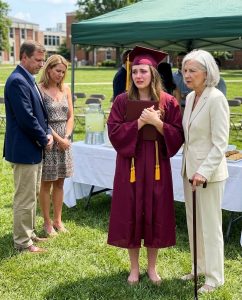
My cap was still in my hand.
My diploma cover was tucked against my hip.
Families were crowding under the refreshment tent, paper cups sweating in the June heat, and my mother was still rearranging my stole every time someone pointed a phone at us.
My grandmother, Vivien Brennan, kissed my cheek, told me she was proud of me, listened to my carefully rehearsed plan about moving to Austin and interviewing for hospitality jobs, and then asked whether the trust had made the transition easier.
“The trust?” I said.
She smiled.
“The one I established for you when you were born.”
When I told her I had no idea what she was talking about, the smile vanished from her face.
My parents froze in a way that made the air change around us.
My father looked at the ground.
My mother gripped her phone so hard her bracelet knocked against the screen.
Then my grandmother said the number.
Three million dollars.
The world did not stop, which almost made it worse.
Someone laughed nearby.
A toddler cried.
A cousin reached for a cookie and quietly put it back.
I stood in the middle of all that ordinary noise and felt my life split open.
I had spent my entire college career believing money was something I had to outrun with discipline.
I took extra shifts between semesters.
I turned down an unpaid internship in Chicago because I could not afford rent there.
I bought used textbooks, wore the same blazer to every formal event, and once put groceries back at a checkout line because I had miscalculated what was left in my account.
My parents had praised me for being practical.
They said adulthood meant sacrifice.
They said nothing was guaranteed
Standing under that tent, I looked at my mother’s designer bag, my father’s almost-new car parked along the curb, and the pictures they had posted from a river cruise the previous summer.
I remembered the kitchen renovation.
The patio.
The vague explanations about points, timing, and doing okay enough.
My grandmother did not raise her voice.
That made her anger worse.
“How much of it is left?” she asked.
Neither of my parents answered.
When she asked whether I had ever received statements, tax notices, or even a meeting request from an advisor, I said no.
Not once.
Not ever.
I watched something settle inside her face.
Later I understood that was the moment she stopped entertaining the possibility of a misunderstanding.
She demanded every record within forty-eight hours.
My father started talking about tax complications and market timing.
My mother said they had meant to tell me after graduation.
My grandmother cut through both of them with a single sentence: “You had years for privacy.
She gets facts now.”
Then my aunt Laurel, who had been hovering at the edge
of the scene trying not to listen, whispered, “Vivien, ask them about the account Harold never wanted touched.”
Harold was my grandfather.
He had died when I was ten, old enough to remember his laugh and the smell of cedar on his sweaters, but too young to understand how much money he had left behind.
I turned back toward my parents, and the look on both of their faces told me the worst part of the story had not been spoken yet.
That night I went home with my grandmother.
She lived in a brick townhouse downtown that always smelled faintly of lemon polish and old books.
Her driver carried in my garment bag and diploma while I sat at her kitchen table in my graduation dress, still wearing the earrings my mother had helped me fasten that morning.
I stared at the marble countertop and tried to understand how a person could wake up worried about security deposits and go to sleep wondering whether her entire adulthood had been built on a lie.
My grandmother poured tea neither of us drank.
At seven thirty, my parents arrived carrying a banker’s box, a laptop, and the expression of people who had not yet decided whether they were cornered or merely inconvenienced.
My aunt Laurel came with them, uninvited but unapologetic.
She had helped my grandfather’s estate attorney organize documents years earlier, and once she realized what was happening, she refused to stay away.
“No scenes,” my mother said the second she walked in.
“You forfeited that request on the quad,” my grandmother replied.
We sat in the library because it had a long table and a door that shut firmly.
My father opened the laptop.
My mother removed folders from the box with trembling hands.
My grandmother called her attorney, Eleanor Price, on speaker.
Eleanor did not waste time pretending this was normal.
“Before anyone explains motives,” she said, “I want access.”
The next two hours were a blur of passwords, paper statements, half-finished answers, and silence that felt louder than shouting.
The trust had been created when I was born, funded with three million dollars from the sale of my grandfather’s final hotel property and several investment accounts.
My grandmother had wanted the money professionally managed until I reached adulthood.
My parents had served as co-trustees after my grandfather died, with a clear duty to use the funds only for my benefit and to provide annual reports to me once I turned twenty-one.
They had done neither.
My father had changed the mailing address to their house years ago.
Then he switched the account to paperless statements sent to an email I had never seen.
My mother had approved electronic acknowledgments using a version of my initials.
There were tax documents I should have received, meetings I should have been invited to, and account summaries I had apparently reviewed without ever knowing they existed.
The first time my grandmother heard my sharp inhale, she reached across the table and put her hand over mine.
“I’m sorry,” she said quietly.
“I trusted them.”
So had I.
The real damage emerged in layers.
At first the statements looked ordinary: diversified funds, municipal bonds, blue-chip equities, quarterly rebalancing.
Then Eleanor began asking for supporting documents behind the distributions.
Tuition payments to schools
I had never attended.
Housing support during years I was living in dorms or rented apartments paid from my own wages.
Educational travel that lined up perfectly with my parents’ European vacation.
Temporary bridge transfers that landed in their joint account and never came back.
My aunt Laurel leaned forward until her reading glasses nearly touched the paper.
“Where is the reserve ladder?” she asked.
My father did not answer.
“The municipal bond ladder Harold insisted be kept intact,” she said.
“The one he called her freedom account.”
My mother started crying.
It turned out there had been a second portfolio nested inside the trust, a conservative ladder of bonds my grandfather never wanted invaded because it was meant to guarantee I would always have a stable foundation no matter what markets did.
My parents had liquidated most of it three years earlier.
“For what?” I asked.
My father rubbed a hand over his mouth.
“To cover a shortfall.”
“What shortfall?”
He looked at my mother again.
She whispered, “The house.
Then the business.
Then other things.”
It sounded almost comical in its vagueness, except the numbers on the page made it obscene.
Over the following two days, Eleanor and a forensic accountant named Daniel Cho reconstructed the story with brutal efficiency.
The first improper withdrawal had happened after my father lost money in a commercial real estate deal.
He called it a temporary loan.
Then my mother’s boutique began failing, and more money moved.
Instead of reducing their lifestyle, they refinanced the lie.
They used trust funds for the kitchen renovation, the patio, credit card balances, a country club initiation my father swore was for networking, and the river cruise my mother had described as a rare treat paid for with points.
Every time they touched the trust, they told themselves the next investment would fix it.
When markets rose, they took that as permission.
When markets fell, they panicked and moved more.
The longer they hid it, the harder it became to admit.
So they built a system around secrecy.
The ugliest truth came when Daniel compared the trust timeline to my college years.
“You never received tuition support from this account,” he said, looking up from his laptop.
“Not because it wasn’t allowed.
Because using it for tuition would have required beneficiary documentation and direct contact once she was an adult.”
The room went completely silent.
I turned to my parents so slowly I could feel my pulse in my throat.
“You let me take loans,” I said, “because paying for school honestly might have exposed you.”
My mother started shaking her head before I had even finished.
“That’s not fair.”
“Isn’t it?”
“We always intended to make you whole,” she said.
“You were doing so well.
You were independent.
We thought—”
“You thought what?” My voice rose for the first time.
“That because I was surviving, I wouldn’t notice being robbed?”
My father stood up then, anger finally breaking through the fear.
“Robbed is a dramatic word.”
Eleanor did not even look at him.
“It is also the cleanest one available.”
That night my parents stopped pretending there had been some administrative mix-up and told the story the way people do when facts have already trapped them.
They never used the word steal.
They used words
My father said he thought he could restore everything before I reached the age of control.
My mother said they were under pressure after my grandfather died, then after the market dips, then after the boutique struggled, then after the mortgage reset.
Every bad choice had, apparently, been followed by another bad choice they called temporary.
“What was the plan,” I asked, “if I asked sooner?”
My mother looked away.
That answer told me they never had one.
By Monday afternoon, Daniel had the numbers.
If the trust had been left alone and managed conventionally, it would have been worth a little over 4.4 million dollars by then.
Instead, the liquid assets remaining totaled just under 1.2 million.
Another 180,000 was trapped in a private investment partnership my father had entered without authorization and was unlikely to recover fully.
The amount clearly misappropriated for my parents’ direct benefit was 1.86 million dollars, not counting growth lost because the money had been removed.
I remember staring at the spreadsheet until the columns blurred.
I had gone into college afraid of being reckless with a forty-dollar late fee.
My parents had taken sums large enough to change generations and still managed to talk to me about discipline.
My grandmother did not cry.
She became efficient.
By evening she had petitioned the court to suspend my parents as trustees, freeze the remaining accounts, and appoint Eleanor as temporary independent fiduciary.
She also gave my parents a choice: cooperate fully, resign, sell what could be sold, and sign a confession of judgment for the missing funds, or face immediate civil action and a criminal referral supported by forged signatures, wire records, and withheld tax documents.
I expected them to fight.
Instead, the fight went out of them the moment they realized there was a paper trail even their explanations could not soften.
My father’s confidence collapsed first.
My mother’s did a day later, when Eleanor slid a stack of beneficiary acknowledgments across the table and pointed to the fake initials that were supposed to be mine.
The months that followed were not dramatic in the cinematic sense.
No one screamed in a courtroom.
No one collapsed in confession.
Real consequences are often quieter and crueler than that.
The house went on the market.
My mother closed the boutique for good.
My father liquidated his retirement accounts and resigned from two board positions he had bragged about for years.
Their country club membership disappeared.
The second car went.
Jewelry my mother called sentimental until sentiment got expensive was appraised and sold.
Under the settlement, every available asset that could legally be directed toward restitution was directed there.
The district attorney’s office did open a case because Eleanor referred the forged documents.
In the end my parents each accepted plea agreements tied to breach of fiduciary duty and falsification of records.
My father received home confinement and probation.
My mother received probation, community service, and financial reporting requirements that would follow her for years.
Some relatives called it humiliating.
I thought humiliation had arrived much earlier, just in a different outfit.
Financially, the recovery was partial but real.
Between the frozen remainder, the forced sales, and a structured restitution agreement secured against future earnings and remaining property interests, the trust was
restored to just over 2.5 million dollars.
It was still less than what should have been there.
The growth they stole could not be unwound like a bad decision on paper.
But choice had been returned to me in a form I could finally see.
The first thing I did was pay off my student loans.
Not because it made everything fair.
It didn’t.
But I needed at least one chapter of that lie to end cleanly.
I sat in Eleanor’s office, clicked the final confirmation, and felt absolutely nothing for three seconds.
Then I cried so hard I had to borrow tissues from a box with a law firm logo on it.
My grandmother sat beside me the whole time.
“You do not have to hurry into a life built by panic anymore,” she said.
The strange thing was, I still wanted the life I had chosen.
I still moved to Austin.
I still took a management trainee role with a hotel group that paid far less than some of my classmates’ jobs but taught me more in six months than I thought possible.
I rented a one-bedroom instead of a room in a shared house, bought a desk that didn’t wobble, and replaced the shoes I had been resoling for two years.
I did not quit working.
I did not become a different person overnight.
The money changed my options, not my instincts.
Maybe that was the one useful thing caution had ever given me.
My relationship with my parents did not survive in any recognizable form.
For almost a year I spoke to them only through attorneys and one therapist my grandmother insisted was better than all of us at separating facts from guilt.
Eventually I met my mother for coffee because part of me still needed to see whether remorse looked different in daylight.
She looked older, smaller, stripped of the polish she had once used like armor.
“I loved you,” she said, tears already rising.
“I know,” I told her.
“That’s what makes this worse.”
Love was never the confusing part.
Plenty of people love selfishly.
Plenty of people convince themselves that protecting their comfort is the same as protecting their child.
My parents had loved me.
They had also watched me struggle under burdens they could have lifted and decided their secret mattered more than my freedom.
My father was harder to face.
He wanted to explain the sequence, the pressure, the logic.
He kept reaching for the story in which he had lost control gradually enough to stay sympathetic.
One afternoon I stopped him.
“You didn’t just take money,” I said.
“You used my resilience as permission.”
For once, he had nothing to say.
Time did what it always does.
It moved whether any of us deserved mercy or not.
My grandmother and I grew closer than we had ever been.
We had dinner every Sunday when I was in town.
She told me stories about my grandfather I had never heard: how he once slept in a lobby office to keep a failing hotel open, how he believed money should create dignity, not obedience, how he hated the phrase character building whenever it came from someone with a full pantry.
One evening she handed me a yellowed note written in his blocky
handwriting.
It had been tucked into the original trust file.
For Maggie, it said, so she always has choice.
I kept that note in my desk long after I stopped checking the trust balance every week like someone verifying a wound had actually closed.
People still ask, sometimes with the careful curiosity reserved for family scandals, whether I forgave my parents.
I never know how to answer in a way that feels complete.
I understand fear more than I did before.
I understand how pride and panic can turn into a machine that eats judgment.
I even understand the seductive lie that says you can borrow from someone you love and fix it before the damage becomes visible.
What I do not understand is how they watched me carry debt, pass up opportunities, and shrink my own dreams to fit the space they left me, and still called themselves responsible.
The biggest red flag was never the patio, the trip, or the designer bag.
It was how naturally they turned my hardship into a lesson while hiding the hand that created it.
Maybe that is what betrayal really is: not the stolen money, but the stolen version of yourself you might have become if the truth had been yours all along.