time I still wanted to help without becoming the story.
That desire died in the emergency room.
“Remove everything not legally required to remain in place,” I told Marcus.
He paused.
“All at once?”
“All at once.
No warnings beyond contractual notice.
No personal explanations.
No soft landing.”
Priya handled the corporate side.
Andre updated residential security and access protocols.
By nightfall, every invisible thread that had cushioned my family’s life had been cut.
Not sabotaged.
Not vandalized.
Not destroyed.
Simply withdrawn.
Contracts expired.
Credit lines were called in under lawful terms.
Property support ceased.
Silent guarantees vanished.
Deferred obligations arrived and became immediate.
It was amazing how quickly a house of mirrors looked fragile once the lights came on.
For a week, there was silence.
Then, on the eighth morning, my phone lit up at 6:12 a.m.
with a voicemail notification.
The transcript loaded before I played it.
CHARLOTTE BROOKS: LENA! WHAT DID YOU DO?!
I listened.
She was shrieking.
Behind her, my mother was crying.
My father barked something I couldn’t make out.
I called Marcus first.
“They found out faster than expected,” he said.
“Charlotte’s board discovered the line of credit disappeared.
Her largest warehouse lease default notices were delivered.
Several vendors are refusing extensions because your guarantee was the thing making them comfortable.
Your parents were also notified that the property support trust has been dissolved.”
“Good,” I said.
By nine that morning, my mother had called fourteen times.
My father sent a single text.
THIS IS SICK.
FIX IT.
Charlotte sent eleven.
What have you done?
Call me.
You can’t ruin us because you had a bad week.
Family doesn’t do this.
That last one sat on my screen for a long time.
Family.
The word looked different now.
At 9:17, Andre called from the security office.
“They’re at the gate,” he said.
My parents and Charlotte had driven to my property without permission.
The cameras showed my father jabbing a finger toward the intercom, furious.
My mother’s mascara was streaked.
Charlotte looked immaculate and murderous.
“Do you want them removed?” Andre asked.
I watched the feed a moment longer.
Charlotte wasn’t panicking because she cared about my surgery.
She was panicking because for the first time in her life, something polished was cracking where everyone could see it.
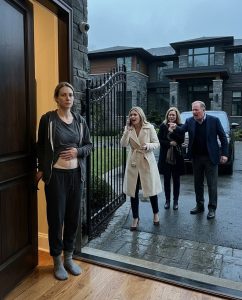
“Bring Charlotte in alone,” I said.
“The others can wait outside.”
She entered my sitting room ten minutes later in a cream coat and heels too sharp for a family crisis.
Her eyes swept across the house first—not at me, but at the vaulted ceilings, the art, the quiet wealth I had never bothered to disguise here because none of them had ever been invited inside.
Then she saw me standing by the fireplace in soft pants and a surgical recovery wrap, one hand resting lightly over my abdomen.
Her face changed.
Not to guilt.
To calculation.
“This is yours?” she asked.
“Yes.”
She gave a brittle laugh.
“How?”
“Sit down, Charlotte.”
She stayed standing.
“My accounts are frozen.
My board is demanding answers.
Dad says the mortgage payment bounced.
Mom’s discretionary account is gone.
Every lender is calling.
What did you do?”
“I stopped paying for you.”
For the first time, she looked confused.
Truly confused.
As if her mind rejected the sentence before it
could land.
“What are you talking about?”
So I told her.
Not everything.
I didn’t need to recite net worth or valuation models or acquisition histories.
I simply explained, piece by piece, the architecture of her life.
The property support for our parents.
The loans.
The guarantees.
The hidden operating line behind Brooks Strategic.
The lease support.
The investment vehicles.
The fact that the empire she had spent years admiring from magazines and conference rumors belonged to the sister she called unstable.
Charlotte went white.
“No,” she said.
“No.
That’s impossible.”
I slid a folder across the table.
Marcus had prepared it at dawn.
Corporate filings.
Notices.
Chain-of-control documents redacted only where necessary.
Enough truth to leave no room for denial.
Her hands shook as she flipped through it.
“You did this?” she whispered.
“I built Orchid Holdings,” I said.
“I financed your launch.
I kept Mom and Dad comfortable.
I covered risks none of you even knew existed.
And on the night I was taken into emergency surgery, all I asked for was for someone to watch my children.”
She swallowed.
I continued before she could speak.
“You heard me ask.
You laughed.”
Her eyes lifted to mine.
“I didn’t know it was serious.”
“I said I might need surgery.”
“You always sounded dramatic—”
“And that made it acceptable?”
She flinched.
There it was.
Not remorse exactly, but the first crack in certainty.
“You don’t get to destroy our parents because you’re hurt,” she said weakly.
I almost smiled.
“Charlotte, I didn’t destroy anything.
I stopped shielding all of you from consequences.
There’s a difference.”
She sat down then, all elegance gone out of her knees.
“What do you want?”
The question told me everything.
She still thought this was a negotiation.
“Nothing,” I said.
“That’s what you don’t understand.
I don’t want repayment.
I don’t want apologies shaped for an audience.
I don’t want to be included in family photographs.
I want distance.”
She stared at me.
“Mom is hysterical.
Dad says you’re vindictive.”
“Your father told me to call a neighbor while my appendix was rupturing.
Your mother posted ‘No burdens, just happy times’ while strangers arranged care for my children.
They can call me whatever helps them sleep.”
Tears sprang to Charlotte’s eyes then, more from panic than grief.
“The board will force me out,” she whispered.
“Then maybe build something that can stand without hidden support.”
She looked toward the front windows, where our parents waited beyond the gate, small and frantic in the distance.
“Please,” she said.
“At least restore the line for thirty days.
I can fix this if I have time.”
“No.”
The word came out calm and final.
She stood, folder clutched to her chest like a shield.
“You can’t just erase us.”
I met her gaze.
“Watch me.”
Andre escorted her out.
My parents tried to rush the door when they saw her face, but security held them back.
My mother screamed my name from the drive.
My father threatened lawsuits so ridiculous even he seemed embarrassed halfway through one sentence.
I went upstairs instead and sat on the edge of Noah’s bed while he napped, one hand on his small warm back, and listened to the muffled chaos outside fade into silence.
The next month was ugly.
Charlotte was
removed as CEO after her board discovered how dependent the company had been on undocumented soft support and concealed risk exposure.
She tried to frame it as market volatility, then as sabotage, then as a temporary restructuring.
None of it held.
The story spread quietly through business circles, not because I pushed it, but because institutions hate surprises and she had become one.
My parents’ house went into distress within six weeks.
Marcus arranged a humane exit: sixty days to vacate, legal counseling, no public records drama beyond what was unavoidable.
I was not interested in spectacle.
I was interested in closure.
My mother sent letters.
Some arrived in envelopes sprayed with her perfume, as though scent could soften history.
In one, she wrote that she had never understood me.
In another, she wrote that mothers make mistakes and daughters are supposed to forgive them.
My father never apologized.
He alternated between rage and lectures about loyalty, as if volume could transform negligence into principle.
Charlotte sent one final email two months later.
I was wrong about you, it said.
That was all.
Not I’m sorry.
Not I should have come.
Just wrong about you, as if the true offense had been misjudging my market value.
I did not reply.
I changed my number.
I updated the trusts.
I rewrote my will.
I added three people to Noah and Lily’s emergency contact list, all of them chosen because they had shown up in ordinary ways without being asked.
I increased the staffing around my home and reduced the emotional traffic in my life.
Then I healed.
Not all at once.
Recovery from surgery was straightforward.
Recovery from clarity was stranger.
For weeks I would reach for my phone after some small triumph—the twins saying a new word, a deal closing, a funny thing Lily said in the grocery store—and remember there was no one on the other end I trusted with joy.
I grieved that.
Not the family I had, but the one I had spent years pretending might still emerge if I tried hard enough.
One autumn afternoon, months later, I took Noah and Lily to a park near the river.
The air was cool enough for sweaters.
Leaves skittered along the path in copper spirals.
Noah chased them.
Lily collected the brightest ones and brought them to me like treasure.
“Are you happy, Mommy?” she asked, completely unprompted.
Children sense what adults try to hide.
I looked at her, really looked.
At the seriousness in her face.
At the small hand full of leaves.
“Yes,” I said.
And for the first time, it was true without effort.
Not because everything was perfect.
Not because betrayal stops hurting on schedule.
Because peace had finally become more important than being chosen.
People who heard fragments of the story later had strong opinions.
Some said I was ruthless.
Some said my parents got what they deserved.
Some said blood should matter more.
Others said blood is exactly why certain wounds cut so deep.
I still don’t know which part would disturb outsiders most: that my family abandoned me for a concert, or that I had been carrying them for years without saying a word.
Maybe the biggest red flag was never Charlotte’s vanity or my father’s contempt.
Maybe it was how
normal it had all started to feel to me.
That is the part I think about now.
Not whether I was too harsh.
But how long I had mistaken survival for love.