softer place would appear.
And maybe it always had.
Until now.
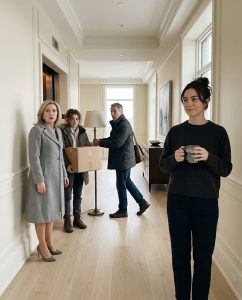
My mother drew herself up.
‘So you planned against your own family?’
‘Yes,’ I said.
The honesty stunned her more than the wall had.
I did not soften it.
‘I planned for a boundary because words have never been enough with you.
If I had left that room intact, you would be unpacking her boxes right now while telling me we could discuss details later.’
Austin muttered something about selfishness.
I looked at him.
‘Interesting word from the only person in this hallway who still eats groceries from Mom’s fridge.’
He went red and shut up.
Brianna set her box down carefully on the floor.
When she spoke again, her voice was smaller.
‘So what am I supposed to do?’
There it was.
Not a performance.
Not a tactic.
A real question.
I answered the real part of it.
‘I already booked a corporate apartment three blocks from my office,’ I said.
Four faces turned toward me.
It was my mother’s turn to be caught off guard.
‘I did it an hour ago,’ I continued.
‘Because when the concierge called to say my family was on the way up with luggage and boxes, I assumed this might be the conversation we were about to have.
It’s paid for through Wednesday.
Brianna can stay there while she figures out next steps.
I’ll help her build a budget, call a recruiter I know, and look at short-term rentals if she wants actual help.
But she is not moving in here.’
My mother’s mouth fell open.
‘You instructed the concierge to call you?’
‘I instructed the concierge that nobody is ever to arrive with move-in items for my unit without my approval.’
The room went still again.
That was the second thing I had changed when I moved in.
Not just the wall.
The access.
This building ran on key fobs and resident lists.
I had made it clear from day one that I was the only resident, and no one—not family, not friends, not anyone with a dramatic story and a stack of boxes—would be added without my direct written consent.
My mother looked at me like I had become a stranger.
Maybe I had.
Or maybe I had finally become visible.
‘You humiliated her,’ my mother said.
I looked at Brianna.
‘Did I? Or did the people who promised you my home without asking me do that?’
Brianna’s eyes filled.
She turned to our mother.
‘You told me she said yes.’
My mother snapped back too quickly.
‘I said Eden would come around once you were here.’
There it was.
The family strategy, spoken aloud at last.
Not a request.
Momentum.
Show up.
Fill the space.
Force the kindest person in the room to decide whether she wants to look cruel.
For years, that person had been me.
Brianna stared at our mother for a long second.
Something in her face shifted.
Not all the way to accountability, not yet.
But the first crack had opened.
She wiped under one eye with the heel of her hand and looked at me.
‘Is the apartment real?’
‘Yes.’
‘For three nights?’
‘Long enough for you to breathe before making the next decision.’
My mother started to object, but Brianna cut across her,
still looking at me.
‘I’ll take it.’
That shut everyone up.
Even me, for half a second.
Austin swore under his breath.
My mother said Brianna’s name in the warning tone she used when one of us stopped following her script in public.
Brianna ignored it.
She bent, picked up her box again, and this time when she straightened, she did not look hopeful.
She looked embarrassed.
And weirdly, finally, honest.
I grabbed my coat and keys.
My mother demanded to know where I thought I was going.
‘To help her move into the place she actually has permission to stay,’ I said.
My father said my name, and for a second I thought he might back my mother again.
Instead he looked at the wall, then at Brianna, and sighed.
‘Your mother should have asked,’ he said.
It was the closest thing to an apology I had heard from him in years.
My mother did not speak to either of us on the elevator ride down.
Austin peeled off in the lobby after muttering that the whole thing was insane.
My father followed him out to the car.
Brianna stood beside me holding the lamp and the box, staring at her reflection in the mirrored elevator doors like she was trying to identify the person in them.
In the parking garage, she said, ‘Did you really know this would happen?’
I unlocked my car.
‘Not the exact day.
Not the exact version.
But yes.’
She winced.
‘That’s bad.’
‘It is.’
The corporate apartment was small, furnished, and bland in the way all short-term rentals are, but it was warm, clean, and unquestionably hers for the next few nights.
I carried the heavier box inside.
She set the lamp down on the counter and stood in the middle of the room with both hands covering her face.
‘I feel stupid,’ she said through her fingers.
I leaned against the kitchenette and let the silence stretch until she lowered her hands.
‘You are not stupid,’ I said.
‘But you do let other people decide things for you and then act surprised when the consequences hit.’
She swallowed hard.
‘Mom said if I asked you directly, you’d say no.’
‘Would I have?’
She looked at me for a long moment and then nodded once.
‘Probably,’ she said.
‘Exactly.’
She sank onto the edge of the sofa bed.
‘I don’t know how I got here again.’
‘By calling rescue a plan,’ I said.
She laughed once, miserably.
‘That sounds like you.’
‘It’s supposed to.’
That afternoon we sat with her bank app open, a legal pad, and the kind of honesty neither of us particularly enjoyed.
Nolan had left more damage than she admitted.
Brianna had ignored late notices out of panic.
She had passed on two decent apartments because she assumed something easier would appear.
By the end of three hours, we had a list.
A recruiter to call Monday morning.
A storage unit for the extra furniture.
A short-term sublet one of my coworkers had heard about in Northeast.
And a rule I made her say out loud before I left.
No more moving based on promises someone else made for another person’s life.
She rolled her eyes at that, but she said it.
The next week was ugly.
My mother
sent long texts about betrayal, family values, and how success had changed me.
My father sent one shorter message that said only, You made your point.
I did not answer either of them that day.
Brianna answered me instead.
She sent me screenshots after her recruiter call.
Then photos of the sublet.
Then a message that read, I signed.
On my own.
Two weeks later she had a contract role with a marketing firm and a roommate she had chosen carefully.
A month after that, she sent me the first fifty dollars toward the old credit card balance.
It was not the amount that mattered.
It was the fact that she named the debt without being asked.
My mother remained furious for longer.
In her version of events, I had walled off not just a bedroom but my heart, my upbringing, my obligations, and every warm thing she believed a family home should mean.
She told an aunt that I had built a literal barricade against my own sister.
The aunt called me, half scandalized and half delighted, because in our family drama was a spectator sport.
I told her the truth.
Three days later she called my mother back and, according to Brianna, said something like, Good for Eden.
About time one of you women learned to use a door properly.
The final shift happened six weeks after the wall reveal, at Sunday dinner in my parents’ house.
I almost did not go.
Brianna asked me to.
So I went.
My mother served roast chicken with the rigid hospitality of a queen entertaining a rival court.
Austin avoided my eye contact.
My father talked about weather and parking.
We made it through soup, bread, and half the main course before my mother finally set down her fork and said, ‘I still cannot believe you thought that wall was the right way to handle family.’
I opened my mouth.
Brianna beat me to it.
‘It was,’ she said.
Everyone looked at her.
She kept going.
‘What wasn’t right was telling me Eden agreed when she didn’t.
What wasn’t right was assuming she’d fix my mess because it was easier than asking Austin or using the basement here.
What wasn’t right was me going along with it because I wanted the nice version instead of the honest one.’
My mother stared at her as if betrayal had changed seats at the table.
Brianna did not stop.
‘Eden didn’t embarrass me.
She forced me to stop pretending help and entitlement were the same thing.’
My father lowered his eyes to his plate.
Austin said nothing.
My mother’s face went rigid, then wounded, then blank.
For once, none of those expressions worked.
Dinner ended early.
Outside, in the dark cold by our cars, Brianna hugged me awkwardly and said, ‘I hated that day.’
‘I know.’
She pulled back.
‘I think I needed it.’
‘I know that too.’
Spring arrived slowly that year.
By March, Brianna was paying her own rent on time.
By April, she had stopped answering Nolan’s messages.
By May, she came up to the penthouse for coffee with only a tote bag and a plant clipping she asked permission to leave on the kitchen counter until she came back the next weekend.
Asked permission.
A small sentence.
A massive difference.
My relationship with my mother never fully returned to what it had been, but once I stopped trying to earn peace by surrendering space, I realized what we had before was not peace anyway.
It was compliance decorated as closeness.
One evening, months later, I stood in the hallway where the second bedroom door used to be.
The wall looked ordinary now.
Just paint, trim, and quiet.
On the other side, my private studio glowed softly through the hidden entrance in my suite, full of work files, books, and the kind of order I had spent my whole life fighting to create.
I touched the wall with my fingertips and thought about how many people would hear this story and decide the construction was the shocking part.
Maybe it was.
But to me, the real shock was how necessary it had been.
The biggest red flag had never been Brianna’s boxes in the elevator.
It had been the years of smaller moments that taught everyone around me my boundaries were negotiable if they arrived smiling.
I still loved my family.
I just finally loved my peace enough to stop donating it.
And even now, in the quiet of that penthouse, with the city lights spread below and no one claiming a room that was never theirs, I sometimes wonder which was harder for them to forgive: the wall I built in my hallway, or the fact that it proved I had seen them clearly long before they ever saw me.