My son and his wife tore apart my beach house, packed my bedroom into boxes, and offered me a locked back room in my own home, but the red folder they left on my dining table changed everything before they could finish taking it.
I drove to my beach house on a Friday afternoon with a grocery bag full of peaches, a paperback I had been saving for three months, and the quiet kind of happiness a woman only understands after spending most of her life answering everyone else’s emergencies.
The highway out of the city was crowded at first, all red brake lights and impatient horns and people trying to outrun the workweek before it caught them by the collar. But after the last shopping plaza disappeared behind me and the road opened into low marshland, my shoulders finally began to loosen.
The sky was pale blue. The radio played old soft rock. The kind of song my husband Arthur used to hum under his breath when he thought nobody was listening.
By the time I passed the weathered seafood stand with the painted wooden crab on the roof, I had already planned the whole week in my head.
Coffee on the deck before sunrise.
Toast with peach preserves.
A long walk along the water while the sand was still cool enough for bare feet.
Maybe on Wednesday I would drive into town, park near the pier, and buy a new basket from the little craft store that sold seashell wind chimes and overpriced candles to tourists from Ohio. Nothing exciting. Nothing loud. Nothing that needed me to sign, approve, fix, comfort, arrange, forgive, or understand.
At seventy-one, peace had become less of a feeling and more of a place.
Mine had white siding, blue shutters, a sagging striped hammock between two posts, and a narrow strip of beach grass that bent toward the ocean every time the wind came in from the east. There was a small American flag mounted beside the front door, faded a little from the sun, the same flag Arthur used to straighten every Fourth of July before the neighbors came over with lemonade and folding chairs.
I had bought that house twelve years earlier with money nobody ever saw me earn because they were too busy seeing what I gave away.
Forty years as a nurse had left me with swollen knuckles, a bad knee, and the habit of waking before dawn even on days when no one needed me. I had worked double shifts during snowstorms, missed birthdays, answered calls on Christmas mornings, and learned how to eat dinner standing beside a break room microwave while a doctor asked for updated vitals through the doorway.
I had held strangers’ hands when their own families were still parking their cars.
I had watched people leave this world with less fuss than some people made over a delayed prescription.
After all that, a quiet house by the water did not feel like luxury. It felt like proof that I had survived.
My son Matthew used to call it “Mom’s little escape,” always with that half-laugh that made it sound charming and unnecessary at the same time. When I first bought the place, he walked through the rooms with his hands in his pockets, smiled at the ocean view, and said, “Good for you, Mom. You deserve something nice.”
I believed him.
That is one of the mistakes mothers make.
We believe the soft version of our children even after life has shown us the harder one.
The first sign that something was wrong came before I reached the driveway.
There was a pickup truck parked on the shoulder near my mailbox, its back loaded with drywall sheets and plastic buckets. I slowed down, frowning, wondering if the neighbors had hired someone for repairs. Coastal houses always needed something fixed. Salt air was beautiful, but it ate through everything eventually: hinges, rails, window latches, even the patience of people who thought ocean living meant permanent vacation.
Then I turned onto my gravel drive and saw two more trucks.
One was backed up near my front steps.
The other was parked crooked beside the hydrangeas.
My hydrangeas.
The blue ones I had babied through three dry summers, hauling watering cans from the side spigot because the sprinkler never reached them properly. A stack of cement bags sat beside them, and white dust had settled over the leaves like flour.
For a moment, I sat there with both hands on the steering wheel and the engine still running.
The house looked like mine and not mine at the same time.
The front door was open.
Not unlocked. Not cracked for air. Open.
Standing wide as if the house had stopped belonging to anyone in particular.
The deck chairs had been shoved into a corner. A rolled rug leaned against the railing. My pots of red geraniums, the ones I had planted after my sister mailed me seeds from Asheville, were pushed near the steps, their blossoms bent and powdered with dust.
And on the deck, facing the water like she had been born there, stood Khloe.
My daughter-in-law had one hand wrapped around a coffee mug and the other lifted in command. Her chestnut hair was tucked behind one ear, sunglasses pushed up on top of her head, cream sweater spotless despite the mess around her. She was speaking to a man in work boots, pointing toward my kitchen window.
“No,” she said. “The tile needs to be here before Monday. We’re already behind.”
She did not turn when my car rolled to a stop.
She did not look startled.
She did not greet me.
That was what sent the first cold line through my body.
Not the trucks.
Not the dust.
Not even the open door.
It was the way she stood there issuing orders on my deck, in front of my house, as if my arrival were a mild inconvenience she had expected eventually.
I turned off the car.
The sudden silence inside it made the drill from the house sound even sharper. It ripped through the afternoon air, steady and metallic, a sound that did not belong anywhere near the week I had imagined.
I stepped out slowly.
“Khloe.”
She looked over her shoulder, and there it was.
The smile.
Khloe had a smile she used when she wanted people to feel unreasonable for noticing something was wrong. Wide enough to be friendly. Smooth enough to hide the calculation beneath it. I had seen it at restaurants when she sent food back without apology. I had seen it at family dinners when she corrected Matthew in front of me but made it sound like affection.
I had seen it at my birthday lunch the year before, when she said, “Olga, you’re so independent,” in the tone people use when they mean difficult.
“Olga,” she said brightly. “You’re here.”
I looked at the trucks, then at the open door. “What is all this?”
Her smile did not move, but her eyes did. They flicked once toward the house.
“Matthew’s inside,” she said. “He’ll explain.”
“Explain what?”
She lifted her mug and took a careful sip. “It’s going to be beautiful.”
There are moments in life when the mind refuses to move forward because it already understands what the heart is not ready to hold.
I stood at the bottom of the steps, my purse strap cutting into my shoulder, the grocery bag hanging from one hand, and I knew before anyone told me that something had been decided without me.
Still, I climbed the steps.
My knees complained the way they always did after a long drive, but I barely felt them. I passed Khloe close enough to smell her perfume, something clean and expensive with no warmth in it. She moved aside only half an inch, as if making room for me in my own doorway required effort.
Inside, the smell hit me first.
Wet plaster.
Fresh cement.
Sawdust.
Paint.
The stale breath of opened walls.
Then I saw the kitchen.
Or what had been the kitchen.
The maple cabinets I had saved for three years to install were gone from the walls. Not gently removed, not wrapped and stored, but ripped out, leaving pale rectangles and jagged scars where they had been. The tile floor I had chosen tile by tile, standing in a showroom under fluorescent lights with a sample in each hand, was buried under gray dust.
Electrical wires hung from one open patch like loose nerves.
My refrigerator sat in the living room, unplugged, its door slightly open.
The little watercolor paintings I had done in my Thursday art class were stacked face-in against the wall, one frame cracked at the corner.
I did not scream.
People think screaming is the natural response to shock.
It is not.
Sometimes shock is so complete that the body becomes practical. It observes. It records. It takes inventory.
The blue casserole dish from my wedding china had been moved to the floor.
The brass lamp from Arthur’s reading corner was wrapped in plastic.
The olive green armchair where he used to fall asleep during Sunday football was pushed beside the fireplace, spared only because it was too heavy for someone to bother moving.
My house had been entered, opened, rearranged, and altered while I was in the city believing it was waiting for me.
A worker in a gray shirt stopped when he saw me. He lowered the drill in his hand.
“Ma’am,” he said uncertainly.
Before I could answer, Matthew appeared from the hallway.
He had dust on his jeans and a streak of white across his sleeve. At forty-five, my son still carried traces of the boy I had raised: the same deep-set eyes, the same way of ducking his head when he expected trouble, the same mouth that tightened when he wanted to be seen as reasonable.
But there was something else there now.
Something that did not belong to the boy who used to crawl into my bed during thunderstorms and whisper, “Mom, are we safe?”
This man was not asking whether we were safe.
He was calculating how much of the truth to give me at once.
“Mom,” he said.
My voice came out quieter than I expected.
“What did you do?”
He glanced toward Khloe, who had followed me inside and was standing near the doorway with her coffee mug against her chest.
“It was supposed to be a surprise,” he said.
“A surprise.”
“Well.” He wiped his palms on his jeans, leaving more dust behind. “Kind of. We wanted to get started before you came so you could see the progress.”
I looked at the empty cabinet wall.
“Progress?”
“Mom, come on. The kitchen was old.”
“It was three years old.”
“The layout was old,” Khloe said from behind me. “The whole house feels closed off. You know how coastal homes are now. Open concept. Better light. Better flow.”
I turned to her slowly. “My house had enough light.”
Her smile flickered. “Of course. I just meant it could be improved.”
I looked back at Matthew. “Who authorized this?”
He exhaled like I was starting in the wrong place.
“We did.”
“You did.”
“Yes.”
“With my house.”
His jaw moved once. “Mom, don’t make it sound like that.”
“How should I make it sound?”
“It’s family property.”
The words landed between us with a softness that somehow made them worse.
Family property.
Not my property.
Not the house I bought after Arthur died and left me with debts he had hidden behind smiles. Not the house whose mortgage payments came out of paychecks earned under hospital lights. Not the house whose porch I painted myself one hot July weekend while Matthew canceled on me because he and Khloe had brunch plans.
Family property.
A phrase people use when they want access without responsibility.
I set the grocery bag on a folding chair. One peach rolled out and stopped against a paint can.
“Where is my bedroom?” I asked.
Matthew blinked. “What?”
I looked toward the stairs. “If you started with the kitchen, you didn’t stop there.”
Khloe looked down at her phone.
Matthew rubbed the back of his neck. “We should go upstairs.”
That was when the house seemed to tilt slightly beneath me.
I followed him because some part of me still wanted him to turn around and say, I’m sorry. We got carried away. The contractor misunderstood. We’ll put it back.
I wanted him to be my son long enough to be ashamed.
The stair railing was covered with a plastic sheet. On the landing, my framed photograph of Arthur and me at the county fair leaned against the wall as if it had been demoted from memory to clutter.
In the photograph, Arthur had one arm around my shoulders and a paper cup of lemonade in his free hand. He had been laughing at something Matthew said off camera.
I had not looked at that picture in months, but seeing it on the floor made my throat tighten.
Matthew stopped at the master bedroom door.
“Mom,” he said, softer now, “try to keep an open mind.”
I did not answer.
He opened the door.
The room I had slept in for twelve summers no longer looked like a room. It looked like an argument someone had started and walked away from.
My bed was gone.
The cream quilt my sister made was gone.
The two bedside tables were gone.
The walls were half-painted a pale mint green that made the afternoon light look sickly.
My grandmother’s carved wooden armoire, the one that had survived three generations and one basement flood in Ohio, was missing.
I stepped into the doorway and gripped the frame.
“Where is the armoire?”
“In storage,” Matthew said quickly.
“What storage?”
“The garage for now.”
“The garage?”
“It’s wrapped.”
I turned to him. “That piece belonged to my grandmother.”
“I know.”
“Then why was it moved?”
He looked away.
Khloe’s voice came from behind us.
“Because the room needed to be cleared.”
I had not heard her come up. She stood one step below the landing, one hand on the banister, her coffee mug still in the other.
“For what?” I asked.
Matthew’s silence had weight.
Khloe gave him a look. It was brief, but I saw it. The kind of look a wife gives a husband when she thinks he is failing at a conversation they rehearsed.
He took a breath.
“Gloria and Frank need a better place,” he said.
I stared at him.
“Khloe’s parents,” he added, as if I had forgotten who Gloria and Frank were.
“I know who they are.”
“Gloria’s health hasn’t been good. The city’s hard on her breathing. Frank can’t keep up with their building anymore. The stairs, the noise, the parking situation. It’s just been a lot.”
I waited.
He kept going.
“Khloe and I have talked about it for months. This house is perfect. It has space. It has air. It has the water. You still have the apartment in the city, so you’re not losing a home.”
Something inside me went very quiet.
“Say that again.”
“Mom—”
“Say it plainly.”
He looked at Khloe.
Then back at me.
“We’re going to move in here,” he said. “Permanently. Khloe and me. Gloria and Frank too. We’ll make the rooms work. We’re redoing the kitchen so everyone has more space. The master bedroom will be better for Gloria because of the light and access to the upstairs bath. You can use the back room when you come.”
I heard the ocean through the open window.
For years, that sound had been comfort.
That afternoon, it sounded distant, like it belonged to someone else.
“The back room,” I said.
“It’s only temporary at first,” he said quickly. “We can figure out a schedule. You can come certain weeks. Or certain months. You don’t need to be here all the time.”
“I don’t need to be here all the time.”
“Exactly.”
I looked at his face. He seemed relieved, as if my repeating his words meant I was beginning to understand him.
“Matthew,” I said, “this is my house.”
“I know.”
“No, you don’t.”
His expression tightened. “Mom, I do know. But at some point, you have to think about what makes sense for everybody.”
“For everybody.”
“Yes.”
“And did everybody include me?”
He sighed.
That sound, that little tired sigh, was the first thing that truly hurt. Not the walls, not the missing bed, not the damaged kitchen.
That sigh told me he had already cast me in the role of obstacle.
“We knew you would react like this,” he said.
I let go of the doorframe. “Like what?”
“Defensive.”
“My bedroom is empty.”
“Because we’re making it better.”
“My kitchen is in pieces.”
“Because it needed updating.”
“My belongings are in boxes.”
“Temporarily.”
“And your wife’s mother is moving into my room.”
He looked at me then, really looked, and for one moment I saw annoyance break through the careful concern.
“Gloria is seventy-three,” he said. “She’s older than you.”
“By two years.”
“She has health problems.”
“So do millions of people.”
“Mom.”
“No. Don’t ‘Mom’ me as if that ends the conversation.”
Khloe came up the last step.
“Olga, nobody is trying to hurt you.”
I turned toward her. “Then what are you trying to do?”
She lifted her chin. “Create a home that works.”
“For whom?”
“For the family.”
I almost laughed. It would have sounded too sharp, so I swallowed it.
“I was family when tuition was due,” I said. “I was family when Matthew needed a car. I was family when your wedding venue required a deposit by Friday and somehow no one had planned for it. But when decisions were made about my house, I became a detail.”
Matthew’s face flushed.
“That’s not fair.”
“Neither is coming home to find my life packed into boxes.”
“You’re making this emotional,” Khloe said.
I looked at her for a long second.
She was younger than Matthew by six years, polished in the way women become when they have learned to turn presentation into armor. I had tried with her. I had really tried. I had invited her to lunch. I had remembered her birthday. I had listened to stories about her job, her mother, her frustration with apartment living, her plans to “eventually settle near the coast.”
I had mistaken those plans for wishes.
I had not understood they had become instructions.
“Yes,” I said. “I am making this emotional. It is my home.”
Khloe’s mouth tightened.
“It’s a house, Olga.”
“No,” I said. “That is what you don’t understand. To you, it is square footage near the water. To me, it is every extra shift I worked after Arthur died. It is every bill I paid alone. It is every morning I got up when my hands hurt too much to button my uniform. It is not just a house because you have decided you want one.”
Matthew stepped between us slightly.
“Let’s all calm down.”
I looked at him.
“There is no ‘all’ here. There is you explaining why you have taken something that does not belong to you.”
His eyes hardened.
“Taken?” he said. “You’re acting like we broke in.”
“Did you have a key?”
He hesitated.
“I gave you that key for emergencies.”
“This was an emergency.”
“No. A pipe bursting is an emergency. A storm taking out the roof is an emergency. Your wife wanting a beach address is not an emergency.”
Khloe’s cheeks colored.
“That is not what this is.”
“Then what is it?”
She looked away first.
Matthew rubbed his forehead. “Mom, we can’t keep living in that apartment.”
“Then move.”
“With what money?”
“With yours.”
He stared at me as if I had said something cruel.
I stared back because I had spent too many years softening truths before handing them to him.
“Not everyone had your luck,” Khloe said quietly.
I turned to her. “My luck?”
Her voice changed. The sweetness drained out of it.
“You bought at the right time. You have two properties. We can barely get ahead, and my mother can’t breathe in that apartment building. You could help. You could make one generous choice, and instead you’re standing here acting like we stole something.”
The word was hers, not mine.
Matthew’s eyes moved to her, warning her to stop.
I let the silence stretch.
“You said it,” I told her.
She looked back at me, her face still controlled but her hand tight around the mug.
“Fine,” she said. “Maybe we should have asked first.”
“Maybe?”
“But you would have said no.”
“Yes,” I said. “I would have.”
Matthew let out a bitter little laugh.
“And there it is.”
“There what is?”
“You always say no when it comes to helping the family.”
The sentence opened something in me I had kept locked for years.
I saw Matthew at nineteen, calling from a college dorm because he had changed majors again and needed another semester covered.
I saw him at twenty-six, sitting at my kitchen table with his head in his hands because his credit card debt had “gotten away from him.”
I saw him at thirty-four, asking if I could help with the down payment on a car because his old one embarrassed him at work.
I saw him standing beside Khloe at a wedding reception I partly paid for, raising a champagne glass and telling everyone his mother was “the strongest woman he knew.”
And now here he was, in my gutted bedroom, telling me I did not help.
“I have helped you your entire life,” I said.
His face did something complicated. For half a second, shame passed over it.
Then Khloe stepped closer, and it disappeared.
“You helped because you wanted to,” he said.
“I helped because I loved you.”
“Then love me now.”
The words were quiet. They should have moved me.
Instead, they showed me the shape of the thing I had been avoiding for years.
To Matthew, love had become a door I was not allowed to close. Every sacrifice had trained him to expect the next one. Every time I had said, “It’s fine,” when it was not fine, I had handed him another piece of the map that led to this moment.
I looked at him, and my voice came out tired.
“I need to sit down.”
He seemed relieved. “Good. Let’s talk downstairs.”
“No,” I said. “I need to sit down because if I stand here one more minute, I may say something I can’t take back.”
I turned before either of them could answer and walked down the stairs.
Behind me, I heard them whispering.
Not loudly enough to catch every word.
Loud enough to know they were not worried about me.
They were worried about losing control of the conversation.
In the living room, I sat in Arthur’s old olive green armchair. It had faded along the arms where his hands used to rest. The cushion dipped on the left because he always leaned that way when he watched football.
For years after he died, I could not sit in it without feeling the absence of his body.
That afternoon, it was the only familiar thing in the house that had not been moved or wrapped or reduced to an obstacle.
Khloe came down first.
She crossed the room and opened one of my cabinets in the temporary mess they had made near the wall, looking for something as casually as if she had done it every morning. She found sugar, spooned some into her coffee, then stepped out onto the deck with her phone.
I heard her laugh.
The sound floated in through the open door.
“No, she’s here now,” she said. “It’s exactly how we thought. She’s upset, but she’ll calm down.”
There was a pause.
Then she added, lower but not low enough, “The old routine is over. She’ll have to get used to sharing.”
I closed my eyes.
One breath.
Then another.
Nurses learn early that panic wastes oxygen. You can fall apart later, in the supply closet, in your car, in the shower with the water running hard enough to hide the sound.
But when the room is full and something important is happening, you count.
You observe.
You hold steady.
When I opened my eyes, my gaze fell on my purse.
It was sitting on the floor beside my chair, where I had dropped it without noticing. Brown leather, worn at the corners, heavier than most women my age preferred. Matthew used to tease me about it.
“Mom, you carry that thing like you’re expecting a court date.”
I had laughed the first time.
He had not known how close he was to the truth.
Inside that purse was a zippered folder with copies of every important document I owned.
Property deeds.
Insurance policies.
Medical directives.
My will.
A contact sheet with phone numbers for my attorney, accountant, insurance agent, and primary doctor.
It was not paranoia. It was experience.
After Arthur died and I discovered the debts he had hidden, I promised myself I would never again be surprised by paper.
Paper had power.
Paper could protect you, or it could ruin you while everyone was still smiling.
Matthew came down a few minutes later.
He stood near the fireplace, watching me.
“I know this is a lot.”
I looked at him. “Do you?”
He put his hands in his pockets.
“We should have eased you into it.”
I almost smiled.
“That is your regret?”
“It’s one of them.”
“What are the others?”
He looked toward the deck. Khloe was still on the phone, her back to us.
“That we didn’t make you understand sooner.”
“Understand what?”
“That things are changing. You’re not getting younger, Mom.”
I felt the sentence before I understood it.
It arrived gently, dressed as concern, but underneath it was something else. A reminder. A countdown. A suggestion that my age had made my choices less absolute.
“No,” I said. “I’m not.”
His shoulders loosened, as if he thought he had found the right opening.
“And we worry about you being alone here.”
“You worry about me being alone in the house you want?”
He looked wounded.
“That’s not fair.”
“Stop saying that.”
“What?”
“Fair. Every time I tell you the truth, you call it unfair.”
He looked away.
I leaned back in the chair and suddenly felt all seventy-one years in my bones. The drive. The stairs. The shock. The insult of having to defend ownership of things I had already paid for with my life.
“I’m tired,” I said.
Matthew nodded too quickly. “Of course. We set up the back room for you. It’s not perfect yet, but it’s comfortable.”
He said it like he had done something kind.
“The back room,” I repeated.
“Just for now.”
“For now,” I said, because repetition was the only way to stop myself from asking whether he heard himself.
He disappeared down the hall and returned with a small key on a plain silver ring.
“We put a lock on it,” he said. “So you’ll have privacy.”
I looked at the key in his open palm.
Privacy.
Not authority.
Not comfort.
Not the bedroom I owned.
Privacy.
A locked little corner in my own house, offered like a favor.
I took the key.
Our fingers did not touch.
The room at the end of the hall had once been a storage room, then a place for extra linens, then, for one brief summer, a room where Matthew’s college friend slept when they came down for a weekend and left beer bottles in the recycling bin.
It was barely large enough for a single bed and a dresser.
The window faced the parking area instead of the ocean.
Someone had put my clothes in cardboard boxes against the wall. My reading lamp sat on the floor. A framed photograph of Arthur had been placed face down on top of a stack of sweaters.
I stood in the doorway for a long time.
Matthew hovered behind me.
“We’ll organize it better tomorrow,” he said.
I stepped inside and picked up the photograph.
Arthur smiled up at me from twenty years ago, sunburned at the nose, happy in the careless way people are when they do not know how little time they have left.
“Leave,” I said.
“Mom—”
“Leave me alone.”
He waited, perhaps expecting me to soften.
I did not.
The door clicked shut behind him.
For the first time since I arrived, I sat on the bed and allowed my hands to shake.
Not much.
Just enough that I had to place the photograph beside me before I dropped it.
Outside the small window, Matthew’s truck sat beside the workers’ vehicles. Beyond them, I could see only a slice of sky. Not the water. Not the horizon. Not the view I had spent years earning.
I heard footsteps downstairs.
A worker asking if they should finish the measurement near the pantry.
Khloe saying yes, then no, then wait.
Matthew saying something about permits.
Their voices moved through the walls like they belonged there.
I put my purse on the bed beside me and took out my folder.
The documents were still in order.
Of course they were.
I had organized them the week before after paying the quarterly insurance bill. The deed to the beach house was in the first sleeve. My name alone. Not Arthur’s. Not Matthew’s. Mine.
I traced the print with one finger, and the simple fact of it steadied me more than prayer would have.
I did not call anyone then.
I wanted to.
My attorney Gregory’s number was there. So was Lydia’s, my closest friend from the hospital, the only person who could listen without interrupting and still make you feel held.
But I did not call.
Not yet.
I needed to know whether I was dealing with stupidity, entitlement, or something more organized than either.
There is a difference.
Stupidity breaks things because it does not think.
Entitlement breaks things because it believes it has permission.
A plan breaks things because it expects to profit from the damage.
I needed to know which one had entered my house.
At dinner, they behaved as if dinner had been agreed upon.
Khloe ordered takeout from the seafood place off the highway, the one Arthur loved, without asking me. When the paper bags arrived, she spread containers across my dining table between contractor folders and paint samples.
Fried shrimp.
Slaw.
Hush puppies.
Lemon wedges in little plastic cups.
The familiar smell made the moment feel even stranger, as if my life had been imitated badly by people who had never paid attention to the original.
Matthew handed me a plate.
“You should eat.”
I looked at the table. “Where are my placemats?”
Khloe blinked. “What?”
“The blue placemats. They were in the sideboard.”
“Oh.” She waved a hand. “Packed, I think. We needed to clear surfaces.”
I sat because standing would have given them the satisfaction of thinking I was unstable.
Matthew sat across from me. Khloe sat beside him, close enough that their shoulders touched.
That detail stayed with me.
They had arranged themselves as a unit.
A team.
I was the guest at the end of my own table.
For several minutes, no one spoke except to ask for salt or napkins. The workers had left, and the house had gone quiet except for the refrigerator humming in the wrong place.
Finally, Matthew cleared his throat.
“We should talk about the practical side.”
I looked up. “The practical side.”
“Yes.”
Khloe folded her napkin. “There are decisions that need to happen quickly if we don’t want delays.”
“Delays to what?”
“The renovation,” she said.
“My unauthorized renovation.”
She pressed her lips together.
Matthew leaned forward. “Mom, we know you’re upset about how this started. We get that. But it has started. Deposits have been paid. Materials have been ordered. The workers are scheduled.”
“With whose money?”
He glanced at Khloe.
“Some of ours,” he said.
“Some?”
“We put down what we could.”
“How much?”
He looked annoyed again. “That’s not the point.”
“It became the point when you used my house.”
Khloe’s fork clicked against her plate.
“Olga, this constant suspicion is not helpful.”
I turned to her.
“Neither is taking apart a kitchen you do not own.”
Her eyes flashed.
Then the smile returned, thinner this time.
“We’re trying to make this comfortable for everyone.”
“Everyone keeps using that word.”
“Because it’s true.”
“Then tell me how this is comfortable for me.”
She looked toward Matthew, then back at me.
“You would have support. You wouldn’t be isolated. Gloria is very easy to get along with when she feels well. Frank mostly keeps to himself. Matthew and I would manage the house. You could come and go without worrying about maintenance.”
I stared at her.
She had said it so smoothly that another person might have missed it.
Manage the house.
Come and go.
Without worrying.
Little phrases, soft as fabric, folding themselves over the harder truth: they did not want to join my life. They wanted to take over the place where my life still answered to me.
Matthew reached across the table, not touching my hand but placing his close enough to suggest tenderness.
“You’ve done everything alone for too long,” he said.
I looked at his hand.
“And you think this is help?”
“I think you don’t know how to accept help.”
I almost admired the elegance of it.
They had entered my home, emptied my room, begun construction, planned their move, and now my failure was not gratitude but resistance.
I pushed my plate away.
“I’m going to bed.”
“Mom, we still need to discuss tomorrow.”
“What happens tomorrow?”
Matthew hesitated.
Khloe stared at him, waiting.
“There are some papers,” he said.
I kept my face still.
“What papers?”
“Just contractor authorization things.”
“What kind of authorization?”
“Minor stuff. The owner needs to sign certain approvals so they can keep moving. It’s standard.”
“If it’s standard, leave them on the table. I’ll read them.”
Khloe’s eyes narrowed slightly.
“It would be easier if Matthew walked you through them.”
“I can read.”
“No one said you couldn’t.”
“You implied I shouldn’t have to.”
Matthew sighed.
“Mom, please don’t turn every sentence into a fight.”
I stood. The chair legs scraped the floor, louder than I intended. Both of them flinched.
“Good night,” I said.
Upstairs, in the little room, I locked the door.
The key turned with a small, insulting click.
I sat on the bed fully dressed for a long time. The room smelled faintly of cardboard and old linen. Someone had set a folded blanket at the foot of the bed. Not one of my good blankets. A thin gray one I kept for guests who got chilly on the deck.
Through the wall, I could hear the low rhythm of Matthew and Khloe’s voices.
Their words were blurred, but their tones were not.
Khloe was sharp.
Matthew was defensive.
Then both became quiet.
I took off my shoes but not my clothes.
I lay down facing the wall with Arthur’s photograph on the pillow beside me.
The old grief came then, not as a wave but as a chair pulled close.
Arthur had not been a perfect man. I knew that better than anyone. He had left me with hidden debts and a humiliation I never discussed at church or the hospital or with Matthew, because what was the point of telling a son that his father had loved appearances more than honesty?
Still, Arthur had never treated the house as something already half his because he wanted it.
He had been gone before I bought it.
This place had been what I built after him, not with him.
That mattered.
Around midnight, I heard Khloe laugh downstairs.
Not loud.
Enough.
Then her voice, clearer than before, came through the vent near the floor.
“She’s going to make this harder than it needs to be.”
Matthew answered too softly for me to hear.
Khloe again.
“Then you need to handle her. Tomorrow. Before the workers come.”
Handle her.
I closed my eyes.
At some point after two, the house finally settled. The workers’ tools were silent. Matthew and Khloe stopped moving. The ocean came back into the room faintly, distant and patient.
I did not sleep so much as drift.
When I woke, the sky outside the little window was not yet light.
Five o’clock.
My body had woken at five for most of my adult life, first for hospital shifts, then for Arthur’s medications near the end, then for no reason at all except that age turns habit into instinct.
I lay still and listened.
Nothing.
No voices.
No footsteps.
No drill.
No coffee maker.
The house was mine in silence, if not in condition.
I got up carefully, every joint reminding me of the previous day. From one of the boxes, I pulled out gray slacks and a white blouse. They were wrinkled because someone had packed them carelessly, but I put them on anyway.
I brushed my hair in the small mirror above the dresser and pinned it back.
My reflection looked pale but clear-eyed.
“You are not confused,” I told the woman in the mirror.
It was important to hear it.
People can do terrible things to you and still make you feel impolite for noticing. Families are especially skilled at it. They wrap pressure in concern, greed in need, entitlement in tradition. They say, “After all we’ve been through,” when they mean, “After all you’ve already given, why stop now?”
I picked up my purse and unlocked the door.
The hallway was dim. Matthew and Khloe were sleeping in the first-floor guest room, the one with the navy quilt and the framed photograph of the pier at sunset. I had always saved that room for people I wanted to welcome properly.
Now the door was closed, and one of Khloe’s scarves hung over the knob.
I walked down the stairs carefully, skipping the third step because it creaked.
That habit came from years of moving through hospital rooms at night, stepping around IV poles and sleeping relatives, learning how to be present without disturbing what little rest people had.
At the bottom of the stairs, the living room looked worse in early morning light.
Dust lay over everything.
The refrigerator stood like a stranded appliance in the center of the room.
A plastic sheet covered half the sofa.
One cabinet door, apparently removed and forgotten, leaned against the fireplace beside Arthur’s chair.
I stood there, breathing slowly, letting anger sharpen instead of scatter.
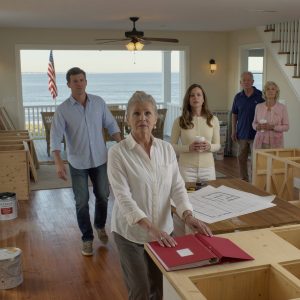
Then I saw the dining table.
The night before, there had been takeout containers, napkins, paint samples, a few loose papers. Now the table was covered end to end.
Maybe they had spread everything out after I went upstairs.
Maybe Khloe had organized it while Matthew “handled” the plan.
Whatever the reason, in the quiet dawn, their intentions lay there with a carelessness that almost felt arrogant.
I moved closer.
Contractor estimates.
Flooring samples.
A printed kitchen design with my room labels changed in neat digital blocks.
Master suite.
Guest room.
Care room.
Care room.
I stared at that phrase for a long time.
My bedroom had become Gloria’s care room before anyone had asked whether I was willing to give it up.
Beside the drawings was a yellow legal pad filled with Khloe’s handwriting. She wrote in sharp, narrow letters that tilted slightly to the right.
Call tile guy.
Move Olga’s boxes to back room.
Ask M about authorization.
Talk to Mom before Saturday.
Mom.
Not Olga.
Not Mrs. Turner.
Mom.
For a strange second, I wondered if she meant herself. Then I realized she meant Gloria. Khloe’s mother had been centered so fully in their planning that I had become a logistical issue in my own house.
I looked at the estimates next.
The first was for kitchen demolition and reconstruction.
The second for flooring.
The third for electrical work.
The fourth for custom cabinetry.
The totals were circled, highlighted, added again in blue ink near the bottom of the page.
I had spent my life reading charts upside down at nurses’ stations. Numbers did not intimidate me.
The total did.
$120,000.
I placed one hand on the back of the dining chair.
For a moment, the room blurred.
One hundred and twenty thousand dollars.
Not twelve thousand.
Not a few repairs.
Not a modest update they had foolishly begun and hoped I would accept.
A full renovation.
A transformation.
A claim.
They had planned to spend an amount of money they did not have on a house they did not own, while expecting me to become either grateful, embarrassed, or tired enough to surrender.
My heartbeat became very steady.
That is what fear does when it grows up and becomes clarity.
I looked toward the closed guest room door.
No sound.
I took out my phone and photographed every page.
Quietly.
One estimate.
Then another.
Then another.
The kitchen drawing.
The handwritten list.
The circled total.
My hands did not shake now.
Under the stack of estimates, I noticed the corner of a folder.
Red.
Not the dusty red of old office supplies. Bright, clean red. New. The kind sold in packs at office stores near the printers and envelopes.
It had been tucked beneath the papers, not hidden exactly, but not left on top either.
I slid the estimates aside.
On the folder’s tab, in Khloe’s narrow handwriting, were two words.
Owner authorization.
I stood very still.
The house was silent around me. Dawn pressed faintly at the windows. Somewhere outside, gulls called over the water. The refrigerator hummed in the middle of the living room like a machine that had woken in the wrong place.
I looked down at my purse, then at the folder.
Everything in me understood that whatever waited inside that red cover was the reason they had not wanted me reading alone.
The night before, Matthew had called it contractor authorization.
Khloe had called it easier if he walked me through it.
I had spent forty years watching people try not to say what they meant. Families in hospital hallways. Husbands outside exam rooms. Adult children whispering by elevators. Doctors choosing gentle phrasing before hard news.
After enough years, you learn that the truth has a shape before it has words.
This folder had a shape.
I reached for it.
The paper was smooth under my fingertips.
From the guest room, a floorboard creaked.
I froze.
No one came out.
A few seconds passed.
Then another.
I pulled the folder toward me, slowly, without lifting it from the table. My name was not visible yet. No signatures. No full pages. Just the edge of something white inside, clipped neatly, waiting.
I thought of Matthew as a boy, standing in the cereal aisle with tears in his eyes because I would not buy the sugary brand with the toy inside.
“But you can,” he had said.
Not angry.
Confused.
Because to a child, the ability to give and the obligation to give look like the same thing.
I thought of him at thirty, hugging me after Arthur’s funeral, whispering, “I’ll take care of you now, Mom,” then borrowing money three months later.
I thought of Khloe on my deck, telling someone the old routine was over.
I thought of the bed missing from my room.
The lock on the little door.
The word privacy.
The $120,000 circled in blue.
I lifted the red cover just enough for the first page to slide into the gray morning light.
And the line at the top made the entire house go silent.