At my daughter’s baby shower, I gave her a quilt I had spent nine months sewing by hand.
Her husband looked at it, smirked, and let it drop to the floor like it had no value at all.
Then he said, “Your mom’s just a lunch lady, babe.”
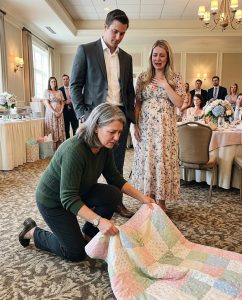
I did not argue.
I did not cry in front of those people.
I picked the quilt up, folded it against my chest, and walked out of the country club in silence.
The next morning, I called my attorney.
By 9:03, Charles Harmon was being told to come into his office immediately, because the woman his son had mocked the day before had just withdrawn the one signature his family had quietly depended on for eleven years.
My name is Helen Bennett, and yes, I work in a school cafeteria.
I have worked at Jefferson Middle School in Columbus for twenty-three years.
I know which children hate peas, which ones fake stomachaches before math tests, and which ones linger just long enough in line that you learn their refrigerator is empty by Thursday night.
I have lived a simple life by most people’s standards.
I have never worn diamonds to lunch or held court in a country club ballroom.
I have packed my own meals, mended my own coats, and built my days around work, family, and the kind of quiet pride that doesn’t need announcing.
That is why men like Grant Harmon always mistake women like me.
They hear cafeteria and picture smallness.
They hear lunch lady and think invisible.
What they do not understand is that a person can live modestly and still possess more backbone, more discipline, and more power than a room full of polished people who have never had to earn anything with their own hands.
I started the quilt the week Lauren told me she was pregnant.
She was glowing and terrified at the same time, the way first-time mothers often are.
We were standing in my kitchen when she said, almost shyly, that she wanted the baby’s room to feel peaceful.
“Not overdone,” she told me.
“Just soft.
Calm.”
I still remember her resting a hand over her stomach as she said it.
That night, I opened the cedar chest where I kept my fabric and began sorting colors.
Pink that wasn’t too bright.
Cream with a little warmth.
Green like spring leaves.
Tiny blue stars for wonder.
It became a ritual after that.
I would come home from school, wash up, eat something small, and sit beneath the yellow kitchen light with my sewing basket beside me.
Each square was a thought.
Each seam was a prayer.
My late husband, Daniel, used to say that the best things in life were made slowly, by people who meant them.
He had been gone twelve years, but I could still hear his voice whenever I stitched late at night.
Sometimes grief changes shape.
It stops being a sharp wound and becomes something quieter—a hand on your shoulder, a memory in the room, a sentence you still hear when you need courage.
Daniel was the reason the Harmon family entered my life long before Grant ever met Lauren.
Eleven years earlier, Charles Harmon had arrived in my attorney’s office sweating through an expensive shirt and trying not
to sound desperate.
His company, Harmon Hospitality Group, was on the brink of disaster.
A reckless expansion had left them overleveraged.
One lender had backed out.
Another was threatening to cut the line that covered payroll and operating expenses.
Charles had spent years projecting security while the numbers beneath him rotted.
Daniel had died the year before, leaving me with life-insurance money, a conservative investment account, and one unshakeable lesson: never sign anything you do not understand.
Charles came because Daniel had once helped him review a financing structure and had known our attorney, Martin Keene, personally.
He knew Martin respected me.
He also knew I had liquid assets, no debt, and a reputation for keeping my word.
What Charles did not have was time.
Martin explained the situation plainly.
If the bridge financing did not come through within forty-eight hours, the company would miss payroll.
Hundreds of employees would be hit first—the ones with real jobs, real children, real rent due.
Not the people in tailored suits.
The people who always suffer first when wealthy men gamble badly.
I told Charles no twice.
Then he said something that stayed with me.
“These people have families,” he said.
“Please.”
I thought about rent checks.
Grocery money.
Medicine.
Winter gas bills.
So I agreed—but only on Martin’s terms.
He wrote an agreement so tight Charles had no choice but to swallow his pride and sign it.
My money secured the emergency line.
In return, I held a secured note against part of the company, a lien tied to specific assets, and a required annual forbearance signature that had to be renewed to satisfy the lenders.
Every spring, my name went on paperwork that allowed Charles to keep breathing room he should have refinanced years earlier.
He always promised it would be temporary.
It never was.
For the first few years, I continued because his father, Harold Harmon, was still alive and understood gratitude.
Harold sent handwritten notes at Christmas.
He asked about Lauren.
He once told me that pride had ruined more men in his family than poverty ever could.
After Harold died, that decency disappeared with him.
Charles became entitled.
Celeste became colder.
Grant grew up inside the illusion that the family’s money was ancient, untouchable, and fully theirs.
Lauren met Grant at a charity event two years ago.
By then, the Harmons had polished their image so beautifully that only lawyers, bankers, and I knew how much of it rested on extensions, leverage, and my quiet refusal to expose them.
I tried to like him for my daughter’s sake.
I watched him send back food without looking at servers.
I watched him talk over Lauren and call it joking.
I watched the way Celeste corrected small things about Lauren’s posture, clothes, choices, as if shaping her into something more presentable for their world.
Every time I raised a concern gently, Lauren defended him.
“He’s under stress.” “He didn’t mean it like that.” “You saw the wrong side of him.”
Mothers know that tone.
It is the voice of a woman already shrinking herself to keep a man comfortable.
The baby shower stripped the illusion away.
When Grant dropped the quilt and called me “just a lunch lady,” I saw something else on Lauren’s face besides embarrassment.
Recognition.
She had
heard him speak like that before.
I drove home without turning on the radio.
I set the quilt on my table and sat beside it for nearly an hour.
Not because I was unsure what to do, but because final decisions deserve stillness.
At 8:14 the next morning, I called Martin.
“Open the Harmon file,” I said.
He did not waste time pretending not to understand.
“Do you want notice sent?”
“Yes.”
“All of it?”
“All of it.”
The letters went out within the hour.
Notice of withdrawal.
Notice that I would not renew the annual forbearance.
Notice that the secured note would be enforced according to the agreement Charles had signed himself.
At 9:03, Martin’s office called back.
Charles had turned white when he read the first page.
While he was still trying to regain his footing, his own office secretary stepped in and said the lenders needed him immediately.
By 9:40, he had called me fourteen times.
By 10:12, Celeste left a voicemail saying Lauren did not need stress before delivery, as if I had somehow created the problem by objecting to humiliation.
At 10:27, Lauren texted me: Mom, what is happening?
I told her to come alone.
She arrived at Martin’s office pale, frightened, and very young all of a sudden.
I slid the first page of the agreement toward her.
She read my name, Charles’s name, the year, the amount, and then the clause requiring my annual signature.
Her hands began to shake.
“Grant never told me,” she whispered.
“He may not have known,” I said.
“But that doesn’t change what he showed us yesterday.”
Tears filled her eyes.
“I should have said something.”
That hurt, because it was true.
Before I could answer, the outer door opened.
Charles came in first, looking ten years older than he had the day before.
Grant followed, irritated rather than worried, with the same polished arrogance still clinging to him.
He stopped when he saw Lauren holding the agreement.
“What is this?” he asked.
Charles turned to him with a face so stripped of pretense it almost startled me.
“Sit down,” he said.
Grant laughed once.
“Dad—”
“Sit down.”
Something in his father’s voice finally cut through.
Grant lowered himself into the chair.
Charles put both hands on Martin’s desk and said, each word clipped and clear, “The woman you insulted yesterday is the reason this family still has a name, a company, and credit.
For eleven years, her signature kept our lenders from tearing us apart.”
Grant stared at him.
“No,” he said automatically.
“That’s ridiculous.”
“It is documented,” Martin replied.
He tapped the file.
“In detail.”
Celeste arrived a few minutes later, breathless and furious, then went silent the moment Martin placed the second set of papers in front of her.
She read enough to understand exactly how exposed they were.
Grant looked from one face to another, waiting for the room to turn back into a place where he was safe.
It didn’t.
Then he made the mistake that finished whatever chance he might have had.
He looked at me and said, “So this is revenge? Over a quilt?”
Lauren turned toward him so fast her chair scraped the floor.
“Over a quilt?” she repeated.
“That’s what you think this is?”
He opened his mouth again,
but Charles cut in.
“It’s over your character,” he said.
Silence settled across the room.
I looked at Grant and saw, maybe for the first time, how weak cruelty really is.
It dresses itself in confidence because it has nothing sturdier underneath.
“I did not act because you embarrassed me,” I told him.
“I acted because you told my daughter, my grandchild, and everyone in that room exactly what kind of man you are.”
Lauren began to cry then, not delicately, not prettily.
The kind of crying that comes when denial finally dies.
She took off her wedding ring, set it on Martin’s desk, and said in a shaking voice, “I’m done.”
Grant stood up so abruptly his chair tipped backward.
“Lauren, don’t be dramatic.”
She flinched.
That tiny movement said more than anything else had.
I stood too.
“You will not speak to her like that again,” I said.
For once, Grant had no clever answer.
Lauren came home with me that afternoon.
The next weeks were ugly in the practical ways betrayals always are.
Lawyers.
Statements.
Financial disclosures.
Quiet phone calls after midnight.
Grant alternated between apologies, anger, blame, and self-pity.
None of it mattered.
Once a person shows contempt, the rest is noise.
Charles, to his credit, did not fight the documents.
He sold a property, unwound investments, and refinanced under terms that no longer depended on me.
The repayment came in full, with interest Martin had preserved down to the penny.
Celeste sent flowers I did not keep.
Lauren moved into my guest room and slept with one hand over her stomach for the first week, as if guarding the baby even in dreams.
She apologized to me more than once.
The first time, I let her finish.
The second time, I hugged her before she could begin.
“Learn from it,” I said.
“That matters more than guilt.”
Two months later, my granddaughter arrived on a rainy Thursday morning with a fierce little cry and a head full of dark hair.
Lauren was exhausted, glowing, and freer than I had seen her in years.
When we brought the baby home, I took the quilt from its box.
Lauren saw it and burst into tears.
“I don’t deserve that,” she whispered.
I laid it across the baby’s legs anyway.
“This was never about deserving,” I said.
“It was about love.”
In the corner, the stitched words were still there: You are loved before you arrive.
My granddaughter curled her tiny fist against the soft cream fabric as if she already understood.
I still work at Jefferson Middle School.
On Mondays, the mashed potatoes are still too thick.
Children still forget their lunch numbers.
Someone still spills milk almost every day.
My life did not become glamorous because the truth came out.
It became clearer.
And sometimes that is better.
People hear what happened and focus on the legal twist, the money, the papers, the panic in Charles Harmon’s office.
But that was never the real heart of it.
The real heart of it was a quilt on a carpet.
A daughter watching.
A mother deciding that silence did not have to mean surrender.
Grant thought value only counted when it came from the right last name, the right room, the right polish.
He learned too late that
the people who hold families together are often the very ones the world dismisses first.
I still wonder what stung him more in the end: losing the leverage, losing Lauren, or learning that the woman he called “just a lunch lady” had seen straight through him before he ever knew her worth.
I know my answer.
The biggest red flag was never the insult itself.
It was how comfortable he felt saying it.