The champagne was still cold in my hand when Brandon called.
I had been standing on the back deck of my new beach house for less than fifteen minutes, watching the Atlantic flash gold under the setting sun, trying to understand what it felt like to reach the end of a life chapter I had spent thirty years writing.
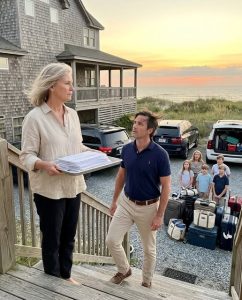
The house sat behind me quiet and beautiful—weathered cedar, clean glass, broad decks, and enough windows to pull the horizon into almost every room.
I had wanted silence for so long that I barely trusted it when I finally had it.
Three months earlier, I had sold Sterling Marketing Solutions, the company I built from a folding table, borrowed patience, and more sleepless nights than I could count.
I started it with a secondhand laptop and a desperate need to prove that I could build something nobody could take from me.
Decades later, a larger firm acquired it for 2.8 million dollars.
After taxes, legal fees, and the usual parade of deductions, I still had more than enough to retire well.
I was sixty-four, healthy, mentally sharp, and exhausted in a way that had nothing to do with illness and everything to do with carrying responsibility for too many years.
I did not want status toys.
I did not want luxury for strangers to admire.
I wanted long mornings, thick books, coffee that stayed hot because nobody interrupted it, and a house where the loudest thing in my day would be the ocean.
That was why I bought the place on the Outer Banks.
It was larger than I needed, but that had not felt wasteful when I signed the papers.
It had felt hopeful.
I imagined family there.
My son Brandon.
My daughter-in-law Melissa.
Maybe grandchildren someday.
Holiday dinners.
Sand tracked across the floors.
A table too crowded for perfect manners.
I told myself that maybe this house could hold the time I had missed while I was busy building the company that paid for everyone else’s comfort.
Then Brandon called, and before the first evening even finished settling over the water, he turned my dream house into a battleground.
He did not ask how I liked it.
He did not say he was proud of me.
He did not even say congratulations.
He went straight to instructions.
He told me I needed to move to the upstairs guest room because Melissa’s whole family was coming the next day.
Her parents.
Her sister, brother-in-law, and children.
Her brother and his girlfriend.
Eleven people in all.
They would be staying for two weeks.
The downstairs bedrooms and the master suite were best for them, he explained, as if he were giving a practical summary to a staff member.
At first, I thought I had misheard him.
I asked him to repeat himself.
He did, more impatiently this time.
The upstairs guest room had a perfectly good view, he said.
I would be fine.
I laughed because the audacity was so pure it crossed into absurdity for a second.
Then I told him the simplest truth available to us both: this was my house.
That was when his tone changed.
He sighed, accused me of making things difficult, and called me selfish for wanting so much space to myself.
I had heard
that word from him before.
Brandon liked to use morality as camouflage whenever he wanted something.
If I hesitated, I was selfish.
If I questioned him, I was stubborn.
If I refused him, I was cruel.
Then he said the line that burned everything else away.
If I was going to be unreasonable, he told me, there was a very nice assisted living facility down the coastal highway.
Maybe living alone in such a large place was too much responsibility for someone my age.
The ocean kept rolling while I stood there in total silence.
Anyone who has not lived long enough to watch entitlement mature into strategy might miss what was happening in that sentence.
Brandon was not just insulting me.
He was testing a narrative.
Too old.
Too alone.
Too overwhelmed.
That is the kind of language people use when they want to recast a capable woman as a problem to be managed.
I told him I would handle my house myself and ended the call.
Thirty seconds later, a text appeared on my screen.
Make sure the downstairs is cleared out before we arrive.
Melissa’s parents need the master.
Stock the fridge too.
Noon arrival.
I stared at the message, then took a screenshot.
I wish I could say his behavior came out of nowhere, but that would not be true.
Brandon had not always been cruel, but he had been drifting toward entitlement for years, and I had been smoothing it over because mothers are experts at rewriting warning signs into temporary moods.
After my divorce, I raised him alone.
His father left with elegant excuses and irregular checks.
I worked through school plays, soccer games, and fevers because missing work meant losing ground I could not afford to lose.
When the business started making real money, I paid for Brandon’s college.
Later, I helped with his first apartment deposit.
Then with an emergency car repair.
Then with a wedding upgrade he and Melissa swore they would cover later.
I told myself I was helping.
In hindsight, I was training him to expect rescue without gratitude.
I put the champagne down, walked through the house, and let the anger sharpen into clarity.
I stood in the master bedroom and looked out at the darkening ocean.
Then I called my attorney, Diane.
Diane had handled the sale of my company.
She was smart, careful, and impossible to rattle.
I read Brandon’s text to her.
Then I repeated the nursing home line.
She did not gasp.
She did not dramatize.
She just got very quiet, which somehow felt more serious.
She told me to save every message and not answer emotionally in writing.
She said that threats involving age, competence, or housing were not cute jokes once someone started acting on them.
Then she told me she would drive down first thing in the morning.
After that, I called a locksmith and security installer the realtor had recommended.
His name was Miguel, and he arrived within the hour with a toolbox, a polite smile, and the kind of discretion you learn in vacation communities.
By ten-thirty that night, every exterior keypad had been reprogrammed, the locks had been checked, and temporary cameras covered the entrances.
Then I made three more calls.
I reserved several ocean-view rooms at a
nearby inn for Melissa’s family because I suspected, correctly, that they had been lied to.
I arranged a catered brunch on the deck for noon the next day because public humiliation lands differently when people are seated and being served coffee.
And finally, I printed envelopes.
One for Melissa’s parents.
One for her sister’s family.
One for her brother.
Hotel keys and reservation notes went inside each one, along with a brief message explaining that there had been a misunderstanding about accommodations.
Then I made a thicker envelope for Brandon.
I barely slept.
Around five in the morning, I gave up and went outside with coffee.
The sky was still bruised purple over the water.
I sat wrapped in a throw and thought about the first apartment I could barely afford after my divorce.
I thought about the folding table that served as my first desk.
I thought about the years I convinced myself that providing was the same thing as being loved.
Diane arrived a little after seven wearing a navy blazer and carrying a leather folder.
We sat at the kitchen island while the light rose over the ocean.
She had drafted exactly what I needed: a formal written notice that Brandon and Melissa had no permission to occupy the property, documentation of the threatening messages, revocations removing Brandon from my emergency medical contacts and financial backup authorizations, and a trust amendment.
That last document mattered most.
Until that morning, Brandon had still been my primary executor and a major beneficiary of my estate.
I had never thought hard enough about it because thinking about your own child as a possible adversary feels unnatural right up until the moment it becomes necessary.
Diane had prepared an amendment transferring the beach house into my living trust with a new directive: upon my death, the property would be sold and the proceeds used to fund scholarships for first-generation women entrepreneurs through a foundation in my mother’s name.
Brandon would no longer inherit the house.
He would no longer serve as executor.
And if he challenged my competence or attempted to pressure my housing decisions again, an additional no-contest clause would sharply reduce what remained to him.
I signed without shaking.
By noon, the house looked serene.
The deck table was set.
Coffee steamed in silver pots.
Fruit glistened in bowls.
Pastries sat beside folded napkins.
Diane waited inside with the folder.
Miguel’s cameras were already live.
At twelve-oh-eight, three SUVs rolled into the driveway.
Children tumbled out first, followed by coolers, beach toys, grocery bags, folding chairs, and all the cheerful disorder of people arriving for a vacation they believe has been lovingly prepared for them.
Melissa stepped out wearing oversized sunglasses and expensive sandals.
Her mother emerged behind her carrying a covered pie plate.
Her father waved when he saw me.
Nobody looked guilty.
Nobody looked aggressive.
They looked grateful.
That told me Brandon had fabricated the entire invitation.
He climbed out last.
His eyes moved over the downstairs windows, then the front door, then finally me.
It was the look of a man checking whether his instructions had been obeyed.
He asked whether I had moved my things out of the master.
I smiled, welcomed everyone to the deck, and suggested lunch before luggage.
Melissa’s mother thanked me
for my generosity.
Her father said Brandon told them I wanted a full house because the place felt too quiet.
Melissa added that she had warned Brandon it was almost too kind to let everyone take the good rooms, but he had insisted I would not hear otherwise.
I looked at my son.
He would not meet my eyes.
That was when I picked up the silver tray and handed out the envelopes.
Confusion spread almost immediately.
Melissa’s father pulled out a hotel key card and frowned at it.
Her sister unfolded the reservation papers and looked at Melissa.
Her brother checked the inn address twice, as if expecting the words to rearrange themselves into something else.
Only Brandon’s envelope remained unopened.
He stared at it, then tore it open.
Before he could speak, Diane stepped onto the deck and placed the leather folder beside him.
She introduced herself calmly and said she represented me in all property and estate matters.
Brandon flushed red and started in on a speech about family, embarrassment, and misunderstanding, but Diane did not let him build momentum.
She told him that the screenshots of his messages had been preserved, that he had no permission to move himself or anyone else into the home, and that any refusal to leave would convert the matter from awkward to legal very quickly.
Melissa went still.
Her father looked from Diane to Brandon and asked, very quietly, whether the nursing home comment I had mentioned was real.
Brandon said he had only been joking.
That was the wrong answer.
Jokes rarely make a wife look sick to her stomach.
Melissa turned to him and asked if he had told her that I invited everyone because he knew I had not.
He did not answer fast enough.
That silence exposed him more completely than any argument could have.
Then Diane slid the trust amendment across the table.
Brandon skimmed it with the impatience of someone certain he can outtalk paperwork.
Halfway down the first page, his expression changed.
He read more slowly.
Then he looked up at me with a kind of naked disbelief I had never seen in him before.
He asked whether I was serious.
I told him I had never been more serious in my life.
The beach house was no longer his to imagine inheriting.
He was no longer my executor.
He was no longer on any emergency or financial backup authorizations.
If he ever used my age, my health, or my living situation as leverage again, the rest of my estate plan would change too.
Love did not make him my owner.
Biology did not make him entitled.
And motherhood did not require me to stand quietly while he rehearsed the theft of my autonomy.
For a moment, I thought he might explode.
His jaw tightened, his hands curled, and he took a step toward the sliding door as though he could still force his way into some version of control.
Miguel appeared from the side walkway at exactly the right time.
He did not say much.
He did not need to.
Brandon stopped moving.
Melissa’s father stood up then and did something I respected immediately: he apologized to me.
Not the thin apology of someone embarrassed to be caught nearby, but a real
one.
He said he had believed Brandon.
He said none of them would stay in my home under false pretenses.
Melissa’s mother, still holding the pie dish she had brought for me, looked close to tears.
Melissa herself seemed split open by humiliation and anger.
She asked Brandon, in front of everyone, how long he had been telling people the house would be his eventually.
He tried to defend himself by saying that was only common sense, that children inherited from parents all the time, that he had simply assumed things would be shared now and later.
That was when Melissa said the one sentence that finally cut through him.
Assuming is not the same as being invited.
Her family loaded themselves back into the SUVs and headed to the inn.
Melissa went with them.
Brandon stayed.
We stood alone on the deck once the engines faded down the road.
The ocean moved behind him, indifferent and endless.
He asked me how I could do this to my own son.
I asked him how he could stand in a house I had bought with thirty years of work and tell me I belonged in a nursing home if I would not surrender my bedroom.
I reminded him who paid his tuition, who helped with his wedding, who answered every crisis call he ever made.
Then I told him the truth I should have said years earlier: helping him had become easier than confronting what he was becoming.
He cried then, whether from anger, humiliation, or genuine shame I could not tell.
He said he had only wanted the family together.
I told him that families who want to be together ask.
They do not assign rooms, issue demands, and threaten competency when they hear no.
He left without another word.
The next week brought a predictable storm of messages.
Some were furious.
Some were pleading.
A few blamed Melissa.
One said he had only panicked because success changed people and he thought I would shut him out.
That was the closest he came to honesty.
Money had not changed me.
It had simply removed my dependence on pretending bad behavior was acceptable.
Melissa called three days later.
She apologized for her part in the mess and admitted Brandon had been speaking for months as though the beach house were already half his.
He had told her I would eventually move closer to them anyway, that managing my affairs would likely fall to him, and that it was practical to start treating the house like shared family property.
She sounded ashamed.
I believed her.
She had been arrogant on that driveway, but not calculating.
There is a difference.
A month later, Brandon asked to meet in person.
I chose a café halfway between us, not the beach house.
He arrived looking older than he had four weeks earlier.
There was no swagger left in him.
He said Melissa had gone to stay with her parents for a while.
He had started therapy.
He admitted that he had resented my work for years, resented the absences, resented the business, resented the fact that the sale made visible how much I had built without him.
When he saw the beach house, he said, something in him translated my success into access.
He told
himself family meant entitlement because admitting otherwise would mean admitting how badly he had behaved.
I listened.
Then I told him something he needed to hear.
An apology can open a door, but it does not rebuild a house.
I said the trust would remain exactly as amended.
The beach house would stay protected.
The scholarship fund would stay in place.
He would not discuss my housing, my finances, or my age with me again unless I invited the conversation.
If he wanted a relationship, it would have to exist with no expectation attached to it—no inheritance strategies, no emotional invoices, no disguised threats.
He cried quietly.
This time it felt less theatrical.
Maybe because there was nobody there to perform for.
I did not forgive him all at once.
People like to imagine forgiveness as a grand, cleansing decision.
Most of the time it is smaller and more stubborn than that.
It is a series of guarded choices.
A lunch.
A returned phone call.
A boundary held.
A pattern observed.
Six months later, he had kept enough distance and done enough honest work that I let him come to the beach house for coffee.
Just coffee.
No overnight bag.
No assumptions.
He stood on the deck and looked out at the water for a long time before he told me he finally understood why the nursing home line had broken something.
It was not just cruel.
It was efficient.
It turned me from a mother into an obstacle.
That was the first truly adult thing I had heard him say in years.
Our relationship is not what it was before, and perhaps that is for the best.
Some illusions are too expensive to restore.
But the honesty between us now is cleaner than the false closeness we had when he was still measuring me in terms of access.
The beach house is still mine.
In the mornings, I drink coffee on the deck and watch the sun pull itself up over the Atlantic.
The trust remains unchanged.
One day, when I am gone, the house will become scholarships for women who are building something from almost nothing.
That feels right.
Sometimes I still think about how easily the threat came out of Brandon’s mouth.
Not shouted.
Not slurred.
Not wild.
Just neat, polished, and practical.
That may have been the worst part.
The sentence was not born in anger alone.
It had been sitting somewhere inside him, waiting for a use.
Even now, I am not sure what hurt more—that my son wanted my bedroom, or that he thought the fastest way to get it was to make me disappear first.