“She’s just a useless girl,” my mother said in front of everyone in court.
The words landed harder than I expected, not because I had never heard them before, but because this time there were witnesses.
A judge.
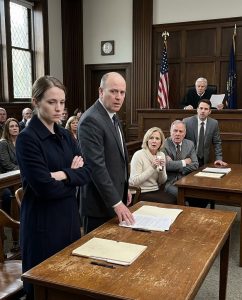
Two attorneys.
A clerk with her fingers frozen above her keyboard.
Neighbors from Mason County sitting shoulder to shoulder in the wooden benches behind us, pretending they had come for justice instead of gossip.
I stood at the front of that old courtroom with my arms folded across my chest and said nothing.
My father sat beside my mother, wearing the gray suit he saved for funerals, weddings, and any occasion where he wanted people to believe he was a respectable man.
His mouth tightened at my silence, as if my refusal to break down was an insult.
My mother kept her chin lifted, one hand curled around a tissue she had not actually used.
Their lawyer looked uncomfortable for half a second.
Only half.
Then he adjusted his cuffs and continued speaking as if my mother had not just stripped me down in front of half the county.
I had known this hearing would be ugly.
I just had not known how eagerly they would make it that way.
Eight years earlier, I left Mason County in a borrowed coat, with seventy-three dollars in my checking account and a cracked phone in my pocket.
I did not leave because I hated the town.
I left because staying in my parents’ house had started to feel like holding my breath underwater.
There had been years of being told I was too quiet, too stubborn, too plain, too ungrateful.
Years of watching my older brother receive praise for doing less than the bare minimum while I was called lazy for surviving quietly.
Years of hearing my parents say, in different ways, that daughters were obligations and sons were legacies.
The only place I ever breathed easily was my grandmother Ruth’s farm.
It sat at the edge of Mason County, past the last gas station, where the road narrowed and the fields opened wide on both sides.
The house was small, white paint peeling near the porch rails, with an apple tree leaning over the yard as if it had grown tired but refused to fall.
Grandma Ruth kept wind chimes by the kitchen window and a coffee can full of clothespins by the back door.
When I was a little girl, she let me sleep on her couch when my parents were fighting.
When I was thirteen, she taught me how to balance a checkbook at her kitchen table while rain tapped the tin roof.
When I was seventeen, she pressed a folded twenty-dollar bill into my palm and told me, “A woman needs something in her own name, even if it is only enough to buy gas.”
She never called me useless.
Not once.
After I left town, I called her every Sunday.
Sometimes for ten minutes.
Sometimes for two hours.
She would tell me about the apple tree, the leaking faucet, the neighbor’s dog getting into her garden.
I would tell her enough of my life to make her feel included and hide enough to keep her from worrying.
What I did not tell my parents was that I was sending
money home.
At first it was small.
Forty dollars here.
Seventy-five there.
Money orders because Grandma Ruth did not trust online banking and because I knew my parents had a way of sniffing out anything that looked like help.
She hated accepting it, so I made her promise to call it repayment for all the meals she had fed me when I was young.
Then the taxes fell behind.
She told me one Sunday like she was mentioning weather.
“Your father says it is only paperwork,” she said.
“But I got a notice from the county.”
I remember standing in my apartment kitchen, one sock damp from a leak under the sink, staring at a stack of textbooks and bills.
I was working days at a legal aid office and nights at a diner.
I was tired all the time, the kind of tired that settles behind your eyes.
“How much?” I asked.
She went quiet.
“Grandma.”
When she finally told me, I sat down on the floor.
My parents had convinced her they were helping.
They had been using her account to pay themselves back for repairs that had never been done, errands they exaggerated, groceries she did not remember asking for.
Not enough at once to look like theft.
Just enough over time to pull the ground out from under her.
I did not confront them then.
I knew what would happen.
My father would rage.
My mother would cry.
They would make Grandma Ruth feel guilty for telling me.
They would call me dramatic, jealous, hateful.
They would turn the whole thing into proof that I was the problem.
So I did what quiet women are always underestimated for doing.
I kept records.
I paid what I could.
I saved every receipt.
I wrote down dates.
I asked Grandma to keep letters from me in the tin box under her bed, the one where she kept her wedding photo and the deed to the farm.
I contacted the county treasurer when I needed proof.
I called an attorney two towns over and asked what could be done to protect an elderly woman from relatives who circled her property like vultures.
That attorney told me about a transfer-on-death deed.
Grandma Ruth signed it herself in a small office with bad coffee and fluorescent lights, wearing her blue cardigan and the pearl earrings she kept for church.
She named me as the beneficiary of the farm.
Not my parents.
Not my brother.
Me.
“You are the only one who ever tried to keep it standing,” she said afterward.
I tried to argue with her.
I told her people would be angry.
She smiled at me then, tired but sharp.
“People are always angry when they cannot take what they expected.”
The document was recorded.
The papers were legal.
The farm would pass to me outside of probate when she died.
She understood that part clearly.
What she did not live long enough to see was the other paper.
Years later, after I finished school and passed the bar, I started working under my mother’s maiden name for a state elder financial abuse unit.
I did not want my parents finding me online, and Carter was common enough to disappear into.
My cases were not glamorous.
They were bank statements,
forged signatures, relatives with excuses, older people frightened of causing trouble.
Every file reminded me of Grandma Ruth.
Every time someone said, “It is a family matter,” I heard my father’s voice.
The year before she died, our office opened a civil investigation into a network of small-town property transfers and suspicious caregiving claims.
I did not handle my own grandmother’s matter.
That would have been improper, and I knew the rules too well.
But I submitted what I had from years earlier: copies of checks, money orders, letters, tax notices, and the dates my parents had accessed her accounts.
The official document my grandmother never saw was the final administrative finding.
It did not send anyone to prison.
Not then.
It did not make headlines.
It simply stated, in cold government language, that there was credible evidence my parents had financially exploited Ruth Carter while she was elderly and dependent on them for transportation and banking.
It also stated that I, Emily Carter, had been the reporting witness and the person who had cured the tax delinquency on the farm.
Grandma died before I could tell her the finding had been issued.
I think part of me was grateful for that.
She had loved my father even when he disappointed her.
There are truths that vindicate you and still break someone else’s heart.
When I drove back to Mason County after nearly eight years away, I did not come to punish anyone.
I came because she was gone.
The farm looked smaller than I remembered.
The porch sagged near the steps.
The apple tree had lost a heavy branch in some storm, and the grass had grown wild around the fence posts.
Inside, the house still smelled faintly of lemon soap and old wood.
Her cardigan hung on the hook by the door.
I sat at her kitchen table that first night and cried so quietly I could hear the refrigerator hum.
The next morning, my parents arrived without calling.
My father stepped onto the porch like he owned it.
My mother stood behind him in a cream sweater, lips pressed thin as she looked me over.
“You should have told us you were coming,” she said.
“It is my grandmother’s funeral,” I answered.
“Our family funeral,” my father corrected.
I knew then they already knew about the deed.
They did not mention grief.
They did not ask how I was.
They walked through the house with their eyes moving over everything: the china cabinet, the oak table, the back acreage, the barn that leaned but still stood.
My mother touched the lace curtain in the sitting room and said, “Your brother could fix this place up.”
“My brother does not own it,” I said.
My father turned slowly.
“You think a piece of paper makes you better than us?”
“No,” I said.
“I think it makes the farm mine.”
Three weeks later, I was served.
Their lawsuit claimed Grandma Ruth had not been of sound mind when she signed the transfer.
It claimed I had manipulated her from afar.
It claimed I had abandoned the family and returned only after her death to seize valuable property.
The language was polished, but I could hear my parents underneath every sentence.
Ungrateful.
Scheming.
Useless.
By the morning of the hearing,
Mason County had turned it into a public event.
People who had not spoken to me since high school nodded stiffly in the courthouse hallway.
Two women from my mother’s church whispered near the vending machine.
Someone’s uncle looked at me like he had already decided I was guilty of something.
The courthouse stood at Main and Jefferson, old brick darkened by October rain.
The floors smelled of dust and floor polish.
The courtroom had high windows, wooden benches, and a flag beside the judge’s bench that hung perfectly still.
My parents had hired Dennis Hale, a local attorney known for sounding kind while cutting people open.
He smiled at me before the hearing began.
“Ms.
Carter,” he said.
“Mr.
Hale,” I replied.
His smile twitched.
I wondered if he had looked me up.
I wondered if he had looked far enough.
He had not.
When the hearing began, he spoke first.
He described my parents as devoted adult children who had cared for Ruth Carter through illness, loneliness, and decline.
He described me as an absent granddaughter who had chosen distance until the land became useful.
He made my silence sound like cruelty.
He made my money orders sound like control.
My mother lowered her eyes at all the right moments.
My father kept his arms folded, radiating injured dignity.
Their story was simple, and simple stories often win a room before complicated truth gets its shoes on.
Then my mother asked to speak.
Her lawyer hesitated, but only for a second.
Maybe he thought her tears would help.
Maybe he believed she was as controlled as she pretended to be.
My mother stood, smoothing her sweater.
“Your Honor, we are not greedy people,” she said.
“We just cannot stand by while our daughter takes advantage of a confused old woman.
Emily left.
She did not care about this family.
She did not care about her grandmother when it mattered.”
My hands tightened under the table.
“She sent a few dollars and thought that made her noble,” my mother continued.
Her voice sharpened.
“But she was never there.
She has always thought she was above us.
She ran away, and now she comes back like she deserves everything.”
The judge watched her over his glasses.
“Mrs.
Carter,” he said, “please answer only the question asked.”
But my mother had already lost the thread of performance.
“She is just a useless daughter,” she snapped.
The courtroom went silent.
It was not shock exactly.
It was recognition.
Everyone had heard a private family truth spoken too plainly in a public room.
I felt heat climb my neck, then vanish.
Something inside me went very still.
There had been a time when I would have defended myself.
I would have tried to prove I was good, prove I had loved enough, prove I had worked hard enough, prove I had not abandoned anyone.
I would have handed them my pain and begged them to measure it honestly.
I was not that girl anymore.
So I said nothing.
My silence unsettled my mother more than any answer could have.
She sat down too quickly.
My father leaned toward her and whispered something.
Their lawyer cleared his throat and tried to recover the room.
Then the judge asked for the documents.
I slid my
file forward.
It was plain manila, the corners soft from being carried in my bag.
Mr.
Hale’s file was thick, tabbed, expensive-looking.
Mine looked like something a schoolteacher might use to save permission slips.
But paper does not become true because it is bound in leather.
The judge began with the will.
Then the transfer-on-death deed.
Then Grandma Ruth’s letters.
The first letter was dated four months after the deed was signed.
Emily, do not let them make you feel guilty for accepting what I freely gave.
This farm was never about money.
It was about having one place where you were not made small.
My mother’s face changed when the judge read that line.
The second letter mentioned the taxes.
Thank you for saving the farm again.
Your grandfather planted that apple tree the week we moved in.
I could not bear losing it because I trusted the wrong people with my checkbook.
A murmur moved through the benches behind us.
Mr.
Hale stood.
“Your Honor, emotional letters do not establish capacity.”
“No,” the judge said.
“But they may establish intent.”
He turned another page.
Money order receipts.
Tax payment confirmations.
Copies of letters from the county treasurer.
Dates.
Amounts.
Proof that I had not appeared after death with open hands, but had been holding the roof up from a distance for years.
My father’s face darkened.
“This is ridiculous,” he muttered.
The judge looked at him once, and my father closed his mouth.
Then the judge reached the administrative finding.
I knew the exact moment he understood what he was holding.
His eyes moved down the page, stopped at my name, then moved to the heading at the top.
His brows drew together slightly.
Outside, October wind hit the side of the courthouse, rattling one of the high windows.
Inside, even the clerk stopped typing.
The judge looked at me.
For the first time that morning, I saw something like recognition in his face.
Then he looked at Dennis Hale.
“Counsel,” he said quietly, “you really do not know who she is?”
Mr.
Hale blinked.
“I beg your pardon, Your Honor?”
The judge held up the document.
“You filed a petition accusing this woman of financial manipulation of an elderly relative.
Did you make any effort to determine her professional background before putting those accusations in writing?”
Mr.
Hale’s mouth opened, then closed.
My mother stared at him.
My father uncrossed his arms.
The judge continued, his voice calm enough to make every word heavier.
“Emily Carter is an attorney with the state elder financial abuse unit.
According to this finding, she was also the reporting witness in an administrative investigation involving the very exploitation your clients now appear to be denying.”
The benches behind us erupted into whispers.
My mother’s tissue slipped from her hand.
Mr.
Hale’s face had gone pale, but the judge was not finished.
“This document states that credible evidence was found that Mr.
and Mrs.
Carter improperly accessed Ruth Carter’s funds, failed to apply money toward her property taxes as represented, and benefited from transactions made while she relied on them for transportation and banking.”
My father stood so fast his chair scraped the floor.
“That is not what happened.”
“Sit down,” the judge said.
Two words.
No volume.
No anger.
My father
sat.
I looked at him then.
Really looked.
The man who had filled my childhood with slammed cabinets and final opinions now seemed smaller under the courtroom lights.
Not sorry.
Not broken.
Just exposed.
My mother turned toward me, and for one strange second, I thought she might apologize.
Instead, she whispered, “You kept records on your own family?”
I felt something inside me release.
“No,” I said.
“I kept records because of my family.”
Her eyes filled then, but not with grief.
With fury.
Mr.
Hale asked for a recess.
The judge denied it.
The next twenty minutes unfolded with terrible precision.
The deed had been properly executed.
Grandma Ruth’s doctor had submitted a statement confirming she was mentally competent at the time.
The notary had known her personally.
The letters established intent.
The tax records showed I had paid substantial arrears.
The administrative finding destroyed the clean, grieving image my parents had tried to present.
Their claim was not just weak.
It was dishonest.
The judge dismissed the petition.
He did it in language that sounded formal and restrained, but the meaning was plain.
My parents had no right to the farm.
Their accusations against me had no support.
Grandma Ruth’s wishes would stand.
Then he turned to my parents.
“I will add,” he said, “that this court takes a dim view of parties who attempt to use legal proceedings to rewrite family history for financial gain.”
My father stared at the table.
My mother cried for real then, but I could not tell whether she was crying because she had lost or because everyone had heard why.
When it was over, nobody moved at first.
The county people who had come to watch suddenly looked embarrassed to be there.
Mr.
Hale gathered his papers with shaking hands.
My parents avoided my eyes.
I picked up my file and slipped it back into my bag.
In the hallway, my mother caught up with me near the courthouse doors.
“Emily,” she said.
I stopped.
She looked older in the gray morning light.
For years, I had imagined that if the truth ever came out, she would soften.
She would realize what she had done.
She would see me clearly and regret the years spent making me feel like a burden.
But her first words were, “You humiliated us.”
I almost laughed.
Not because it was funny.
Because after everything, she still believed humiliation was worse than theft.
Worse than lying.
Worse than dragging her own daughter into court and calling her useless in public.
“No,” I said.
“You told the truth about how you saw me.
I brought proof of what you did.”
My father came up behind her, face stiff.
“This is not over,” he said.
“It is,” I answered.
For once, he had no next line.
I walked out of the courthouse into the cold October air.
The flag snapped above me.
Across the street, a woman from my mother’s church looked away when I glanced in her direction.
I drove straight to the farm.
The house was quiet when I unlocked the door.
Sunlight fell across the kitchen floor in a pale rectangle.
The wind chimes tapped lightly against the window, the same delicate sound that used to drift through the room while Grandma Ruth rolled
pie dough on the counter.
I set the file on the table.
Then I went outside and stood beneath the apple tree.
Most of the fruit had already fallen.
A few bruised apples lay in the grass, sweetening the cold air.
One small red apple still clung stubbornly to a high branch, shining in the thin light.
I thought about Grandma Ruth signing that deed.
I thought about her saving my letters in the tin box.
I thought about every time I had mistaken silence for weakness because that was what my parents had taught me to believe.
They had called me useless because they could not use me.
For years, that sentence would have destroyed me.
That day, it felt almost like freedom.
I did not celebrate their downfall.
I did not feel victorious in the clean, satisfying way people imagine they will when truth finally wins.
I felt tired.
I felt sad.
I felt relieved.
I felt the strange ache of being proven right about people I had once wanted desperately to love me.
A week later, I changed the locks.
A month later, I had the porch repaired.
By spring, I planted three new apple saplings along the fence line, not because the old tree was dying, but because Grandma Ruth had taught me that keeping something alive means thinking beyond the season you are standing in.
My parents never apologized.
They told people the court had been biased.
They said I had legal connections.
They said I had always been vindictive.
Some believed them because some people prefer a familiar lie to an uncomfortable truth.
But not everyone.
One afternoon, an envelope appeared in my mailbox with no return address.
Inside was a copy of a photograph I had never seen before.
Grandma Ruth and me on the porch when I was maybe six years old, my hair in crooked braids, her hand resting gently on my shoulder.
On the back, in her handwriting, were six words.
This one knows how to stay.
I stood beside the mailbox and read it three times.
My parents had spent a lifetime calling me the daughter who left.
My grandmother had known the difference between leaving and escaping.
She had known that sometimes the person who walks away is the only one still trying to save what matters.
The farm stayed in my name.
The apple tree bloomed again.
And the people in Mason County who had watched me stand silent while my mother called me useless were left with a question nobody could answer for them: was I cruel for exposing my parents in court, or had they finally met the truth they spent years daring me to speak?