“This is the fat pig we live with.”
My father said it the way some men say grace.
Loud.
Familiar.
Certain that the room belonged to him.
I had just stepped in from the garage with my duffel still hanging from one shoulder and the sting of cold air clinging to my sweatshirt.
The house smelled like fried wings, stale beer, and the lemon cleaner my mother used whenever people came over and pretended not to notice how unhappy she was.
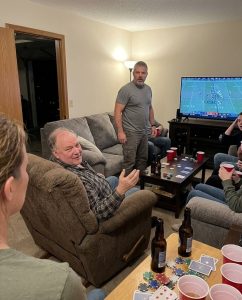
The football game was blasting from the television.
Men filled the living room in wide-legged poses, balancing paper plates on their knees and bottles between their fingers.
Their wives hovered along the edges of the room, laughing half a second late, smiling at things they did not find funny.
My father sat in the center of it all in his old brown recliner, one socked foot crossed over the other, his belly pressing against his T-shirt.
Dennis Hayes had always known how to take up more space than his body required.
The moment he saw me, his face brightened.
Not with love.
With opportunity.
“Look who finally decided to show up,” he shouted over the announcer.
“Gentlemen, this is the fat pig we live with.”
My hand tightened around the strap of my duffel.
For one clean second, no one laughed.
That was always the worst second.
The little gap where people could choose to be decent.
Then someone snorted.
Someone else barked out a laugh.
The rest followed because cruelty, when offered by the loudest man in the room, often feels safer than silence.
My father pushed himself up and came toward me, grinning as if he had just paid me a compliment.
He hooked his arm around my shoulders and pulled me in close.
His palm landed hard on the top of my arm.
“This one,” he said, giving me a shake, “has been eating me out of house and home since she could crawl.”
A man near the poker table lifted his beer.
“You sure the Navy isn’t paying you in groceries?”
More laughter.
I smiled.
I hated that I smiled.
But the body remembers what once kept it safe.
Mine had learned a long time ago that if I laughed first, my father sometimes stopped sooner.
If I made myself small enough, the joke might pass over me instead of landing in my ribs.
“Good to see you too, Dad,” I said.
He squeezed my shoulder again.
“That’s my girl.
Tough as a boot.
Can take a joke.”
Those were his favorite words.
Can take a joke.
He said them after he pinched the back of my arm at thirteen and told me boys liked girls who didn’t jiggle.
He said them after he introduced me to relatives as the daughter who got all her mother’s appetite and none of her looks.
He said them when I came home from the academy with a commendation and he asked whether they gave medals for cafeteria duty.
I had spent decades mastering rooms where men underestimated me.
Yet this room, with its sagging couch and dusty trophies on the shelf, still knew my original name.
Failure.
Embarrassment.
Burden.
I looked past my father’s shoulder and saw my mother standing by the kitchen doorway.
Her hands were wrapped
around a red plastic cup she had not lifted to her mouth.
Her eyes met mine, then slid away.
That hurt too, though it was an older hurt.
My father kept performing.
“She disappears for months, comes back looking like she wrestled a fuel truck, and expects her old man not to notice,” he said.
“You hungry, Maggie? Stupid question.
Of course you are.”
The men laughed again.
The neighbor boys on the carpet laughed with them, even though they were too young to understand everything behind the words.
They understood enough.
They understood who was powerful and who could be mocked.
I shifted the duffel higher on my shoulder.
“I’m going to put my bag downstairs,” I said.
My father did not let go.
“Stay a minute.
Collins here was just telling us about training with the SEALs.”
That was when I noticed the man on the far end of the couch.
He was not laughing anymore.
Chief Petty Officer Mark Collins sat with one forearm resting on his knee, a beer bottle loose in his hand.
He had the dense, quiet build of a man whose body had learned usefulness before vanity.
His hair was close-cropped.
His expression was polite, but his eyes were active.
I knew the type.
More than that, I knew the posture.
Even at a party, he kept exits in his peripheral vision.
My father had talked about him for weeks before this visit.
A real Navy SEAL, he had said, as if the rest of the Navy were decorative.
A man who had seen things.
A man who knew discipline.
A man who would have made something of himself no matter what.
The comparison had been implied, as most of my father’s insults were.
I gave Collins a small nod.
He nodded back.
Then his eyes dropped.
My sweatshirt sleeve had ridden up when my father grabbed me.
Just an inch, maybe less.
Enough to expose the inside of my right forearm.
Black ink.
Plain lines.
No decoration.
UNIT 17.
It was not beautiful.
It was not meant to be.
Most people who saw it thought it was a private joke or a code from some forgotten posting.
My father once said it looked like a prison stamp.
My mother had asked me, years ago, whether I could cover it with makeup for family photos.
Collins saw it, and everything in him changed.
The bottle stopped halfway to his mouth.
His face went still in a way that made the room feel suddenly loud.
His gaze lifted from my arm to my face, and I watched recognition move through him like a shock wave he had no time to hide.
He set the bottle down on the coffee table carefully.
Not casually.
Carefully.
My father noticed the movement and chuckled.
“Don’t mind her tattoo.
She got that after one of her mysterious little Navy phases.
Won’t say what it means.
Probably some desk-jockey club.”
Collins stood.
The conversation died around him.
He did not stand like a guest excusing himself.
He rose with the precision of a man responding to rank.
His shoulders squared.
His chin lifted.
His hands went behind his back.
The living room shrank around him.
My father blinked.
“What are you doing?”
Collins did not answer him.
He faced
me.
“Admiral Hayes, ma’am,” he said.
“It’s an honor.”
The room went silent in a way I had rarely heard outside operations centers.
Not quiet.
Silent.
Even the laughter seemed embarrassed to have existed.
The television announcer screamed about a replay.
No one looked at the screen.
My father’s arm slid away from me.
“What did you just call her?” he asked.
Collins kept his eyes on mine.
“Admiral Hayes.”
My father gave one hard laugh, but it broke in the middle.
“No.
No, you’ve got the wrong person.
This is Maggie.”
“Yes, sir,” Collins said.
“Margaret Anne Hayes.”
My mother made a small sound in the kitchen doorway.
I looked at Collins.
His face held the strained discipline of someone trying to obey two loyalties at once: the loyalty to a civilian host and the deeper one to truth.
“Good evening, Chief,” I said.
The words came out colder than I intended.
Or maybe exactly as cold as they needed to be.
“At ease.”
Collins relaxed by a fraction, but he did not sit down.
My father stared at me.
“What is this?”
“It is what he said,” I replied.
His cheeks flushed.
“You expect me to believe you’re an admiral?”
“No,” I said.
“I stopped expecting you to believe anything about me a long time ago.”
A few people looked down at their cups.
My father hated losing control of a room.
I could see it building in him, the instinct to turn discomfort into anger, anger into volume, volume into victory.
He pointed at Collins.
“You’re messing with me.”
“I’m not,” Collins said.
“Then explain it.”
“Dad,” I said softly.
He rounded on me.
“No, don’t ‘Dad’ me.
You come in here dressed like you slept in a hangar, you let everyone think you’re still bouncing between paperwork jobs, and now my friend is calling you admiral?”
“Let everyone think,” I repeated.
The words landed harder than I expected.
Because that had been the agreement, though he had never known it.
Let them think.
Let them underestimate.
Let the world be safer because certain names never appeared in public stories.
Collins’s jaw tightened.
“Sir,” he said to my father, “with respect, do you not know who your daughter is?”
My father’s eyes flicked toward the others.
He saw them watching him now, not me.
That made him meaner.
“I know exactly who she is,” he said.
“I raised her.”
“No,” Collins said before he could stop himself.
“You knew the version you could insult without consequences.”
Someone inhaled sharply.
My father’s face darkened.
“Careful.”
Collins looked down for a moment, as if measuring the line he was about to cross.
Then he reached into the inside pocket of his jacket and pulled out a worn photograph folded twice at the edges.
My stomach tightened.
I knew that photograph before he opened it.
“Chief,” I said.
He froze.
For a second, he was back under my command.
But this was not a classified briefing room.
This was my father’s house.
And perhaps that was exactly why Collins looked at me with something almost pleading in his eyes.
“Ma’am,” he said quietly, “permission to speak freely?”
I should have said no.
For thirty years, I had protected my father from the truth of me.
I had let him believe
my silence meant there was nothing worth saying.
I had let every holiday pass with jokes about my body, my work, my life, while classified files carried my decisions under redacted headings and young officers saluted me in corridors my family would never see.
I had not done it for him.
Not entirely.
I had done it because certain doors, once opened, did not close neatly.
But then one of the neighbor boys whispered, “Is she really an admiral?”
His mother shushed him too late.
I looked at that boy, sitting cross-legged beside the coffee table, his soda forgotten in his hand.
He had laughed at me because the room had taught him to.
Maybe the room could teach him something else.
I nodded once.
“Permission granted.”
Collins unfolded the photograph.
The paper had softened with age.
Across its surface was a sun-bleached runway, a horizon blurred by heat, and six men standing in dusty gear behind a woman in a flight suit.
The woman wore no makeup.
Her hair was hidden under a cap.
One sleeve was pushed up enough to show the same black mark on her forearm.
UNIT 17.
Me.
Fourteen years younger.
Fourteen lifetimes away.
Collins turned the photo so the room could see.
My father stared at it with open suspicion, as if a photograph could be accused of lying.
“That’s her?” someone asked.
Collins nodded.
“Yes.”
My father snatched the photo from his hand.
For a moment, I thought he might tear it.
He didn’t.
He only looked.
His eyes moved over my younger face, the aircraft behind me, the men standing close enough to show trust but not familiarity.
“What is Unit 17?” he asked.
The room waited.
Collins looked at me again.
I said nothing.
He chose his words carefully.
“A joint command group.
Special operations support, intelligence coordination, aviation, extraction planning.
Some of it is still not for public discussion.”
My father gave a harsh, disbelieving laugh.
“Support.
So paperwork.”
“No, sir,” Collins said.
“Not paperwork.”
My father flinched at the firmness in his voice.
Collins pointed to the photo.
“That was taken after Operation Glass Harbor.
My team was pinned outside a coastal transfer site after bad intelligence put us in the wrong place at the wrong time.
Communications were compromised.
Air support was delayed.
Command wanted to pull back.”
The living room had become something else now.
No one moved toward the kitchen.
No one reached for chips.
Collins’s voice dropped.
“Your daughter overruled the recommendation.”
I closed my eyes for half a second.
I could still smell that night if I let myself.
Burning fuel.
Hot dust.
Metal.
Saltwater.
Fear hidden under training.
Collins continued.
“She read the pattern faster than anyone else in the room.
She realized the signal loss wasn’t equipment failure.
It was a trap.
She redirected a carrier-based rescue window that everyone said was impossible, rerouted two assets without exposing the larger fleet, and kept talking to us through a broken relay until we reached the extraction point.”
His hand curled once at his side.
“Four of us were carrying injuries.
One was unconscious.
We had eight minutes before the whole coastline closed.”
My father still held the picture.
His knuckles had gone pale.
Collins looked at him.
“We made it because Admiral Hayes
refused to leave us on the ground.”
No one said anything.
I hated the way they looked at me then.
Not because it was cruel.
Because it was worse.
It was awe, and pity, and shock all tangled together, as if I had become a person only after a man translated me into something impressive enough to understand.
My father swallowed.
“Why didn’t you tell us?”
I almost laughed.
The question was so small compared to the years behind it.
“I tried,” I said.
His brow furrowed.
“When?”
“When I graduated first in my flight program and you said they must have needed a diversity poster.”
His mouth tightened.
“When I received my first command and you told Aunt Carol I was probably supervising filing cabinets.”
My mother lowered her cup.
“When I came home after Glass Harbor,” I said, and my voice almost changed then.
“I was thirty-six.
I had not slept in three days.
I walked into this kitchen and you asked whether I had finally found a man desperate enough to marry me.”
My father looked away first.
That, more than the words, moved through the room like a verdict.
“I stopped trying after that,” I said.
For years, I had imagined saying those things with fire.
I had imagined myself raising my voice, making him feel a fraction of the shame he had handed me like a family heirloom.
But the truth came out quietly.
Quietly was worse.
My father shifted his weight.
“Maggie, I didn’t know.”
“No,” I said.
“You didn’t ask.”
My mother whispered, “Margaret.”
I turned to her.
She looked smaller than I remembered.
Not innocent.
Never that.
But tired in a way that made excuses tempting if I let them be.
“I wanted to tell people,” she said.
That finally cracked something in me.
“You wanted to tell people I was important,” I said.
“Not that I was hurting.”
Her face folded.
My father dragged a hand over his mouth, then tried to recover the only way he knew how.
“Well,” he said, forcing a brittle chuckle, “hell, you could’ve said something before I made myself look like an idiot.”
No one laughed.
Not one person.
He looked around, waiting for the room to rescue him.
The room refused.
Collins stepped closer to the coffee table and took the photograph back from my father with careful hands.
Then he turned to me.
“Ma’am,” he said, “I apologize for speaking out of turn.”
“You didn’t,” I said.
My father’s voice came softer then.
“Maggie.”
I faced him.
For the first time that night, he looked old.
Not weak.
Not harmless.
Just old enough that his cruelty could no longer pass as strength.
He stared at my forearm.
“Unit 17,” he said.
I pulled my sleeve down, covering the tattoo.
His eyes lifted to mine.
“So all this time… you were…”
“Still your daughter,” I said.
“That was the part you kept missing.”
The words struck harder than any rank could have.
His face reddened, then emptied.
He opened his mouth, but nothing useful came out.
Not an apology.
Not yet.
Maybe he did not know how to build one without putting himself at the center.
I picked up my duffel from where I had dropped it near the door.
My mother stepped forward.
“Are you leaving?”
I looked at the people in the room.
The poker buddies who would tell this story later with themselves edited clean.
The wives who had laughed because it was easier than objecting.
The children who had seen a lesson corrected in real time.
Collins, still standing with the posture of a man who understood that respect was not decoration.
My father, finally silent.
“Yes,” I said.
My father swallowed.
“You just got here.”
“I know.”
The sentence hung between us with all the years inside it.
He took one step toward me.
“I was joking.”
“No,” I said.
“You were practicing.
You have been practicing for years.”
His eyes shone suddenly, and I hated that even then some part of me wanted to comfort him.
That was the oldest training of all.
I did not move.
Collins spoke again, not loudly.
“Sir, a joke requires everyone to be safe.”
My father looked at him as though the words were in a language he had spent his life refusing to learn.
I turned toward the garage.
Behind me, my father said my name once.
Not Maggie.
“Margaret.”
I stopped with my hand on the doorframe.
“I’m sorry,” he said.
The room held its breath.
I looked back.
His apology was rough, late, and too small for the damage.
But it was the first sentence he had said all night that did not ask me to shrink.
I nodded once.
“I hope you mean it when there’s no audience.”
Then I left.
Outside, the evening air was cold enough to sting my lungs.
I put my duffel in the back seat and stood beside the car for a moment, listening to the muffled silence inside the house where laughter had been.
A minute later, the garage door opened.
Collins stepped out, holding the old photograph.
“You forgot this, ma’am,” he said.
I took it from him.
For a second, neither of us spoke.
Then he said, “You saved more than my team that night.”
I looked at him.
He nodded toward the house.
“Maybe you saved someone in there from becoming him.”
Through the living room window, I could see one of the neighbor boys standing near the couch.
He was looking at my father, not with fear or admiration, but with a child’s dawning understanding that adults can be wrong in public.
That mattered.
More than I expected.
I folded the photograph and slipped it into my coat pocket.
“Thank you, Chief,” I said.
He gave me a small, respectful nod.
“Always, Admiral.”
I drove away without crying until the house disappeared from the rearview mirror.
Three days later, my father called.
I let it ring twice before answering.
There was no joke in his voice this time.
No performance.
No audience.
“I don’t know how to fix what I did,” he said.
For a long moment, I listened to him breathe.
“You start,” I said, “by never calling love a joke again.”
He was quiet.
Then, for once, he did not defend himself.
“I can do that,” he said.
Maybe he could.
Maybe he couldn’t.
Some apologies arrive too late to unlock the door they were meant for, but that does not make them meaningless.
It only means forgiveness, if it comes at all, has to be
earned in the quiet after everyone stops watching.