I came home unannounced after six years in Houston, expecting to see my parents sitting in the shade of the porch I had built for them.
Instead, I found my father sweeping dirt under the kind of Texas sun that burns mercy right out of the air.
For a moment, I did not move.
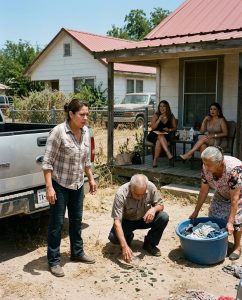
I stayed inside my truck with both hands locked around the steering wheel, staring through the dusty windshield at the white house with the red roof.
That house had lived in my head for years before it ever stood on that land.
I had imagined my mother on the porch every evening, a cup of coffee in her hands, sunset on her face.
I had imagined my father walking through the cornfield with his shoulders straight, not because he had to work to survive, but because the land was finally his to enjoy.
I had bought that land.
I had paid for that house.
I had sent money every month from Houston until my own life became nothing but work, sleep, and sacrifice.
But the man sweeping the yard looked nothing like the father I remembered.
Don Hilario had once seemed impossible to bend.
When I was little, he could throw feed sacks over one shoulder and still lift me with the other so I could reach mangoes from the old tree.
He had hands like roots and a laugh that filled any room.
Now his shirt clung to his back with sweat.
His face had sharpened.
His shoulders curved inward as if someone had been pressing him down for years.
On the porch, in the only patch of shade, sat my sister-in-law Paola and her mother, Irma.
They were drinking soda from glass cups.
Irma’s fingers glittered with rings.
Paola had her legs crossed, her sandals new, her phone angled toward her face like the world owed her entertainment.
Beside them, bottles of lotion and skin cream sat on the porch table, expensive brands I recognized from Paola’s social media posts.
Every month, I had sent money for my parents’ medicine.
Now I was looking at where some of it had gone.
My father’s broom raised a small cloud of dust.
It drifted too close to Irma’s feet.
She clicked her tongue.
‘Watch it, old man.
You’re getting dirt all over my sandals.’
The words struck me so hard my fingers cramped on the steering wheel.
He did not answer.
He only lowered his head and swept farther from the porch.
I should have climbed out right then.
I should have shouted his name and run to him.
But something colder than shock held me still.
In Houston, I had learned that when a truth stinks, you do not run into the middle of it screaming.
You watch.
You listen.
You find out who is giving orders, who is obeying, and who has been selling you lies with a smile.
Then my mother appeared around the side of the house.
She was carrying a blue plastic tub full of wet laundry.
Her back bent with the weight of it, and each step looked measured against pain.
My mother had suffered from chronic back pain for years.
That was why I had sent money for a new washing machine.
I still remembered calling her after it
was delivered and hearing her cry softly into the phone.
‘Mija,’ she had said, ‘now my hands can rest.’
But her hands were not resting now.
They gripped the sides of that tub so tightly her knuckles had gone pale.
Behind her came Paola, one hand holding her phone, the other a glass full of ice.
‘Don’t leave my blouses smelling damp,’ Paola said, not even looking up.
‘And keep my black dress separate.
Don’t ruin it.’
My mother nodded.
That nod split something inside me.
It was not agreement.
It was not peace.
It was obedience worn down into habit.
My father leaned the broom against the wall and took a glass of water from a small table.
He carried it toward the porch as if even that small task had to be done carefully.
When his foot reached the first step, a little water spilled onto the boards.
Irma sprang from her chair.
‘Useless!’ she barked.
She slapped the glass out of his hand.
It hit the ground and shattered.
My father froze.
Water spread through the dust.
One small cut opened along his finger, bright against his worn skin.
He said nothing.
He just lowered himself to pick up the broken pieces.
That was when I saw the ring on Irma’s hand.
A chunky gold band with a fake ruby set high in the middle.
I knew that ring.
A week earlier, Paola had posted a photo of her mother wearing it at a restaurant.
That same day, Paola had called me with her sweet voice, saying my parents were not doing well and that maybe I could send a little extra for medicine and some repairs around the house.
There was the medicine.
There were the repairs.
Shining on the hand of the woman who had just humiliated my father on my own porch.
Every sacrifice I had made came rushing back so fiercely I could barely breathe.
The double shifts at the factory.
The nights hemming uniforms for cash.
The weekends cleaning houses owned by people who did not remember my name.
The months I wore the same two pairs of shoes because my parents needed prescriptions.
The Christmases I spent alone because a plane ticket home cost more than I was willing to take from them.
I had not done it so Paola could live like a queen.
I had done it so my parents could rest.
I opened the truck door.
The sound was small, but everyone heard it.
My father looked up first.
His eyes widened, and the expression on his face was not joy.
It was fear.
That hurt worse than anything Irma had said.
My mother turned with the laundry tub still in her arms.
Her mouth opened, but no sound came out.
Paola looked up from her phone, and the color drained from her face.
Irma shaded her eyes with one jeweled hand.
‘Who are you?’
I stepped onto the dirt I had bought with six years of my life.
‘Papa,’ I said, keeping my voice steady, ‘why are you picking up glass in your own yard?’
My father’s lips trembled.
My mother whispered, ‘Mija, please… not here.’
Not here.
Those two words told me this was not a bad day.
It was a system.
Paola stood quickly, knocking
her glass against the porch table.
‘Marisol.
You should have told us you were coming.
We would have prepared something.’
I looked at my mother’s wet laundry, my father’s bleeding finger, and Irma’s ring.
‘Looks like you prepared plenty.’
No one answered.
Then a truck turned in from the road.
My older brother Mateo got out and stopped dead when he saw me.
Mateo was the one I had trusted.
He lived closest.
He was supposed to check on them.
He was the one who sent voice messages saying, ‘Everything is good, sister.
Mama and Papa are resting.
Don’t worry.’
But he did not smile when he saw me.
He looked terrified.
His eyes dropped to the folder on the passenger seat of my truck, the folder that held my land papers, bank transfers, receipts, and every document I had kept because Houston had taught me never to trust promises without paper.
Then I noticed an envelope tucked under Paola’s phone.
My name was printed on the front.
Beside it was a notary stamp.
I reached for it.
Paola snatched it up.
‘That’s nothing,’ she said.
Mateo stepped between us.
‘Marisol, you’re tired from the road.
Come inside.
We’ll talk like family.’
‘Move.’
His jaw tightened.
‘Don’t make this ugly.’
‘It got ugly before I got here.’
Irma rose from her chair.
‘This is not your business.’
I laughed once.
It sounded strange even to me.
‘Not my business? The house is in my name.
The land is in my name.
The money was mine.
My parents are mine.
So tell me which part is not my business.’
Irma’s eyes flicked to Mateo.
That tiny look told me everything.
My mother set the laundry tub down.
Water sloshed over the sides.
Her hands shook, but her voice came out clear enough to cut through the porch.
‘Enough.’
Paola’s face hardened.
‘Stay out of it.’
My mother reached for Paola’s wrist.
‘No.
Enough.’
For a second, no one moved.
Then Paola loosened her grip, and I took the envelope from her hand.
Inside were papers I did not understand at first.
Legal words.
Transfer language.
A power of attorney form.
A deed modification request.
Then I saw my name at the bottom.
My signature.
Except I had never signed it.
My whole body went still.
‘Who forged this?’ I asked.
Mateo looked away.
Paola spoke first.
‘You’re being dramatic.
It was just paperwork to help manage things while you were gone.’
‘Manage what?’
No answer.
I turned to my father.
‘Papa, did you sign something?’
He lifted his cut hand slowly.
‘They said if I didn’t, you would lose everything.’
My mother began to cry without making a sound.
Mateo cursed under his breath.
‘You don’t understand.
Taxes were due.
Repairs were needed.
People were asking questions.’
‘What people?’
His silence answered before his mouth could.
I pulled more pages from the envelope.
There was a loan application using the property as collateral.
There were copies of my identification documents, ones I had sent Mateo years earlier for a utility issue.
There were signatures made to look like mine.
Some were close.
Some were careless.
And there, stapled to the back, was a notice from the county clerk requesting in-person verification because something about the transfer had been flagged.
That was
why Mateo looked scared.
I had come home before they could fix it.
Before they could steal the house completely.
I looked at Paola.
‘You were going to take the house.’
She crossed her arms.
‘We live here.
We take care of things.
You don’t know how hard it is.’
My father flinched.
‘Take care of things?’ I said.
‘You mean making my father sweep in the heat and my mother wash your clothes?’
Irma lifted her chin.
‘They need structure.
Old people get lazy.’
The porch went so quiet I heard my mother gasp.
Something in Mateo’s face changed.
Shame flickered there, but it came too late.
‘Get off my porch,’ I told Irma.
Her mouth opened.
‘Excuse me?’
‘Get off my porch.
Take your rings, your creams, your attitude, and get off my land.’
Paola turned to Mateo.
‘Say something.’
He swallowed.
‘Marisol, let’s not involve outsiders.’
‘Too late.’
I took out my phone and called the sheriff’s office.
Then I called the attorney whose number I had saved months before, after a strange feeling told me to ask questions about my property.
While we waited, I photographed everything.
The forged documents.
The envelope.
My father’s cut hand.
The broken glass.
The laundry tub.
Irma’s ring.
Paola tried to grab my phone once.
My mother stepped between us.
She was small, hurting, exhausted, but in that moment she looked more powerful than anyone on that porch.
‘Do not touch my daughter,’ she said.
Paola backed away.
When the deputy arrived, Mateo tried to sound calm.
He said it was a misunderstanding.
He said family paperwork could look confusing.
He said I had always trusted him.
‘That was before I saw my signature on papers I never signed,’ I said.
The deputy’s expression changed when he saw the notary stamp and the transfer forms.
He asked who had brought the papers.
Paola blamed Mateo.
Mateo blamed Paola.
Irma claimed she knew nothing, though her ring caught the sun every time she waved her hands and denied taking a dime.
My father finally spoke.
His voice was weak at first, then steadier.
He told the deputy that after I left for Houston, Mateo began coming over more often.
At first, he helped.
Then Paola moved into the house temporarily with her mother after some rent trouble.
Temporary became permanent.
They took the largest bedroom.
They controlled the food.
They answered the phone when I called.
When my parents complained, Mateo told them I was under too much stress and that they should not upset me.
Then the money started disappearing.
Medicines were skipped.
The washing machine broke and was never repaired.
My parents were told to do chores to ‘contribute.’ When my father objected, Mateo warned him that if I found out, I might stop sending money and they would all lose the house.
‘He said I would become a burden to you,’ my father whispered.
I knelt in front of him.
‘Papa, you were never my burden.’
His face broke then.
Not loudly.
Not dramatically.
He simply covered his eyes with one hand and cried like a man who had been holding humiliation inside his bones.
My mother came to him, and I wrapped my arms around both of them.
For the first time since I had arrived, Paola
had nothing to say.
The following weeks were not easy, but they were clean.
The forged transfer was stopped before it became final.
The attorney helped me file the reports and lock every account, every deed, and every utility under protections Mateo could not touch.
The notary whose stamp appeared on the forms denied witnessing my signature, which opened another investigation.
Mateo and Paola hired a lawyer.
Irma stopped posting photos of new jewelry.
I changed every lock on the house.
I repaired the washing machine.
I hired a local caregiver to come three days a week and a farmhand to help with the heavy work my father kept pretending he could still do.
Mateo came once, standing at the edge of the road, asking to speak to me alone.
He looked smaller than I remembered.
Not poor.
Not hungry.
Just exposed.
‘I made mistakes,’ he said.
‘No,’ I told him.
‘A mistake is forgetting a bill.
You watched Papa bleed and Mama bend over laundry while your wife and her mother spent the money I sent for medicine.’
He looked at the house.
‘I thought you had plenty.’
That sentence stayed with me longer than his apology.
I had not had plenty.
I had had discipline.
I had had aching feet, skipped meals, and nights where loneliness sat beside me like another person.
But because he had never seen the cost, he decided the money was easy.
I did not let him inside.
Months later, my parents finally sat on the porch the way I had imagined.
My mother held coffee in both hands.
My father wore a clean shirt and watched the corn move in the wind.
His back was still bent, but something in his face had returned.
Not all of it.
Some damage does not disappear just because the villains leave.
But peace had come back through the front gate, slowly, carefully, like it was afraid of being turned away.
One evening, my mother touched my hand and said, ‘I didn’t tell you because I thought I was protecting you.’
I looked at her, then at my father, then at the red roof glowing under the last light of day.
‘Next time,’ I said, ‘protect me with the truth.’
She nodded, crying softly.
I forgave my parents for their silence because fear had trapped them.
I did not forgive Mateo for using that fear as a key.
Sometimes people think betrayal arrives shouting.
But sometimes it sits on your porch, drinking from your glasses, wearing rings bought with medicine money, and calling your parents lazy while standing on land they never earned.
The worst part was not that I came home and found strangers acting like owners.
The worst part was realizing the door had been opened for them by family.