By the time I found Table Twelve, my feet already hurt.
Not because I was old, and not because the country club ballroom was that large, but because hope is heavy when you have carried a family on your back for years and want, just once, to put it down somewhere soft.
I had spent all morning getting ready for my little brother’s wedding in the kind of apartment where steam from the bathroom fogs the hallway mirror.
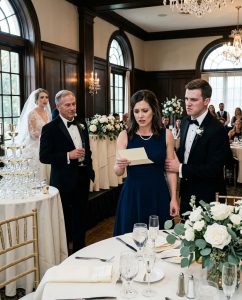
I pressed my navy dress three times because the fabric wrinkled if I looked at it wrong.
I fixed the loose clasp on my shoes with clear nail polish.
I curled my hair, brushed it out, and told myself that tonight was not about how much money everybody else had.
It was about Caleb.
Caleb, who used to fall asleep over homework at our kitchen table while I filled out forms neither of us understood.
Caleb, who never knew how many times I said I had already eaten so he would not split his dinner in half.
Caleb, who had once stood in a thrift-store blazer at seventeen and promised me that one day I would sit at an event for him and not have to explain to anyone why I belonged there.
Our mother died when he was twelve and I was twenty-one.
Our father had been gone in every way that mattered long before the funeral.
After that, there was no grand speech, no movie scene where I decided to become both sister and parent.
There were only rent notices, grocery lists, school meetings, utility bills, and the blunt math of who would keep us afloat if I stopped moving.
So I moved.
I waitressed.
I cleaned offices.
I picked up reception work during the day and late shifts on weekends.
I learned how to make ten dollars stretch like an insult.
Caleb learned how to work just as hard without letting it harden him.
He was the first person in our family to finish college.
Then graduate school.
Then he built something bigger than either of us had expected: a nonprofit that helped high school seniors from low-income families navigate scholarships, admissions, and financial-aid traps that swallow smart kids whole.
He used to say the organization existed because too many students were one confusing form away from losing their future.
I knew the real reason.
It existed because he remembered who stayed up all night with him at the kitchen table.
When he met Claire Ashford, I was afraid for reasons that had nothing to do with Claire.
Claire was warm from the first afternoon I met her.
She hugged instead of offering a careful handshake.
She asked me about my work at the medical office where I had finally landed a stable job and listened to the answer.
She laughed easily, not cruelly.
She loved my brother in the visible way, the kind that makes other people feel safer around the person being loved.
But Claire belonged to the Ashfords.
And the Ashfords belonged to the kind of world that treats generosity like a performance and pedigree like a blood type.
Richard Ashford, Claire’s father, had money old enough to feel inherited even when it was earned.
He chaired boards, funded museums, appeared in magazines standing beside giant
checks, and spoke the way certain men do when they have never once mistaken courtesy for equality.
The first time I met him, he looked at my hands before he looked at my face, as if work itself left fingerprints you could never quite wash away.
He was never rude in the obvious way at first.
Men like Richard rarely are.
They prefer a cleaner blade.
At the engagement dinner, he asked where I had gone to school and then nodded in a way that turned my community-college years into a regrettable detail.
At brunch, he referred to Caleb’s nonprofit as admirable but emotionally driven, which in his language meant unserious.
Once, while Claire was in the restroom, he told Caleb that marriage was easier when both families understood the same rooms.
Caleb heard the insult.
So did I.
He answered by changing the subject because Claire had just come back, and he wanted peace.
Peace lasted until the wedding.
The ballroom at the Westchester country club looked like the inside of a bridal magazine spread.
White roses climbed silver stands.
The windows looked out on a lawn cut so evenly it seemed imaginary.
Crystal caught the light overhead, and even the air smelled expensive, like chilled champagne and gardenias.
I found my place setting and saw the card.
‘Poor, uneducated sister—living off her brother.’
For one second I did not understand what I was reading.
My brain kept reaching for the normal explanation.
Maybe it belonged to a joke favor bag.
Maybe it had been placed there by accident.
Maybe my eyes were misfiring from the light.
Then someone laughed.
A bride’s cousin, napkin to her mouth, shoulders shaking.
Then an older woman in pearls whispered, loud enough for me to hear, ‘They actually printed it.’
That was the moment I knew it had been deliberate.
Deliberate and planned and anticipated.
The humiliation was not just the words.
It was the coordination.
The cardstock, the calligraphy, the placement, the family members who already knew enough to enjoy it.
I looked across the room at Caleb, thinking only one thing: leave before he sees.
I had not sacrificed half my life for that boy just to be the reason his wedding turned into a disaster.
If I disappeared quietly enough, maybe I could call him tomorrow and invent a migraine.
Maybe I could protect him one more time.
I set the place card down and reached for my purse.
A chair scraped.
Caleb crossed the room faster than I had ever seen him move in a suit.
His hand closed around mine.
‘Maya,’ he said, and in that single word I heard the little brother I used to wake before dawn, the teenager whose tie I had fixed for scholarship interviews, the man who still called me after every big meeting.
‘Don’t move.’
Everything that happened next took maybe two minutes.
It felt like a trial.
Caleb picked up the card, read it, and looked straight at Richard Ashford.
‘You just made the most expensive mistake of your life.’
The string quartet failed in slow motion.
A violin stopped first, then the cello.
Forks froze halfway to mouths.
Claire turned from the head table, saw the card, and went white.
Richard adjusted his jacket and told Caleb to sit down
before he embarrassed himself.
Caleb did not sit.
He asked for an explanation.
Richard called it a joke.
When Caleb repeated the word back to him, Richard shrugged and said I was old enough to handle humor.
I stepped beside my brother and asked why, if it was humor, I was the only person chosen as the punchline.
That was when Richard stopped pretending.
‘People like you take everything personally,’ he said.
Then, because men like him often believe the first cruelty did not go far enough, he kept talking.
He warned Caleb about valuable connections.
He reminded him that the Ashfords had opened doors.
He said sacrifice and hardship did not make a person educated, refined, or equal.
He said family was not a word people use to force themselves into rooms where they do not belong.
I remember every line because each one landed in a part of me that had worked very hard to survive without bitterness.
I remembered the bracelet I sold to cover Caleb’s summer program deposit.
I remembered counting bus money.
I remembered taking extra shifts so he could keep an unpaid internship that later became his first real opportunity.
‘I did not come asking to be equal to your money,’ I told Richard.
‘I came here because I am his family.’
Caleb stepped in front of me so fast my breath caught.
‘Where I stand,’ he said, ‘she belongs.’
No one laughed after that.
Richard reached for his phone and tried another tactic.
He began talking about reconsidered job offers, delayed grants, promises that could be paused.
That was when something in Caleb changed.
Not his anger.
His certainty.
He smiled once, thin and calm.
‘Thank you,’ he said.
Richard frowned.
‘For what?’
‘For saying that in front of witnesses.’
Then Caleb reached into his jacket and pulled out a folded document on Ashford letterhead.
Claire made a sound so small I almost missed it.
She knew the paper.
So did Richard.
Weeks before the wedding, though I did not learn this until later that night, Richard had invited Caleb to lunch under the banner of fatherly support.
He presented a polished packet: an executive role with one of the Ashford philanthropic ventures, a sizable grant for Caleb’s nonprofit, and long-term financial backing that would have placed Caleb in rooms he had never asked to enter.
On the surface it looked generous.
On the inside it was a leash.
Buried in the packet, disguised as branding language and family advisement, was a condition stating that my presence in major Ashford family events and public materials should be carefully limited because I did not reflect the image the family wished to project.
There was even language suggesting that immediate relatives presented in formal spaces should meet the educational and social expectations of the Ashford name.
I read that line later and felt physically cold.
Caleb had read it weeks earlier.
He had refused to sign anything.
Claire had found out about the packet after noticing her father’s assistant emailing revised drafts late at night.
She confronted Richard, who claimed it was just legal overreach, language that would never matter, language that would be cleaned up.
He promised he would drop it.
He said he only wanted to protect the family from awkward optics and
opportunists.
Claire told him, clearly, that Caleb would never be asked to choose between her and his sister.
Richard smiled, apologized in that bloodless way men like him apologize, and let the wedding planning continue.
Now, in the middle of the ballroom, Caleb laid the paper beside my place card.
The wedding planner near the door visibly flinched.
When Caleb asked who approved the final seating cards, she swallowed hard and said Richard’s office had delivered replacements at noon.
Not a printer’s error.
Not a mix-up.
A direct order.
The room shifted again.
Guests who had spent years orbiting Richard’s money started studying his face the way investors study a collapsing chart.
Caleb unfolded the paper and read the hidden condition aloud.
He did not raise his voice.
He did not need to.
Silence carried every word.
‘In order to preserve brand alignment and family presentation standards,’ he read, ‘representation of Ms.
Maya Bennett as immediate family in formal public settings should be avoided unless expressly approved.’
The final phrase was worse.
‘…in order to reduce reputational confusion.’
Claire shut her eyes.
Her mother, Elaine, went visibly gray.
Richard tried one last defense.
He said the language had been drafted by advisers.
He said this was how families at their level handled complexity.
He said I was making the evening emotional and Caleb was throwing away his future over wounded pride.
Then Claire took off her veil.
Not dramatically.
Not with a flourish.
She simply lifted it back and set it on the table as if clearing her vision.
‘No,’ she said.
‘You are the one throwing things away.’
He told her not to do this in public.
She looked at him with tears in her eyes and said, ‘You already did.’
It is hard to describe what it feels like to watch a daughter finally see her father without the softening filter of childhood.
Something breaks.
Something else becomes honest.
Claire turned to me.
‘I am so sorry,’ she said.
The words shook.
‘I knew he looked down on people.
I did not know he would try to erase you.’
I could not answer right away.
Because humiliation is a strange thing.
Even when the guilty person is exposed, some part of you still wants to shrink.
I told her she did not owe me an apology for her father’s character.
Then Caleb did something I will love him for until I die.
He took my hand and said, loud enough for the whole room to hear, ‘Everything I am stands on what she gave up for me.
If my family cannot honor that, there is no wedding worth having.’
Richard told him to think carefully.
Caleb laughed once, without joy.
He explained that he had already rejected the job.
He had already declined the grant.
He had already arranged alternative funding for his nonprofit through partners who believed in the work without demanding that he amputate his life to fit a donor’s aesthetic.
Richard looked genuinely stunned.
He had mistaken need for dependence.
He had never understood the difference.
Then the consequences began arriving faster than he could control them.
One of the independent directors from his foundation board, seated two tables away, stood up and quietly asked for a copy of the packet.
Another guest, a lawyer
who advised one of Richard’s companies, put his phone down and said nothing, which somehow felt louder than outrage.
Elaine informed the planner that her husband’s instructions no longer represented the family.
A cousin who had laughed at the card started crying.
Whether from shame or fear, I could not tell.
Richard announced that if people intended to insult him, he would leave and take his support with him.
Claire answered before anyone else could.
‘The balance was paid this morning,’ she said.
He stared at her.
She had emptied an investment account her grandmother left her and covered the remaining wedding costs after finding out, days earlier, that her father had been quietly attaching conditions to gifts.
She had hoped she was being paranoid.
She had paid anyway.
‘I wanted one day in my life that wasn’t rented by your approval,’ she told him.
That was the closest Richard came to looking old.
Elaine stood up then, removed the diamond bracelet he had given her for their thirtieth anniversary, and set it beside Claire’s veil.
‘Enough,’ she said.
Richard left the ballroom alone.
No dramatic explosion.
No shattered glass.
Just a man in a custom tuxedo discovering that authority disappears quickly when everyone stops volunteering to pretend it is grace.
For ten minutes nobody knew what to do.
Then Claire turned to the officiant and asked if he was still willing to marry them.
He said yes.
She asked the quartet if they would play on the veranda instead of in the ballroom.
They said yes.
She looked at me next.
‘Maya,’ she said, and this time her voice steadied, ‘will you stand with Caleb?’
I almost said no, because I was still shaking and because I did not know how to move from public humiliation into ceremony in the span of a breath.
But Caleb squeezed my hand.
So I stood with him as the guests willing to stay drifted outside into the early evening.
The veranda overlooked the lawn and the fading gold of the sky.
Without the ballroom’s spectacle, everything felt stripped down and true.
Claire walked out without her father.
Elaine walked beside her for half the distance, then let her finish alone.
Caleb cried before the vows even started.
So did Claire.
So did I.
When the officiant asked who gave support to the marriage, Elaine answered first.
Then, unexpectedly, a half-dozen voices joined her from different corners of the veranda.
People who had looked away inside the ballroom finally looked straight at what mattered.
Afterward, when the staff reset the tables for dinner, one of the servers replaced my place card with a plain folded card written in blue pen.
It said only Maya Bennett.
I have never loved my own name more.
The public consequences came later.
Someone posted a short clip from the reception.
Not the whole confrontation, just enough for the questions to start.
Then the planner confirmed, privately at first and then formally, that Richard’s office had ordered the replacement cards.
Then the packet surfaced.
Then former employees of one of his companies, apparently tired of staying quiet around power, began talking about the ways philanthropy had been used to buy obedience.
Within a month, Richard resigned from two boards and took a leave from the foundation that had
been so central to his identity.
Donors requested audits.
One pending partnership froze.
Newspapers used the language they always use for men who believed consequences were for other people: scrutiny, review, reputational damage.
Claire did not speak to him for a long time.
Elaine moved into an apartment in the city.
Caleb kept building his nonprofit with the alternative funding he had secured, and because the universe sometimes enjoys irony, the story of what happened at the wedding brought more supporters to his work than Richard’s money ever could have.
The next spring, Caleb and Claire invited a new group of scholarship students to visit the nonprofit’s office.
On the wall near the entrance, there was a framed photograph from the veranda ceremony.
Not the ballroom.
Not the chandeliers.
Not the Ashford side of the family.
Just Claire laughing through tears, Caleb looking like he had finally become exactly the man I always knew he could be, and me standing beside him in the same navy dress.
Sometimes people ask whether Claire deserved forgiveness because she did not stop her father sooner.
Sometimes they ask whether I regret staying.
Sometimes they ask what the biggest red flag was.
For me, the answer is simple.
The biggest red flag was not the printed insult.
It was the belief behind it—the belief that money can decide whose sacrifice counts, whose love is presentable, and whose family gets to use the word family out loud.
Richard lost more than a wedding that day.
He lost the illusion that worth can be curated like a guest list.
And even now, when I think about the plain handwritten card that replaced the cruel one, I still wonder how many people in that ballroom had laughed because they agreed, how many had stayed quiet because comfort mattered more than decency, and how different the world might look if more people stood up as fast as Caleb did.