He was trying to fix something the world had no right to leave broken.
Three months earlier, we had buried his father.
David had been the sort of man who never threw away a bent nail if he thought he could straighten it and use it again.
He built shelves for neighbors, repaired loose fences without being asked, and once spent an entire Sunday widening a bathroom doorway for an older man down the street who had come home from surgery in a wheelchair.
Ethan followed him everywhere, small toolbox in hand, collecting sawdust like treasure.
After David died, the house became too quiet.
Ethan didn’t cry much where people could see him.
He just noticed things more.
He noticed when Mrs.
Alvarez had to carry her groceries one bag at a time because her wrist was in a brace.
He noticed when the mail carrier limped by the end of his shift.
He noticed the kid next door who sat on the porch every afternoon and watched the other children play like he was looking through glass.
That kid was Caleb.
He was nine, quick to smile, and so used to being left out that he had learned how to make it look normal.
He would sit in his wheelchair at the top of the porch, elbows on the armrests, and watch the neighborhood move around him.
Chalk games bloomed on the pavement below.
Bikes rattled over cracked sidewalks.
Kids chased foam footballs through the cul-de-sac.
Caleb smiled at all of it, but he never came down.
One afternoon, Ethan stood at our front window for a long time, then asked, ‘Mom…
why doesn’t Caleb ever come down?’
So we walked next door and knocked.
Mia, Caleb’s mother, opened the door with the tired expression of someone who had already apologized for too much in life.
The answer was right there in front of us anyway: four steep wooden steps dropped from the porch to the walkway, and there was no ramp, no lift, no side entrance, no safe path for a wheelchair.
Mia let us in and explained it in a rush, like she was embarrassed to even say it out loud.
Insurance had refused to cover a ramp.
She had appealed twice and lost twice.
Every time she thought she was making progress, something else took the money first: repairs to Caleb’s chair, extra therapy, medication, a missed week of work, a car problem, rent going up.
They had a jar on the counter marked RAMP FUND with a few folded bills and a scattering of change inside.
She said they’d been saving for over a year.
Then she looked toward the porch and said the sentence that stayed with Ethan all night: ‘I hate that he has to watch other kids live his life for him.’
Ethan didn’t say much on the walk home.
He ate dinner quietly, cleared his plate, and disappeared into the hallway closet where David’s old tools were stored.
A few minutes later he came back carrying graph paper, a dull carpenter’s pencil, and the metal ruler his father
used for every home project.
He spread everything across the kitchen table and started sketching.
I asked what he was doing even though I already knew.
He said, ‘If the angle’s too steep, it won’t help.
Dad always said you build for the person, not for the picture.’
The next morning he took the envelope of money he had been keeping in his dresser for a new bicycle and poured it onto the table.
Bills, coins, birthday money, lawn-mowing money, every dollar he had.
We went to the hardware store, and he bought lumber, brackets, screws, sandpaper, sealant, and a length of grip tape.
When I asked if he was sure, he looked at me like there was nothing to think about.
‘Bike can wait,’ he said.
For three days he worked after school until there was barely enough light to see.
He measured twice.
Cut once.
Then measured again because he didn’t trust himself yet.
He redid a support beam when it sat crooked by less than half an inch.
He sanded the edges until they were smooth enough that Caleb’s hands wouldn’t catch.
He sat on the garage floor surrounded by wood scraps, his father’s level across his knees, and for the first time since the funeral I saw him look like himself.
On the third evening, he ran his palm over the finished rail and nodded once.
‘It’s not perfect,’ he said.
David used to say that was how you knew something mattered.
We carried the ramp next door together.
Mia cried the moment she realized what she was looking at.
Ethan got embarrassed and pretended not to notice.
We bolted the top plate into place, checked the slope, steadied the side rails, and stepped back.
It wasn’t fancy, but it was solid.
Strong enough to give a child what he’d been denied for too long.
Caleb rolled forward slowly at first, almost suspicious of his own freedom.
Then his chair touched the sidewalk.
He stopped at the bottom and just stared.
Not because anything dramatic had happened, but because something ordinary finally had.
He was on the street.
He was where the other kids were.
Within minutes he was in the middle of a chalk game, laughing so hard he nearly dropped the blue ball somebody had handed him.
Ethan walked beside him like it was the most normal thing in the world.
I remember thinking that if David could see us then, he would know exactly where his son had learned to be brave.
The next morning, I woke to shouting.
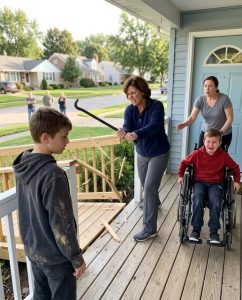
I ran outside barefoot and found a woman from three houses down standing beside the ramp with fury on her face and a metal landscaping bar in her hands.
Her name was Brenda Halston.
She was the kind of neighbor who talked about lawns the way other people talked about religion.
Everything around her had to look clean, expensive, controlled.
She was preparing to list her house that month, and later we learned she had already complained to two different neighbors about toys being left visible in driveways.
At that moment, though, all I knew was that she was staring at the ramp like it had personally insulted her.
‘It’s an eyesore,’ she snapped.
‘It ruins the view from my front windows.’
Before any
of us could make sense of what she was doing, she swung the metal bar down.
The first blow split one side rail.
The second knocked loose the support Ethan had spent almost an hour leveling.
Wood cracked.
Screws shot free.
Caleb screamed from the porch.
Mia rushed out behind him yelling for her to stop, and Ethan just stood there, frozen, as if his body couldn’t catch up to what his eyes were seeing.
Brenda swung again.
And again.
She didn’t stop until the ramp shifted sideways and collapsed into a heap of broken boards, grip tape, and splinters.
Then she dropped the bar on the grass and said, with a disgust that still turns my stomach, ‘Fix your mess.’
Caleb was stranded on the porch again.
Watching again.
That was the part Ethan couldn’t bear.
He knelt in the wreckage and touched one of the broken rails like he was trying to understand how kindness could be smashed so quickly.
What Brenda didn’t know was that cruelty has witnesses now.
Lucy from across the street had caught almost the whole thing on her Ring camera.
So had two other houses.
By noon, the footage had been saved in three places.
By evening, it had been shared in our neighborhood group chat with Mia’s permission.
People who had barely spoken to one another in months were suddenly asking what they could do.
Someone offered temporary portable ramps.
Someone else offered money.
A local contractor offered labor.
The outrage spread faster than Brenda’s excuses did.
That night, Mia made a phone call she had avoided making for years because she hated asking her family for help.
She called Caleb’s grandfather.
The next morning, three black SUVs pulled up in front of Brenda’s house.
Not police cars.
Not neighbors.
Three silent, polished vehicles that seemed to change the air on the whole street.
Men in dark suits stepped out carrying folders, measuring tools, and one hard-sided case.
Brenda opened her front door wearing the same smile people wear when they still think the story can be managed.
That smile disappeared in under five seconds.
The man at the center of it all stepped out of the last SUV last.
He was in his sixties, silver-haired, straight-backed, and calm in a way that made everyone else look noisy.
Caleb saw him and lit up so suddenly it hurt to watch.
‘Grandpa Noah,’ he said.
His name was Noah Whitaker.
Even if you didn’t follow legal news, you knew the name in our state.
He was the disability-rights attorney who had forced school districts to install elevators, pressured hospitals to rethink access policies, and built a reputation on the sort of quiet relentlessness that made institutions nervous.
He had started a nonprofit after his own daughter—Caleb’s mother—nearly lost access to treatment years earlier because a facility wasn’t equipped for her recovery.
By the time he reached Brenda’s porch, she already knew exactly who she was looking at.
One of the attorneys with him opened a folder and laid out printed stills from the Ring footage.
There was Brenda with the metal bar over her shoulder.
Brenda bringing it down.
Brenda standing over the collapsed ramp while Ethan stared.
And there was Caleb, small and helpless at the top of the porch, trapped in
plain view.
Brenda began talking fast.
She said she was protecting property values.
She said the structure wasn’t approved.
She said it looked terrible from her windows.
One of Noah’s associates slid another document toward her and said, very evenly, ‘Accessibility modifications are protected.
Destroying one is not.’
By then a city inspector was walking up the driveway from the second SUV, and two licensed contractors were unloading measuring tools from the third.
Noah didn’t even glance at the broken wood when he spoke.
He looked at Ethan.
‘You’re the one who built it?’
Ethan nodded, jaw tight.
Noah’s expression softened.
‘Your father taught you well,’ he said.
I don’t know how he understood, from one look at my son and a homemade ramp, that this had been grief turned into something useful.
But he did.
Ethan’s eyes filled immediately, and he looked away before anyone could see.
Noah turned back to Brenda.
‘You didn’t hit lumber yesterday,’ he told her.
‘You hit a child’s only way out.’
He did not shout.
He did not threaten.
He simply listed what would happen next.
The footage had already been preserved.
A criminal complaint had been filed.
A civil action for damages and emotional distress was being prepared.
The city was sending an emergency accessibility review team.
And because Caleb had been put at risk and intentionally isolated again, every relevant agency would be informed.
Then he handed Brenda a sealed envelope.
Inside, as we later learned, was notice from his firm, a demand to preserve evidence, and copies of the complaints already moving through the system.
The sound Brenda made when she saw them was the sound of somebody realizing the story had left her control forever.
What happened next mattered more to Ethan than anything legal.
Noah crossed the yard, crouched in front of Caleb, and asked, ‘Tell me what you want this house to feel like when you leave it.’
Caleb, still raw from the day before, swallowed hard and said, ‘Like I don’t need help just to get to the sidewalk.’
Noah nodded once and stood.
‘All right,’ he said.
‘Then that’s what we’re building.’
The contractors began that afternoon.
Not another temporary structure, but a permanent, code-compliant ramp with proper handrails, a gentler slope, a wider landing, weather sealing, and a path that connected cleanly to the sidewalk.
Noah’s nonprofit covered the upfront cost without making a performance out of it.
The city inspector expedited the approval.
Two neighbors brought cold drinks.
Someone delivered pizza.
Kids hovered on the curb and asked when Caleb would be able to come back out.
Ethan worked beside the crew the whole time.
One contractor showed him how to set anchors properly.
Another let him mark the placement for the handrail posts.
When they needed a final check on the slope, Ethan used his father’s old level and adjusted one corner by a fraction until the bubble sat perfectly centered.
The foreman looked at Noah and said, ‘You’ve got a builder here.’
Noah smiled.
‘I know,’ he said.
The permanent ramp was finished two days later.
Caleb rolled down with his mother beside him and Ethan walking backward in front of him, grinning like an idiot and pretending to be a traffic guide.
The kids on the block cheered before Caleb
even reached the bottom.
This time he didn’t stop in shock when his wheels hit the sidewalk.
He kept going.
Straight to the chalk drawings.
Straight to the laughter.
Straight into the part of childhood that had been waiting for him the whole time.
As for Brenda, consequences arrived from every direction.
Police cited her for vandalism and trespassing, and the footage made denial impossible.
Her homeowners’ insurer refused to shield intentional destruction.
The civil case didn’t drag on for long because Noah’s team had more evidence than they needed and Brenda’s own words had been recorded clearly.
In the settlement, she paid for the destroyed materials, Caleb’s emotional damages, and additional accessibility improvements to the property.
The court also ordered community service, and not the symbolic kind.
She spent months volunteering with an adaptive recreation program where every curb, doorway, and ramp became impossible for her to ignore.
The neighborhood changed too.
Not in a dramatic movie way.
In a real way.
People started noticing what Ethan had noticed all along.
A retired couple at the corner added a handrail to their porch.
Someone organized a small accessibility fund for families on our street who needed modifications.
The HOA, suddenly eager to discover a conscience, rewrote its guidance to make clear that accessibility changes would never be obstructed.
Nobody said that happened because they were afraid of Noah Whitaker, but nobody said it didn’t.
A week later, Noah came back with a gift for Ethan.
It wasn’t money.
It wasn’t anything flashy.
It was a sturdy red toolbox engraved with small silver lettering: DAVID PARKER YOUTH BUILD AWARD.
Noah had created it on the spot, he admitted, because he thought boys like Ethan should be told early that skill and compassion belong together.
Along with it came a paid place in a summer builders’ program and, to Ethan’s complete shock, enough anonymous money in an envelope to replace the bicycle he had given up.
Ethan tried to refuse the bike money at first.
Noah told him, ‘A good deed should cost you effort, not your childhood.’
That was the end of the argument.
The best part came later, after the lawyers were gone and the neighborhood had stopped whispering.
One evening I looked outside and saw Caleb racing down the new ramp while Ethan coasted beside him on his bike, both of them laughing, both of them arguing about who had cheated to reach the mailbox first.
The ramp didn’t look like an eyesore.
It looked like exactly what it was: a way into the world.
I still think about Brenda sometimes.
Not because I wonder whether she regretted it.
I’m sure she did, once the bills, the footage, and the consequences arrived.
I think about how the biggest red flag wasn’t the metal bar in her hands.
It was what she had seen before she picked it up.
A child stranded on a porch.
A boy’s freedom built out of scrap money and grief.
And still, all she could call it was damage to her view.
Ethan saw the same thing and built a way down.
That’s the difference I can’t stop turning over in my mind.
On our street, the wood was replaced within days.
The trust took longer, but it came back too.
And every time
Caleb rolled past our house without stopping, I thought the same thing: some people look at a ramp and see something ugly.
My son looked at it and saw a boy who deserved to touch the sidewalk.