The black Bentley waited at the curb like an animal holding its breath.
My driver, Marcus, stepped out the moment he saw me. His eyes flicked from my face to Elena, then to Leo, then to the battered suitcases. He had worked for me for seventeen years. He knew better than to ask questions in public.
“Sir,” he said quietly.
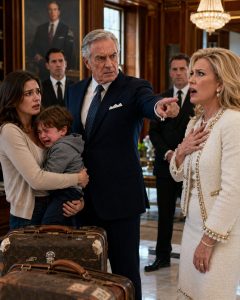
“Put the luggage in the trunk,” I told him. “All of it.”
Elena hesitated beside me, one arm around Leo, the other clutching that crumpled envelope as if it were proof she still existed. Her lips were pale. Her hair, usually pinned neatly, had come loose around her face. She looked younger than her twenty-nine years. Not weak. Never weak. Just exhausted in the way only betrayal can exhaust a person.
“Raymond,” she whispered, “I don’t want to cause trouble.”
I looked at her, and for a moment I saw Liam.
Not as the soldier he had become, not in uniform, not with medals pinned to his chest, but as a boy of eight standing in my study with a scraped knee and a fierce little frown.
“She’s scared, Dad,” he had once told me after finding a stray dog shivering under the hedges. “So don’t talk too loud.”
I softened my voice.
“Elena, you are not causing trouble. Trouble was caused when my sister sent my grandson to an airport bench with a one-way ticket and guards at your back.”
Her eyes filled again.
“And as for Beatrice,” I added, opening the car door, “she has mistaken my absence for permission.”
Elena climbed in, holding Leo close. I slid in beside them. Marcus shut the door, and the airport noise vanished behind thick glass.
For a few seconds, only the engine hummed.
Then Elena handed me the envelope.
Inside was a plane ticket to Cleveland, three hundred dollars in cash, and a typed letter on family stationery.
Family stationery.
I unfolded it slowly.
Elena Voss,
Effective immediately, your residence at the Ainsworth estate is revoked. You will remove yourself from all family properties and cease using the Ainsworth name in any social, charitable, or legal capacity.
Your continued presence creates confusion regarding inheritance, hierarchy, and public image. Leo will remain under review concerning his future placement, education, and trust access.
This matter has been decided by the family council.
—Beatrice Ainsworth
I read it twice.
Not because I needed to.
Because I wanted to memorize every word before I burned her world to ash.
“The family council,” I said softly.
Elena looked down. “She said they all agreed. She said you wouldn’t oppose it because deep down you knew she was right.”
A laugh left my throat. It was not warm.
“There is no family council.”
Elena stared at me.
“There was one in my father’s day. He dissolved it thirty-two years ago after my uncle tried to sell company shares to a rival bank. Since then, the Ainsworth estate, the family trust, the charitable foundation, and all major holdings have been controlled by one legal chair.”
I tapped my chest once.
“Me.”
Elena went still.
“And after me,” I said, looking at Leo’s sleeping face, “the next primary beneficiary is him.”
Her breath caught. “Leo?”
“Liam was my only son. Leo is his child. Beatrice knows exactly what that means.”
The car merged onto the expressway. Rain began striking the windows, thin silver lines sliding across the city lights.
Elena’s voice came out broken. “Then why would she do this?”
“Because she is afraid.”
“Of me?”
“No.” I looked at the letter again. “Of what Liam left behind.”
Elena frowned. “Liam didn’t leave anything behind except his things. His uniforms. A few letters.”
I folded the paper with care and slipped it back into the envelope.
“That is what you were meant to believe.”
For the first time since I had found her, I saw something stronger than fear in Elena’s eyes.
Confusion.
Then suspicion.
“What are you saying?”
I looked toward the partition separating us from Marcus, then pressed a button. The glass rose higher, sealing us in complete privacy.
“After Liam died, his military records were sealed for internal review. You were told it was routine.”
“It wasn’t?”
“No.”
Her fingers tightened around Leo’s jacket.
“Three weeks before the accident,” I said, “Liam called me from a base in Virginia. He sounded strange. Careful. He said he had discovered financial irregularities tied to a veterans’ rehabilitation fund. Money meant for wounded soldiers was being redirected through shell charities.”
Elena’s face drained of color.
“He said he had names. He said one of them was familiar.”
She shook her head slowly. “No.”
“He wouldn’t tell me over the phone. He said he was coming home that weekend and would bring documents.”
“But he never came home,” Elena whispered.
“No.”
The rain grew harder.
“He died two days later.”
The words sat between us, heavy and alive.
Elena looked down at Leo as if trying to shield him from a truth too large for the backseat of a car. “You think Beatrice—”
“I think Beatrice is many things. Greedy. Proud. Cruel. Reckless when cornered.” I paused. “But I have never known her to act alone.”
The Bentley turned through the iron gates of the Ainsworth estate just after dusk.
The house rose ahead of us, pale stone and black windows, its towers half-swallowed by rain and fog. The place had been in our family for four generations. People called it a mansion. I had always thought of it as a museum where the dead still argued.
Tonight, every light in the east wing burned.
Beatrice was expecting victory.
Marcus stopped beneath the covered entrance. Before I could open the door, Elena touched my sleeve.
“Raymond,” she said, “please. Don’t let her take Leo.”
I looked at my grandson, his small hand curled against his cheek, unaware of the war beginning around him.
“No one takes Leo.”
I stepped out into the rain.
The front doors opened before I reached them. Mrs. Vale, our housekeeper, stood inside, stiff-backed and pale.
“Mr. Ainsworth,” she said, voice trembling. “We were told you would return tomorrow.”
“So I keep hearing.”
Her eyes slid past me to Elena and Leo getting out of the car. Relief flickered across her face so quickly others might have missed it.
I did not.
“Prepare the blue suite,” I said.
Mrs. Vale blinked. “For Mrs. Ainsworth?”
“For my daughter-in-law and my grandson.”
Her mouth tightened with emotion. “Yes, sir.”
“And have tea sent up for Elena. Something warm for the boy when he wakes.”
“Yes, sir.”
I handed her Beatrice’s letter.
“Make a copy of this. Then give the original to Mr. Caldwell when he arrives.”
“Mr. Caldwell?”
“My attorney. He will be here within the hour.”
Behind her, footsteps echoed from the grand staircase.
Slow.
Measured.
Deliberately theatrical.
Beatrice descended in a cream silk suit, pearls at her throat, silver hair swept into a flawless knot. At sixty-four, my sister had preserved herself like an expensive weapon. She stopped halfway down the stairs when she saw Elena.
For the first time in my life, I watched Beatrice Ainsworth lose control of her face.
Only for a heartbeat.
Then she smiled.
“Raymond,” she said. “What a wonderful surprise.”
“Is it?”
Her eyes sharpened, but her smile remained.
“You should have told us your flight changed. We would have prepared dinner.”
“I found my dinner plans altered when I discovered my daughter-in-law abandoned at JFK.”
Elena stood behind me, holding Leo. Beatrice’s gaze touched her like frost.
“Abandoned is a dramatic word.”
“Accurate ones often are.”
Beatrice reached the bottom step.
“Elena misunderstood a difficult but necessary decision. The household has been under strain. Her presence here has become… emotionally disruptive.”
“To whom?”
“To all of us.”
“No,” I said. “Try again.”
Her nostrils flared.
“Raymond, you’ve been away. You don’t know what has been happening here.”
“I know you forged authority you do not possess. I know you expelled Liam’s widow from property you do not own. I know you attempted to separate a four-year-old child from his mother by threatening ‘future placement.’ And I know you did it while using my letterhead.”
Silence spread across the foyer.
Two footmen stood frozen near the hall. Mrs. Vale lowered her eyes.
Beatrice’s voice dropped. “This is not a conversation for servants.”
“Then speak carefully. They may become witnesses.”
Her smile died.
Elena inhaled sharply behind me.
Beatrice looked at her. “You see what you’ve done? You ran crying to Raymond like a helpless little thing, and now you’ve turned brother against sister.”
I stepped forward.
“Do not address her.”
Beatrice’s gaze snapped back to me.
“You have always been blind where Liam was concerned,” she said. “And now you’re blind with the woman he married. She never belonged here. Everyone knows it. She was a waitress when he met her.”
“She was putting herself through nursing school.”
“She trapped him.”
“She loved him.”
“She gave him a child at the most inconvenient possible time.”
“She gave this family its heir.”
The words cracked through the hall.
Beatrice went very still.
There it was.
The wound beneath the silk.
For years, she had circled the estate like a patient hawk. She had no children. Her husband had died early. Our younger brother, Martin, had drunk himself into the grave. I had Liam. Liam had Leo.
Bloodlines. Trusts. Seats. Names.
To Beatrice, love was decorative. Inheritance was real.
“You think that boy can carry this family?” she whispered. “Raised by her?”
“I think he already carries more claim than you ever will.”
Her eyes glittered.
Then she laughed once, softly.
“You always did enjoy sounding like Father.”
“And you always mistook cruelty for intelligence.”
Before she could answer, Leo stirred in Elena’s arms.
“Mommy?” he mumbled.
Elena kissed his forehead. “I’m here, baby.”
Leo blinked, saw the foyer, then saw me. “Grandpa?”
The rage inside me loosened just enough for pain to enter.
“Hello, little man.”
He reached toward me.
Elena passed him over, and I held him against my chest. He smelled of sleep, airport air, and the faint vanilla soap Elena used. His small fingers clutched my collar.
“Are we home?” he asked.
I looked straight at Beatrice.
“Yes,” I said. “You are home.”
Beatrice turned away first.
A small defeat.
Not enough.
Never enough.
“Go upstairs,” I told Elena gently. “Mrs. Vale will take you. Lock the door until I come.”
Elena hesitated.
“I promise,” I said.
She nodded and followed Mrs. Vale up the staircase, Leo looking over my shoulder until the landing swallowed them.
When they were gone, Beatrice’s voice hardened.
“You are making a mistake.”
“No, Beatrice. I made the mistake long ago, when I allowed you to remain near my family because I believed blood deserved patience.”
Her eyes narrowed.
“I know about the veterans’ fund,” I said.
Nothing in her body moved.
Not her hands.
Not her mouth.
Not even her breath.
But I saw it.
The truth landing behind her eyes.
“I don’t know what you’re talking about,” she said.
“Yes, you do.”
“Grief has made you paranoid.”
“Possibly. But paranoia with subpoena power is still inconvenient.”
For the first time, she looked toward the door.
“You cannot prove anything.”
“I didn’t say I could.”
That unsettled her more.
“What do you want?”
“Tonight? I want you out of my house.”
Her mouth opened.
I raised my hand.
“You will move into the city apartment until further notice. Your accounts tied to the family office will be frozen pending review. Your seat on the foundation board is suspended. You will surrender your house keys, vehicle access cards, and any estate security codes before you leave.”
She stared at me as though I had struck her.
“You wouldn’t dare.”
“I already called Caldwell from the car.”
“You can’t freeze my personal accounts.”
“I don’t need to. Only the ones you’ve been using.”
Color crept up her neck.
There.
Another truth.
She stepped closer. Her voice became low and venomous.
“You think Elena is some innocent little widow. Ask her what she was doing in Liam’s study the night before the funeral.”
I did not react.
Beatrice smiled slowly.
“Oh. She didn’t tell you?”
A cold thread moved through me.
“What are you implying?”
“I’m not implying anything. I’m advising you not to confuse a pretty face and a crying child with loyalty.”
Behind us, the front door opened.
Charles Caldwell entered with his leather case, rain speckling his overcoat. He was seventy-two, bald, and built like a retired judge, which he was not, though he enjoyed allowing people to assume it.
“Raymond,” he said.
“Charles.”
His eyes moved to Beatrice. “Mrs. Whitcombe.”
Beatrice’s chin lifted. “Mr. Caldwell. I hope you have advised my brother that emotional decisions make poor legal strategy.”
“I have advised your brother for forty years,” Caldwell said. “He rarely listens to bad advice, emotional or otherwise.”
I almost smiled.
“Do you have the papers?” I asked.
He opened his case and removed a slim folder.
Beatrice’s expression changed again. Not fear yet. Calculation.
“What papers?”
“Temporary suspension of discretionary privileges under the Ainsworth Family Administrative Trust,” Caldwell said. “Emergency asset protection review. Security revocation authorization. Notice of internal audit.”
Beatrice laughed. “An audit? Of what?”
“The foundation. The household accounts. The veterans’ rehabilitation initiative.” He paused. “And any entity that received transfers through the Whitcombe Charitable Consultancy.”
Her face went white.
Only slightly.
But enough.
“You arrogant old man,” she said to me.
“Which one of us?” Caldwell asked.
I took the folder and signed where he indicated.
Beatrice watched the pen move across the paper with naked hatred.
“You have no idea what you’re disturbing,” she said.
“Then enlighten me.”
Her lips pressed together.
Caldwell removed another envelope from his case.
“There is also the matter of Mrs. Elena Ainsworth’s legal residence and guardianship protections. Liam executed updated documents before deployment. They were sealed until Raymond returned from London.”
My hand stopped above the page.
I looked at Caldwell. “What documents?”
He held my gaze.
“Liam named Elena as Leo’s sole guardian under all circumstances except proven incapacity. He also named you secondary protector of Leo’s trust interests.”
“I know that.”
“There is more.”
Beatrice made a small sound.
I turned toward her.
Caldwell continued, “Liam created a separate sealed directive. It was to be opened only if any family member attempted to remove Elena from estate property, challenge her guardianship, or restrict her access to Leo.”
For a moment, the entire house seemed to fall silent around us.
Even the rain quieted.
“What does it say?” I asked.
Caldwell opened the envelope.
Inside was a handwritten letter.
My son’s handwriting.
Strong, slanted, impatient.
Caldwell handed it to me.
Dad,
If you are reading this, then someone has gone after Elena.
I need you to understand something. This will not be about manners, class, reputation, or grief. It will be about money. Follow the money through Beatrice’s consultancy, then through the veterans’ fund. Don’t trust anyone who tells you I died careless.
I didn’t.
Elena knows part of it, but not all. I kept things from her because I thought I was protecting her. I was wrong.
There is a key hidden where Mom used to keep the Christmas angel.
You’ll know what to do.
Protect them.
Liam
The page blurred.
For a second, I was not Raymond Ainsworth, chairman, patriarch, power broker.
I was only a father reading the voice of his dead son.
My hand shook once.
Then steadied.
Beatrice backed toward the staircase.
Caldwell noticed. “I would advise against leaving, Mrs. Whitcombe.”
She stopped.
I folded Liam’s letter and placed it inside my jacket.
“The Christmas angel,” I said.
Caldwell frowned. “Do you know what that means?”
“Yes.”
My wife, Margaret, had loved Christmas to the point of absurdity. Every December, she transformed the house into a cathedral of candles, garland, and gold ribbon. At the top of the tree, she placed an old porcelain angel with a cracked wing. After she died, I could not bear to see it. I ordered the decorations stored away in the west attic.
But that was not where Margaret kept the angel before Christmas.
She kept it in the music room, inside the bench of her old Steinway.
I walked away without another word.
“Raymond,” Beatrice called.
Her voice had changed.
Not commanding now.
Careful.
I kept walking.
The music room smelled of dust, polished wood, and old flowers. No one used it anymore. Margaret had played Chopin there on Sunday mornings while Liam lay under the piano as a boy, claiming the music sounded better from below.
I crossed to the Steinway and lifted the bench lid.
Sheet music. A metronome. A velvet pouch of tuning tools.
And beneath them, wrapped in yellowing tissue, the angel.
Its porcelain face stared upward, serene and cracked.
I lifted it carefully.
Something rattled inside.
My pulse slowed.
There was a seam along the base.
I twisted it.
The bottom came loose.
A small brass key fell into my palm.
Not a house key.
Not a safe key.
A bank box key.
Taped to it was a strip of paper.
M-17.
I closed my fist around it.
Behind me, the floor creaked.
I turned.
Elena stood in the doorway, wrapped in a robe Mrs. Vale must have given her. Her eyes were red, but alert.
“I’m sorry,” she said. “I heard voices. Then I heard Liam’s name.”
I should have told her to go upstairs.
Instead I held out the key.
She stared at it.
Then her hand flew to her mouth.
“You’ve seen it before,” I said.
She nodded slowly.
“The night before the funeral,” she whispered, “I found Liam’s dress uniform hanging in his study. I couldn’t sleep. I went in there because it still smelled like him. One of the pockets had a note inside. It said, ‘Angel. M-17. Dad will know.’”
“Why didn’t you tell me?”
“Because Beatrice came in.”
My blood chilled.
“She caught you?”
Elena nodded. “She took the note. She said Liam had been under stress before he died. That he wrote strange things. That if I started spreading wild stories, she would have me declared unstable. She said grief could make a mother look unfit.”
Her voice cracked.
“I was terrified she would take Leo.”
The room seemed to darken at the edges.
“And tonight she finally tried.”
Elena stepped closer. “Raymond, what is M-17?”
“A private vault facility in Manhattan. My father used it. So did I, years ago.”
The hallway behind her filled with movement.
Caldwell appeared first.
Then Marcus.
Then Beatrice, flanked by two estate guards who looked deeply uncomfortable.
“Mr. Ainsworth,” one of them said, “Mrs. Whitcombe requested—”
“You take orders from me,” I said.
Both guards lowered their heads.
Beatrice’s gaze locked on my closed fist.
“You found it,” she said.
No pretense now.
No elegance.
Just hunger.
“You knew about the key,” I said.
“I knew Liam was reckless.”
“What’s in the box?”
She smiled, but her lips trembled.
“Open it and find out.”
“I will.”
“You may regret it.”
“I have regretted many things. Loving my son was never one of them.”
Her face twisted.
“Liam was going to ruin everything.”
“No,” Elena said quietly. “He was going to tell the truth.”
Beatrice looked at her with such contempt that even Caldwell stiffened.
“You stupid girl,” she hissed. “You still think this is about truth?”
I took one step toward her.
She stepped back.
Good.
Fear suited her better than pearls.
“You will leave this house now,” I said.
For once, she did not argue.
She gathered herself, smoothing her jacket, rebuilding the mask piece by piece.
But as she passed Elena, she stopped.
“Ask Raymond about Margaret’s accident,” she whispered.
Elena froze.
I did too.
Beatrice turned her head slightly, her smile returning like a knife sliding from a sleeve.
“Families are built on buried things.”
Then she walked out into the rain.
The front doors closed behind her.
For several seconds, no one spoke.
Caldwell was the first to break the silence.
“Raymond?”
I looked at him.
His expression told me he had heard her.
Everyone had.
Margaret’s accident.
My wife had died twelve years ago when her car went off a bridge in Connecticut during a winter storm. The police report said black ice. I had read it a hundred times. I had buried her with that phrase carved into my skull.
Black ice.
An accident.
A tragedy.
A clean explanation.
And now my sister had spoken of it as if it were a locked room.
Elena touched my arm.
“Raymond?”
I realized my fist was clenched so tightly around the key that the teeth had cut into my palm.
A thin line of blood ran down my wrist.
I opened my hand.
The key lay there, bright and small and terrible.
“Caldwell,” I said, my voice quiet.
“Yes?”
“Arrange access to the vault at first light.”
He nodded.
“And call the private investigators we used after the merger scandal.”
“All of them?”
“All of them.”
Marcus stood near the door, jaw tight. “Sir, should I increase security around the estate?”
I looked toward the staircase, where Leo slept somewhere above us, innocent beneath a roof full of ghosts.
“Yes. No one enters without my approval. No one leaves with Elena or Leo. Not staff. Not family. Not police unless I see a warrant myself.”
Marcus nodded once and disappeared down the hall.
Elena remained beside me.
“I don’t understand,” she said. “Why would Liam hide something in a vault instead of giving it to you?”
“Because he didn’t know whom to trust.”
“But he trusted you.”
I looked at the angel on the piano bench.
“Maybe he trusted me to find it only after the wrong person revealed herself.”
Elena swallowed. “And Beatrice just did.”
“Yes.”
But my mind had already moved elsewhere.
To Margaret’s last morning.
She had worn a blue scarf. She had kissed me on the cheek while I read the financial pages and told me I worked too much. Liam had called from college that afternoon. I missed the call. By nightfall, she was dead.
For twelve years, grief had been a room I kept locked.
Now I wondered who had built the lock.
Caldwell stepped closer and lowered his voice.
“There is one more issue.”
I turned. “What?”
“When I arrived tonight, a courier was waiting at my office. He delivered a package addressed to you. No return name. My assistant scanned it and sent me a photograph.”
He handed me his phone.
On the screen was a brown envelope.
Across the front, in Liam’s handwriting, were five words:
If Elena is forced out.
Beneath the photograph was another image.
The envelope opened.
Inside was a single printed picture.
Grainy.
Dark.
Taken at night.
A car on a bridge.
Margaret’s car.
And standing beside it, half-turned toward the camera in a long winter coat, was Beatrice.
But she was not alone.
A man stood beside her.
Tall. Broad-shouldered. Face blurred by falling snow.
I stared at the image until the room seemed to tilt.
Caldwell spoke carefully.
“Raymond, do you recognize him?”
I enlarged the photograph with two fingers.
The man’s face remained unclear.
But his hand was visible.
On his smallest finger, he wore a gold signet ring.
Not an Ainsworth ring.
Military.
My throat closed.
Elena saw my expression.
“What is it?”
I lowered the phone.
Outside, thunder rolled over the estate.
“The man in the photograph,” I said.
Caldwell waited.
Elena waited.
The dead waited.
“I buried him,” I whispered.
At that exact moment, from upstairs, Leo screamed.
Not a sleepy cry.
Not a nightmare.
A scream of pure terror.
Elena ran first.
I followed, key in one hand, Liam’s letter burning against my chest.
We reached the blue suite to find Mrs. Vale standing frozen in the doorway, one hand pressed to her mouth.
Leo sat upright in bed, sobbing, pointing at the open window.
Rain blew through the curtains.
On the pillow beside him lay a small porcelain angel.
Its wing was freshly broken.
And tucked beneath it was a note written in black ink.
Stop digging, Raymond.
Or the boy joins his father.