I had just given birth when my husband looked me in the eyes and said, “Take the bus home.
I’m taking my family out for hotpot.” Two hours later, his voice was trembling on the phone: “Mariana… what did you do? Everything is gone.”
“Take the bus home, Mariana. I’m taking my family to dinner in Polanco.”
I had given birth only six hours ago.
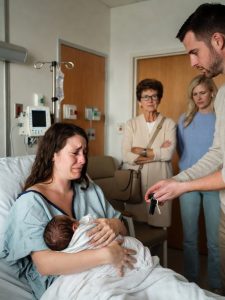
I had stitches, a fever, a stained gown, trembling hands, and my newborn son asleep on my chest. And yet, the first thing Diego, my husband, did was check his cell phone as if the birth of our baby were just another notification.
The nurse hadn’t even finished explaining the postpartum care to me when he dropped that line.
For a second, I thought I had misheard him.
“What did you say?” I asked, my voice breaking.
His mother, Doña Teresa, adjusted her designer bag on her arm and sighed as if I were ruining the mood.
“Oh, Mariana, don’t start with your drama. You’ll be discharged tomorrow. The bus passes right outside, and there’s the subway too. You’re not the first woman to have a child.”
Sofia, Diego’s sister, let out a little giggle while applying lipstick in front of the window.
“Besides, my mom made this reservation weeks ago. We’re not canceling just because the lady is ‘a little tired.’”
I looked at Diego, waiting for him to laugh, to say it was all a cruel joke, to come over and take my hand.
But he just shrugged.
“My parents came all the way from Guadalajara. They deserve a good dinner. You’ll be fine here.”
My son made a tiny sound, as if he, too, felt the coldness in that room.
“Diego,” I said slowly, “are you leaving me alone in the hospital?”
He leaned toward me with that fake smile he used in front of others.
“Don’t make that face. You should be grateful my family accepted you, considering… everything you are.”
Considering everything I was.
To them, I was a quiet accountant with no important family, no heavy last name, and nothing to brag about. A simple woman who had been lucky enough to marry Diego Robles.
That was what I had let them believe.
Doña Teresa opened the diaper bag I had prepared so carefully and wrinkled her nose.
“What cheap things. We’ll buy the boy something decent later… if he really turned out to be a Robles.”
I felt something break inside me.
It wasn’t sadness.
It was clarity.
Diego kissed the baby’s forehead like someone posing for a photo, grabbed the keys to the car that I had paid for, and headed for the door.
“Don’t keep calling. We’re going to celebrate.”
The door closed.
I cried for three minutes.
Then, I picked up my phone.
I had two contacts that Diego had never bothered to ask about.
My lawyer.
And my father’s private office.
I called the lawyer first.
“Mariana,” Licenciado Salcedo answered. “Has the baby been born?”
“Yes,” I whispered. “And Diego just abandoned us at the hospital.”
There was a silence.
Then his voice changed.
“Do we proceed?”
I looked at my son’s tiny hand curled around my finger.
“Yes. Freeze everything.”
Two hours later, while Diego and his family were posting photos of themselves toasting with expensive cuts of meat, my phone began to vibrate.
It was him.
When I answered, his voice was shaking.
“Mariana… what did you do? Everything is gone.”
And I still couldn’t believe what was about to happen next…

PART 2
I held the phone away from my ear for a moment and looked at my son. His breath was a whisper of warmth against my hospital gown. He had no idea that his father was crumbling on the other end of the line, that the world outside this sterile room was already burning.
“Mariana, are you there? I said everything is gone. The accounts are frozen. The cards don’t work. The restaurant manager is looking at us like we’re criminals. What did you do?”
I pulled the thin blanket higher over my chest and let the silence stretch until I heard Diego’s ragged breathing turn into a plea.
“I thought you were just an accountant.”
“I am an accountant,” I said, my voice finally steady. “I’m just a very good one. And I kept a separate ledger for your family. Want to know what I found?”
He didn’t answer, so I told him.
“Your car? It’s in my name. The loan on your parents’ condo in Guadalajara? My father’s bank holds the paper, and I just called the note. That restaurant you’re sitting in, ordering the forty-ounce tomahawk steaks and the Clase Azul reposado? The majority stake in the Polanco location was purchased six months ago by a holding company called Valhalla Ventures. I named it that because I knew one day I’d need a place for fallen gods. I own that restaurant, Diego. The manager is on my payroll, and he’s about to present your mother with a bill she can’t pay, in front of everyone she wanted to impress.”
I heard muffled shouting in the background. Doña Teresa’s voice rose above the ambient music of the hotpot restaurant, that unmistakable shrillness she used to berate waitstaff. Then I heard my mother-in-law gasp as a male voice cut through the chaos.
“Mrs. Robles, I’m going to have to ask you to lower your voice. This establishment has a zero-tolerance policy for harassment of staff. Additionally, the transaction on all three of your cards has been declined. I’ll need an alternative form of payment immediately, or I’ll be forced to involve the authorities.”
Sofia’s whine followed. “This is ridiculous! My father is a notary. Do you know who we are?”
The manager’s response was calm and practiced. I knew because I had written his script myself three weeks ago, sitting in my nursery, rubbing my belly while the baby kicked.
“I know exactly who you are, miss. The question is whether you know who you’re dealing with.”
I pressed the phone tighter to my ear. “Diego, are you listening?”
“Mariana, please. My mother is going to have a heart attack. The police are outside. How could you do this? We have a son.”
I laughed, and it felt like the first genuine laugh I’d had in three years. It pulled at my stitches and hurt like hell, but I didn’t stop.
“Do we? You told me to take the bus, Diego. Bus number seventeen, I think. You left your wife and your newborn baby in a hospital room with thirteen stitches between her legs and a lactation consultant who hadn’t even shown up yet. But you’re right. We should talk about our son.”
I paused to look down at Mateo. His tiny fingers were curled into a fist against my collarbone. He had my father’s nose and my mother’s mouth. He had absolutely nothing of Diego.
“His full name is Mateo Arturo Del Valle. Notice the surname.”
Silence. Then a sound like a chair scraping against marble.
“Del Valle? That’s not my name. We agreed on Mateo Diego Robles.”
“No, you agreed. You named him while I was pushing, while I was hemorrhaging, while your mother was telling the anesthesiologist that natural birth was ‘the least I could do’ after ‘trapping’ her son. I never agreed to anything. And legally, the birth certificate reads Del Valle. My name. My father’s name. The name you never bothered to ask about.”
“Who the hell is your father?”
I smiled, even though he couldn’t see it. “Arturo Del Valle. You might have heard of him. He owns Del Valle Financial Group, Del Valle Real Estate, and a little thing called the Mexican Central Credit Bureau. The car you drove tonight? The loan originated with his bank. Your family’s entire financial existence? Backed by paper that traces back to his signature. When I married you, I told you I was an orphan. I said my father had died in a car accident and left me nothing. You believed me because I was plain, and quiet, and grateful. That was the first lie. The second was that I needed you.”
The hospital door opened a crack, and a nurse peeked in with a worried expression. I covered the receiver and whispered, “I’m fine. Family drama.” She nodded and retreated. New mothers sobbing on phones were apparently not uncommon.
Diego’s voice had gone dangerously low. “If you’re lying to me…”
“Open your banking app. Check the balance. Then ask your mother to check hers. Ask your sister to check the account that funds her little Instagram boutique. She has three hundred thousand pesos in debt she hasn’t disclosed. I consolidated it. Now I’ve called it. Do the math, Diego. It’s what I do.”
There was a crash in the background, and I could picture it perfectly: Doña Teresa overturning a serving tray, Sofia filming the chaos for stories, Diego’s father trying to bluster past the manager only to be blocked by a security guard I’d hired from a private firm. Polanco restaurants don’t usually have armed security. This one did tonight.
“Mariana, let’s be reasonable. I’ll come back to the hospital. I’ll fix this. We can talk.”
“No, you won’t. The hospital has been notified. You, your mother, your sister, and your father are all on a prohibited visitors list. Security has your photos. If you step foot on this floor, you’ll be arrested for trespassing. And if you try to take Mateo, the abduction alert will go out before you reach the elevator. I’ve already filed an emergency custody motion, citing abandonment. The judge is a friend of my father’s. He was at our wedding, actually. You wouldn’t remember him. He was the man in the gray suit you ignored.”
I could hear the exact moment Diego’s world collapsed. It wasn’t a scream or a sob. It was a terrible, hollow exhale, the sound of a man realizing that every pillar he had stood on was made of glass, and I had just thrown a stone.
“You planned this,” he whispered. “You were waiting for me to mess up.”
“No,” I said, and for a moment my voice wavered. “I was waiting for you to be a husband. Six hours, Diego. You had six hours. If you had stayed, if you had told your mother no, if you had held my hand instead of your car keys, none of this would be happening. I would have let you live your comfortable little life forever. But you left your son. And my father didn’t raise a woman who allows a man to walk out on his child without consequences.”
Mateo stirred and made a soft, rooting sound. I adjusted him, and the movement sent a sharp pain through my abdomen. I bit down on my lip and tasted copper.
“This isn’t over,” Diego said, and his tone shifted from desperate to ugly. “I have rights. A father has rights.”
I closed my eyes. This was the moment I had rehearsed in the mirror for nine months, the line I had promised myself I would deliver with ice in my veins.
“You’re not his father, Diego.”
Silence so complete I could hear the hum of the hospital machinery.
“You’re sterile.”
PART 3
The word hung in the air between us like a grenade with the pin pulled.
“What did you say?”
“I said you’re sterile. Zero sperm count. Azoospermia. You never went to that urologist appointment I booked for you two years ago because you were ‘too busy’ playing golf in Valle de Bravo. So I had your labs run from the blood sample you gave during your executive physical. My father’s medical division processed it. The results have been in my safety deposit box ever since.”
“You’re lying. You’re lying just to hurt me.”
“I rarely lie anymore, Diego. It’s exhausting. The truth is so much sharper. I found out six months into our marriage, when we’d been trying for a year and nothing happened. I went to a specialist, had every test, and was told I was perfectly fertile. So I started looking at you. And I found the lab error from your college years that your mother paid to have sealed. Mumps. Orchitis. It left you incapable of fathering a child. Your mother has known for over a decade. She’s the one who suggested we ‘stop preventing and let God decide.’ She knew it would never happen, and she planned to blame me for the infertility.”
I heard Sofia in the distance screaming something about her followers, and Doña Teresa’s wail piercing through the noise. Diego said nothing. I pressed on.
“Mateo was conceived through an anonymous donor. A brilliant, kind medical student who wanted to help people like me. I chose him, I paid for the procedure, and I did it alone while you were on a business trip in Monterrey with your mistress. Yes, I know about Valeria. I’ve known for a year. You leave your location sharing on, Diego. You always have. An accountant notices things.”
I let him absorb that before delivering the final blow.
“Legally, you have no claim to Mateo. The donor contract was signed before his birth. The birth certificate reflects the correct father information—deliberately left blank in the paternity field, with a court order attached confirming no legal parental relationship with you. I filed it this afternoon while you were choosing a parking spot. The judge signed it thirty minutes before you walked out that door. It’s over.”
The call went dead for a few seconds. I thought he had hung up. Then his voice returned, barely a rasp.
“Why? Why did you marry me if you knew what I was?”
“Because I thought I could love you enough to make you a good man. Because I was stupid, and lonely, and my mother died when I was twenty-two, and my father was distant grief. You looked at me like I mattered, for a little while. But love doesn’t fix rot, Diego. It just gets infected by it.”
The restaurant noise suddenly swelled—a door slamming, a police radio crackling, Doña Teresa’s voice rising in a final, theatrical scream. The manager must have called the authorities after all. I heard Diego stammer something to an officer, then the line cut.
I set the phone on the bedside table and let the tears come, not from grief but from an overwhelming release. Mateo blinked up at me with dark, serious eyes, and I traced the line of his cheek with one finger.
“We’re going to be fine,” I whispered. “You and me, and Grandpa Arturo, and a whole army of people who actually show up.”
Thirty minutes later, my nurse knocked again, this time holding a tablet with a video call connected. My father’s face filled the screen, silver-haired and stern, with the softness around his eyes that he reserved only for me.
“Mari, are you all right?”
“I’m sore, Daddy. But I’m free.”
“The car is downstairs. The hospital agreed to release you tomorrow morning under our security detail. I have a private nurse waiting at the penthouse, and the nursery has been ready for two weeks. Is my grandson healthy?”
I tilted the screen so he could see Mateo’s sleeping face.
“Ten fingers, ten toes, and a very strong set of lungs.”
Arturo Del Valle blinked rapidly, and I realized my father, who had negotiated billion-peso deals without flinching, was crying.
“He looks like your mother,” he said.
“He does.”
“Then he’s perfect.”
The next morning, I dressed in a soft linen outfit my assistant had brought from my real wardrobe—the one Diego had never seen, with labels from European designers he couldn’t pronounce. A nurse wheeled me to a private exit where a black Escalade waited, flanked by two SUVS and a team of security personnel. The hospital had been paid a generous donation to ensure absolute discretion, and the few reporters who had caught wind of the Robles family’s spectacular implosion were camped outside the restaurant, not the maternity ward.
As the car pulled away from the curb, I caught a glimpse of a city bus lumbering past, its digital sign flashing the route number. Bus seventeen. I smiled and closed my eyes.
At the penthouse, a suite on the twenty-eighth floor of a glass tower overlooking Chapultepec Park, my father’s housekeeper had prepared a light breakfast and set out fresh flowers. My personal attorney, Licenciado Salcedo, arrived at ten o’clock sharp with a leather briefcase and a quiet, satisfied expression.
“The accounts are fully frozen,” he said, spreading documents across the dining table. “The house in Lomas? It’s in your name only, as per the prenuptial agreement you insisted upon. I’ve initiated eviction proceedings against the entire Robles family. Given the circumstances—abandonment of a postpartum spouse, financial fraud, and the paternity findings—we have a very strong case for expedited removal. Diego’s sister’s boutique has been seized by the tax authority. His mother’s charity foundation is under investigation for embezzlement. And his father’s notary commission has been suspended pending a review.”
I nodded slowly, bouncing Mateo in my arms. “What about Diego himself?”
“He was arrested at the restaurant last night on charges of theft related to the vehicle. It’s in your name. He had no legal right to take it. He was released on bail early this morning, but that’s only the beginning. We have a civil suit for emotional distress and fraud ready. And the media has the story. Every outlet in the city is running some version of ‘Millionaire Heiress Abandoned After Birth; Husband’s Family Exposed.’”
I had expected satisfaction, but what I felt was quieter—a deep, settling calm, like the last piece of a puzzle clicking into place.
“What about the donor?” I asked. “Is his identity secure?”
“Absolutely. The contract is ironclad. He’s a third-year resident at a hospital in the United States. No connection to Mexico, no desire for parental rights. But if you ever want to meet him, the option exists.”
I looked at Mateo, who was starting to root again. “Maybe someday. For now, all he needs is me.”
Later that day, as the sun turned Chapultepec Park into a wash of gold and green, my phone buzzed with an unknown number. I almost ignored it, but something compelled me to answer.
It was Sofia.
Her voice was stripped of its usual sneer, hollow and desperate.
“Mariana, please. My mom is in the hospital. Her blood pressure. My dad is talking about going to the press with all kinds of lies. Diego hasn’t stopped drinking since they let him out. Our accounts are frozen, our credit cards are dead, and the landlord changed the locks on the boutique. I have nothing. I can’t even pay for a cab.”
I let the silence hang for a beat. “I remember you telling me I wasn’t the first woman to have a child. That I should be ‘grateful.’ Do you remember that, Sofia?”
“I was an idiot. We all were. Please, just help my mom.”
“Your mother raised you to treat people like they were disposable. She planned for years to blame me for a condition her son had, to humiliate me publicly. And you helped. You stood in that hospital room and put on lipstick while your brother walked out on his family. So no, Sofia. I’m not going to unlock those accounts. But I will pay for your mother’s medical care, anonymously, because I’m not a monster. That’s the last check I ever write that benefits your family.”
I hung up before she could respond.
Two weeks later, the eviction of Diego’s family from the Lomas house made the national news. Video showed Doña Teresa being escorted from the property by federal agents, her designer bags piled on the sidewalk. Diego was nowhere to be seen; reports said he had fled to Guadalajara, where his relatives had refused to take him in after learning he had been cut off. Sofia’s Instagram account disappeared overnight. Their family name, once a fixture in society columns, became a punchline.
And me? I held a private naming ceremony for Mateo in my father’s garden, surrounded by people who had loved me without condition. I hired a night nurse to let me sleep. I started working again, not as a quiet accountant but as the newly appointed CFO of Del Valle Holdings. The board approved my appointment unanimously, and my first act was to acquire the majority stake in the hospital where my son was born.
I also kept something from that final confrontation. When Diego had called, his voice trembling, I recorded the entire conversation. I played it for Mateo once, when he was a week old, and promised him I would never let anyone make him feel like an afterthought.
Three months later, I received a handwritten letter delivered by courier. It was postmarked from a small town in Veracruz, where Diego had apparently found work at a fishing cooperative. The envelope contained a single sheet of paper and a photograph of him holding a fish, sunburned and thinner, with a look of shattered pride.
The letter read: “I was wrong. I know that now. Can I see him? Even once.”
I burned the letter over the kitchen sink and let the ashes drift into the morning light. Then I picked up my son, who was beginning to laugh, and we went to the window to watch the city wake up.
“No, Diego,” I said to the empty room. “You can’t.”
Some mistakes, you don’t get to fix. Some people, you lose forever. And some women, you never really knew at all.
EPILOGUE
Five years later
Mateo Arturo Del Valle was a hurricane in a tiny suit. He had my eyes and my mother’s smile, and he ran through the offices of Del Valle Holdings as if he owned the place—which, technically, one day he would.
I watched him charm my executive assistant into giving him a second cookie and marveled, not for the first time, at the strange mercy of fate. If Diego had been a different man, I might have stayed in that cramped house in Lomas with a mother-in-law who measured my worth in brand names. Instead, I sat in a corner office overlooking the city, my net worth ten times what it had been, my reputation untouchable.
The Robles family had faded into obscurity. Diego had tried, twice, to petition for visitation rights, but both cases were dismissed with prejudice. His mother had passed away a year ago from a stroke, and I had sent a modest flower arrangement without a card. Sofia, I heard, was selling real estate in Cancún under a different name. The world spins on, and people who do not adapt get left in its wake.
Today, however, was special. As I packed my briefcase, my assistant informed me that a young man was in the lobby, asking for five minutes of my time. He had no appointment, but his name had paused my hand over my calendar: Dr. Ethan Webb, the anonymous donor who had made Mateo possible.
I had kept tabs on Ethan over the years—a brilliant pediatric resident now completing a fellowship in neonatal medicine. He had never reached out before, honoring the contract. But something in the timing, perhaps Mateo’s fifth birthday approaching, had prompted him to fly to Mexico City.
I agreed to see him in the private garden downstairs. When he walked in, I saw immediately where Mateo got his serious dark eyes and that particular tilt of his head. Ethan was tall, gentle-spoken, with a quiet warmth that put me instantly at ease.
“I’m sorry to intrude,” he said, twisting his hands together. “I never intended to disrupt your life. I just… I made a promise to myself that when the child turned five, I’d offer medical history updates and maybe a conversation. Only if you wanted.”
I studied him for a long moment, then did something that surprised us both. I opened my phone and showed him a photo of Mateo holding up a painting he’d made that morning, a wild splash of green and blue.
“That’s him,” I said. “That’s your biological son.”
Ethan’s eyes filled with tears, and he let out a laugh that was half a sob. “He’s beautiful. He looks like my mother. She passed when I was in med school.”
“I’m sorry.”
“Don’t be. She would have loved knowing a piece of her lived on.”
We talked for an hour about nothing and everything. Ethan didn’t ask to meet Mateo, and I didn’t offer—not yet. But I saw something in him that I had never seen in Diego: a decency that asked for nothing, a selflessness that expected no reward. When he left, I walked him to the elevator and shook his hand. His palm was warm and calloused from years of healing children.
“Maybe one day,” I said, “when Mateo is older, I’ll tell him the whole story. And if he wants, I’ll give him your contact information. But for now, I have to protect him.”
Ethan nodded. “I understand. I’ll wait as long as it takes. Thank you, Mrs. Del Valle.”
“Mariana,” I corrected.
“Mariana.” He smiled. “Thank you for giving me a chance to exist in his life, even in the smallest way.”
That night, I tucked Mateo into bed and read him a story about a brave knight who defeated a dragon with nothing but kindness. When I turned out the light, he asked, “Mamá, will I ever meet my papá?”
The question hit me like a freight train, but I had been preparing for it since the day he was born.
“Your papá is a very good man who helped Mamá bring you into the world,” I said carefully. “One day, when you’re ready, we’ll talk about him. But for now, you have me, and Grandpa Arturo, and a whole universe of people who love you. Is that enough?”
Mateo considered this with the gravity of a five-year-old philosopher. “Do I have a dragon?”
I laughed, the sound bright in the quiet room. “No, mi amor. No dragons. Just a lot of people who will always, always show up.”
He snuggled deeper into his pillow and was asleep within minutes. I stood by his bed for a long time, watching the rise and fall of his chest, the flutter of his eyelashes as he dreamed.
The world had tried to break me in a hospital room, with stitches and fever and the coldness of a man who had never really seen me. But I had built something from the ashes, something strong and true.
I was not the bus-riding girl they had dismissed. I was Mariana Del Valle, and I had everything I had ever needed—because I had finally learned to need no one who wouldn’t stay.
Two years later, a small article appeared in the business section: Del Valle Holdings Foundation Partners with Pediatric Hospital in Mérida. The lead donor was listed as Ethan Webb, MD, in honor of his mother. Mariana Del Valle, CEO, said in a statement, “Sometimes the family we choose comes to us through unexpected doors.”
No one connected the dots, but somewhere in Guadalajara, a man whose name no longer appeared in any society pages read the article and wept into his glass. He thought of a cold hospital room, a son who didn’t carry his name, and a wife who had once loved him enough to hide her power just to give him the chance to be a decent man.
He had missed that chance. And that, perhaps, was the heaviest justice of all.
THE END