When I brought my daughter home from the ER, my mother had already thrown all our belongings outside.
“Pay her rent or get out!” she screamed, demanding $2,000. I refused.
My father slapped me so hard I hit the ground, bleeding—right in front of my child. He sneered, “Maybe now you’ll obey.”
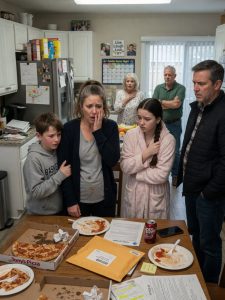
They thought that would break me. They had no idea what I was about to do next.
The blood reached the kitchen tile before my mind caught up to the fact that my father had actually hit me.
It tasted like copper and salt. Ruby’s scream ricocheted off the cabinet doors, thin and terrified, while the fluorescent bulb above the dining table flickered once, as if even the house had flinched.
“Mom!”
I pushed one palm against the floor and tried to sit up without letting her see how badly my cheek was shaking. My jaw burned. My lip had split somewhere near the corner, and the hospital bracelet from St. Matthew’s Regional ER still hung loose around Ruby’s small wrist.
Twelve years old, pale from severe anemia, discharged only an hour earlier with instructions to rest, hydrate, and return if she fainted again.
Instead, she was standing in my parents’ kitchen watching her grandfather loom over me like violence was a family rule.
My mother did not bend down. She did not gasp. She did not even reach for a towel.
She stood beside the counter with her arms crossed, her sweater sleeve pulled neatly over one wrist, irritation carved into her face like my bleeding had created an inconvenience she had not budgeted for.
“Maybe now you’ll listen,” my father muttered.
At the dining table, Paige barely looked away from the takeout containers spread across the lace runner. The same sesame noodles and orange chicken I had paid for two nights earlier sat open under the lights, filling the room with stale soy sauce, grease, and the sour heat of reheated entitlement.
She was wearing my robe.
“Oh my God, Evelyn,” she sighed, twirling noodles around her fork. “It’s rent. Stop acting like a victim.”
Rent.
Not mine.
Hers.
Three months at Brighton Oaks. One overdue Discover card balance my mother kept calling a temporary setback. Paige’s missed car payment from March. And the apartment lease they had quietly pushed into my name after using my Social Security number like a spare house key.
Some families do not confuse kindness with weakness. Families like mine build entire budgets around it.
Ruby clutched her bandaged arm and stared at the blood on my chin. Her oversized hoodie swallowed her shoulders, and under that hard kitchen light, she looked younger than twelve. Smaller. Like the ER had sent home a child and my family had turned her straight into a witness.
Nobody said a word.
My uncle stared into his drink.
Paige kept eating.
My mother adjusted her sweater sleeve and looked toward the stove as if eye contact might make her responsible.
A paper napkin drifted off the counter and landed beside the red smear on the tile.
Nobody moved.
For one ugly heartbeat, I imagined grabbing the ceramic serving bowl off the table and throwing it directly at my father’s face. I imagined Paige finally dropping the fork. I imagined my mother’s mouth closing for the first honest time in years.
I did not do it.
Quiet rage is not forgiveness. Sometimes it is just a mother counting exits.
“This is our house,” my father snapped, pointing toward the front door.
I almost laughed.
Because no.
It wasn’t.
But I had learned a long time ago that people who steal from you listen hardest when they think you are still afraid.
For years, I had been the disposable daughter. The divorced one. The single mother. The one expected to cover emergencies, smooth over insults, pay the bill, take the blame, and call it love because blood was supposed to mean something.
I had trusted my mother with Ruby’s school pickup list. I had given Paige my old car for just a few weeks after her transmission died. I had let my father keep copies of my tax documents in his file cabinet back when I still believed parents protected the paperwork their children handed them.
That was the trust signal.
They weaponized every inch of it.
On October 14 at 9:42 p.m., the first notice from Huntington Credit Services arrived with my name on an apartment I had never rented.
Three days later, I requested the lease file.
Paige’s signature was not the problem.
My forged signature was.
That was the night I stopped begging my family to love me correctly and started documenting instead.
Every Wells Fargo transfer. Every Venmo request. Every voicemail where my mother said family helped family. Every text where Paige wrote, “Just cover it this once.” Every utility statement attached to Brighton Oaks. Every rent ledger. Every copy of the forged lease.
Not a misunderstanding. Not a rough patch. A system.
By the time Ruby collapsed at school, I had already filed a notarized fraud complaint with Jefferson County Civil Court. I had already copied the Brighton Oaks apartment agreement. I had already put the Discover statement, the March car-payment notice, and the bank records into a thick manila envelope.
And I had already secured the one document they did not know existed.
Ruby looked at me then, her eyes glassy and wet.
“Mom,” she whispered, voice breaking, “please don’t let them hurt us again.”
Something inside me went completely still.
My father pointed to the door one more time.
“Get out.”
I rose slowly, wiped blood from my mouth with the back of my hand, and reached into my purse.
My mother finally frowned.
Paige’s fork paused halfway to her mouth.
I pulled out the manila envelope and set it on the table beside the takeout I had paid for. The county seal showed through the top page, clean and dark against the paper.
My father stared at it.
Then I slid out the property deed.
The kitchen changed shape.
My mother’s face lost its color. Paige stopped chewing. My uncle’s glass touched the table with a soft, guilty click.
My father’s confidence drained out of him the second he saw his name was not the one that mattered anymore.
And then someone started pounding on the front door.
Three hard knocks.
Ruby grabbed my sleeve.
I looked at my father, still standing over the blood he had put on the floor, and smiled.
The first thing I saw when the door opened was a Jefferson County deputy’s badge catching the porch light.
The second thing I saw was the woman standing behind him with a folder pressed to her chest.
My mother made a small sound, almost a laugh, like she thought authority still belonged to whoever spoke first. “There’s been a misunderstanding,” she said, already smoothing her voice into the version she used at church.
The deputy looked past her, saw the blood on my mouth, saw Ruby’s hospital bracelet, saw my father’s hand still half-raised like he had forgotten to lower the evidence. His expression changed without moving much.
“Ma’am,” he said to me, “are you Evelyn?”
I nodded.
The woman behind him stepped forward. She was not police. She wore a navy coat, sensible shoes, and a Brighton Oaks Leasing Office ID badge clipped crookedly near her collar.
That was the new thing none of them had expected.
She held up a second folder.
“Evelyn,” she said quietly, “we reviewed the lease file after your fraud complaint. There is a second signature page.”
Paige’s face emptied.
My mother whispered, “Paige?”
But Paige was staring at the folder like it had grown teeth.
The deputy stepped inside, slow and careful, his eyes moving from the deed to the blood to Ruby’s shaking hands. My father started to speak, but the deputy lifted one palm.
“Sir, I need you to step away from her.”
For the first time in my life, my father obeyed someone smaller than his ego.
The leasing officer opened the folder, and one loose page slid forward just enough for my mother to see the initials at the bottom.
They were not mine.
They were hers.
My mother’s knees actually softened.

The blood was still drying on my chin when my mother’s knees gave way.
She didn’t fall—not exactly. She just sagged, one hand catching the edge of the counter while the other pressed flat against her chest like she’d been shot. Her mouth opened, closed, opened again. For the first time in my life, my mother had nothing prepared.
The leasing officer from Brighton Oaks held the folder open, patient as a librarian. Her sensible shoes were planted on the welcome mat my mother had bought at HomeGoods two years ago—the one that said Bless This Home in looping script. The irony was so thick I could taste it behind the copper still flooding my mouth.
“Mrs. Hartwell,” the officer said, tilting the page toward my mother’s frozen face, “these are your initials, correct? Right here, beneath the tenant signature line?”
My mother’s lips moved soundlessly. She looked at Paige. Then at my father. Then at the deputy, whose hand had drifted to his belt in that casual way officers do when they’re counting the exits and the threats and the potential weapons in a room.
“I don’t—I never—” My mother’s voice cracked. “That’s not what it looks like.”
“It looks like a witnessed signature on a fraudulent lease,” the officer said calmly. “A lease filed under Evelyn Hartwell’s name, Social Security number, and credit history. A lease, I should add, that is now four months delinquent and has triggered a formal eviction filing with the county. Against Ms. Hartwell.” She nodded toward me. “The woman whose Social Security number you used.”
Paige’s fork clattered into her takeout container. Orange grease splashed onto the lace runner, staining the white thread with a slow, ugly bloom.
“Wait,” Paige said, her voice climbing. “Wait, wait, wait. Mom? You initialed it?”
My father’s head swiveled between them like a man watching a tennis match where the ball had caught fire. His hand—the one that had split my lip ten minutes ago—hung limp at his side now, forgotten.
“She told me it was just a co-sign!” my mother burst out, pointing a trembling finger at Paige. “She said Evelyn had agreed to help! She said she just needed a signature because Evelyn was working late and couldn’t come to the leasing office. I was helping. I was being a good mother!”
The leasing officer closed the folder gently. “Mrs. Hartwell, the signature you witnessed was not Evelyn Hartwell’s. It was forged. And your initials on the witness line mean you attested, under penalty of perjury, that you personally saw Evelyn Hartwell sign that document. Which you did not. That’s not helping. That’s fraud.”
The deputy shifted his weight. His shoes made a soft sound on the tile—the same tile where my blood had pooled into a thin, sticky crescent. He hadn’t taken his eyes off my father since the moment he’d walked through the door, and I realized with a strange, dislocated calm that he’d seen the slap. He’d seen the aftermath. He’d seen Ruby’s hospital bracelet and my swollen mouth and the way my father had been standing over me like a man who believed ownership extended to flesh and bone.
“Sir,” the deputy said quietly, “I’m going to ask you to step outside with me.”
My father didn’t move.
His face had gone the color of old oatmeal. The arrogance that had propped him up for seventy-two years—the sneer, the pointing finger, the maybe now you’ll obey—had drained out of him so completely that he looked like a stranger wearing my father’s clothes.
“I didn’t do anything,” he said. “She’s my daughter. I was disciplining her. That’s not a crime.”
The deputy’s expression didn’t change. “Sir, I observed you strike an adult woman hard enough to draw blood. That’s battery. I’m not asking you again.”
My uncle set down his glass with that soft, guilty click I’d heard earlier—only now he was staring at the floor, at the blood, at the napkin no one had picked up, and I could see the calculation happening behind his eyes. He was deciding how to distance himself. How to make sure whatever happened next didn’t stick to his shoes.
Paige was crying now, the ugly kind, the kind that came with snot and mascara and hiccuping breaths. “I didn’t know Mom initialed it!” she kept saying, as if that made her innocent. As if forging my signature on a lease she’d pushed into my name was somehow less criminal because her mother had helped her get away with it. “I was going to pay it back! I was going to fix it! Evelyn, you know I was going to fix it!”
I looked at her.
I looked at her sitting at my mother’s dining table, wearing my robe, eating food I’d purchased with money I’d earned at a job I’d kept while raising a child alone while they drained my bank account and stole my identity and called it family helps family.
“You weren’t going to fix anything, Paige,” I said. My voice came out steadier than I expected—low and clear, the way a judge reads a verdict. “You’ve never fixed anything in your life. You just keep breaking things and handing me the bill.”
Paige’s mouth opened, but no sound came out.
The deputy had my father by the arm now, guiding him toward the front door. My father went stiff-legged for a moment—that reflexive resistance of a man who’d never been touched by authority in a way that counted—but the deputy was calm and immovable, and my father was seventy-two years old, and the math of that equation had only ever worked when the people he pushed around were too beaten down to push back.
At the threshold, my father twisted his head around to look at me.
“You’ll regret this,” he said, and his voice was hoarse with something that might have been rage or fear or the first cold touch of accountability. “You’ll regret humiliating this family.”
I met his eyes. “This family humiliated itself the moment you raised your hand to me in front of my daughter. You just didn’t think anyone else would be watching.”
He had nothing for that.
The screen door banged shut behind him, and through the window I watched the deputy walk him to the cruiser parked at the curb. The streetlights had come on while we were inside, spilling orange pools across the asphalt. Neighbors I’d grown up with—Mrs. Delgado from three houses down, the Peterson twins who used to babysit me—stood frozen on their porches, watching the show. My father’s face was illuminated in the cruiser’s interior lights when the deputy opened the back door: pale, disbelieving, the face of a man who’d spent his whole life believing consequences were for other people.
Paige was still crying. My mother was still frozen against the counter. My uncle had inched backward until his shoulder blades touched the dining room wall, as if proximity to any of us might be contagious.
The leasing officer cleared her throat.
“Ms. Hartwell,” she said, and I realized with a start that she was looking at me, not my mother. “I realize this is an extraordinarily difficult moment, but I want you to know that Brighton Oaks has flagged the lease as fraudulent. You will not be held financially responsible for the delinquency, and the eviction proceedings will be refiled against Paige Hartwell as the occupant. We’ve also filed our own report with the county prosecutor’s office regarding the forged signature.”
“The witness initials too?” I asked.
She nodded. “Everything’s been forwarded.”
My mother made a sound—a thin, high keen like a wounded animal. “You can’t,” she whispered. “I’ll lose my job. I work at a bank, they’ll never—Evelyn, please, you can’t let them prosecute me.”
I turned to face her fully, and something shifted in my chest—something heavy and locked that had been rusted shut for years, cracking open.
“You watched him hit me,” I said. “You stood right there, and you watched him split my lip, and you didn’t move. You didn’t get a towel. You didn’t tell him to stop. You didn’t even look at Ruby. And now you want me to protect you.”
My mother’s face crumpled. “I didn’t know he was going to hit you.”
“You never know,” I said. “That’s the point. You arrange your ignorance like furniture so you never have to see the mess.”
Ruby tugged at my sleeve. She’d been so quiet during all of it—too quiet, the way kids get when they’ve learned that noise is dangerous—and when I looked down, her eyes were huge and wet but not broken. There was something new there. Something hard and bright, like a match flaring in a dark room.
“Mom,” she said, “can we go home now?”
Home.
The word landed differently than it used to.
I reached into my purse again—the same purse I’d pulled the manila envelope from, the same purse where I’d been carrying evidence and property deeds and the carefully documented wreckage of my family’s fraud—and I pulled out a key ring with a single silver key.
“We don’t live here anymore, baby,” I said, loud enough for everyone to hear. “We haven’t for a while.”
My mother’s head jerked up.
Paige stopped crying mid-sob.
My uncle finally—finally—looked me in the eye.
“What do you mean you don’t live here?” my mother demanded. “You’ve been staying in the guest room for six months. You and Ruby both.”
“No,” I said. “We’ve been staying here one night a week so Ruby could see her cousins and you could pretend we were a family. The rest of the time, we’ve been living in a two-bedroom off Carmine Street I’ve been renting for eight months. The lease is in my name. My real name. The one nobody forged.”
Silence.
It pressed against the windows. It filled the space between the takeout containers and the blood on the floor and my mother’s trembling lips. It swallowed the kitchen whole.
“But you said you were working late,” my mother whispered. “You said Ruby had after-school activities.”
“I said a lot of things,” I replied. “So did you. Turns out words are easy.”
I took Ruby’s hand—the one without the hospital bracelet—and started toward the door. The leasing officer stepped aside to let us pass, and I paused just long enough to catch her eye.
“Thank you,” I said quietly. “For coming in person.”
“It’s my job,” she said. But her expression was soft. “Good luck, Ms. Hartwell.”
Paige stumbled up from the table, my robe dragging on the floor behind her. “Evelyn, wait. You can’t just leave. What about Dad? What about the—the house, the—who’s going to pay the mortgage on this place?”
I stopped in the doorway.
The evening air was cool and clean, carrying the smell of cut grass and distant rain. The cruiser was still parked at the curb, my father’s silhouette barely visible through the tinted window. The neighbors were still watching. Mrs. Delgado lifted one hand in a hesitant wave, and I lifted mine back.
Then I turned to face my sister.
“That’s the other thing,” I said. “The mortgage on this house.”
My mother stiffened.
“Six years ago, when Dad lost his job and the bank was about to foreclose, someone stepped in and bought the note. Paid off the remaining balance. Saved the house. Remember that?”
My mother nodded slowly. “That was a—a family friend. Someone from church. They asked to remain anonymous.”
“No,” I said. “That was me.”
The words hung in the air like a bell that had been struck and was still vibrating.
“I was thirty-one years old,” I continued. “Single mother. Working seventy hours a week between two jobs. I liquidated my retirement account. I sold my car and bought a used Civic. I borrowed against a life insurance policy Grandma left me. And I bought the note on this house, and I paid it off, and I let you believe it was a miracle from God because I knew—I knew—that if you found out it was me, you’d find a way to take more. You’d see it not as a gift but as a debt you were owed.”
My mother’s face had gone waxen. “You bought the house?”
“I own the house,” I corrected. “I’ve owned it for six years. The property deed is in my name. I never told you because I wanted to see how you’d treat me when you thought I had nothing left to give. And you treated me like an ATM. You forged my signature on a lease. You demanded rent while living under a roof I provided. And tonight, my father hit me in the face in front of my child, and you watched, and you did nothing.”
I pulled the deed back out of the envelope—the crisp, official paper with the county seal and my name printed in black ink: Evelyn Marie Hartwell, sole owner.
“So no,” I said, sliding it back into my purse. “I won’t be paying rent. Not on this house. Not on Paige’s apartment. Not on the credit card balance or the car payment or any of the other messes you’ve made. I’m done cleaning up after people who can’t even be bothered to hand me a napkin when I’m bleeding.”
Paige’s voice was barely a whisper. “You can’t evict us.”
“I can,” I said. “And I will. You’ve got thirty days. I’d start packing.”
My mother took one stumbling step forward. “Evelyn, I’m your mother.”
“I know,” I said. “I’ve been paying for it my whole life.”
Ruby squeezed my hand.
We walked down the porch steps together—past the planter boxes my mother had never let me touch, past the gardenia bush that had bloomed every summer of my childhood, past the mailbox where I’d found my first credit card statement at eighteen and discovered my father had already opened an account in my name.
At the curb, the deputy was closing the cruiser door. He saw me coming and paused.
“Ma’am,” he said, “we’ll need a statement from you at the station. Your father’s being booked on battery charges. Given what the leasing officer told me about the fraud, there may be additional charges. You okay to come in tonight?”
I looked at Ruby. She was exhausted—the bone-deep weariness that came after adrenaline faded and the body remembered it was sick. The hospital bracelet was still loose around her wrist, and she was shivering a little in her oversized hoodie.
“Tomorrow,” I said. “She needs to rest. She was in the ER today.”
The deputy followed my gaze to Ruby’s bracelet, to her pale face, to the bandaged arm she was still clutching against her chest. Something flickered in his eyes—the same thing I’d seen when he first noticed the blood on my mouth.
“Tomorrow’s fine,” he said. “Take care of your little girl.”
I nodded my thanks and led Ruby to my car—the used Civic I’d bought after selling the one I’d liquidated my retirement for. It was parked around the corner, out of sight of the house, because I’d learned a long time ago not to leave anything I valued where my family could see it.
We drove in silence for a while. The streets were quiet, the kind of residential quiet that settled over neighborhoods after dinner and before the late news. Ruby leaned her head against the window, watching the houses pass.
“Mom?” she said eventually.
“Yeah, baby.”
“Was Grandma always like that?”
I thought about it. The question deserved an honest answer, not the sanitized version I’d been telling myself for decades.
“I think so,” I said. “I think I just didn’t want to see it. When you love people, sometimes you edit out the worst parts so you can keep loving them. But there’s a point where the editing costs too much.”
Ruby was quiet for another block.
“Are you going to be okay?” she asked. “Without them?”
The question hit me right behind the ribs—not because it was painful, but because it was such a grown-up thing for a twelve-year-old to ask. She’d spent the evening watching her mother be hit and bleeding and betrayed, and she was worrying about me.
I pulled the car into the parking lot of our apartment building and turned off the engine. The building wasn’t fancy—no gardenia bushes, no lace runners, no HomeGoods welcome mats—but the lights were on in the windows, and there was a pot of yellow marigolds on our tiny balcony that I’d planted myself.
I turned in my seat to face her.
“Ruby, I’ve been okay for a long time,” I said. “I just didn’t know it until I stopped waiting for them to treat me like I mattered. Tonight was horrible. Your grandfather hit me, and that’s something I’ll carry for a while, and I’m sorry you had to see it. But the rest of it? The house, the fraud, the years of taking and taking and never giving back? That part is over. That part ended the moment I stopped believing their version of the story.”
Ruby’s chin wobbled, just a little. “You’re really brave, Mom.”
I reached over and tucked a strand of hair behind her ear. “No, baby. I’m just tired. And sometimes being tired enough looks like brave.”
She smiled—a small, wobbly smile, but real.
We went inside. I made her hot chocolate with extra marshmallows and sat with her on the couch until she fell asleep, her head in my lap, her hospital bracelet catching the light from the TV. I didn’t move for an hour. Maybe longer. I just sat there, running my fingers through her hair, feeling the weight of everything that had happened settling into my bones.
The blood on my chin had dried. The swelling on my jaw was beginning to stiffen. Tomorrow I’d have a bruise, and I’d have to explain it to the deputy at the station, and I’d have to file the eviction papers, and I’d have to face the fact that my father was in a holding cell and my mother might be next.
But tonight, Ruby was safe. Tonight, we were in our own apartment, behind a door locked with a key only I possessed. Tonight, the house I owned but had never truly been welcome in was full of people who were finally, finally facing the bill for everything they’d taken.
My phone buzzed on the coffee table.
A text from an unknown number: You’ll regret this. I promise you, you will regret this.
I stared at it for a long moment. The number wasn’t saved, but I recognized it anyway. My father must have used his one phone call.
I typed back slowly: No. I won’t.
Then I blocked the number, set the phone facedown, and let Ruby’s slow, steady breathing pull me toward something I hadn’t felt in years.
Peace.
Three weeks later, I stood in a courtroom with a folder of evidence and a very patient attorney named Priya who specialized in elder fraud cases—though, as she’d noted dryly, my family had been stealing from me since I was old enough to have a Social Security number, so the “elder” part was more about them than me.
Paige had taken a plea deal: probation, restitution, and a permanent note on her credit report that would follow her long after the robes and the takeout containers were forgotten. My mother, facing fraud charges related to the witnessed signature, had been sentenced to community service and mandatory financial counseling. The judge had been lenient, citing her age and lack of prior offenses, but the bank where she worked had not been. She’d been terminated within a week of the charges becoming public.
My father’s case was more complicated. The battery charge had been straightforward—my split lip and Ruby’s witness statement had seen to that—but the identity theft that had started when I was eighteen had unspooled into something much larger. Multiple credit cards. A personal loan. An auto lease from 2014 that I hadn’t even known about until Priya’s investigator dug it up. He was facing real time, and for the first time in my life, I didn’t feel guilty about it.
The house on Gardenia Lane sold in April. I’d considered keeping it—considered renting it out, or moving back in, or letting it sit empty as a monument to everything I’d survived. But in the end, I’d walked through the empty rooms one last time, seen the faint stain on the kitchen tile where my blood had been scrubbed away, and decided I didn’t want to own a museum of my own pain.
I used the sale money to start a college fund for Ruby and to make a donation to a legal aid clinic that helped victims of familial fraud. The rest I tucked into a high-yield savings account that no one else had access to.
Ruby turned thirteen in May. We celebrated with a small party at our apartment—just her friends from school, a cake I’d baked myself, and a card that said You are the bravest person I know in my handwriting. She’d read it, hugged me, and tucked it into her bedside drawer with the kind of care kids reserve for things they plan to keep forever.
And somewhere in the middle of all that ordinary, extraordinary life—the school drop-offs and the doctor’s appointments and the mornings when I woke up and forgot, for one blissful second, what my father’s hand had felt like—I realized I wasn’t waiting anymore.
I wasn’t waiting for an apology.
I wasn’t waiting for them to love me correctly.
I wasn’t waiting for the family I’d been born into to become the family I deserved.
I’d built my own.
On a quiet evening in late spring, Ruby and I sat on our tiny balcony, surrounded by marigolds and the distant sound of traffic, and she asked me if I missed them.
I thought about it.
“No,” I said honestly. “I miss the idea of them. I miss the version I made up in my head. But the real version?” I shook my head. “The real version hit me in front of you. The real version stole from me. The real version never deserved either of us.”
Ruby nodded slowly, the way she did when she was processing something too big for words.
“Good,” she said finally. “I don’t miss them either.”
And just like that, the last chain broke.
I don’t know where my parents are now. I don’t know if Paige ever paid back the restitution or if she found someone else to clean up her messes. I don’t know if my uncle ever stopped drinking or if he ever told anyone what he’d seen that night in the kitchen.
What I know is this:
I am thirty-seven years old. I have a daughter who is healthy and safe and learning, slowly, what it means to be loved without conditions. I have an apartment with a balcony and marigolds that come back every year. I have a job I’m good at and friends who showed up when I finally stopped hiding the truth about where I came from.
And I have the deep, quiet certainty that the people who were supposed to protect me never did—but I became someone who could protect myself.
Some families are built on blood.
Mine is built on survival.
And survival, as it turns out, is a much sturdier foundation.