I WATCHED MY HUSBAND STEAL OUR NEWBORN SON AND GIVE HIM TO HIS MISTRESS — BUT HE DIDN’T KNOW I HAD ALREADY SWITCHED THEM BACK
The elevator doors closed on Nathan Caldwell’s smile.
That calm, polished, beautiful smile I had once trusted more than my own heartbeat.
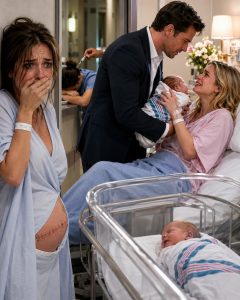
For seven years, that smile had greeted me across breakfast tables, charity galas, family holidays, and quiet nights when he came home smelling faintly of expensive cologne and lies I had not yet learned to name.
Now it disappeared behind brushed steel doors while he carried another woman’s dying child in his arms, believing he had stolen mine.
I stood there in the hospital corridor with one hand pressed against my fresh C-section incision and the other curled around the handle of my son’s bassinet.
My real son.
The one with the tiny crescent-shaped birthmark hidden beneath his left foot.
He slept as if the world had not already tried to tear him from me.
My knees shook. Blood dampened the waistband beneath my loose hospital robe. Every breath burned.
But I did not collapse.
Not yet.
The private nurse I had hired, a quiet woman named Mara with gray eyes and military posture, stepped close beside me.
“Mrs. Caldwell,” she said softly, “we need to leave before your husband realizes anything.”
I looked at the elevator.
“He won’t realize it today.”
“No,” Mara said. “But men like that always come back to check the damage.”
I turned to her then.
Mara had been recommended by an old college friend who now worked in private crisis medicine. Former ICU nurse. Former Air Force medic. Licensed in three states. Discreet enough to vanish a patient from a hospital without creating a paper trail, if the money was right.
Half a million dollars made many impossible things possible.
“Can you protect him?” I asked.
Mara looked down at my sleeping son.
“I can protect a newborn,” she said. “The question is whether you can protect yourself.”
At that moment, I did not know the answer.
I only knew that Nathan could not be allowed anywhere near my child again.
Within twenty minutes, Mara had changed my discharge paperwork, rerouted my prescriptions, and arranged for a black SUV to pull into the private medical exit below the maternity wing.
My official discharge stated that I had left for the Caldwell estate with my newborn under my husband’s supervision.
In reality, I left through the service elevator wrapped in an oversized cashmere coat, trembling with fever, holding my son against my chest.
Every step felt as though a hot blade was being dragged through my abdomen.
Mara walked beside me, carrying a medical bag in one hand and the bassinet paperwork in the other.
“Name?” she asked as we reached the underground exit.
I looked at my son.
Nathan had wanted to name him Theodore, after some long-dead Caldwell patriarch who had built railroads, ruined towns, and smiled in oil portraits like he owned God.
I had agreed because that was what I had done for seven years.
Agreed.
Smiled.
Adjusted.
Endured.
But now my baby opened his tiny mouth, searching blindly, trusting the warmth of my body.
“Leo,” I whispered.
Mara glanced at me.
“Is that official?”
“It will be.”
The SUV door opened. I climbed in slowly, teeth clenched against the pain, and settled Leo in my arms.
As the hospital disappeared behind us, I watched its glowing windows shrink in the rearview mirror.
Somewhere inside that building, security cameras had caught Nathan drugging a nurse. Somewhere inside that hospital system, bracelets had been scanned, medications logged, records altered, and footsteps recorded.
Nathan believed money had erased him.
He had forgotten I had money too.
And unlike him, I was no longer afraid to use it.
We did not go to Bel Air.
We drove east through the darkening city, past palm trees and glass towers, until Beverly Hills became downtown, downtown became freeway, and freeway became empty stretches of night.
Mara took me to a private recovery home hidden behind a high wall in Pasadena, registered under a name I had not used since before my marriage.
Olivia Hart.
Not Olivia Caldwell.
The woman who entered that house was stitched, bleeding, betrayed, and shaking.
The woman who would leave it would be someone else.
For the first twenty-four hours, survival was small.
A sip of water.
A dose of pain medication.
Leo’s soft breathing against my neck.
Mara checking my incision beneath the yellow glow of a bedside lamp.
“Your blood pressure is too high,” she said.
“I need my phone.”
“You need rest.”
“I need evidence.”
Mara’s eyes lifted.
There was no pity in them. That was why I liked her.
“What evidence do you already have?”
I swallowed.
“I saw him drug the nurse. I saw him take my son. I heard him tell Vanessa he would let me raise her dying baby.”
“Did you record it?”
The question cut deeper than my stitches.
“No.”
“Then we build from what can be proven.”
She pulled a chair beside the bed.
“Hospital security. Medication logs. Nurse toxicology report. Infant ID scans. Discharge footage. Texts. Bank transfers. Anything connecting him to Vanessa.”
I stared at the ceiling.
Nathan had always told me I was too trusting.
Maybe he was right.
But he had confused trust with weakness.
“Call Daniel Reeves,” I said.
Mara paused. “The attorney?”
“My father’s attorney.”
“Your father died six years ago.”
“And Daniel has been waiting six years for me to stop pretending my marriage was safe.”
By sunrise, Daniel Reeves arrived in a charcoal suit, carrying no briefcase, only a slim leather folder and the expression of a man who had already prepared for war.
He was in his late sixties, white-haired, precise, and terrifyingly calm. He had represented my father through three hostile acquisitions, two federal investigations, and a family trust dispute so vicious it had made the business pages for months.
When he saw me pale and half-sitting in bed with Leo sleeping beside me, his jaw tightened.
“Did he hurt you?” Daniel asked.
“Yes.”
“Physically?”
“Not with his hands.”
Daniel nodded once.
That was all.
No gasping. No outrage. No useless comfort.
He opened the folder.
“Tell me everything.”
So I did.
I told him about Nathan and Vanessa. About the syringe. About the neonatal wing. About the child with the heart defect. About the crescent birthmark. About reversing the switch.
Daniel listened without interruption.
Only once did his expression change.
When I repeated Nathan’s words.
“For you, I’d let them bury Olivia beside that dying child if I had to.”
Daniel removed his glasses and cleaned them slowly.
Then he said, “We will not begin with divorce.”
I stared at him.
“What?”
“Divorce gives him a battlefield he understands. Assets. Reputation. Lawyers. Statements. He will frame you as unstable postpartum, grieving, confused after surgery.”
My fingers curled around the sheet.
“He already has the Caldwell name.”
“Yes,” Daniel said. “And you have the Hart trust.”
The Hart trust.
My inheritance.
The thing Nathan had never fully controlled, no matter how many times Evelyn Caldwell had implied that a good wife should merge fortunes with her husband’s legacy.
My father had known men like Nathan.
That was why my inheritance had been locked behind clauses so strict even marriage could not touch it.
Daniel leaned forward.
“We begin with the hospital. Quietly. We secure footage before it disappears. We obtain the nurse’s bloodwork. We confirm infant identity through independent DNA testing. We document that your son is alive and in your custody. Then we wait for Nathan to expose himself.”
“He thinks he has my baby.”
“No,” Daniel said. “He thinks he has power. There is a difference.”
That afternoon, Nathan called me thirty-seven times.
I did not answer.
His messages began charming.
Liv, where are you? Mom said you left early. I’m worried.
Then confused.
The hospital says there was a paperwork issue. Call me immediately.
Then irritated.
This isn’t funny. You just had surgery. You’re not thinking clearly.
Then cold.
Olivia, if you are doing something dramatic, stop now. You are embarrassing yourself.
By evening, the mask cracked.
Pick up the phone.
I watched the messages appear one after another while Leo slept on my chest.
At 8:14 p.m., Vanessa called.
I let it ring.
She left no voicemail.
At 9:02 p.m., Nathan sent a photo.
It was of the infant he had taken from my room—the child he thought was Leo—lying inside a luxury bassinet beneath a pale blue blanket.
The baby looked impossibly fragile. His lips had a bluish tint. A thin line of oxygen tubing curved beneath his nose.
Nathan’s message came beneath it.
Our son is not well. Where are you?
For one brief, sharp second, grief moved through me for that child.
Not guilt.
Grief.
He had been born into a web of selfishness, fear, and obsession. He was innocent of every adult crime committed over his tiny body.
But he was not my son.
And Nathan had chosen his fate when he tried to hand that fate to me.
I typed nothing.
The next morning, the first crack appeared in Nathan’s perfect world.
Daniel called at six-thirty.
“The nurse woke up,” he said.
I sat upright too fast and hissed as pain shot through my abdomen.
“What did she say?”
“She remembers seeing Nathan at the station. She remembers him leaning over her IV line. Then nothing. Hospital administration is attempting to keep it internal.”
“Can they bury it?”
“Not anymore.”
“Why?”
“Because I sent a preservation demand to the hospital board, copied to their malpractice carrier and outside counsel, at 5:40 this morning.”
Despite everything, I almost smiled.
“What about the footage?”
“A source inside security confirms there is footage of Nathan entering the neonatal wing during restricted hours.”
“A source?”
Daniel’s voice remained dry. “Your father donated that wing.”
For the first time since the hospital hallway, I felt something other than pain.
I felt the ground return beneath my feet.
By noon, Nathan arrived at the Bel Air mansion expecting to find me.
Instead, he found Evelyn Caldwell waiting in the drawing room with a glass of white wine and a face carved from disappointment.
I know this because Evelyn called me later from her private number.
I almost ignored it.
Then I remembered something important.
Evelyn did not love me.
But Evelyn loved the Caldwell image more than she loved Nathan.
So I answered.
“Olivia,” she said, her voice clipped. “Where are you?”
“Recovering.”
“You have caused considerable confusion.”
“I gave birth two days ago. Confusion seems natural.”
“Do not be clever with me.”
I looked down at Leo. His tiny fist rested against my collarbone.
Evelyn continued, “Nathan says you left the hospital with the baby.”
“Did he?”
“He also says you’re unstable.”
“Of course he does.”
There was a pause.
Then Evelyn said, “Is the child with you?”
“My child is safe.”
Another pause.
Sharp. Calculating.
“My child,” she repeated.
I said nothing.
Evelyn’s tone changed by a fraction. “Olivia, listen to me carefully. Whatever quarrel you and Nathan are having, it must be handled privately. No police. No press. No scandal.”
“There was already a scandal, Evelyn. I simply did not create it.”
“What did he do?”
The question hung between us.
For all her cruelty, Evelyn was not stupid.
I could almost see her standing beneath the chandelier, diamonds at her throat, realizing that her son had done something ugly enough to threaten everything.
“Ask Nathan,” I said.
“He is not making sense.”
“Then perhaps he should stop lying.”
“Olivia.”
It was the first time she said my name without contempt.
I ended the call.
Three hours later, Nathan sent one message.
What did you do?
I read it twice.
Then I blocked him.
On the fourth day after Leo’s birth, my fever broke.
On the fifth, I stood without Mara’s help.
On the sixth, Daniel returned with a sealed envelope.
Inside were printed stills from the hospital security footage.
Nathan at the nurses’ station.
Nathan’s hand near the IV line.
Nathan entering neonatal care.
Nathan leaving with a newborn.
Nathan entering Vanessa Monroe’s room.
Nathan leaving later with another infant.
Each image was grainy, silent, imperfect.
Together, they were devastating.
Daniel laid another paper on the bed.
“The night nurse tested positive for a fast-acting sedative not prescribed to her. The hospital is terrified.”
“Good.”
“They want settlement discussions.”
“I don’t want money.”
“They know.”
I looked up.
Daniel’s expression was unreadable.
“What do they want?” I asked.
“To survive.”
A bitter laugh escaped me. “Don’t we all?”
Then Daniel placed the final document in front of me.
DNA results.
I froze.
Even though I already knew. Even though I had seen the crescent mark. Even though Leo’s face felt written into my bones.
My hands trembled as I opened the page.
Probability of maternity: 99.999998%.
Probability of paternity: 99.999997%.
Nathan was Leo’s father.
I closed my eyes.
Some foolish, broken part of me had hoped he was not.
Daniel saw my face.
“This complicates custody,” he said gently.
“No,” I whispered. “It clarifies the war.”
That night, I finally allowed myself to cry.
Not loudly.
Not beautifully.
There was nothing graceful about it.
I cried with one hand over my stitches and the other on Leo’s back, my body shaking so hard Mara came in and checked my blood pressure again.
Seven years of memories tore themselves apart inside me.
Nathan holding my hand in Paris.
Nathan dancing with me barefoot in our kitchen.
Nathan sleeping beside me with his arm heavy across my waist.
Nathan whispering that he wanted a family with me.
Every tender thing became evidence of his cruelty.
Because somewhere in all those years, he had looked at me and decided I could be used.
By morning, the tears were gone.
In their place was a clean, quiet rage.
Not frantic.
Not reckless.
Useful.
I called Daniel.
“I want to see Vanessa.”
“No.”
“Yes.”
“She may be cooperating with Nathan.”
“She hesitated,” I said. “In the hospital. She asked if it was too cruel.”
“That does not make her innocent.”
“I don’t need her innocent. I need her afraid.”
Daniel was silent for a moment.
Then he said, “Public place. Two exits. Mara nearby. You say nothing that can be twisted against you.”
“I know.”
“Do you?”
I looked at Leo asleep in his bassinet.
“I’m learning.”
Vanessa agreed to meet me at a private garden café in Santa Monica the next afternoon.
She arrived twenty minutes late, wearing sunglasses too large for her delicate face and a cream-colored coat that made her look softer than she was.
I had always known Vanessa was beautiful.
Nathan had described her once, years ago, before I understood that men only describe old loves when they are not old at all.
“She was fragile,” he had said. “Brilliant, but fragile.”
What he meant was that Vanessa had always made him feel powerful.
She sat across from me with both hands wrapped around a cup of untouched tea.
“You shouldn’t be out,” she said quietly. “You just had surgery.”
“And you shouldn’t have accepted a stolen baby.”
Her face went white.
Around us, silverware chimed. A waiter laughed near the entrance. Sunlight moved across the tiled floor as if the world had no interest in our ruin.
Vanessa leaned forward.
“I didn’t know what he had planned.”
“But once you knew, you held my son.”
Her mouth trembled.
“I thought—”
“You thought what?”
“That Nathan would fix it.”
I stared at her.
“He drugged a nurse and switched two newborns. Which part of that looked like fixing?”
Tears gathered in her eyes.
“I was desperate.”
“So was I.”
She flinched.
For a moment, neither of us spoke.
Then Vanessa whispered, “The baby is dying.”
The words landed softly and still struck hard.
“Your baby,” I said.
Her shoulders curled inward.
“They’re saying he needs surgery, but he’s too weak. Nathan is furious. He keeps saying the doctors are incompetent. He flew in a specialist from Boston last night.”
Of course he did.
Nathan would spend millions trying to save the child he believed was his heir.
The child he had intended for me to mourn alone.
“Does he know?” I asked.
Vanessa looked at me.
Her silence answered first.
Then she said, “Not yet.”
I felt every nerve in my body go still.
“Not yet?”
Vanessa’s hand shook around the cup.
“He ordered new genetic testing. The cardiologist asked about family history because the condition is often associated with inherited markers. Nathan didn’t want to provide his sample at first, but Evelyn insisted.”
My pulse slowed.
“When will results come back?”
“Soon.”
“How soon?”
“Tonight.”
The garden seemed to tilt.
Tonight.
Nathan Caldwell was hours away from discovering that the dying infant in his mansion was not mine.
Not his.
Not Caldwell blood.
And once he knew, there would be no version of reality in which he stayed calm.
Vanessa looked at me with wet eyes.
“I didn’t tell him about the birthmark.”
I said nothing.
“I saw you check his foot,” she whispered. “In my room. I woke up for a second. I saw you take him back.”
My fingers tightened beneath the table.
“And you said nothing.”
“I couldn’t.”
“Because you were ashamed?”
“Because I was relieved.”
The honesty was ugly.
That made it useful.
Vanessa lowered her head.
“I loved Nathan when we were young. I thought he loved me too. Then he married you because your father’s name opened doors his family couldn’t force open. He told me it was temporary. He told me you knew the marriage was practical. He told me after the baby came, everything would change.”
A cold laugh left me.
“He told us both stories.”
“Yes.”
“And you believed yours because it made you the chosen one.”
Her tears spilled.
“Yes.”
I should have hated her more in that moment.
But hatred is difficult to aim when the target is already crumbling.
Vanessa was not innocent.
She was not the mastermind either.
She was something Nathan had used to flatter himself—proof that he could leave destruction behind and still be adored.
“Listen to me carefully,” I said. “When Nathan learns the truth, he will blame you first.”
Her lips parted.
“He wouldn’t—”
“He would. He already gave your child away once.”
She looked as if I had slapped her.
Good.
Some truths needed to land like violence.
I placed Daniel’s card on the table.
“You have one chance to be smarter than I was. Give my attorney every message Nathan sent you. Every recording. Every promise. Every threat. Everything.”
Vanessa stared at the card.
“And if I don’t?”
“Then when Nathan burns, he will pull you into the fire and swear you lit the match.”
Her hand hovered over the card.
Then she took it.
As I stood, pain flashed through my body, bright enough to blur my vision.
Vanessa rose instinctively as if to help.
“Don’t,” I said.
She froze.
I walked away without looking back.
That evening, rain moved into Los Angeles.
It struck the windows of the Pasadena house in thin silver lines while Mara fed Leo from a bottle and I sat beside the bed with my phone in my lap.
At 8:43 p.m., Evelyn Caldwell called.
This time, when I answered, she did not greet me.
Her voice was low.
“What have you done?”
I looked toward the window.
“Be specific.”
“The child at the house is not Nathan’s.”
There it was.
The truth had entered the Caldwell mansion.
And from the sound of Evelyn’s voice, it had not knocked politely.
“That seems like something Nathan should explain,” I said.
“Do not play games.”
“I stopped playing games when your son stole my newborn.”
Evelyn inhaled sharply.
So Nathan had not told her everything.
How typical.
“How do you know that?” she demanded.
“I watched him.”
A silence opened.
For once, Evelyn Caldwell had nothing elegant to say.
In the background, I heard Nathan shouting. Not words. Just rage stripped of language.
Then his voice came closer.
“Give me the phone.”
Evelyn said, “Nathan, not like this—”
“Give me the damn phone.”
A second later, Nathan was breathing into my ear.
For one absurd instant, my body remembered him as husband.
Then he spoke.
“Where is he?”
No apology.
No denial.
No attempt.
Just possession.
I looked at Leo in Mara’s arms.
“Safe.”
“You think this is clever?”
“I think it’s accurate.”
“That is my son.”
“He was your son when you carried him into another woman’s room?”
His breath caught.
Then he lowered his voice into the intimate tone he used when convincing donors, judges, board members, and once, me.
“Olivia. You are emotional. You’ve been through a traumatic delivery. I understand why you’re confused.”
I almost admired the instinct.
Even now, with evidence closing around him, Nathan reached first for manipulation.
“You drugged a nurse,” I said.
A pause.
“You can’t prove that.”
“Try me.”
Another pause.
This one colder.
“You have no idea what you’re doing.”
“No,” I said. “But Daniel Reeves does.”
That name changed the air.
Nathan knew Daniel.
Everyone in our world knew Daniel Reeves.
A man like Daniel did not bark. He simply opened doors beneath your feet and let you discover gravity.
Nathan’s voice sharpened.
“You brought him into this?”
“You brought our son into this.”
“I want to see my child.”
“No.”
“You cannot keep him from me.”
“I can tonight.”
“Olivia.”
For the first time, beneath the anger, I heard panic.
It was small. Faint. Delicious.
“You listen to me,” he said. “Whatever you think happened, we can fix it privately. I’ll come get you. We’ll talk. No lawyers. No scandal.”
I closed my eyes.
There it was.
The same offer Evelyn had made.
Privacy.
The burial ground of powerful men’s crimes.
“No,” I said.
His voice dropped.
“If you try to destroy me, I will take him from you legally. I will tell every court you are unstable, vindictive, postpartum, delusional. I will bring in doctors. I will bring in your history. Do you really want the world examining you?”
For a moment, fear touched me.
Not because he was right.
Because he knew exactly where to cut.
I had a history.
A miscarriage two years earlier. Depression after. Medication. Therapy. Nights when I could not get out of bed and Nathan had held my hair while I cried.
Things he had witnessed as a husband.
Things he would weaponize as an enemy.
My voice shook once before I steadied it.
“Do you really want the world examining hospital footage?”
Silence.
Then Nathan said, very softly, “You’ll regret this.”
“No,” I said. “I already regret everything before this.”
I ended the call.
My hand trembled.
Mara watched me from across the room.
“He threatened custody,” she said.
“Yes.”
“He’ll move fast.”
“So will we.”
The next morning, the story broke without my name attached.
A prestigious Beverly Hills hospital had placed a senior nurse on leave following a “security breach” in the maternity wing.
That was all the article said.
No names.
No babies.
No sedatives.
But in our world, whispers did what headlines could not.
By noon, Nathan lost a board meeting.
By three, Caldwell Capital issued a statement denying knowledge of “private family medical matters.”
By evening, paparazzi waited outside the Bel Air gates.
Daniel did not release anything.
He didn’t need to.
He only had to let important people know that proof existed.
Proof was more dangerous than publicity.
Publicity could be managed.
Proof had teeth.
On the tenth day after Leo’s birth, Nathan filed an emergency petition for temporary custody.
Daniel expected it.
By the eleventh day, we stood in a closed courtroom in Los Angeles before a judge with silver hair and no patience for rich people behaving badly.
I wore black because it was the only color that made me feel held together.
Leo stayed with Mara in a secure room nearby.
Nathan arrived in a navy suit, clean-shaven, handsome, wounded-looking.
He had brought an attorney famous for turning villains into victims.
Vanessa was not with him.
Evelyn was.
She sat behind Nathan like a monument, pearls glowing at her throat, face unreadable.
Nathan’s attorney began with concern.
My client is a devastated father. My client has been denied access to his newborn. My client fears for his child’s safety due to Mrs. Caldwell’s erratic behavior following a difficult birth.
Then came the words Nathan had promised.
Postpartum instability.
Emotional distress.
History of depression.
Possible paranoia.
I listened.
My hands stayed folded.
Daniel let them speak for twenty-three minutes.
Then he stood.
He did not raise his voice.
He did not need to.
“Your Honor,” he said, “before this court entertains Mr. Caldwell’s request, we ask that it review three pieces of evidence under seal.”
Nathan turned his head slowly.
Daniel submitted the hospital stills.
The toxicology report.
The DNA report proving the infant Nathan had removed from the hospital and taken into private care was not biologically related to either Caldwell parent.
The courtroom changed temperature.
Nathan’s attorney stopped writing.
The judge looked at the first image.
Then the second.
Then the third.
Her face revealed nothing, but her silence became immense.
Finally, she looked at Nathan.
“Mr. Caldwell, did you remove an infant from the neonatal wing without authorization?”
Nathan’s attorney rose. “Your Honor, my client—”
“I asked Mr. Caldwell.”
Nathan’s jaw tightened.
“Everything I did was for my child.”
Daniel turned slightly.
“Which child?”
The question landed like a blade between them.
Nathan looked at me.
Not with love.
Not even hatred.
With disbelief.
As if I had violated some natural law by surviving him.
The judge granted me temporary sole physical custody.
Nathan was allowed no visitation pending investigation.
The hospital was ordered to preserve all records.
A guardian ad litem was appointed for Leo.
And Nathan Caldwell walked out of court without his son, without control, and without the story he had planned to tell.
For the first time since I had known him, cameras caught him looking afraid.
That night, I held Leo in the nursery Mara had helped me create in the Pasadena house.
It was nothing like the nursery at the Bel Air mansion.
No imported wallpaper.
No antique silver rattles.
No monogrammed blankets chosen by Evelyn.
Just a crib, a rocking chair, a soft lamp, and my son breathing peacefully against my chest.
“You won the first round,” Mara said from the doorway.
“No,” I replied. “I survived it.”
She nodded.
“Survival is underrated.”
I looked down at Leo’s face.
His lashes rested like fine dark brushstrokes against his cheeks. His mouth moved in tiny dreams.
“I don’t want him growing up in courtrooms,” I whispered.
“Then make sure Nathan can’t drag him there forever.”
That became the next objective.
Not revenge for its own sake.
Freedom.
Clean, permanent, documented freedom.
Vanessa delivered sooner than expected.
Three days after the hearing, she gave Daniel everything.
Texts from Nathan going back eighteen months.
I should have married you first.
Olivia’s pregnancy changes nothing.
Once the baby is born, I’ll handle it.
No one will question a grieving mother.
That message made Daniel go still.
No one will question a grieving mother.
There are sentences that do not merely reveal intent.
They reveal design.
Then came audio.
Vanessa had recorded Nathan two days before delivery, panicked because doctors had told her the baby’s heart defect was worse than expected.
His voice filled Daniel’s office speaker.
“I told you I’d fix it.”
“How can you fix this?”
“Olivia’s child is due any day. Same hospital. Same floor. Same doctor group. It’s perfect.”
“Nathan, no.”
“You want our family or not?”
“Our baby needs medical care, not—”
“Our baby needs a future. I can give him one. Olivia will raise yours, and when he dies, she’ll mourn. She’s good at mourning.”
The recording ended.
I sat very still.
Daniel turned it off.
No one spoke.
I thought of my miscarriage. Of Nathan holding me while I wept. Of him remembering my grief not as pain but as a tool.
That was the moment I stopped thinking of Nathan as someone who had betrayed me.
Betrayal implied there had once been truth.
Nathan had only ever been arranging rooms inside a house of lies.
The criminal investigation began quietly.
Then not quietly.
A detective came to take my statement.
The hospital suspended two administrators.
The nurse Nathan had drugged hired her own attorney.
Caldwell Capital’s investors began asking questions.
Evelyn stopped calling me.
Nathan did not.
Since he could no longer reach my phone, he sent letters through lawyers.
Cold letters.
Then pleading ones.
Then furious ones.
One was handwritten.
Liv,
You know me. You know I would never intentionally hurt you. Vanessa was unstable. She manipulated the situation. I panicked. I made a mistake. Don’t let outsiders destroy what we built. Let me see Leo. He needs his father.
N.
I read it once.
Then I placed it in an evidence folder.
Nathan always believed emotion erased facts.
It had worked on me for seven years.
It would not work on paper.
Two weeks after the hearing, the sick infant died.
His name was Adrian Monroe.
Vanessa called me herself.
I did not know what to say when I answered.
For a long moment, there was only her breathing.
Then she whispered, “He’s gone.”
I closed my eyes.
I saw him again in the hospital bassinet, small and pale beneath blue blankets, born into a story no child should have carried.
“I’m sorry,” I said.
And I was.
Not for taking Leo back.
Never for that.
But for the life Adrian had been given by adults who loved badly, selfishly, desperately, or not at all.
Vanessa cried quietly.
“Nathan didn’t come,” she said.
My eyes opened.
“What?”
“He said he couldn’t be photographed at the hospice. He said it would complicate the case.”
There was nothing surprising left in Nathan.
Only confirmations.
Vanessa’s voice broke.
“I thought when Adrian died, I would hate you. But I don’t. I hate that I ever believed him.”
I said nothing.
She continued, “There’s something else.”
My body went still.
“What?”
“Nathan came to my apartment last night. He was angry. Not just angry. Different. He said everyone had turned against him. He said if he couldn’t have his son, no one would.”
My hand tightened around the phone.
“Did he threaten Leo?”
“He didn’t say his name. But yes.”
“Did you record it?”
A pause.
“Yes.”
Within an hour, Daniel had the recording.
Within two, the court had it.
Within four, Nathan’s temporary visitation request was not only denied, but a protective order was granted.
By morning, Nathan Caldwell was ordered to surrender all firearms registered in his name and stay five hundred yards away from me, Leo, and the Pasadena recovery house.
Men like Nathan do not interpret boundaries as law.
They interpret them as insult.
That was why Mara doubled the security.
That was why Daniel hired a former federal investigator named Elise Ward to map Nathan’s movements.
And that was why, when a white delivery van appeared outside the Pasadena house three nights later and remained parked for eighteen minutes with its lights off, nobody ignored it.
Elise ran the plates.
Fake.
Mara moved me and Leo into the interior room.
Security called the police.
The van left before officers arrived.
But the next morning, a small envelope was found tucked beneath the front gate.
Inside was a single photograph.
Me, standing by the nursery window with Leo in my arms.
Taken from outside.
On the back, in Nathan’s handwriting, were six words.
You cannot hide my blood forever.
I stared at the photograph until the edges blurred.
Mara took it gently from my hand.
“We need to move you.”
“I’m tired of running.”
“This is not running. This is positioning.”
Daniel agreed.
That night, I left Pasadena in a decoy car while Leo was carried through the service entrance by Mara and placed into a medical transport vehicle under another name.
We moved to a coastal house north of Santa Barbara owned by the Hart trust, a place Nathan had never visited because I had never told him it existed.
It sat above black cliffs and restless water, surrounded by cypress trees bent by wind.
My father had bought it before I was born.
My mother had hated it.
I had loved it.
As a child, I thought the ocean there sounded like something ancient guarding the shore.
For the first time since Leo’s birth, I slept three full hours.
In the morning, sunlight spilled across the bedroom floor. Leo yawned in his bassinet. The sea moved beyond the windows, enormous and indifferent.
I almost believed we were safe.
Almost.
Then Daniel called.
His voice was grave.
“Nathan disappeared last night.”
I sat up slowly.
“What do you mean disappeared?”
“His attorney claims he checked into a private treatment facility for exhaustion. He is not there.”
“Where is Evelyn?”
“Refusing calls.”
“What about his passport?”
“Still active. We’re working on it.”
A cold certainty moved through me.
“He’s coming.”
“We don’t know that.”
“I do.”
The next forty-eight hours passed with strange quiet.
No calls.
No messages.
No sightings.
No Nathan.
But silence from a man like him was never peace.
It was distance before impact.
On the third night, a storm rolled in from the Pacific.
Wind shook the windows. Rain slashed against the glass. The power flickered twice before the backup generator hummed to life.
Mara checked the locks.
Elise monitored the cameras.
I sat in the nursery rocking Leo, telling myself the storm was only weather.
At 2:17 a.m., the security system went dark.
The lamp beside the crib flickered once.
Then blackness swallowed the room.
Leo startled and began to cry.
I stood too quickly, pain still pulling beneath my scar even weeks later.
“Mara?” I called.
No answer.
The ocean roared below the cliffs.
Then I heard it.
A sound from downstairs.
Glass breaking.
My blood turned to ice.
I lifted Leo from the crib and held him against my chest, one hand over his head.
From the hallway came Mara’s voice, low and urgent.
“Olivia. Safe room. Now.”
I stepped into the hall.
Emergency lights glowed red along the floor.
Mara stood near the stairs with a gun in both hands, face calm as carved stone.
Then a voice rose from below.
“Olivia.”
Nathan.
Not shouting.
Not raging.
Almost tender.
As if he had come home late and expected forgiveness waiting in the dark.
“Don’t make this worse,” he called.
Mara pushed me toward the concealed panel at the end of the hall.
“Move.”
I ran as well as I could, Leo crying against me.
Behind us, footsteps thundered on the stairs.
Mara shouted, “Stop where you are!”
Nathan laughed.
It was a broken sound.
Then came a crash.
A struggle.
A gunshot.
The world split open.
I screamed Mara’s name, but my hand had already found the hidden latch.
The safe room door opened.
I stumbled inside with Leo.
As the door sealed, I saw Nathan at the far end of the hallway.
His hair was wet from rain.
Blood ran from his temple.
His eyes locked on Leo.
For one second, he looked nothing like the man I had married.
He looked like a stranger wearing his face.
Then the safe room door closed between us.
Inside, Leo screamed.
I sank to the floor, clutching him, my own breath coming in torn pieces.
The monitor screens inside the room flickered on.
Camera one: empty kitchen, rain blowing through shattered glass.
Camera two: front hall, broken vase, muddy footprints.
Camera three: upstairs hallway.
Mara was on the floor.
She moved.
Thank God.
Then Nathan entered the frame.
He stood outside the safe room door.
He looked directly at the hidden camera.
And smiled.
Not victorious this time.
Not charming.
Something worse.
Certain.
He lifted his phone and placed it against the door.
A second later, the safe room intercom crackled.
His voice filled the small steel chamber.
“Liv,” he said softly. “Open the door.”
I held Leo tighter.
Nathan exhaled, almost sadly.
“You still don’t understand. This was never about Vanessa. It was never about the baby.”
My heart pounded so hard I could barely hear.
He leaned closer to the camera.
His next words were quiet.
“The Hart trust unlocks when your firstborn son reaches thirty days old.”
My blood went cold.
Thirty days.
My father’s trust.
A clause I had never read closely because I had never imagined my husband had.
Nathan smiled through the screen.
“Happy almost-birthday to our little key.”
Behind him, Mara dragged herself toward the wall, leaving a dark streak on the floor.
Nathan did not see her.
But I did.
And then, from the corner of the monitor, another figure stepped into the hallway behind him.
Evelyn Caldwell.
Soaked in rain.
Holding a gun.