PART 2 – The Papers He Never Signed
The elevator doors opened into the lobby, and for one terrible second, nobody moved.
Emma lay on the stretcher between two paramedics, her face pale beneath the harsh gold light of the chandelier. One hand clutched mine. The other rested protectively over her swollen belly, as if she could shield our unborn son with nothing but trembling fingers and willpower.
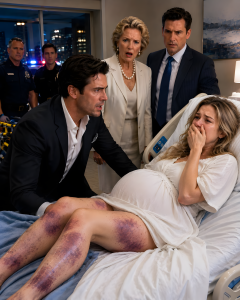
Across the marble floor stood my mother.
Margaret Bennett looked exactly as she always did—pearls at her throat, silver hair pinned neatly, lipstick perfect, posture straight enough to shame a soldier. Beside her stood my cousin Nathan, holding a thick leather folder against his chest like a priest carrying scripture.
Neither of them looked surprised to see the ambulance.
That was what stopped my heart.
They had known.
“Lucas,” my mother said, taking one step forward. “Thank God. We were so worried.”
Emma’s grip tightened until her nails cut into my palm.
I looked at Nathan’s folder.
“What is that?”
Nathan gave a small, polished smile. He had been smiling that way since childhood, whenever he knew something other people didn’t.
“Documents,” he said. “Nothing that needs to be handled in the middle of a medical emergency.”
“Then why are they in your hand?”
My mother sighed. “Lucas, please. Your wife needs care.”
“My wife needed care six days ago.”
Her eyes flicked to Emma.
A small movement.
Cold.
Assessing.
“Emma refused,” she said.
Emma shook her head weakly. “That’s not true.”
Nathan stepped forward. “This is not the time for accusations.”
I turned on him. “Open the folder.”
“Lucas—”
“Open it.”
The paramedic beside me shifted uneasily. “Sir, we need to transport her.”
I didn’t look away from Nathan. “We will. But first he opens that folder.”
My mother’s mouth tightened. “You’re making a scene.”
I almost laughed.
A scene.
My pregnant wife was covered in bruises, terrified of a hospital, afraid I had signed away our child, and my mother was worried about appearances.
Nathan looked around the lobby at the doorman, the paramedics, the night security guard. Then he lowered his voice.
“You don’t want to do this publicly.”
That sentence told me everything.
I released Emma’s hand just long enough to walk toward him.
Nathan’s smile weakened.
“Lucas,” he warned.
I snatched the folder from his hand.
My mother gasped. “Enough!”
But I had already opened it.
The first page was titled:
Emergency Maternal Incapacity and Infant Guardianship Agreement.
My vision narrowed.
Below the title were lines of legal text, dense and sterile. Words like medical instability, prenatal risk, temporary guardianship, best interests of the child.
Then I saw the signature.
Lucas Alexander Bennett.
My name.
My handwriting.
Or something close enough to make my blood turn cold.
The witness line was signed by Nathan.
The notary stamp belonged to a firm my company used.
The guardian listed was Margaret Bennett.
I looked up slowly.
“What did you do?”
Nathan lifted both hands. “You signed that during the March board retreat.”
“No, I didn’t.”
“You were under stress. There were several documents that day.”
“I know what I sign.”
“Apparently not.”
The words were soft.
Insulting.
Designed to make me doubt myself.
I had heard that tone from him before, usually directed at employees he wanted removed without leaving fingerprints.
My mother stepped beside him. “Lucas, this was protection. Nothing more. Emma has been unstable for months.”
Emma made a small sound from the stretcher.
I turned.
Her eyes were wide with horror.
“There it is,” she whispered. “That’s what they kept saying.”
“What?”
“That I was unstable.”
My mother leaned toward the paramedic. “She has been paranoid, refusing appointments, accusing staff of harming her.”
The paramedic frowned. “Ma’am, we need to get her to the hospital.”
“Of course,” my mother said smoothly. “I’ll ride with her.”
“No,” Emma cried.
The sound tore through the lobby.
I moved back to her immediately.
“No one rides with her but me,” I said.
Nathan closed the folder in my hands with deliberate calm. “Lucas, you need to think carefully. If you interfere with medically necessary decisions, it could support the concerns already documented.”
I stared at him.
“Are you threatening me?”
“I’m advising you.”
“You’re threatening me while my wife is on a stretcher.”
My mother’s voice sharpened. “We are trying to save your son.”
“Our son,” Emma whispered.
Margaret ignored her.
Something inside me hardened.
I handed the folder to the younger paramedic. “Keep this with you. Do not give it to them.”
Nathan reached for it. “That contains privileged material.”
I caught his wrist.
For the first time in my life, Nathan looked afraid of me.
“Touch it,” I said quietly, “and I’ll break your hand.”
My mother inhaled sharply. “Lucas.”
I leaned close to Nathan. “And if I find out you forged my name, a broken hand will be the smallest thing you lose.”
The paramedics moved.
I climbed into the ambulance beside Emma. As the doors closed, my mother stood on the curb beneath the canopy, still as a statue. Nathan was already on his phone.
That frightened me more than if he had shouted.
Because Nathan never panicked.
He prepared.
Inside the ambulance, Emma began shaking.
I took her hand again. “I’m here.”
Her lips trembled. “You didn’t sign?”
“No.”
“They told me you did.”
“Who?”
She closed her eyes. Tears slipped down her temples into her hair.
“The nurse. Your mother. Nathan. They said you were tired of dealing with me. They said you only cared about the baby.”
My chest constricted.
“They said if I made trouble, they would show the doctors proof I was unstable. They said they would sedate me if they had to.”
The paramedic looked up sharply.
“What nurse?” I asked.
“Claudia.”
My mother’s private nurse.
The one she insisted was “a gift” while I traveled.
I remembered Emma resisting at first. I remembered my mother laughing softly and saying, “Don’t be proud, dear. Good mothers accept help.”
Good mothers.
God.
I had been blind.
The paramedic checked Emma’s blood pressure and frowned.
“What?” I asked.
“We’re going to move quickly.”
Emma grabbed my sleeve. “Lucas, the baby.”
I looked down at her belly.
Our son had been a promise before he was a person. We had seen him on the ultrasound months ago, one tiny hand raised as if waving. Emma had cried. I had pretended not to, badly.
“He’s coming home with us,” I said.
But even as I said it, I looked through the ambulance window at Nathan’s folder and understood something worse than fear.
This was not a family disagreement.
This was a legal machine already in motion.
And someone had built it while I was sleeping beside the woman it was meant to crush.
At Northwestern Memorial, the emergency entrance swallowed us in light.
Doctors and nurses surrounded Emma. Questions came fast.
How long had she been swollen?
Had she fallen?
Was she taking medication?
Who had been monitoring her pregnancy?
Emma tried to answer, but pain twisted her face.
I answered what I could.
Then one doctor, a woman with black hair pulled into a bun and serious eyes, looked at me.
“Mr. Bennett, we need to examine your wife privately.”
“No,” Emma said immediately.
Her terror returned full force.
The doctor softened. “Emma, my name is Dr. Priya Shah. I’m here to help you and your baby. But I need to ask some questions where you can answer freely.”
Emma looked at me.
I understood.
She wasn’t afraid of the doctor.
She was afraid of being alone.
I leaned down. “I’ll stand right outside the door. I won’t leave.”
“You promise?”
“I promise.”
Her eyes searched mine, looking for the man who had missed everything and finding, maybe, the man trying to come back.
She nodded.
I stepped outside.
The door closed.
For five minutes, I stood in the hallway staring at nothing while my mind tore itself apart.
Then my phone rang.
My mother.
I declined.
It rang again.
I declined again.
A text appeared.
You are emotional. Do not make decisions you cannot undo.
Another followed.
Nathan is speaking with hospital counsel.
A third:
Emma’s condition is unfortunate, but your child must be protected.
I typed one response.
From you.
Then I blocked her number.
Ten seconds later, Nathan called.
I blocked him too.
A nurse approached. “Mr. Bennett?”
“Yes?”
“There’s an attorney asking for access to your wife’s medical information.”
“Nathan Bennett?”
She nodded.
“Deny it.”
“He claims to hold authorization.”
“He doesn’t.”
“We’ll need—”
“He does not have my consent, and he does not have hers. Put a privacy restriction on her chart. Now.”
The nurse studied me for half a second, then nodded. “I’ll alert security.”
For the first time that night, I felt the smallest edge of control return.
Then Dr. Shah opened the door.
Her face took it away.
“Mr. Bennett,” she said, “your wife has significant edema and bruising. There are signs of compression injuries around the ankles. She also has an infection developing in one leg. We’re running more tests, but she should have been seen days ago.”
“My mother’s nurse said bed rest would fix it.”
Dr. Shah’s eyes hardened. “Bed rest does not create bruising around the ankles.”
I swallowed.
“What does?”
She didn’t answer directly.
“That’s something we’ll document carefully.”
“Is the baby okay?”
“For now, there is a heartbeat. But Emma is under serious physical stress.”
For now.
Those two words nearly dropped me.
“I need to see her.”
Dr. Shah nodded. “She wants you.”
Emma was propped against pillows, exhausted and damp with sweat. A monitor rested around her belly. The rapid rhythm of our son’s heartbeat filled the room like a tiny galloping horse.
I had never heard anything more beautiful.
Or more fragile.
Emma watched me approach.
“They believed me,” she whispered.
I sat beside her. “Of course they did.”
“No.” Her eyes filled. “Not of course.”
I lowered my head.
She was right.
Nothing was of course anymore.
“I’m sorry,” I said.
She looked away.
I deserved that.
“I thought you were tired,” I continued. “I thought you were scared of the pregnancy. I thought my mother was irritating you, not hurting you. I should have seen it.”
Emma’s voice was almost empty. “I tried to tell you.”
I closed my eyes.
“You did.”
“You said your mother was just difficult.”
“I know.”
“You said Nathan was harmless.”
“I know.”
“You said I was letting stress get to me.”
The words were not shouted. That made them worse.
“I know.”
Her hand moved over her stomach.
“The first time Claudia tied my ankles, she said it was to reduce swelling.”
My head snapped up.
“Tied?”
Emma nodded, tears spilling down her face. “Compression straps. That’s what she called them. She said the doctor approved it. They hurt, but she said good mothers tolerate discomfort.”
My hands curled into fists.
“When I tried to remove them, your mother told me I was endangering the baby. Nathan came with papers. He said if I refused care, they would have me evaluated.”
I stood so quickly the chair hit the wall.
Emma flinched.
I froze.
Slowly, I sat back down.
“I’m sorry,” I whispered. “I’m not angry at you.”
“I know.”
But her body didn’t know.
That was what killed me.
Love could forgive before the body learned it was safe.
The door opened before I could speak again.
A security guard stood outside.
“Mr. Bennett, there are visitors requesting access.”
My mother appeared behind him.
So did Nathan.
And Claudia.
The private nurse wore navy scrubs and a calm expression. She looked like every nurse in every medical brochure—competent, gentle, forgettable.
Until Emma saw her.
Her entire body went rigid.
“No,” she whispered.
I stepped between the door and the bed.
“They’re not coming in.”
My mother looked past me to Emma. “Sweetheart, this has gone far enough.”
I had never heard anything uglier than that word in her mouth.
Sweetheart.
Nathan held up a document. “We have a court-recognized emergency guardianship preparation and signed authorization regarding prenatal care.”
Dr. Shah appeared at the end of the hallway, summoned by some silent hospital instinct.
“This patient has requested privacy,” she said.
Nathan smiled. “Doctor, with respect, you may not understand the legal complexities.”
“With respect,” Dr. Shah replied, “you are standing in my emergency department asking to override a conscious adult patient.”
“My cousin is emotionally compromised,” Nathan said. “His wife has a documented history of instability.”
I stepped toward him. “Say that again.”
Nathan lowered his voice. “Lucas, don’t perform for the staff.”
My mother’s eyes remained on Emma.
“Emma,” she said, “tell them the truth. Tell them you haven’t been yourself.”
Emma’s face drained.
Claudia spoke for the first time.
“She’s confused. She refused meals. She hid medication. She became aggressive twice.”
“Liar,” Emma whispered.
Claudia’s eyes slid to her.
Something passed between them.
A warning.
I saw it.
So did Dr. Shah.
“Security,” Dr. Shah said, “remove them from the treatment area.”
Nathan’s smile vanished. “That would be a mistake.”
“No,” Dr. Shah said. “Allowing you near my patient would be.”
The guard moved forward.
My mother straightened, offended beyond measure. “Lucas, if you allow this, you will regret it.”
I looked at her.
“No, Mother. I think I’m just beginning to regret everything I allowed before.”
They were escorted away.
But Nathan looked back once.
Not at me.
At Claudia.
And Claudia, before disappearing around the corner, touched two fingers to her throat.
A signal.
Small.
Quick.
Practiced.
My stomach went cold.
This wasn’t just my mother’s cruelty or Nathan’s greed.
There was coordination here.
A system.
I turned to Dr. Shah. “I want security outside this door.”
“Already arranged.”
“And I want toxicology. Full panel. Anything that could make her confused, weak, compliant.”
Emma looked at me.
Dr. Shah nodded slowly. “We’ve already drawn blood.”
“Why?”
Her eyes moved to Emma.
Then back to me.
“Because your wife said the nurse gave her pills that weren’t prescribed by her obstetrician.”
The room went silent.
Emma closed her eyes.
“I thought they were vitamins,” she whispered.
I sat down before my legs failed.
The next several hours became a blur of machines, forms, whispered consultations, and growing horror.
By dawn, a hospital social worker had joined us. So had a police detective named Irene Walsh, who carried a small notebook and spoke with careful patience.
Emma gave her statement in pieces.
Claudia had arrived two months earlier. At first she was helpful. She cooked. Organized appointments. Took blood pressure readings. Then she began isolating Emma.
Calls from friends went unanswered.
Messages disappeared.
Appointments were rescheduled.
When Emma complained of dizziness, Claudia told her pregnancy hormones caused paranoia. When bruises appeared, Claudia told her swelling made the skin fragile. When Emma cried, my mother said, “This is why Lucas worries about your judgment.”
All while I traveled.
All while Nathan quietly built paperwork.
All while the household staff were reduced, replaced, reassigned, or convinced Emma wanted privacy.
My penthouse had not been a home.
It had been a controlled environment.
At six-thirty in the morning, Detective Walsh asked me to step into the hallway.
“We checked the notary on the guardianship agreement,” she said.
“And?”
“The stamp is legitimate. The signature may not be.”
“I told you I didn’t sign.”
She studied me. “Do you use an electronic signature system?”
“For business documents, yes.”
“Who has access?”
“My executive assistant. Legal department. Nathan, in some cases.”
“In some cases?”
“He manages family trust issues.”
Her pen stopped.
“Family trust?”
I exhaled. “My grandfather created a trust. Certain shares transfer when I have a legitimate heir.”
“There it is,” she said quietly.
“What?”
“The motive everyone pretended wasn’t there.”
I leaned against the wall.
Our son was not even born, and already people had turned him into property.
“What happens if your wife is declared unstable?” Detective Walsh asked.
I knew the answer.
But saying it made me sick.
“My mother could seek temporary control of the child after birth. Nathan could argue I’m too emotionally compromised to oppose it. They could pressure me through the company, the board, the trust.”
“And if something happened to Emma?”
The hallway seemed to stretch.
“Then the guardianship papers activate.”
Detective Walsh’s expression remained neutral, but her eyes sharpened. “And those papers were already prepared.”
I looked through the glass at Emma.
She was sleeping now, one hand resting on her belly.
“Yes,” I said. “They were.”
By midmorning, lab results began returning.
Dr. Shah entered with a toxicologist and Detective Walsh.
I knew from their faces it was bad.
Emma woke as they came in.
“What is it?” she asked.
Dr. Shah sat beside the bed. “Emma, we found a sedative in your system.”
Her lips parted.
“It’s not something prescribed in your medical chart.”
I gripped the bedrail.
“How long?”
“We can’t say exactly yet,” the toxicologist said. “But based on levels and her symptoms, possibly repeated dosing.”
Emma stared at the blanket.
“I’m not unstable,” she whispered.
“No,” Dr. Shah said firmly. “You were drugged.”
Emma began to cry.
Not loudly.
Just silent tears of relief and devastation.
I wanted to hold her, but I waited until she reached for me.
When she did, I took her hand with both of mine.
“I knew something was wrong,” she said. “But every time I tried to think clearly, everything got foggy.”
Detective Walsh looked at me. “We’re moving to obtain a warrant for Claudia’s room and medical bag.”
“She’s gone,” I said.
Everyone looked at me.
“I saw her signal Nathan. She won’t be at the penthouse.”
Detective Walsh was already reaching for her phone.
But she stopped when my phone buzzed.
Unknown number.
A video message.
I opened it before anyone could stop me.
The screen showed my mother sitting in the back seat of a car. Her face was composed, but her eyes were burning.
“Lucas,” she said, “you are being manipulated by a frightened little woman who never belonged in our family.”
Emma turned pale.
I put the phone on speaker.
My mother continued.
“I did what your father lacked the courage to do. I protected the Bennett name. One day, when your son is old enough to inherit what weak women and sentimental men cannot build, he will understand.”
Nathan’s voice spoke from off-camera.
“Margaret, stop.”
But she didn’t.
“If you push this further, you will not just destroy me. You will destroy the company, the trust, and every secret your father buried to leave you that throne.”
The video ended.
For several seconds, nobody spoke.
Then Detective Walsh said, “Forward that to me.”
I did.
But I was staring at one phrase.
Every secret your father buried.
My father had died ten years earlier. Heart attack at sixty-two. Sudden, clean, respectable. Just like everything in our family.
Respectable on the outside.
Rotten underneath.
I turned to Emma.
“I need to make a call.”
She looked afraid.
“Not to them?”
“No. To someone my mother hates.”
I called Arthur Vale.
Arthur had been my father’s oldest accountant and, later, the first man my mother forced out after the funeral. He was in his seventies now, retired in Evanston, and had refused my calls for years.
This time, he answered on the second ring.
“Lucas,” he said, as if he had been expecting me for a decade.
“Arthur, I need to know what my mother meant by my father’s secrets.”
Silence.
Then he said, “Is your wife safe?”
I looked at Emma.
“No.”
Arthur exhaled slowly. “Then listen carefully. Your wife is not the first woman they tried to remove from the Bennett line.”
The words landed like ice water.
“What are you talking about?”
“Your father had another son.”
The hospital room vanished around me.
“No.”
“Yes.”
“My father never—”
“Your father had a son before he married Margaret. The woman was paid off. The child disappeared from the family records. Your mother made sure of it.”
I gripped the phone.
“What does that have to do with Emma?”
“Everything. Your grandfather’s trust doesn’t only transfer through you.”
I closed my eyes.
“There’s another heir.”
“Yes.”
“And my mother knows?”
“She has spent thirty years making sure he never proves it.”
Detective Walsh stepped closer, listening.
Arthur’s voice lowered.
“Lucas, if your son is born and recognized, the trust becomes harder for her to control. But if Emma is discredited and Margaret becomes guardian, she controls the next generation. She’s been waiting for a child she could legally possess.”
I looked at Emma’s belly.
Not love.
Not legacy.
Possession.
“Who is my half-brother?” I asked.
Arthur was silent too long.
“Arthur.”
“I only know the name he used as an adult.”
“Tell me.”
“Nathan.”
My blood stopped.
Across the room, Detective Walsh went still.
I laughed once because the alternative was screaming.
“Nathan is my cousin.”
“No,” Arthur said. “Nathan is your father’s first son. Margaret brought him into the family under another branch after his mother died. She kept him close enough to use and far enough to deny.”
I turned toward the doorway, half expecting Nathan to be standing there with that thin smile.
“Does Nathan know?”
Arthur’s voice was grave.
“That is the question you should be most afraid of.”
The call ended with a promise to send documents.
But promises no longer comforted me.
I sat beside Emma and told her everything.
Her first reaction was not shock.
It was exhaustion.
“So Nathan isn’t helping your mother steal the baby,” she said.
I nodded slowly.
“He may believe the baby is stealing something from him.”
The fetal monitor kept beating.
Fast.
Innocent.
Alive.
Emma looked at me with a kind of fear I had never seen before.
“Lucas,” she whispered, “what if he doesn’t want custody?”
I understood before she finished.
What if Nathan didn’t want our son controlled?
What if he wanted him gone?
At that exact moment, the lights flickered.
Once.
Twice.
Then the room went dark.
Machines beeped in protest.
Emergency lights blinked red along the walls.
A nurse shouted in the hallway.
Dr. Shah rushed in with a flashlight. “Backup power should engage.”
It didn’t.
The fetal monitor went black.
Emma grabbed her stomach.
“Lucas.”
I leaned over her. “I’m here.”
Somewhere down the hall, someone screamed.
Detective Walsh drew her weapon.
“Stay with her,” she ordered.
The door opened.
A man in hospital maintenance clothes stepped in.
For half a second, I thought he was staff.
Then I saw the syringe in his hand.
I moved before thought.
He lunged toward Emma.
I hit him with my shoulder, driving him into the wall. The syringe clattered across the floor. Detective Walsh shouted. The man swung at me, catching my jaw. I slammed him down over the chair, and security rushed in.
As they pinned him, his cap fell off.
I knew him.
Not his name.
His face.
He had been in our penthouse two weeks ago, carrying boxes from Claudia’s car.
Detective Walsh grabbed the syringe with a gloved hand.
Dr. Shah checked Emma immediately.
“She’s okay,” she said. “Baby’s heartbeat is back.”
The backup power finally surged, bathing the room in cold light.
The man on the floor laughed.
Blood marked his teeth.
“You’re too late,” he said.
Detective Walsh crouched. “For what?”
He looked at me.
Then at Emma.
Then he smiled.
“The papers weren’t for the baby.”
My skin went cold.
“What does that mean?” I demanded.
He said nothing else.
Within minutes, the hospital was locked down. Police flooded the floor. Emma was moved to a secured maternity room with two officers outside. The syringe was taken for testing. The man refused to give his name.
But his warning stayed behind.
The papers weren’t for the baby.
I kept replaying the guardianship document in my mind. Emergency maternal incapacity. Infant guardianship. Custody if something happened to Emma.
What else could they be for?
Then Emma suddenly whispered, “Lucas.”
I turned.
She was staring at the folder the paramedic had saved.
“It said infant,” she said.
“Yes.”
“Not unborn child.”
I opened the folder again.
This time I read slower.
Every line.
Every definition.
Every word Nathan had expected me to skim.
Then I found it.
Buried on page eight.
For the purpose of this agreement, “infant” shall refer to any minor child under the care, custody, or legal dependency of Emma Claire Bennett, biological or otherwise.
My heart began to pound.
“Biological or otherwise,” I repeated.
Emma stared at me.
“I don’t understand.”
Neither did I.
Not until a nurse knocked softly and entered with an envelope.
“Mr. Bennett? This was left at the desk for you.”
Detective Walsh took it first, checked it, then handed it to me.
Inside was a birth certificate.
Old.
Folded.
Worn soft at the creases.
The mother’s name:
Emma Claire Harris.
Emma gasped. “That’s my maiden name.”
The child’s name:
Ava Rose Harris.
Date of birth:
Eleven years ago.
I looked at Emma.
All the color had left her face.
“No,” she whispered. “No, that’s impossible.”
But her hand had gone to her mouth.
As if some buried part of her remembered before her mind could.
“What is this?” I asked.
Emma shook her head, tears forming.
“I was seventeen,” she whispered. “There was an accident. I was in the hospital. They told me I lost the baby.”
The room went silent.
“You were pregnant?”
She nodded, shattered. “Before you. Before Chicago. My mother said the baby didn’t survive. I never held her. I never saw her.”
I looked at the birth certificate again.
Ava Rose Harris.
Alive long enough for a certificate.
A minor child under the care, custody, or legal dependency of Emma Claire Bennett, biological or otherwise.
The papers weren’t for our unborn son.
They were broad enough to seize any child legally tied to Emma.
Including one she thought was dead.
Detective Walsh took the certificate, her face grim.
“There’s a note,” she said.
A small folded slip had fallen from the envelope.
I opened it.
Five words.
Ask Nathan where Ava is.
Emma began sobbing.
I wrapped my arms around her carefully, afraid of hurting her, afraid of letting go.
Before I could say anything, my phone rang.
This time, the number was Nathan’s.
Detective Walsh nodded for me to answer and put it on speaker.
Nathan’s voice came through calm and smooth.
“Lucas.”
I looked at Emma.
Her eyes were locked on the phone.
“What did you do?” I asked.
Nathan sighed. “You always ask the wrong question.”
“Where is Ava?”
Silence.
Then a soft laugh.
“So Arthur finally talked.”
Emma covered her mouth.
Nathan continued. “Tell Emma not to cry too hard. Stress is bad for the baby.”
I stood, every muscle in my body shaking.
“If you hurt either of them—”
“You still think this is about hurting people,” Nathan said. “That’s your problem. You inherited the company but not the vision.”
“Where is she?”
“Close.”
The word chilled me.
“How close?”
Nathan’s voice lowered.
“Close enough that Emma has seen her and never knew.”
Emma stopped crying.
Her eyes widened.
Nathan said, “Goodnight, brother.”
The line went dead.
Brother.
The word stayed in the air like poison.
Detective Walsh called for a trace, but I already knew he was gone.
Emma grabbed my wrist.
“Lucas,” she whispered.
“What?”
Her face had gone ghost-white.
“The new girl at the bakery.”
I stared at her.
“What new girl?”
“The one Margaret hired to help with the baby shower pastries. She was young. Maybe nineteen, but she looked younger. Dark hair. A little scar under her chin.” Emma’s voice broke. “She said her name was Ava.”
The room tilted.
Detective Walsh moved toward the door.
Then my phone buzzed again.
A photo appeared from an unknown number.
It showed the unfinished nursery in our penthouse.
The crib had been assembled.
The walls had been painted pale blue.
And sitting in the rocking chair, holding one tiny knitted shoe, was a teenage girl with dark hair and a scar beneath her chin.
Beside her stood Claudia.
Behind them, reflected faintly in the nursery window, was Nathan.
A message followed.
One child for another. Bring Emma, or Ava disappears again.
Emma screamed my name.
And for the first time in my life, I understood that my family had not built an empire.
They had built a cage.