PART 2
The dispatcher’s voice was calm enough to make the chaos around me sound even more absurd.
“911, what’s your emergency?”
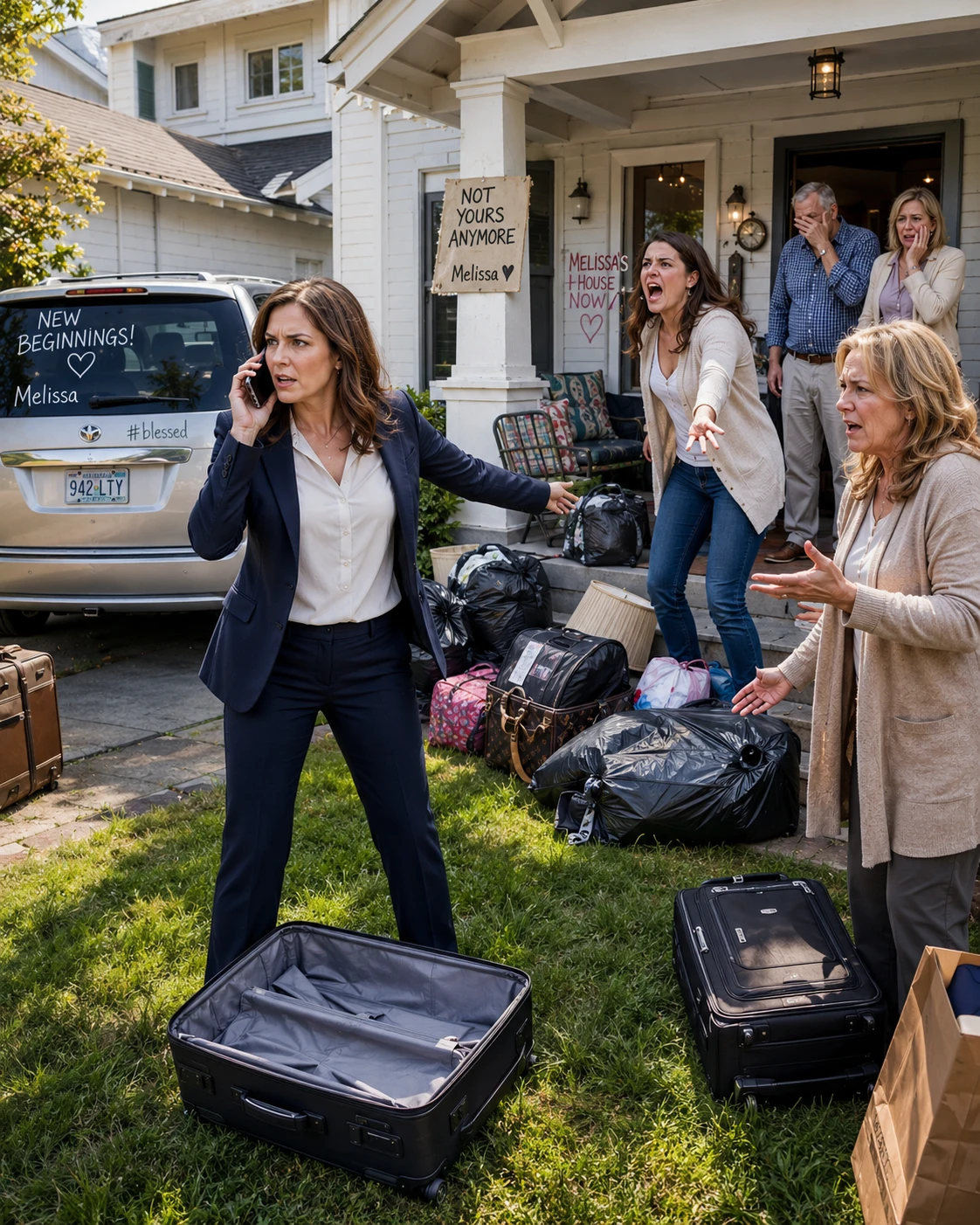
I stood in the middle of my front lawn with one of Melissa’s in-laws’ suitcases lying open at my feet, shirts spilling into the damp grass like surrender flags. My mother was on the porch, red-faced and furious. Melissa was beside her, clutching my cardigan around herself as though my clothing had become part of her legal defense.

“There are unauthorized people in my home,” I said, keeping my voice steady. “I own the property. I just returned from a business trip and found strangers living here. My belongings have been moved, and they refuse to leave.”
Melissa lunged down the porch steps. “She’s lying! It’s a family dispute!”
I turned away from her.
The dispatcher asked for my address. I gave it. She asked whether anyone was armed. I looked at Melissa’s father-in-law, who had come outside holding a paper plate of noodles and looking deeply offended.
“No weapons,” I said. “Just entitlement.”
“Amanda!” my mother snapped.
The dispatcher told me officers were on the way and advised me not to physically engage with anyone further. I thanked her, ended the call, and slid my phone into my coat pocket.
For a moment, no one moved.
Then Melissa laughed.
It was a sharp, ugly little laugh I recognized from childhood, the one she used when she believed she had already won. When she was thirteen and broke my birthday necklace, she had laughed like that before Mom told me not to be dramatic. When she borrowed my car at twenty-two and returned it with a cracked bumper, she laughed like that before Mom said insurance existed for a reason. When she announced her engagement at my promotion dinner, she laughed like that too, with one hand on her fiancé’s arm and the whole table turning toward her.
Now she stood on the porch of my home wearing my cardigan and gave me that same laugh.
“You really called the police on your own family,” she said.
“No,” I replied. “I called the police on people trespassing in my house.”
Her mother-in-law, a thin woman named Carol according to the label on one of the prescription bottles that had rolled out of her purse, pressed a hand to her chest. “We were invited.”
“Not by me.”
Melissa’s husband, Derek, emerged from the house then. He was a broad-shouldered man with a boyish face and the confused expression of someone who had finally realized he had been handed a bomb with a bow on it.
“Amanda,” he said carefully, “maybe we can talk this through.”
I looked at him. “Did you know this house was mine?”
He opened his mouth.
Nothing came out.
That silence did more damage than any confession.
Melissa spun toward him. “Derek.”
His eyes flicked to hers, then away. “I thought… I mean, your mom said Amanda helped with it.”
I laughed once. It had no humor in it. “Helped with it?”
My mother came down the steps now, palms lifted like she was approaching a skittish animal. “Amanda, I didn’t mean it like that. I only said you were fortunate. I only said you could afford to help.”
“You told these people the house belonged to Melissa.”
“I said family property.”
“There is no family property.” My voice rose despite myself. “There is my property. My mortgage. My deed. My insurance. My taxes. My name.”
Across the street, Mrs. Alvarez had come out to water the same hanging basket she watered every evening, except this time the hose wasn’t even on. Next door, Mr. Bell stood beside his mailbox pretending to examine envelopes. A dog barked twice, then fell silent, as though even it wanted to hear the rest.
Melissa noticed the neighbors and lowered her voice. “You’re embarrassing yourself.”
That almost made me smile.
For years, embarrassment had been the family leash. Don’t embarrass your mother. Don’t embarrass Melissa. Don’t make a scene. Don’t ruin dinner. Don’t bring up money. Don’t say no in front of company.
But standing on my lawn with my sister’s stolen suitcase at my feet, I realized embarrassment only worked if I still wanted their approval.
I didn’t.
“I want everyone out,” I said. “Now.”
Carol began to cry harder. Her husband, Martin, set his plate on the porch railing and wiped his mouth with the back of his hand. “Young lady, we sold our condo.”
The words dropped into the yard like stones.
I looked from him to Melissa. “You what?”
Martin’s face tightened. “Melissa said this was a done deal. Said the house was hers, and Amanda was never home anyway. We put most of our things in storage and sold the condo last month.”
Derek went pale.
Melissa’s lips parted. “Dad, not now.”
But the damage had already begun spreading.
My mother shut her eyes.
I stared at Melissa, and for the first time that afternoon, something colder than anger slid through me.
“You told them to sell their home?”
Melissa crossed her arms. “They wanted to downsize.”
“To my address?”
“You don’t understand what it’s like,” she snapped. “You have everything. The career, the house, the freedom. I have pressure from every side. Derek’s parents needed help, Mom needed peace, and you had rooms sitting empty like a selfish monument to yourself.”
My house, my sanctuary, my proof that I had built a life no one could take from me, had become an accusation in her mouth.
I stepped closer, slowly.
“You moved strangers into my home while I was gone.”
“They’re not strangers. They’re family now.”
“They moved my clothes into trash bags.”
“I told them that room was being cleared.”
“You wore my clothes. Used my things. Lied to your husband’s parents. Lied to our family. Lied to me.”
Melissa’s eyes flashed. “I did what Mom should have done years ago. I made things fair.”
Sirens sounded in the distance.
My mother grabbed my wrist. Her fingers were cold and tight. “Amanda, please. Think about this. Once the police come, you can’t undo it.”
I looked down at her hand until she let go.
“No,” I said. “You should have thought about that before you gave away my house.”
The patrol cars arrived two minutes later.
Two officers stepped out, one woman and one man. The woman introduced herself as Officer Grant. She had a firm voice, tired eyes, and the posture of someone who had walked into domestic madness many times and expected it to get worse before it got better.
“Who called?” she asked.
“I did.” I raised my hand. “Amanda Blake. This is my property.”
Melissa immediately talked over me.
“This is a misunderstanding,” she said, hurrying down the steps. “My sister is unstable. She travels a lot for work, she came home overwhelmed, and now she’s throwing our family’s belongings into the yard.”
Officer Grant looked at the suitcases, then at me. “Do you have identification and proof of residence?”
“Yes.”
I reached into my purse and pulled out my driver’s license. Then I opened the folder in my work bag, the same folder I kept for mortgage paperwork, tax notices, and insurance documents. I had always been meticulous. Melissa used to mock me for it, calling me “the human filing cabinet.”
That day, the filing cabinet came armed.
I handed Officer Grant my ID, a copy of the deed, the property tax bill, and the homeowner’s insurance policy.
She examined them while the male officer, Officer Ruiz, spoke quietly to Derek and his parents.
Melissa’s confidence faltered when she saw the paperwork.
My mother’s eyes fixed on the deed as though it were a snake.
Officer Grant looked up. “This property is solely in Amanda Blake’s name.”
“Yes,” I said.
Melissa scoffed. “Paperwork doesn’t explain family arrangements.”
“Do you have any lease agreement?” Officer Grant asked her.
Melissa blinked. “What?”
“A lease. Written permission. Proof that Ms. Blake authorized you or anyone else to move in.”
“My mother—”
“Does your mother own the house?”
Melissa looked at Mom.
Mom looked away.
Officer Grant turned to me. “Did you give permission for your sister, her husband, or his parents to live here?”
“No.”
“Did you give permission for your belongings to be moved?”
“No.”
“Did you give permission for your sister to represent herself as owner of the property?”
“No.”
Melissa’s face had gone blotchy. “This is insane. Amanda, tell them. Tell them Mom said it was okay.”
I tilted my head. “Mom also told me to move out.”
Officer Ruiz paused mid-note and looked up.
Derek whispered, “She what?”
Melissa shot him a warning glare, but he was no longer looking at her the same way. Something in him had shifted, and I could see the first cracks of doubt widening into a canyon.
My mother pressed her hands together. “Officer, this is between my daughters. Amanda has always been independent. Melissa has had a harder life. I thought Amanda would understand.”
“Understand what?” Officer Grant asked.
“That family helps family.”
Officer Grant’s expression did not change. “Helping is voluntary. Moving into someone’s home without permission is not.”
For the first time all afternoon, my mother had no answer.
The officers asked everyone inside to gather only essential personal belongings. They made it clear that no one had permission to remain in the house if I wanted them gone. Melissa argued. Carol cried. Martin muttered about lawyers. Derek went quiet and began carrying boxes out himself.
I stood by the front door while strangers filed through my home under police supervision.
Every time someone emerged with another box, I saw new evidence of invasion.
My favorite blue vase was packed between Derek’s socks.
My grandmother’s quilt had been spread over Carol and Martin’s bed.
My office chair had been moved into the garage.
A plastic bin labeled “Amanda—donate?” sat near the hallway closet.
I stared at it until my vision blurred.
Not because of the objects. Objects could be replaced. But the label told me everything.
They had not moved in as guests.
They had moved in as inheritors.
At some point, my phone began buzzing. Then buzzing again. Then again.
Aunt Linda.
Cousin Rachel.
Uncle Joe.
Unknown number.
Family group chat.
I ignored them all.
Melissa didn’t.
As Officer Ruiz watched her carry a laundry basket toward the front door, she balanced her phone between her shoulder and ear, voice trembling with outrage.
“Yes, Aunt Linda, she called the cops. On Mom. On all of us. She’s making Derek’s parents homeless.”
I stepped into the doorway. “Put it on speaker.”
Melissa froze.
“What?”
“You wanted everyone involved. Put it on speaker.”
She looked at Officer Grant, perhaps hoping the officer would stop me. Officer Grant only lifted an eyebrow.
Melissa’s jaw tightened. Then, with a dramatic jab, she switched the call to speaker.
Aunt Linda’s voice blasted into the foyer. “Amanda? Have you lost your mind?”
“No, Aunt Linda. I found my deed.”
There was a pause.
“What?”
“This house is mine. Only mine. Melissa moved people into it while I was on a business trip. Mom told me to move out so Melissa could be happy. The police are here because I did not give anyone permission to live here.”
On the other end, muffled voices erupted.
Then Uncle Joe’s voice came through. “Wait, Melissa said your mother bought that house for both of you.”
My entire body went still.
Melissa’s face drained of color.
I looked at my mother.
She whispered, “Amanda…”
Aunt Linda continued, “She said you were staying there temporarily until Melissa and Derek were ready to settle in. She said you knew.”
The foyer seemed to tilt.
For weeks, maybe months, they had not merely planned to occupy my home. They had rewritten my life around me. In their version, I was not the owner. I was the placeholder. The temporary resident. The selfish older sister refusing to step aside.
Officer Grant’s eyes sharpened. “Ms. Blake, do you want to make a report for fraud?”
Melissa gasped. “Fraud? That’s ridiculous.”
Derek set down the box he was carrying. “Melissa.”
She rounded on him. “Do not start.”
“Did you tell my parents this house was yours?”
“I told them it would be ours.”
“That is not the same thing.”
“It was supposed to become the same thing!” she shouted.
Silence crashed down.
There it was.
Not confusion. Not miscommunication. Not a family misunderstanding.
A plan.
My mother took a step back as though Melissa’s words had physically pushed her.
Derek stared at his wife. “What does that mean?”
Melissa swallowed. For the first time, she looked afraid.
I spoke softly. “Yes, Melissa. What does that mean?”
Her eyes darted toward my mother, then toward the officers, then toward the neighbors watching shamelessly from the sidewalk now.
“It means,” she said slowly, “Amanda was supposed to realize this was better for everyone.”
Officer Grant folded her arms. “Better how?”
Melissa’s mouth twisted. “She’s single. She doesn’t have children. She works all the time. What does she need a house like this for? Derek and I want a family. His parents could help with childcare. Mom could visit. It made sense.”
My laugh came out hollow. “So I was supposed to surrender my home because your fantasy needed square footage.”
“You make everything sound ugly.”
“It is ugly.”
My mother suddenly burst into tears.
Not quiet tears. Not guilty tears. Big, trembling, attention-hungry tears that had saved Melissa from consequences for most of her life.
“I only wanted my girls to stop fighting,” she sobbed.
I looked at her in disbelief. “You created this.”
“I tried to keep the family together.”
“You helped my sister steal from me.”
She flinched. “Don’t say that.”
“Why? Because it’s true?”
Her crying hardened into something colder. “You have always been selfish with success, Amanda. You never understood how it felt for Melissa to watch you win.”
The sentence struck me harder than I expected.
Not because it was new.
Because it was honest.
There it was, buried beneath years of birthday excuses and borrowed money and overlooked insults. My success had not made my mother proud. It had made her resentful on Melissa’s behalf.
I nodded slowly.
“Thank you,” I said.
My mother blinked through her tears. “For what?”
“For finally saying it plainly.”
The officers finished taking statements. Officer Grant explained that because Melissa and the others had not established lawful tenancy and had entered without my permission, they had to leave. Any further dispute could be handled civilly, but remaining after being told to leave could lead to arrest.
Melissa clung to that word like a knife had touched her throat.
“Arrest?” she whispered.
Officer Grant’s voice remained even. “Do not return without Ms. Blake’s permission.”
Carol wailed that they had nowhere to go. Martin cursed under his breath. Derek called a hotel. My mother kept staring at me, waiting for me to soften.
I didn’t.
By sunset, my front lawn looked like the aftermath of a small, humiliating eviction. Suitcases, laundry baskets, cardboard boxes, a lamp I had never seen before, Derek’s golf clubs, Carol’s houseplants, and Martin’s half-eaten takeout container sat in clusters near the curb.
Melissa stood beside the minivan, shaking with rage.
“You think you won?” she said when the officers were speaking near their cruiser. “You think this makes you powerful?”
“No,” I said. “It makes me the homeowner.”
“You destroyed my marriage.”
I looked at Derek, who was helping his mother into the van without meeting Melissa’s eyes.
“No. I think you handled that yourself.”
She stepped closer, voice dropping. “You have no idea what you just did.”
I met her gaze. “Neither do you.”
For one second, something flickered across her face.
Not anger.
Fear.
Then she climbed into the minivan and slammed the door so hard the whole vehicle rocked.
My mother lingered behind.
She stood at the edge of the driveway with her purse clutched against her stomach, looking smaller than she had that morning and somehow more dangerous for it.
“Amanda,” she said quietly, “don’t make this permanent.”
I was exhausted. My hands smelled like cardboard and wet grass. My house behind me felt violated, waiting to be cleaned, reclaimed, made mine again.
“It became permanent when you told me to leave my own home.”
“I’m your mother.”
“Yes,” I said. “That’s what made it worse.”
Her mouth trembled, but no apology came. Only expectation.
When I did not offer forgiveness, she turned and walked toward Melissa’s minivan.
I watched them drive away.
The street became quiet again.
Mrs. Alvarez approached after the police left, carrying a foil-covered casserole like she had been waiting years for this level of neighborhood drama.
“I made too much,” she said.
I looked at the casserole, then at her.
She shrugged. “Also, I heard everything.”
For the first time that day, I almost laughed.
“Thank you,” I said.
She touched my arm gently. “Change the locks tonight.”
“I will.”
“And check your documents.”
That made me pause.
She glanced toward my house. “People who feel entitled do not usually stop at furniture.”
After she left, I stood alone in the doorway, casserole in one hand, keys in the other.
The house was a wreck.
My rugs were crooked. My bookshelves had been rearranged. Someone had taken down the painting over the fireplace and replaced it with a family photo of Derek’s parents at the beach. My kitchen smelled like fried onions and someone else’s coffee. In the guest bedroom, my clothes sat twisted inside black garbage bags, hangers snapped, silk blouses wrinkled into knots.
I moved slowly from room to room, touching things as though confirming they were real.
Then I reached my office.
The door was ajar.
I always closed my office door.
Inside, drawers hung open. Files had been shifted. My desk lamp was on. The locked cabinet beneath the window had scratch marks near the keyhole.
My breath caught.
That cabinet held old tax returns, property documents, my passport, savings records, and personal papers. Things no one had any reason to touch.
I knelt and opened it with my key.
At first glance, everything seemed present. Folders, envelopes, binders.
Then I saw the gap.
A red folder was missing.
The folder with my original house purchase documents, mortgage correspondence, and title insurance paperwork.
I sat back on my heels, pulse thudding.
Copies were safe online. I had digital backups. Melissa could not simply steal my ownership with a folder.
But why take it?
My phone buzzed again.
This time, it was a message from Derek.
I almost ignored it.
Then I saw the preview.
Amanda, I didn’t know all of it. But there’s something you need to see.
A second later, an image came through.
It was a screenshot of a text conversation between Melissa and my mother.
Mom: She’ll fight at first. Let her exhaust herself.
Melissa: What if she refuses?
Mom: Then we pressure her with everyone. Once your things are there, she won’t throw family out.
Melissa: Derek’s parents sold the condo. There’s no going back.
Mom: Good. That forces Amanda to accept reality.
Melissa: And the paperwork?
Mom: I found the old folder in her office last time I visited. Bring it to me. Your cousin knows a notary.
I stopped breathing.
A notary.
My eyes flew back to the open cabinet.
The missing red folder was not about proving ownership.
It was about changing it.
Another message arrived from Derek.
There’s more. Melissa told me your mom wanted you to sign something at Sunday dinner. She said it was for “estate planning.” I thought it was weird. I’m sorry.
Sunday dinner.
The family dinner my mother had been pushing for all month. The one I had postponed because of Dallas. The one she said was important because she “wanted peace before summer.”
My hands went cold.
I scrolled back through my missed calls and saw Aunt Linda had left a voicemail. I played it on speaker.
Her voice came through tense and hurried.
“Amanda, call me. I don’t know what Melissa told you, but your mother called us last week saying you had agreed to transfer part of the house into a family trust. She said it was your idea. She said you were signing papers Sunday. Honey, if that isn’t true, you need to know something. Your cousin Brian really does work with a notary. And he was bragging that this trust was going to ‘fix the Blake girls’ problem’ once and for all.”
The voicemail ended.
The house was silent around me.
Outside, night pressed against the windows.
I stood in the middle of my office, surrounded by opened drawers and disturbed papers, and understood that what had happened today was not the worst of it.
It was the part I had come home in time to see.
My sister had not only tried to take my house by occupation.
My mother had been preparing to take it on paper.
My phone buzzed one more time.
Unknown number.
I stared at it, then answered.
For a moment, there was only breathing.
Then Melissa’s voice came through, low and shaking.
“You should have just let us stay, Amanda.”
I tightened my grip on the phone. “Where is my red folder?”
She laughed softly, but the sound was broken now. “You always cared more about documents than people.”
“Where is it?”
A pause.
Then she whispered, “Ask Mom what she already signed.”
The line went dead.
I stood there with the phone pressed to my ear long after the call ended, staring at the empty space in my cabinet where the folder had been.
Downstairs, the front porch light flickered once.
Then the doorbell rang.