I Was Holding My Newborn When My Uncle Saw the Handprints on My Neck — My Husband Laughed Until He Realized Who Uncle Ray Really Was
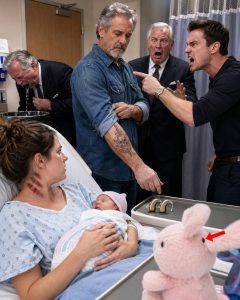
“Derek, stop! For the love of God, don’t touch him!” Richard shrieked in absolute, high-pitched panic. “You’re already dead!”
The words landed harder than any slap.
Derek froze mid-step, his fist still raised, his face twisted between rage and confusion.
For the first time in the seven years I had known him, Derek Voss looked uncertain.
Not afraid yet.
Just uncertain.
He stared at his father, then at Uncle Ray, then at the faded tattoo on Ray’s forearm as if some hidden equation were trying to solve itself in his head.
“What are you talking about?” Derek snapped. “Dad, get up. You’re embarrassing yourself.”
Richard Voss did not get up.
The billionaire who had terrified boardrooms, crushed competitors, and once made a senator apologize on live television was on his knees beside a hospital trash can, shaking so violently his cufflinks clicked against the metal frame of the bed.
Uncle Ray did not move fast.
That was the terrible part.
There was no dramatic lunge, no roar, no wild explosion of anger. He simply stepped away from the table where his hearing aids rested and turned his whole body toward Derek.
His calm was colder than screaming.
“Claire,” he said softly, without looking at me, “keep your eyes on the baby.”
I lowered my gaze to my daughter.
She was so small she looked unfinished, still wrapped in that striped hospital blanket, her lips opening and closing in sleep as if she were whispering secrets to herself. Her tiny fingers curled against my skin.
I should have been full of joy.
Instead, every swallow burned beneath the bruises around my throat.
Derek had done it less than an hour after I gave birth.
Not because I had screamed.
Not because I had threatened him.
Because I had told the nurse I wanted my daughter’s last name hyphenated.
Because I had looked him in the eye and said, “She is mine too.”
That was when his smile had changed.
That was when his father had stepped outside to “handle paperwork,” leaving Derek alone with me.
That was when Derek leaned over my hospital bed and wrapped his hand around my neck.
Not long enough to kill me.
Just long enough to remind me.
His words had been quiet then.
“You can push all you want now, Claire. But when we leave this hospital, you and that baby belong to me.”
He had not known about the stuffed rabbit.
He had not known that Uncle Ray had given it to me three months earlier and said, “Put this in your hospital bag. Don’t ask me why unless you need to.”
I had needed to.
Now the little rabbit sat tilted three degrees to the right, one black glass eye staring toward the bed, streaming every word to a police server through a secure channel I did not understand and had not wanted to understand.
Uncle Ray understood.
Derek laughed once, but it came out wrong.
“You people are insane,” he said. “You think you can threaten me? In my hospital? My family donated the neonatal wing.”
Ray’s eyes shifted for a fraction of a second.
“Your family donated a sign,” he said. “Not the law.”
Derek’s face reddened.
Then he lunged.
It was the last foolish thing he did standing up.
Ray moved like a closing trap.
One moment Derek’s arm was slicing through the air. The next, his wrist was turned inward at an impossible angle, his body folded sideways, and his knees struck the floor with a sound that made Richard gag again.
Derek’s mouth opened, but no sound came out.
Ray held him there with one hand.
One hand.
The other remained loose at his side.
“Breathe,” Ray said.
Derek tried to twist free.
Ray adjusted his grip by a single inch.
Derek gasped and went still.
I had seen my uncle lift engines, carry toolboxes, fix busted tractors in summer heat without complaint. I had seen him sit at my mother’s grave in the rain, his cap in his hands, silent as stone. I had seen him smile at babies and feed stray cats behind his garage.
I had never seen this man.
This man had lived behind the one I knew like a locked room beneath a house.
Richard pressed his back to the wall, his eyes glassy with recognition.
“You don’t understand,” he whispered to Derek. “You stupid boy, you don’t understand what he is.”
Ray looked at him then.
Richard flinched.
“What I was,” Ray corrected.
Derek found his voice at last.
“I’ll sue you,” he choked. “I’ll ruin you. I’ll ruin her. I’ll take the baby before she leaves this building.”
Something in me went cold.
My arms tightened around my daughter.
Ray heard none of it, not in the ordinary way. His hearing aids were still on the tray. But he read enough from Derek’s lips.
His expression did not change.
“That threat,” Ray said, “was recorded.”
Derek blinked.
Richard closed his eyes.
A knock struck the door.
Three times.
Hard.
“Mrs. Voss?” a woman called from the hallway. “This is Nurse Patel. Is everything all right?”
Nobody answered.
My heartbeat slammed.
Derek’s eyes flicked to the door.
Ray’s hand tightened enough to keep him from moving, but not enough to break anything. He looked at me.
I knew what he was asking.
I swallowed through the pain.
“Yes,” I called, though my voice came out ragged. “Please call Detective Morales. Tell him the rabbit is awake.”
Silence followed.
Then Nurse Patel’s voice changed.
“Understood.”
Footsteps hurried away.
Derek’s head snapped toward me.
“What did you just say?”
I looked at him over my sleeping daughter’s head.
For months, Derek had told me I was helpless.
He had chosen my clothes, tracked my phone, reviewed my bank statements, mocked my friends until they stopped calling. He had smiled at dinner parties with his palm resting on the back of my neck, pressing just enough to remind me to laugh at the right times.
He thought fear made people smaller.
He had never understood that fear, stored long enough, could become architecture.
A hidden camera in a rabbit.
A nurse with a code phrase.
A detective waiting two floors down.
An uncle who had once disappeared for eleven years and returned with silver in his hair, scars on his ribs, and a habit of sitting with his back to walls.
“I said,” I whispered, “you’re not taking my daughter.”
Derek stared at me as if I had slapped him.
Then the sirens began.
Not outside.
Inside the hospital.
A soft security alarm pulsed through the corridor.
Richard slid down the wall until he was sitting on the floor.
“Ray,” he said hoarsely. “Listen to me. This doesn’t have to go public.”
Ray tilted his head.
Richard licked his lips.
“There are things you don’t know. Things that connect us. Old contracts. Old operations. If the police start digging—”
Ray stepped closer, dragging Derek with him as effortlessly as moving a chair.
Richard stopped talking.
Ray’s voice lowered.
“I know what you bought in 1998.”
Richard went motionless.
“I know who disappeared outside Basra,” Ray continued. “I know who signed the denial forms. I know whose private security subsidiary supplied the transport route that never existed.”
Richard’s face collapsed inward.
Derek looked between them, suddenly much younger than thirty-eight.
“What is he talking about?”
Ray did not answer him.
He looked only at Richard.
“You built your empire on graves,” Ray said. “And then your son put his hands on my niece.”
For one terrible moment, the room felt too small for all the ghosts that had entered it.
Then the door shook.
“Police!” a voice called. “Open the door!”
Ray did not move.
He looked at me again.
This time, there was sorrow in his eyes.
Not for Derek.
Not for Richard.
For me.
For the fact that this had become necessary at all.
“Claire,” he said, “when that door opens, you tell the truth once. Clearly. Then say nothing without your attorney.”
My attorney.
The words almost made me laugh.
I had never had an attorney.
Derek had attorneys.
Richard had buildings full of attorneys.
I had Uncle Ray, a newborn, and bruises turning purple on my throat.
But when the lock clicked and the door swung inward, I saw Detective Morales standing behind two uniformed officers, and beside him was a woman in a navy suit holding a leather folder.
She looked at me with steady, kind eyes.
“Claire Voss?” she said. “I’m Anika Shah. Your uncle retained me six weeks ago.”
Derek made a strangled sound.
Six weeks ago.
Before the hospital.
Before the birth.
Before his hands closed around my neck.
Uncle Ray had seen the ending coming while I was still trying to call it a rough patch.
The officers took Derek from Ray’s grip.
The second they touched him, his confidence returned in a flash, like a mask snapping into place.
“Careful,” Derek spat. “Do you know who I am?”
Detective Morales looked down at him.
“Yes,” he said. “That’s why we brought extra paperwork.”
They cuffed him.
Derek stared at the metal around his wrists in disbelief.
“This is absurd. She’s unstable. She just gave birth. Ask anyone. She’s been paranoid for months.”
Anika stepped forward.
“Mr. Voss, every word you said in this room has been transmitted to law enforcement. Your assault is visible on camera. Your threat to remove the child is recorded. Your father’s attempted interference is also recorded.”
Richard’s head jerked up.
“I did not interfere.”
Ray slowly turned toward him.
Richard looked away.
Derek laughed again, but now panic showed through.
“You think a recording matters? My family owns half this city.”
Detective Morales smiled without humor.
“Not the half with the jail.”
They pulled him toward the door.
As he passed my bed, Derek twisted his head toward me.
The hatred in his eyes was so intimate it felt like a touch.
“You’ll regret this,” he whispered. “You have no idea what you just started.”
My daughter stirred.
A tiny wrinkle appeared between her brows.
I bent and kissed it.
“No,” I said. “I know exactly what I ended.”
The officers took him out.
Richard remained.
No one had cuffed him yet.
He sat on the floor with vomit on his tie and terror in his eyes, looking not at the police, not at his son, but at Uncle Ray’s tattoo.
Detective Morales crouched beside him.
“Richard Voss, we have some questions.”
Richard gave a dry, broken laugh.
“About my son?”
“Eventually.”
The room changed again.
I felt it.
So did Richard.
He looked toward the stuffed rabbit, then toward Ray, then toward me.
“What have you done?” he whispered.
Ray put his hearing aids back in.
The small gesture made him look old again.
Tired.
Human.
But his answer was not gentle.
“I opened one door.”
Anika came to my bedside while Detective Morales escorted Richard into the hall.
Her voice softened.
“Claire, I know you’re exhausted. But I need to ask whether you feel safe with your uncle present.”
“Yes,” I said immediately.
Uncle Ray’s shoulders shifted, barely.
Relief, maybe.
Or grief.
Anika nodded.
“Good. The hospital is moving you to a secure room under a private name. Child protective services has already been notified, but this is not against you. It is to document the threat and protect custody. We are filing for an emergency protective order before the hour is out.”
I looked down at my daughter.
She opened her eyes for the first time since all of it began.
Dark blue.
Unfocused.
Searching.
“What about Derek?” I asked.
Anika’s mouth tightened.
“He will try to make this about your credibility. We will make it about evidence.”
“And Richard?”
At that, Uncle Ray stepped closer.
His face had gone distant again.
“Richard is why Part Two is not over,” he said.
I looked up at him.
“What does that mean?”
He did not answer right away.
Instead, he reached into the pocket of his denim jacket and pulled out a folded photograph.
It was old, creased white at the edges.
He handed it to me.
The picture showed four men standing in desert sunlight beside a transport helicopter. Their faces were younger, harder, sunburned. One of them was Uncle Ray.
Another was Richard Voss.
My breath caught.
“You knew him.”
Ray nodded.
“Once.”
Anika glanced at the photo and went very still.
“Raymond,” she said carefully, “is that the missing contractor file?”
“Part of it.”
I stared at my uncle.
The man who brought me soup when I had the flu. The man who fixed my first car and threatened my prom date with a tire iron if he didn’t have me home by midnight. The man I thought had spent his life repairing engines because he liked quiet work.
“What missing file?” I asked.
Ray took the photo back, but gently.
“When your mother died,” he said, “she made me promise I would protect you from anything that came for our family.”
“Our family?”
He nodded.
“Your mother wasn’t just a school librarian, Claire.”
The room seemed to tilt.
My mother had smelled like lemon soap and paper. She had worn cardigans with wooden buttons. She had made cinnamon toast on rainy mornings and cried during old musicals.
“What are you saying?”
Ray’s eyes shone.
“I’m saying she kept records. Records Richard thought were destroyed. Records that prove his company sold out a military unit, buried the survivors, and used the profits to build Voss Global.”
I heard Anika inhale.
My daughter made a soft sound against my chest.
“And Derek?” I whispered.
Ray’s jaw tightened.
“Derek married you for a reason.”
The words moved through me slowly, then all at once.
No.
I almost said it aloud.
No, he had loved me once. He had brought flowers. He had remembered my coffee order. He had danced with me barefoot in the kitchen of our first apartment while rain hit the windows.
But memory is a liar when it is desperate.
Had he loved me?
Or had he studied me?
The orphaned daughter of a quiet woman with a dead brother’s secrets hidden somewhere in her life.
“My mother’s records,” I said. “Derek wanted them?”
“Richard wanted them,” Ray replied. “Derek was his instrument.”
The room blurred.
I held my baby tighter, as if she were the only solid thing left in the world.
Anika spoke quietly.
“Claire, do you know anything about files your mother may have left behind? A storage unit? A safe deposit box? A book? Anything she asked you to keep?”
I shook my head.
Then stopped.
A memory rose.
Small.
Ordinary.
My mother in the kitchen, three weeks before the accident that killed her, pressing a silver locket into my palm.
“For someday,” she had said.
I had been sixteen and irritated, more interested in finishing homework than listening to another one of her sentimental speeches.
“It doesn’t open,” I had told her.
“It will,” she said.
I still had it.
Not at Derek’s house.
Not in our bedroom.
He had thrown away most of my old jewelry after the wedding, claiming it was cheap clutter.
But the locket was in the one place he had never cared to search.
In Uncle Ray’s garage, inside a shoebox labeled “Claire — School Stuff.”
Ray saw the change in my face.
“You remember something.”
Before I could answer, Detective Morales appeared at the door.
His expression was grim.
“Ray,” he said. “We have a problem.”
Ray turned.
Morales held up a phone in a clear evidence bag.
“Richard Voss had this in his jacket. He sent one message before we separated him from his counsel.”
“What message?” Anika asked.
Morales looked at me.
Then at the baby.
His voice lowered.
“Two words.”
The hospital lights hummed.
Outside the room, alarms faded into footsteps and distant voices.
Morales said, “Find Grace.”
My blood turned cold.
Grace.
We had not named her publicly yet.
Only the birth certificate clerk knew.
Only Nurse Patel.
Only me.
And Derek.
My newborn daughter slept against my chest, unaware that somewhere beyond the hospital walls, Richard Voss had just put her name into the dark.
Uncle Ray reached for the bed rail.
For the first time since he entered the room, he looked afraid.
Not of Richard.
Not of Derek.
Of time.
“Claire,” he said, “where is your mother’s locket?”
I opened my mouth to answer.
Then my phone buzzed on the bedside table.
Everyone looked at it.
The screen showed a blocked number.
A text message waited there.
No greeting.
No signature.
Just a photograph.
Uncle Ray’s garage.
The door hanging open.
The shoebox on the workbench.
Empty.
Beneath the photo was one sentence.
YOUR MOTHER SHOULD HAVE BURNED THE TRUTH WHEN SHE HAD THE CHANCE.
My daughter opened her eyes again.
And smiled.