I was already dressed for dinner when my son sent two texts less than a minute apart.
The first one said plans at the new townhouse had changed.
The second one told the truth.
You were not invited.
Marissa does not want you there.
I read the sentence three times, not because it was complicated, but because it was so blunt my mind refused to accept it on the first pass.
At seventy-seven, I had lived long enough to know humiliation could arrive in many forms.
Sometimes it came wrapped in silence.
Sometimes it came disguised as concern.
Sometimes it came smiling across a holiday table.
But every now and then it came exactly like that, flat and graceless, on a glowing little screen you had to hold with both hands because your fingers had gone weak.
I sat down in the armchair beside the lamp and listened to the rain against the porch rail.
The house was very quiet.
Old houses become quiet in a different way than new ones do.
New houses feel empty when they are still.
Old houses feel watchful.
My grandfather clock ticked in the hallway.
The kettle I had planned to use after dinner sat cold on the stove.
On the mantel, my husband James smiled at me from a silver frame, handsome and dry-eyed in the tuxedo he had worn for our fiftieth anniversary.
I looked at that photograph and heard his voice in my head as clearly as if he had been standing in the room.
There is a difference between helping people and teaching them to lean so hard on you they forget how to stand.
James used to say that whenever Garrett called asking for one more favor, one more bridge loan, one more temporary fix.
I had never liked hearing it.
Garrett was our only child.
After James died, he became more than my son.
He became the last living shape of the family we had built together.
Every time I paid something, covered something, rescued something, I told myself I was protecting family.
I told myself I was making life easier for everyone.
I told myself I was doing what mothers do.
The truth was uglier.
I had become useful, and I had let useful stand in for loved.
My phone buzzed again.
This time it was my granddaughter Rebecca.
Grandma, are you still coming? Dad said you had to be here by 7.
That was the moment the humiliation turned into clarity.
So Garrett had told the children I was invited.
He had told me I was needed there.
He had let me dress, plan, and wait.
And then when Marissa decided she did not want me at her table, he had sent the truth the way a coward drops a glass plate and steps back to watch somebody else bleed.
I typed to Rebecca with careful fingers.
Sweetheart, it seems I am not wanted there tonight after all.
Her answer came immediately.
That is not true.
Dad said the dinner was partly for you.
I closed my eyes for a second.
Partly for me.
That was almost the cruelest part.
Somewhere in that house they had been arranging glasses, laying out napkins, talking about a special announcement, and my place in all of it was still.
considered useful enough to mention.
Just not useful enough to include.
I stood up and walked to the secretary desk in my dining room.
It had belonged to my mother, and after James died it became my strange little fortress against chaos.
I kept every paper filed there.
Tax records.
Insurance statements.
Estate documents.
Medical forms.
Property tax receipts.
Donation acknowledgments.
The thickest folder in the desk was labeled GARRETT.
I carried it to the table and opened it.
There are humiliations that explode all at once, and there are humiliations that reveal themselves line by line.
Mine was the second kind.
A twenty-thousand-dollar cashier’s check for Garrett’s failed home-inspection venture.
Roofing work on their old house.
Marissa’s real-estate licensing courses.
Rebecca’s tuition reimbursements.
Toby’s private tennis coaching from the year he was sure college scouts would notice him.
Quarterly insurance for Marissa’s SUV.
Country club dues.
A florist invoice for one of Marissa’s charity luncheons because the centerpieces had run over budget.
The down payment wire for the townhouse at River Ridge Estates.
I stared at the paperwork so long the print began to blur.
Then I picked up the landline and called Fayetteville Community Bank.
The woman who answered was cheerful until I finished my request.
I wanted every automatic payment, recurring transfer, reimbursement, and scheduled draft leaving my accounts suspended immediately.
I wanted Garrett removed as authorized user, signer, and account viewer anywhere his name appeared.
She verified my identity, asked me to repeat my instructions, and then placed me on hold.
When she came back, her voice had changed.
Mrs.
Wembley, temporary suspensions are now in place.
For your records, there are one hundred seventy-four active recurring items affected.
Permanent cancellation and revocation will require signed forms in person when the branch opens.
One hundred seventy-four.
I had not even known the number.
That was how dependency had worked its way through my life.
Quietly.
Efficiently.
One small yes at a time until it no longer looked like generosity at all.
It looked like infrastructure.
After I ended the call, I sent Garrett one sentence.
Then you and Marissa can start paying your own way.
I turned my phone off after that.
I took off the navy dress I had put on for dinner.
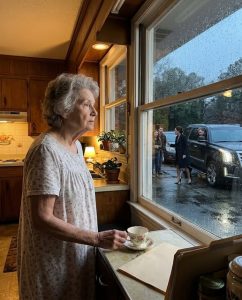
I changed into a house dress, boiled water, and sat in my chair with a real teacup in my hands.
Not a mug.
A teacup.
Something delicate and unnecessary and entirely mine.
I expected to cry.
Instead I felt relief.
The next morning I arrived at the bank before it opened.
Linda Howard, who had handled our accounts for years, took one look at my face and led me straight into her office.
Linda had known James.
She had known me before widowhood changed my posture and thinned my voice.
She had known Garrett back when he wore Little League socks and came in asking for lollipops from the candy dish on her desk.
She did not waste time pretending this was only about paperwork.
Are you certain? she asked.
I am, I said.
So she laid out the forms.
Revocation of account authority.
Cancellation of standing transfers.
Removal of backup card access.
Termination of bill-pay instructions.
Withdrawal of view-only permissions.
My hand cramped halfway through.
I flexed my fingers and kept.
signing.
Then she turned the monitor toward me.
Sometimes it helps to see the whole picture, she said.
The summary was eight pages long.
Mortgage draft for River Ridge Estates.
Marissa’s auto insurance.
Country club dues in Marissa’s name.
A standing transfer that covered Toby’s rent when he fell short.
Card payments tied to Toby’s spending account.
Rebecca’s tuition reimbursement.
Dental specialist charges.
Premium cable.
Home security.
Cleaning service.
Garrett’s football tickets.
A landscaping subscription for the townhouse.
Dozens and dozens of charges, large and small, respectable and ridiculous.
I did not realize it was this much, I told her.
Linda folded her hands on the desk.
These situations almost never happen all at once.
No, I said.
They happen one inch at a time while you keep calling it temporary.
When I signed the final form, Linda slid a copy into a folder for me and hesitated.
You should speak to your attorney too, she said gently.
Not because I think your son is dangerous.
Because I think boundaries need to be written down when money has blurred them this long.
I had not planned to cry, but that was the sentence that nearly did it.
Not because it was harsh.
Because it was sane.
I left the bank with my folder, stopped by my attorney’s office, and made an appointment for the following week to review my will, powers of attorney, and trust distributions.
Then I drove home.
My phone was on by then, and the calls had begun.
Garrett had left twelve voicemails.
Marissa had left six.
Toby had texted in all caps that his card was being declined.
An insurance office wanted to know whether the Lexus policy should be reinstated.
A billing service had flagged the townhouse mortgage.
There were two messages from numbers I did not recognize, both related to accounts that had bounced back as unauthorized.
I listened to none of the voicemails.
I made tea instead.
The rain had stopped by then, but the driveway was still wet and dark.
I was standing in my kitchen with the cup warming my hand when I heard tires outside.
One vehicle first.
Then another.
Marissa’s SUV pulled in hard enough to spit gravel.
Garrett was in the passenger seat.
Toby got out of the back looking angry before the door was even shut.
Behind them came Garrett’s truck.
Rebecca climbed out more slowly, face pale, shoulders pulled tight.
I set my teacup in the sink and opened the front door before they could knock.
Marissa took two steps up my walk and said, What did you do?
No greeting.
No softness.
Not even pretense.
The mortgage draft bounced, she snapped.
My insurance is showing inactive.
Toby’s card got declined.
Garrett said there has to be some mistake.
Garrett stood behind her, not meeting my eyes.
Rebecca looked from him to me and then said quietly, Dad told me dinner was partly for Grandma.
Marissa swung toward her.
Rebecca, stay out of this.
No, I said.
She stays in it.
She was the only one who bothered to text me like I mattered.
Toby let out a short, angry laugh.
So you blew up everybody’s life over one dinner?
I walked back into the foyer, lifted the folder from the hall table, and opened it.