My name is Megan Foster.
I used to think the worst thing that could happen to a mother would arrive loudly.
A crash.
A scream.
A phone call in the middle of the night.
I did not know it could arrive under fluorescent hospital lights, behind a door that had not fully latched, while a police officer whispered for me to look through the crack.
That morning had been ordinary enough to fool me.
The kitchen smelled like pancake batter, coffee, and the faint lemon soap I used on the counters when I was nervous about company.
Sunlight pushed through the window over the sink and landed across the tile in a clean yellow stripe.
Ashley’s backpack sat by the mudroom door with one strap twisted under it.
Her sneakers were in the middle of the laundry room again.
I remember those things because later I went over the whole day in my head so many times that even the smallest details felt like evidence.
“Ashley,” I called toward the stairs. “Are you awake?”
No answer.
I flipped a pancake and listened to it hiss.
“Ashley Foster, you have school in forty minutes.”
That got me a muffled sound from upstairs, the kind that could have been words or could have been a teenager fighting for her life against a pillow.
Daniel walked into the kitchen first.
He was already dressed for work, pale blue shirt, dark slacks, wedding ring catching the light as he adjusted one cuff.
“Morning, Meg,” he said.
He kissed my cheek the way he always did.
Quick.
Automatic.
Not cold enough for me to notice then.
He worked as a sales manager for an industrial cleaning equipment company, which meant early meetings, client dinners, long drives, airports, and the kind of schedule that made him seem overworked even when he was standing still.
I had trusted that schedule.
That was one of the first things I hated myself for later.
“Big presentation today?” I asked.
He took the coffee I handed him and smiled. “Important one. I’m a little nervous.”
“You’ll be fine,” I said. “You always are.”
Ashley came into the kitchen with her hoodie half-zipped and her hair pulled into a messy ponytail.
At fifteen, she was all elbows, sarcasm, and sudden softness.
She could roll her eyes at me for asking about homework and then leave half a muffin on my plate because she knew I liked the top.
She had Daniel’s chin and my habit of biting the inside of her cheek when she was thinking.
“Can I go to the mall after school?” she asked.
“With who?”
“Emma and Olivia.”
“Homework?”
“Done.”
“Phone charged?”
“Mom.”
“That is not an answer.”
She smiled because she knew she had won. “Yes. Charged. Home by eight.”
I told her yes.
She leaned across the counter, stole a pancake with her fingers, and said, “You’re the best.”
It was such a small thing.
A stolen pancake.
A messy ponytail.
A girl who still believed coming home by eight was the hardest part of being trusted.
I did not know I was looking at the last normal morning I would have with my daughter for a long time.
That night, Daniel came home careful.
Not late.
Not drunk.
Not angry.
Careful.
There is a kind of calm that does not soothe a room.
It measures it.
He waited until Ashley was upstairs before telling me Rachel had lost her job.
Rachel was Daniel’s younger sister.
For years, she had drifted from one crisis to another, and each time Daniel explained it like life had simply been too hard on her.
A bad boss.
A bad roommate.
A misunderstanding.
A bill she had not expected.
A boyfriend who had taken advantage.
By the time someone is always unlucky, you start to wonder whether luck is really the problem.
“She needs somewhere to stay for a little while,” Daniel said.
I dried my hands on a dish towel.
“How long is a little while?”
“Just until she gets back on her feet.”
I looked toward the ceiling, where Ashley’s music played faintly above us.
I did not want Rachel in our house.
I did not want her near my daughter.
I did not want her crying at my table while Daniel made me feel cruel for noticing the pattern.
But marriage teaches women strange forms of silence.
You learn which concerns turn into arguments.
You learn which instincts get renamed as attitude.
You learn to swallow the word no until it tastes like peace.
“Fine,” I said.
Rachel arrived Saturday afternoon while rain tapped against the porch railing.
She stood under the small overhang with wet hair and a duffel bag at her feet, smiling like someone grateful enough to be harmless.
“Megan,” she said, hugging me with damp sleeves. “Thank you. Really.”
Then she hugged Daniel.
A second too long.
Not long enough to accuse.
Long enough to remember.
Ashley came down the stairs, and Rachel’s whole face changed.
“There she is,” Rachel said. “You got so grown up.”
Ashley smiled politely at first.
By Tuesday, they were laughing in the living room like old friends.
By Wednesday, Rachel was sitting on Ashley’s bed while Ashley painted her nails.
By Thursday, they lowered their voices whenever I passed the hallway.
I told myself not to be dramatic.
Rachel was family.
Ashley was fifteen.
Whispering was practically a second language at that age.
Still, the house felt different.
Rachel asked too many questions about Daniel’s work.
What time did he usually leave?
Was he driving or flying next week?
Did he keep samples in the garage?
Did he still use the basement storage shelves for work things?
None of the questions sounded dangerous by themselves.
That was the trouble.
Danger rarely introduces itself as danger.
It arrives as one harmless question after another.
Ashley started taking her phone everywhere.
Into the bathroom.
To the kitchen.
Under her pillow.
If I came into her room, she turned the screen facedown.
At 8:12 p.m. Friday, my daughter walked through the front door and pressed both hands to her stomach.
“Mom,” she said.
Her voice was small.
That was what scared me first.
Not the color of her face.
Not the sweat gathering along her hairline.
The voice.
Ashley was rarely small.
“What happened?” I asked, moving toward her.
“I don’t know,” she whispered.
Then she folded in half.
Her backpack slid off one shoulder and hit the floor.
She was shaking so hard that I could hear her teeth click.
I got her onto the couch, but she curled inward, gripping her stomach and gasping like every breath had to fight its way through her body.
“Ashley, look at me.”
She tried.
Her eyes could not focus.
I called Daniel first.
It rang four times.
Then voicemail.
I called 911.
The operator asked questions.
I answered with one hand on Ashley’s forehead and the other gripping the phone so tightly my palm cramped.
At 8:21 p.m., I heard the siren.
At 8:24 p.m., red and blue light flashed through our front windows.
A neighbor stepped onto her porch in slippers and wrapped her arms around herself.
The EMTs moved fast.
They asked about allergies.
Medication.
Food.
Drinks.
Anything unusual.
Rachel stood near the staircase with both hands over her mouth.
Daniel arrived while they were lifting Ashley onto the stretcher.
His car door slammed in the driveway.
He ran in, breathless, asking what happened.
I remember thinking he looked scared.
I held onto that thought because I needed it.
At Massachusetts General, the night turned into white light and noise.
Rubber soles squeaked on polished floors.
A monitor beeped somewhere behind a curtain.
The air smelled like sanitizer, burned coffee, and fear that nobody had time to name.
A nurse put a hospital wristband around Ashley’s wrist at 9:03 p.m.
An intake clerk asked me to spell her full name.
Another nurse asked what she had eaten.
At 9:26 p.m., I signed a hospital intake form with a hand that did not feel like mine.
At 10:41 p.m., a doctor came toward me with his mouth set in a line too gentle to be good news.
“Mrs. Foster,” he said, “your daughter is showing signs consistent with acute poisoning.”
The hallway seemed to tilt.
I put one hand against the wall.
“Poisoning?”
“We’re treating her,” he said. “She’s receiving care now. The police have been notified because of the circumstances.”
The circumstances.
That is what official people call your nightmare before they know how ugly it is.
I turned to Daniel.
For one second, I wanted him to grab me.
I wanted him to fall apart with me.
I wanted proof that whatever had entered our home had hurt him too.
But Daniel was not falling apart.
He was standing too still.
His eyes moved once toward the end of the corridor, where Rachel sat hunched in a chair with her coat still on.
It was quick.
Too quick.
I saw it anyway.
Near midnight, a police officer approached me.
He was not unkind, but he had the careful voice of someone carrying information like glass.
“Mrs. Foster, can you come with me?”
“Is Ashley worse?”
“No,” he said. “This is about the investigation.”
He led me away from the waiting area.
Past vending machines.
Past a darkened family consultation room.
Past a security desk where a small American flag stood beside a stack of visitor badges.
Then he stopped outside a room with a door that had not fully closed.
“Look through the crack,” he said quietly. “Just for a second. Don’t let them see you.”
I wanted to refuse.
Something in me already knew.
A body can understand betrayal before the mind has proof.
I leaned forward.
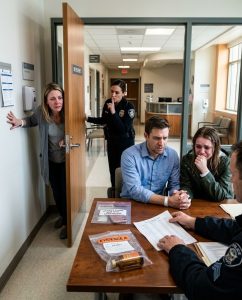
Inside the interview room sat Daniel and Rachel.
Together.
Not apart like witnesses.
Not confused like innocent people caught in the same terrible storm.
Together.
Rachel was crying.
Daniel was holding her hand.
Two detectives sat across from them.
On the table was a sealed evidence bag.
Inside it was the small bottle officers had taken from our kitchen.
I had seen that bottle before, sitting near the sink after Rachel moved in, harmless-looking enough that I had pushed it aside while wiping crumbs from the counter.
Now it sat under plastic, labeled, handled, transformed from clutter into proof.
My knees weakened.
The officer beside me shifted closer but did not touch me.
One of the detectives opened a folder.
He placed a page in front of Daniel.
Daniel’s hand tightened around Rachel’s so hard her knuckles whitened.
Whatever was on that page did not surprise him.
That was the moment my marriage ended.
Not in court.
Not with papers.
Not with someone moving out.
It ended behind a cracked hospital door while my daughter fought to stay alive one floor away.
The page was a screenshot from Ashley’s phone.
I could not see every word through the narrow gap, but I saw Rachel’s name at the top.
I saw the time stamp.
7:58 p.m.
Fifteen minutes before Ashley came home sick.
The detective pointed to another line.
Daniel said nothing.
Rachel whispered, “Danny, please.”
Danny.
It sounded intimate.
Private.
Practiced.
I covered my mouth with my hand because a sound had started inside me and I was afraid it would come out.
A nurse appeared at the end of the corridor carrying a clear hospital property bag.
Inside was Ashley’s phone in the glittery case I had bought her at the mall after she begged for it for two weeks.
The screen lit once through the plastic.
Daniel saw it.
His face changed.
The detective slid the phone log beside the evidence bag.
“Then why did this message come from your account?” he asked.
Rachel bent forward like she had been struck by the question itself.
Daniel looked at the detective and said, very carefully, “I want a lawyer.”
I stepped back from the door.
The officer guided me into the empty room across the hall.
Only then did I realize I had been shaking so hard my teeth hurt.
They took my statement at 12:37 a.m.
I told them when Rachel arrived.
I told them about the questions.
I told them about Ashley locking her phone.
I told them about the bottle near the sink and the way Daniel had looked at Rachel after the doctor spoke.
A detective wrote everything down.
Another asked me to repeat the timeline.
Not because he doubted me.
Because timelines matter when people try to lie their way through them.
At 2:14 a.m., a nurse let me sit beside Ashley.
She looked too small in the hospital bed.
Her hair stuck damply to her forehead.
A monitor beeped beside her.
A clear tube ran from her arm.
I took her hand and felt the hospital wristband rub against my thumb.
“Mom?” she whispered.
“I’m here.”
“Am I in trouble?”
That question broke something in me more cleanly than any accusation could have.
“No, baby,” I said. “You are not in trouble.”
Her eyes filled with tears.
“Aunt Rachel said not to tell you.”
I kept my face still because rage would not help my daughter breathe.
“What did she say not to tell me?”
Ashley swallowed.
“She said Dad was stressed and you were making it worse. She said she had something that would calm my stomach because I was nervous. I thought she was helping.”
I closed my eyes.
For one ugly second, I wanted to run back into that interview room and put my hands around the truth until it screamed.
Instead, I kissed Ashley’s knuckles.
A mother’s rage is useless if it leaves the child alone.
So I stayed.
Daniel did not come into Ashley’s room again that night.
Rachel did not either.
By sunrise, the police had taken more statements.
The evidence bag, the phone log, and the hospital intake record became part of a file I would later hear referred to as a police report.
Those words sounded so flat for something that had torn through our lives.
Police report.
Evidence bag.
Phone log.
Hospital record.
A marriage can hide behind smiles for years, but once the paperwork starts, it becomes harder for lies to breathe.
Ashley stabilized that morning.
The doctor told me she was responding to treatment.
I cried in the hospital bathroom with the faucet running so she would not hear me.
Then I washed my face, went back to her room, and sat beside her like I had not just fallen apart over a sink.
Daniel called me at 9:18 a.m.
I did not answer.
He left one voicemail.
Then another.
Then a third.
By the fourth, his voice had changed from pleading to careful.
“Megan, you need to understand, this is not what it looks like.”
I deleted it without listening to the rest.
Rachel tried once too.
Her message was shorter.
“I never meant for Ashley to get hurt.”
That sentence told me everything her tears had not.
Not I didn’t do it.
Not I had nothing to do with it.
Never meant.
There are confessions that dress themselves like apologies because they are too cowardly to stand naked.
When Ashley was strong enough to sleep without waking in panic, I went home with a police escort to collect clothes, her charger, and her favorite gray blanket.
The house looked normal from the street.
Our mailbox leaned slightly to the left.
The porch light was still on.
A paper grocery bag sat on the kitchen floor where I had dropped it the day before.
The sink held two mugs.
One was mine.
One was Daniel’s.
I stood in that kitchen and understood that ordinary objects can become witnesses after a betrayal.
I packed Ashley’s things first.
Then mine.
I did not take Daniel’s clothes.
I did not touch Rachel’s duffel bag.
I photographed the bottle’s empty spot near the sink because the detective had told me to document anything that seemed relevant.
I photographed the trash.
I photographed the counter.
I photographed the guest room where Rachel had been sleeping.
Not because I was calm.
Because calm was the only weapon I had left.
Over the next days, the investigation moved through our lives with the slow force of a machine.
Detectives requested records.
They processed devices.
They asked questions more than once.
Ashley gave her statement with a patient advocate present, her hands wrapped around a paper cup of water.
When she cried, the advocate slid tissues closer without interrupting.
I learned then that kindness can be quiet and still save you.
Daniel’s story changed.
At first he said he knew nothing.
Then he said Rachel had been unstable and he was only trying to calm her down.
Then he admitted there had been messages but insisted they were misunderstood.
Every version made him smaller.
Not innocent.
Smaller.
Rachel’s version broke faster.
She said Daniel had made her feel like I was the problem.
She said he told her Ashley would be fine.
She said she never understood how serious it could become.
I stopped asking for details after that.
There are answers that do not heal you.
They only give your pain better lighting.
A county clerk later handed me forms across a counter and told me which window to take them to next.
I remember the scrape of the pen.
The hum of the printer.
The way my own last name looked suddenly heavy on every line.
Foster.
I had built a life under that name.
Now I was using it to pull my daughter and myself out of the wreckage Daniel had made.
The legal part did not happen quickly.
Nothing about real consequences moves at the speed your heart wants.
There were interviews.
Hearings.
Temporary orders.
Financial questions.
A house that had to be divided from a life that could not be.
Daniel tried to reach Ashley through relatives.
I stopped every attempt that I could.
When Ashley was finally ready, she read one letter from him with her therapist present.
She folded it back into the envelope after the first page.
“He keeps saying he loves me,” she said.
“Yes.”
“But he knew enough.”
I looked at my daughter then and saw something new in her face.
Not hardness.
Clarity.
“Yes,” I said. “He knew enough.”
Rachel’s name disappeared from our daily life slowly.
Not because the damage faded.
Because Ashley refused to let Rachel keep taking space from her.
She went back to school part time first.
Then full days.
She stopped wearing the hoodie from that night.
She started leaving her phone on the kitchen counter again.
The first time she did it, I went into the laundry room and cried into a towel because trust had become such a small and enormous thing.
Months later, we moved into a smaller rental with a narrow driveway, a squeaky front door, and a kitchen that got bright morning sun.
It was not the house I had imagined growing old in.
But it was clean of Daniel’s footsteps.
It was quiet in a way that did not measure me.
On our first Saturday there, I made pancakes.
Ashley came into the kitchen with her hair down and her phone in one hand.
She leaned against the counter.
“Can I help?” she asked.
I handed her the spatula.
She burned the first one.
We laughed harder than the pancake deserved.
For a second, the room filled with coffee, heat, sunlight, and the sound of my daughter breathing easily.
That was when I realized survival does not always feel like triumph.
Sometimes it feels like a teenager stealing the good pancake before it reaches the plate.
Sometimes it feels like deleting a voicemail.
Sometimes it feels like standing in a hospital hallway and choosing not to collapse until your child is safe.
I used to think my life was quiet because nothing terrible had happened in it.
Now I know quiet can be rebuilt.
Not the same as before.
Not innocent.
But real.
Ashley still asks hard questions sometimes.
She asks whether she should have known.
She asks why Rachel picked her.
She asks how Daniel could hold Rachel’s hand while she was lying in a hospital bed.
I never give her easy answers.
Easy answers are for people who did not live through the room behind the cracked door.
I tell her the truth I can stand behind.
“You were a child. They were adults. This was never yours to carry.”
Some nights she believes me.
Some nights she only leans into my shoulder and lets me say it again.
That is healing too.
Repetition.
Proof.
A mother staying when everyone else made trust feel dangerous.
The last time I saw Daniel in person, he looked older.
Not tragic.
Not ruined in the romantic way guilty people want to be seen.
Just older.
He tried to say my name.
I walked past him.
There was nothing left in me that needed his explanation.
That night at the hospital had already explained him.
Rachel’s tears.
Daniel’s hand around hers.
The evidence bag on the table.
The phone log beneath the detective’s finger.
A whole marriage reduced to one question under white hospital light.
Then why did this message come from your account?
I still hear that question sometimes.
Not because I need the answer.
Because it was the first honest thing spoken in a room full of people who had lied to me.
My daughter lived.
That is the sentence I return to when the rest of it feels too heavy.
Ashley lived.
She grew stronger.
She learned that betrayal can come from family and safety can come from strangers in hospital corridors with steady voices.
She learned that her mother could shake and still stand.
And I learned that a quiet life is not something a husband gives you.
It is something you protect.
Even if you have to protect it from the person sleeping beside you for years.
